The demand for skilled engineering talent has continued to rise sharply across industries. As software becomes the backbone of modern business innovation, the need to deploy new features, deliver technical upgrades, and accelerate digital transformation has never been greater. However, the competition for qualified developers especially those specializing in software development, mobile app development, and web development has become more intense.
As a result, many companies have turned to offshore development teams as a strategic method for filling skill gaps, reducing cost, and expanding delivery capacity. While offshore hiring delivers undeniable advantages, it also comes with risks that must be managed deliberately, especially when remote collaboration, intellectual property protection, and time-zone differences are involved.
This guide has been written to provide business leaders, CTOs, founders, and technical project managers with a clear, proven framework for how to hire offshore developers safely while minimizing operational, financial, and delivery-related risks.
Why Offshore Development Has Become a Strategic Priority
A global shift in talent acquisition has taken place over the past decade. The ability to hire a team of developers from multiple regions has enabled companies to scale faster, reduce labor costs, and extend round-the-clock development cycles. Offshore developers now contribute to major software platforms, enterprise applications, mobile products, and mission-critical systems.
Several factors have accelerated the use of offshore development:
A shortage of local technical talent
High-demand roles such as full-stack developers, AI engineers, iOS developers, Android developers, and cloud specialists remain difficult to fill in local markets.
Development costs have increased
Hiring senior engineers in the U.S., U.K., Canada, or Western Europe involves premium salaries and overhead expenses. Offshore teams allow businesses to optimize budgets without sacrificing expertise.
Access to global skills
Companies gain access to a larger pool of specialists in mobile app development, web development, DevOps, AI, product engineering, and more.
Faster delivery capacity
Multiple time zones allow development to continue beyond a local team’s working hours, accelerating project velocity.
Despite these benefits, offshore hiring must be approached with a structured methodology to ensure quality, reliability, and protection against operational risks.
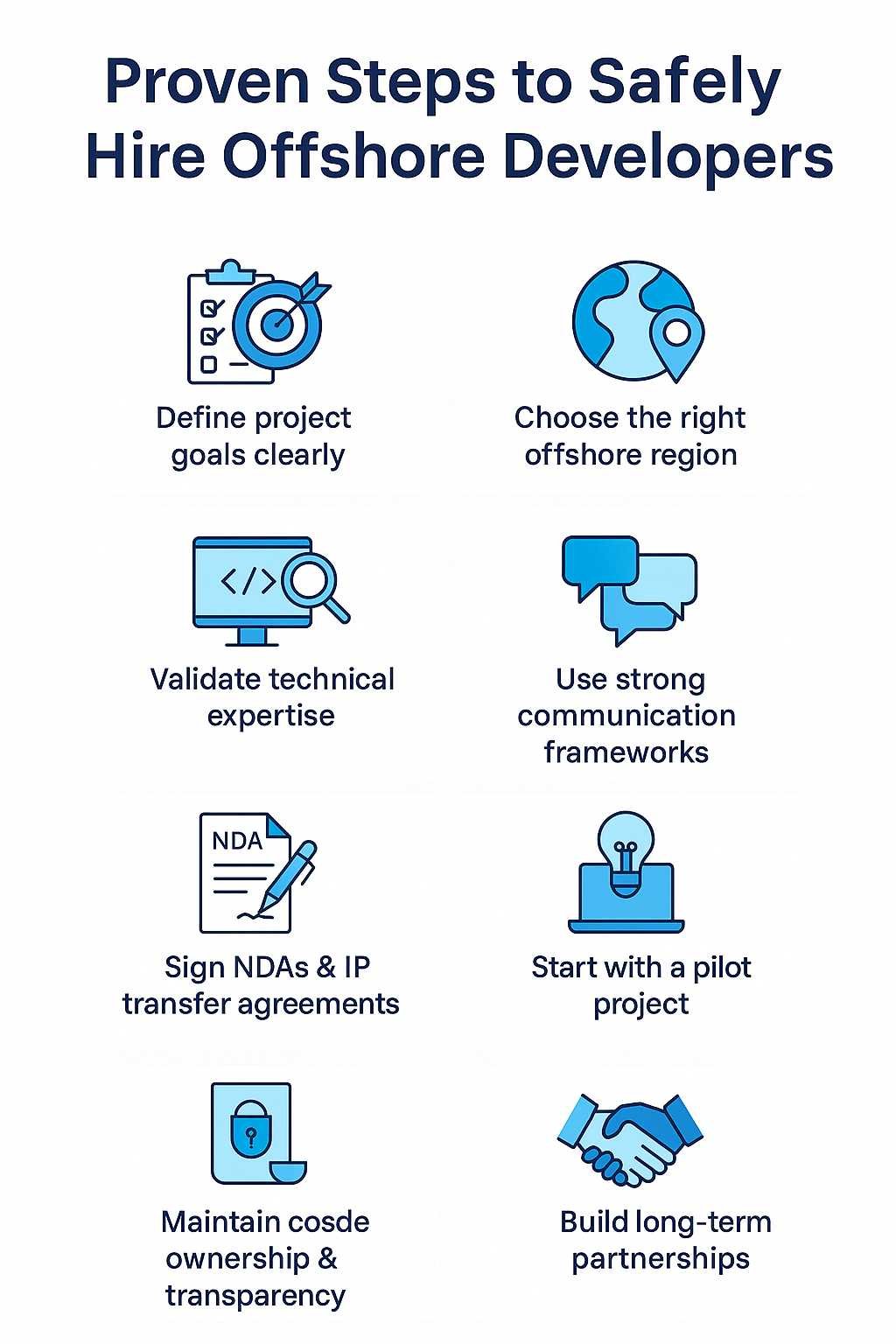
Step 1: Define the Business Objectives Before Hiring Offshore Developers
The safest offshore hiring strategies begin with clarity. Before engaging any external developers or offshore agencies, decision-makers must define the exact goals of the engagement.
Key areas that must be clarified include:
- The desired outcome of the project
- The scope of software development work
- Whether mobile app development, web development, or backend work is needed
- Technology stack requirements
- Expected timeline and milestones
- Budget allocation
- Integration needs
- Long-term maintenance considerations
Without documented objectives, offshore hiring becomes reactive instead of strategic. A well-defined plan reduces risk and misalignment throughout the partnership.
Step 2: Choose the Right Offshore Location Based on Skills and Stability
The success of offshore development is heavily influenced by the region from which developers are hired. Each region offers different benefits, risks, costs, and talent availability.
Most common offshore regions include:
- India — Large engineering workforce, strong English communication, cost-effective, skilled in web, mobile, and enterprise software development.
- Eastern Europe (Ukraine, Poland, Romania) — High technical proficiency, strong engineering culture, great for fintech, AI, and complex software systems.
- South America — Time-zone friendly for North American companies, strong front-end and mobile development talent.
- Southeast Asia (Philippines, Vietnam, Indonesia) — Competitive pricing, strong English-speaking workforce, growing software development sector.
Key evaluation criteria include:
- Political/economic stability
- Education quality
- Engineering reputation
- Time-zone alignment
- Communication skills
- Cultural compatibility
- Legal protections for intellectual property
Risk is minimized when regions are selected based on long-term stability, engineering maturity, and well-established outsourcing ecosystems.
Step 3: Decide Whether to Hire Freelancers, a Dedicated Team, or an Offshore Agency
The method used to hire offshore developers significantly affects control, delivery quality, and risk exposure.
Hiring Models to Consider:
Freelance Developers
Freelancers are often chosen for short-term tasks or small projects. However, this model presents higher risk, especially for complex mobile app development or enterprise software.
Risks include:
- Limited accountability
- Inconsistent communication
- Potential project abandonment
- Limited long-term commitment
Freelancers are best used only for small tasks with low operational risk.
Dedicated Offshore Developers (Staff Augmentation)
In this model, developers act as remote team members and integrate into your internal workflow.
Advantages:
- Full control
- Flexible scaling
- Lower cost than in-house hiring
- Access to specialized technical skills
This model is preferred for long-term software development needs.
Offshore Development Agencies
Agencies provide full teams developers, designers, testers, project managers, and DevOps engineers.
Advantages:
- End-to-end delivery
- Project oversight
- Reliable processes
- Reduced management burden
- High accountability
- Predictable delivery timelines
For businesses seeking risk-free execution, agencies generally offer the safest model for offshore development.
Step 4: Verify the Technical Expertise of Offshore Developers
Technical screening must be handled systematically, especially when the goal is to hire a team of developers capable of delivering production-level code.
Technical vetting must include:
- Assessing relevant experience in software development
- Reviewing portfolio and code samples
- Evaluating experience in mobile app development or web development
- Conducting technical interviews
- Assigning practical coding assessments
- Ensuring familiarity with modern frameworks (React, Node.js, Flutter, Swift, Kotlin, Python, etc.)
- Validating knowledge of architecture, security, and testing
Hiring developers without strong verification increases the risk of poor code quality, scalability issues, and technical debt.
Step 5: Ensure Strong Communication and Collaboration Frameworks
When offshore teams are hired, the biggest operational challenges often revolve around communication. Smooth communication is essential for reducing misunderstandings and delays.
Safe offshore hiring requires documented:
- Communication channels
- Daily/weekly meeting schedules
- Reporting formats
- Definition of responsibilities
- Response-time expectations
- Milestone reviews
- Agile sprint planning
- Use of collaboration tools (Jira, Slack, GitHub, Asana, Trello)
Without strong communication frameworks, even technically skilled offshore developers may deliver inconsistent outcomes.
Step 6: Protect Intellectual Property and Secure Legal Agreements
One of the most important considerations when learning how to hire offshore developers safely is protecting intellectual property (IP). Every engagement must be legally secured before any code is written.
Essential legal documents include:
- Non-Disclosure Agreement (NDA)
- Intellectual Property Rights Transfer Agreement
- Service Level Agreement (SLA)
- Master Services Agreement (MSA)
- Contract specifying payment terms, deadlines, scope, and responsibilities
The safest offshore hiring practices involve legally enforceable agreements that ensure your ownership of all code, design, and assets created during the development process.
Step 7: Start with a Pilot Project to Reduce Initial Risk
A small pilot project is one of the most effective and low-risk ways to evaluate offshore developers before committing to long-term engagement.
Examples of pilot work include:
- Building a small module
- Re-engineering a single feature
- Conducting UI/UX improvements
- Creating a backend microservice
- Developing a basic mobile screen
- Performing a code audit
This allows teams to assess the offshore developers’ competence, delivery speed, and communication quality before scaling the engagement.
Step 8: Implement Transparent Project Management Practices
To reduce delivery-related risk:
Transparency must be maintained through:
- Clear success metrics
- Weekly sprint demos
- Code pushed to shared repositories
- Frequent stakeholder alignment
- Continuous testing
- Budget tracking
A predictable delivery workflow increases trust and reduces miscommunications that commonly occur in offshore collaborations.
Step 9: Maintain Full Code Visibility and Technical Ownership
Organizations must retain full control over:
- Source code
- Cloud infrastructure
- Design files
- Documentation
- Deployment pipelines
- Credentials and keys
Even though development is performed offshore, ownership of the technical ecosystem must remain internal.
This ensures long-term safety and reduces dependency-related risks.
Step 10: Build Long-Term Relationships, Not One-Time Transactions
Long-term offshore partnerships deliver stronger outcomes because developers become familiar with the business domain, processes, and architecture.
Companies that treat offshore teams as strategic partners not vendors experience:
- Higher retention
- Better productivity
- Faster delivery cycles
- Improved collaboration
- Lower maintenance costs
Strong relationships reduce risk and increase development quality significantly.
Conclusion
The global shift toward offshore development has created new opportunities for businesses to scale quickly, innovate efficiently, and access world-class engineering talent. However, it has also created new risks that must be carefully managed. Knowing how to hire offshore developers safely has become essential for companies seeking high-quality software development, mobile app development, or web development without exposing themselves to delivery delays, security vulnerabilities, or financial risk.
By following the proven steps outlined in this guide defining objectives, choosing the right region, validating skills, securing contracts, testing with pilot projects, implementing strong communication processes, and protecting intellectual property offshore development can be executed with confidence and long-term success.

Frequently Asked Questions
What is the safest way to hire offshore developers?
The safest method involves a structured evaluation process that includes technical screening, legal documentation, controlled access to infrastructure, and a pilot project before long-term engagement. This approach minimizes risk and ensures competency.
How can communication risks be reduced with offshore teams?
Communication risks can be reduced through scheduled standups, documented processes, shared project management tools, defined response-time expectations, and transparent milestone reporting. Clear communication frameworks create predictable collaboration.
Is IP protection guaranteed when working with offshore developers?
IP protection is ensured only when NDAs, IP transfer agreements, and SLAs are signed before development begins. Ownership clauses and code repository control further reinforce intellectual property safety.
How can code quality be maintained in offshore development?
Code quality is maintained through peer reviews, architecture standards, shared Git repositories, automated testing, and continuous integration workflows. Transparent review processes ensure consistent output.