Enterprise mobile app development in 2026 has continued to evolve into a critical pillar of digital transformation. Organizations across industries including healthcare, finance, manufacturing, logistics, retail, education, and government have continued investing heavily in mobile ecosystems to improve operational efficiency, strengthen customer engagement, and support internal teams with modern tools.
The capabilities of enterprise applications have expanded far beyond simple productivity tools. They now serve as fully integrated hubs for automation, data intelligence, machine learning, security governance, workflow orchestration, and real-time analytics. With hybrid work models becoming standard and connected technologies reshaping operations, enterprise mobile solutions have become an essential component of business growth strategies.
To meet these rising expectations, enterprise applications must be built using secure, scalable, and user-centric architectures. Well-defined processes, strong UI/UX foundations, and dependable mobile application development services are also required to ensure that business objectives are met.
This guide explores the best practices, complete development process, and proven strategies used in 2026 to successfully deliver enterprise-grade mobile applications.
Why Enterprise Mobile App Development Matters in 2026
Enterprise mobility has been driven by the need for seamless automation, faster decision-making, and secure accessibility across distributed teams. With the workforce becoming increasingly mobile, the ability to manage critical operations through mobile platforms has become crucial.
Several key trends have shaped the enterprise mobile ecosystem in 2026:
1. The Rise of AI-Powered Mobile Systems
AI and machine learning have been integrated into enterprise apps to automate decisions, improve user recommendations, detect anomalies, and optimize workflows. AI-powered enterprise solutions have enabled organizations to reduce labor-intensive processes while increasing accuracy.
2. Cloud and Edge Computing at Scale
Enterprise apps have been migrated to multi-cloud environments, where scalability, performance, and uptime are stronger. Edge computing has enabled faster local processing for industries such as logistics, energy, and manufacturing.
3. Increased Focus on Security and Compliance
With cyber threats intensifying, mobile app security has become a central priority. Compliance frameworks such as HIPAA, GDPR, SOC 2, ISO 27001, FINRA, and CCPA have heavily influenced enterprise mobile architecture in 2026.
4. Integration With Enterprise Software Ecosystems
Enterprise mobile applications have been connected with ERP, CRM, HRM, BI, accounting, inventory, and operations tools. Seamless integration has made mobile apps essential for real-time business intelligence and decision-making.
5. Demand for Exceptional User Experiences
Employees and customers have expected frictionless interactions. Because of this, UI/UX design services have played an essential role in building enterprise systems that feel modern, intuitive, and high-performing.
These shifts have proven that enterprise mobility is no longer optional. It has become the foundation for long-term success, operational resilience, and digital advantage.
Key Characteristics of Enterprise Mobile Apps in 2026
Enterprise mobile apps must provide more complex features compared to consumer apps. They must be robust, stable, and adaptable for thousands or even millions of users while ensuring strong data protection.
1. High-Level Security
Security protocols are enforced through:
- Biometric authentication
- Role-based access control
- Zero-trust security models
- Data encryption for rest and transit
- Threat detection systems
- Penetration testing and vulnerability scanning
Because enterprise apps typically handle confidential data, security frameworks are prioritized at every development stage.
2. Scalability and Performance
Enterprise applications must support:
- High user traffic
- Complex workflows
- Multi-department usage
- Global accessibility
Scalable cloud infrastructure ensures that apps perform without lag as business needs grow.
3. Integration Capabilities
Enterprise systems rarely function in isolation. Apps must integrate with:
- CRM (Salesforce, HubSpot)
- ERP (SAP, Oracle)
- BI tools
- Cloud systems
- Custom APIs
- IoT devices
A mobile application development company typically builds integration architecture early in the planning phase.
4. Maintainability and Extensibility
Enterprise systems evolve. New modules, features, and workflows are added regularly. Clean code, modular structure, and robust documentation ensure long-term maintainability.
5. Consistent, Easy-to-Use UI/UX
A well-designed interface reduces training costs, increases productivity, and improves operational adoption rates. Because of this, UI/UX design services significantly influence long-term enterprise success.
Enterprise Mobile App Development Process (2026 Edition)
A structured development lifecycle is required to ensure apps are delivered correctly, securely, and at enterprise scale. Below is the complete process used by leading mobile app development services in 2026.
1. Discovery & Requirements Analysis
This phase includes executive interviews, stakeholder workshops, workflow mapping, and technology evaluations.
The goal is to define:
- Business objectives
- Current operational challenges
- App requirements
- User roles and permissions
- Security compliance frameworks
- Integration requirements
- KPI expectations
- Budget and timeline
A detailed functional specification is created to guide the project.
2. Enterprise UX Research & Information Architecture
User research is conducted to understand user types, workflows, and pain points.
Enterprise UX focuses on:
- Reducing steps in workflows
- Improving navigation
- Increasing clarity and usability
Wireframes, prototypes, and user flows are created to validate the experience before development begins. High-quality interfaces are designed using UI/UX design services aligned with brand standards.
3. Technical Architecture & System Design
A mobile application development company designs a scalable architecture that includes:
- Backend infrastructure
- Database schema
- API gateway
- Middleware
- User authentication
- Cloud architecture
- DevOps pipelines
The architecture ensures the system remains future-ready, secure, and adaptable.
4. Development Phase (Frontend + Backend)
Both frontend and backend are developed in parallel using modular coding practices.
Frontend Development Includes:
- Native development (Swift, Kotlin)
- Cross-platform development (Flutter, React Native)
- UI implementation from design prototypes
Backend Development Includes:
- Building APIs
- Configuring servers
- Database development
- Microservices implementation
- AI and analytics integration
This phase is executed by specialized teams often found within a robust mobile application development company.
5. Integration With Enterprise Systems
APIs and middleware are implemented to connect the mobile app with:
- ERP
- CRM
- BI tools
- Cloud storage
- Warehouse or inventory systems
- IoT infrastructure
Smooth integration ensures seamless real-time data synchronization.
6. QA Testing & Compliance Validation
Security, performance, and functionality are tested extensively.
Testing includes:
- Functional testing
- Load testing
- Penetration testing
- Unit & regression testing
- Compliance validation
- Device compatibility tests
A dedicated QA team ensures the application meets enterprise standards.
7. Deployment & Release
Deployment includes:
- Cloud configuration
- App Store / Enterprise distribution
- Monitoring setup
- DevOps CI/CD pipelines
Apps are typically released in phases to minimize disruptions.
8. Ongoing Maintenance & Scaling
This phase includes:
- Bug fixes
- Feature upgrades
- Security patches
- Scaling for more users
- Performance optimization
Long-term maintenance is considered essential by every mobile app development company serving enterprise organizations.
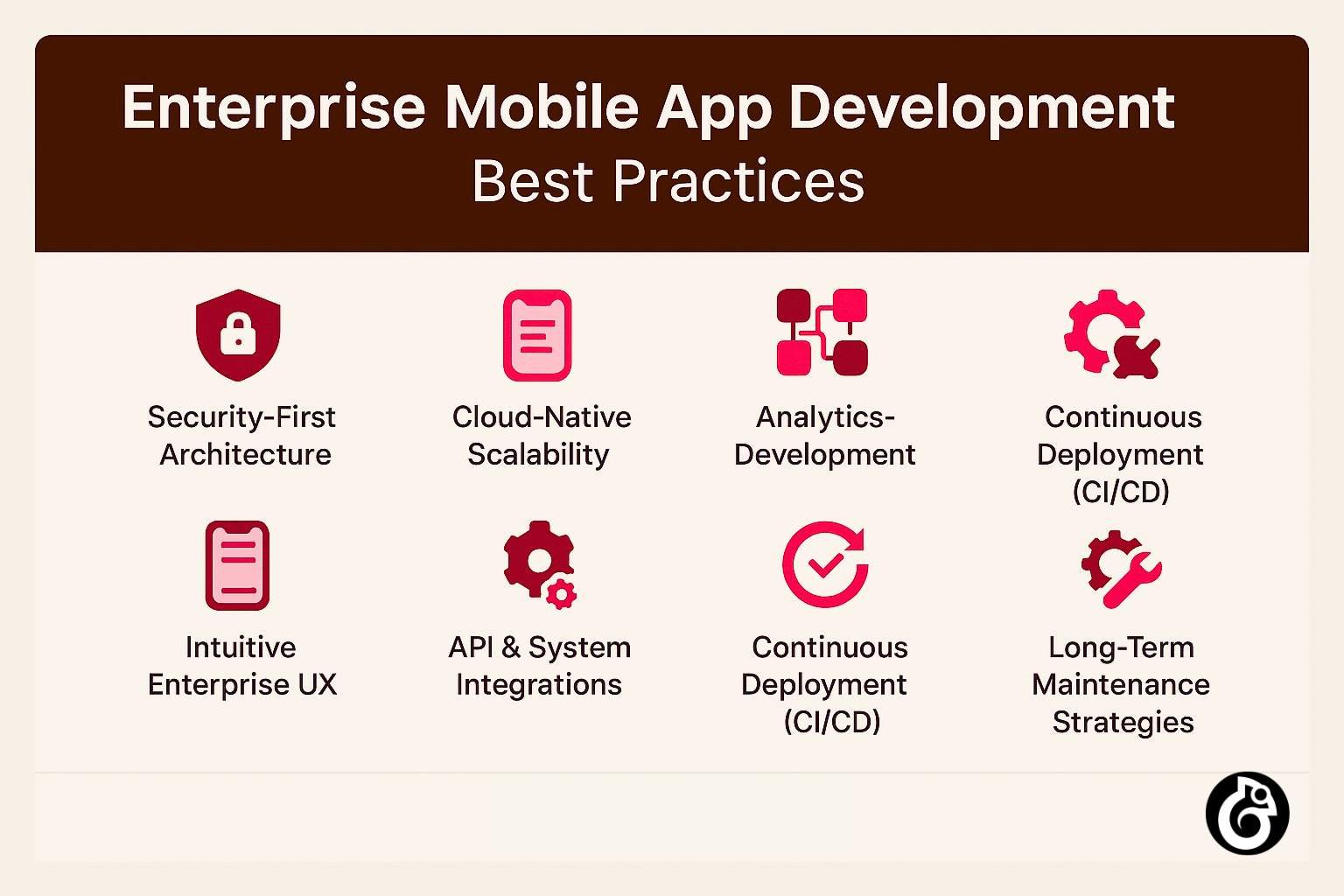
Best Practices for Enterprise Mobile App Development in 2026
Below are proven best practices used universally in enterprise development projects:
1. Build With Security-First Architecture
Security must be prioritized at the architectural level.
Best practices include:
- Zero-trust frameworks
- Role-based access
- Real-time threat detection
- Secure APIs
- Multifactor authentication
2. Choose Cloud-Native Development
Cloud-native development improves:
- Scalability
- Fault tolerance
- Deployment speed
- Global accessibility
3. Focus on Enterprise-Grade UX
Enterprise UX should simplify rather than complicate workflows.
Clear navigation, fast onboarding, and intuitive interactions must be emphasized.
4. Use Modular Architecture
Microservices or modular structures allow:
- Easier updates
- Independent feature deployment
- Cleaner codebase management
5. Leverage Data-Driven Decision-Making
AI, machine learning, and predictive analytics are now core features in enterprise apps.
6. Prioritize Strong Governance & Compliance
A compliance-first approach ensures safe and ethical data handling.
7. Invest in Continuous Optimization
A mobile application development company ensures long-term evolution by analyzing performance data and user feedback.

Proven Strategies for Enterprise App Success in 2026
The following strategies have consistently delivered successful outcomes:
1. Build MVP First for Large-Scale Enterprise Systems
Early validation reduces long-term costs and eliminates redundant features.
2. Use a Cross-Functional Dedicated Team
Product managers, UI/UX designers, developers, security engineers, and QA testers are required for enterprise projects.
3. Implement Strong Documentation
Documentation supports maintenance, upgrades, and onboarding.
4. Set Clear Metrics & KPIs
KPIs may include:
- Task completion time
- System uptime
- Workflow efficiency
- Cost savings
5. Choose the Right Technology Stack
Flutter, Swift, Kotlin, Node.js, and cloud-native frameworks are widely adopted.
6. Ensure Future-Proof Scalability
Systems must support multi-tenancy, global expansion, and API extensions.
How Enterprises Choose a Mobile App Development Partner
Selecting the right mobile app development company is critical for success. Enterprises evaluate:
- Experience with large-scale systems
- Security certifications
- Strength in UI/UX design services
- Integration and backend expertise
- Long-term maintenance capabilities
A partner offering end-to-end design & development & services ensures smooth execution and predictable outcomes.
Conclusion
Enterprise mobile app development in 2026 has evolved into a sophisticated process requiring advanced planning, modern architecture, strong security foundations, and exceptional user experience. Businesses across industries are leveraging mobile ecosystems to strengthen competitiveness, automate operations, and support large internal teams.
Success requires a strategic approach powered by data-driven planning, scalable infrastructure, intuitive UX, and dependable mobile app development services. By selecting the right mobile application development company and following enterprise best practices, organizations can ensure long-term digital growth.
FAQ on Enterprise Mobile App Development
How long does enterprise app development typically take?
Enterprise mobile app development usually requires 4–12 months, depending on the project’s scope, features, integrations, compliance requirements, and infrastructure needs. Complex enterprise systems with multi-module functionality may require extended timelines.
What features are most important for enterprise mobile apps?
Security, scalability, role-based access, cloud integration, analytics, workflow automation, and offline functionality are considered essential. These features ensure that the application supports business continuity and user productivity.
How important is UI/UX in enterprise mobile applications?
UI/UX is considered crucial. Enterprise apps must be intuitive, easy to adopt, and aligned with organizational workflows. Strong UI/UX design services reduce training time, minimize errors, and increase employee adoption rates.
What technologies are used for enterprise mobile development in 2026?
Flutter, Swift, Kotlin, React Native, Node.js, Python, and cloud-native technologies such as AWS, Azure, and Google Cloud are frequently used. Microservices and containerization also play major roles in architecture planning.
How is security ensured in enterprise mobile apps?
Security is enforced through encryption, MFA, RBAC, zero-trust frameworks, API security, compliance audits, and continuous monitoring. Penetration testing and code reviews are also part of the security lifecycle.
Why should enterprises outsource app development?
Outsourcing allows enterprises to access specialized talent, reduce development risk, accelerate timelines, and leverage proven processes. Working with a mobile application development company ensures dedicated expertise and predictable delivery.