Healthcare app development has evolved rapidly over the past decade, but by 2026 it has reached an entirely new level of complexity, responsibility, and opportunity. Digital healthcare solutions are no longer viewed as optional enhancements; they are now considered essential components of modern care delivery, patient engagement, and operational efficiency.
From telemedicine and remote patient monitoring to AI-assisted diagnostics and electronic health record (EHR) integrations, healthcare applications are being used to reshape how care is accessed, delivered, and managed. As a result, healthcare app development in 2026 is being approached with greater strategic planning, stricter regulatory compliance, and higher expectations for usability, security, and scalability.
This guide provides a comprehensive breakdown of healthcare app development in 2026, covering the development process, key features, and a detailed cost breakdown, while also highlighting how experienced providers of software development services play a critical role in successful outcomes.
The State of Healthcare App Development in 2026
In 2026, healthcare applications are being developed in response to several major industry shifts:
- Increased demand for remote and virtual care
- Greater focus on patient-centric digital experiences
- Rising adoption of wearable and IoT health devices
- Stronger regulatory oversight and data privacy laws
- Pressure to reduce operational costs while improving outcomes
Healthcare apps are now expected to deliver clinical-grade reliability while offering consumer-level usability. Because of this, development is no longer handled casually or rapidly without structure. Instead, healthcare app projects are being executed through mature, well-defined processes by experienced software development companies with healthcare domain expertise.
Why Healthcare Apps Are Mission-Critical in 2026
Healthcare applications are being used across the care continuum, from prevention and diagnosis to treatment, recovery, and long-term monitoring. Their impact is being felt by patients, providers, payers, and administrators alike.
By 2026, healthcare apps are being relied upon to:
- Improve access to care for remote or underserved populations
- Enable real-time communication between patients and providers
- Support chronic disease management
- Streamline administrative workflows
- Enhance data-driven clinical decision-making
Because of these responsibilities, healthcare app development is being treated as a high-stakes initiative where quality, compliance, and performance are non-negotiable.
Types of Healthcare Apps Being Built in 2026
Healthcare app development in 2026 spans multiple categories, each with its own technical and regulatory requirements.
1. Telemedicine and Virtual Care Apps
These applications support video consultations, secure messaging, digital prescriptions, and virtual follow-ups. They are widely adopted by hospitals, clinics, and independent practitioners.
2. Remote Patient Monitoring Apps
Remote monitoring apps integrate with wearables and medical devices to track vital signs such as heart rate, blood pressure, glucose levels, and oxygen saturation in real time.
3. Patient Engagement and Wellness Apps
These apps focus on appointment scheduling, medication reminders, health education, lifestyle tracking, and personalized wellness plans.
4. Clinical Workflow and Provider Apps
Healthcare providers use these apps to manage schedules, access patient records, document care, and communicate with care teams.
5. Health Data and Analytics Apps
Advanced healthcare apps are built to analyze large datasets, generate insights, and support population health management.
Each category requires a tailored approach to design, development, and compliance, making collaboration with a specialized mobile app development company essential.
Healthcare App Development Process in 2026
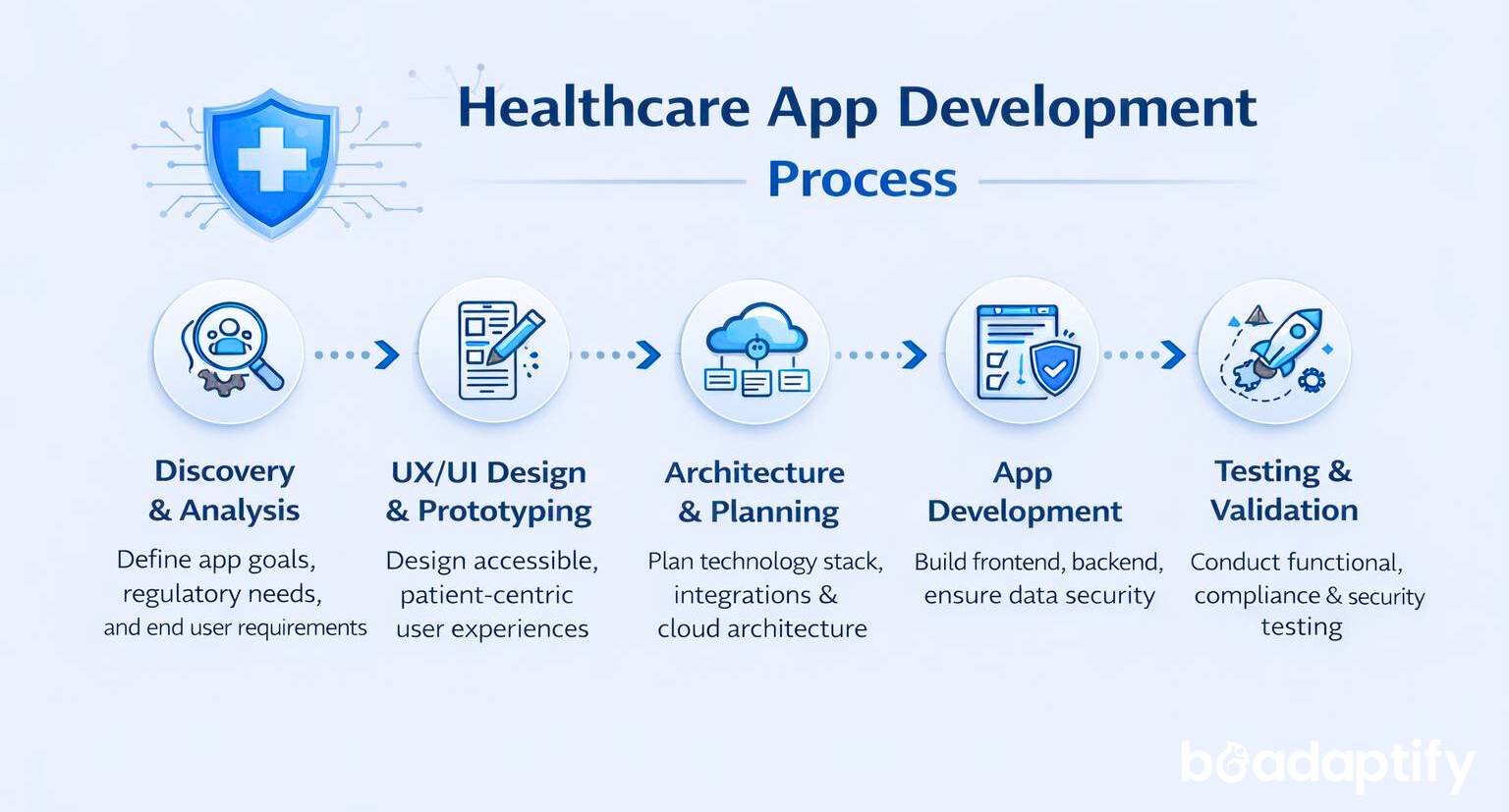
Healthcare app development in 2026 is being executed through a structured, multi-phase process designed to reduce risk and ensure compliance.
Phase 1: Discovery and Requirement Analysis
The development process is initiated with detailed discovery and planning. During this phase, business objectives, clinical workflows, user personas, and regulatory requirements are analyzed.
Key activities include:
- Stakeholder interviews
- User journey mapping
- Technical feasibility assessment
- Regulatory and compliance review
This phase ensures that the app is aligned with both clinical needs and business goals before any development begins.
Phase 2: UX/UI Design and Prototyping
Healthcare apps must be intuitive, accessible, and stress-free to use. In 2026, UX/UI design is treated as a foundational component rather than an afterthought.
Design efforts are focused on:
- Clear navigation and information hierarchy
- Accessibility for elderly and differently abled users
- Minimal cognitive load
- Consistent design systems
Interactive prototypes are created and validated with stakeholders before development proceeds.
Phase 3: Architecture and Technology Planning
A scalable and secure architecture is designed to support long-term growth and integration.
Key considerations include:
- Cloud infrastructure selection
- API and microservices architecture
- Data encryption and storage strategy
- Integration with EHR, EMR, and third-party systems
This phase is critical for ensuring performance, reliability, and future scalability.
Phase 4: Application Development
Development is carried out using agile methodologies, with iterative releases and continuous feedback.
Development typically includes:
- Frontend development for mobile and web
- Backend development and database management
- API integrations
- Security implementation
This phase is handled by specialized teams within a software development company offering end-to-end software development services.
Phase 5: Testing and Quality Assurance
Extensive testing is conducted to ensure the app meets healthcare standards.
Testing includes:
- Functional testing
- Performance testing
- Security and penetration testing
- Compliance validation
- Device and platform compatibility testing
Healthcare apps are tested more rigorously than standard consumer apps due to their sensitive nature.
Phase 6: Compliance, Certification, and Deployment
Before launch, compliance with healthcare regulations is validated. Depending on the region, this may include HIPAA, GDPR, HL7, FHIR, or other standards.
Once approved, the app is deployed to app stores or enterprise environments using secure CI/CD pipelines.
Phase 7: Maintenance, Monitoring, and Continuous Improvement
Healthcare apps require ongoing support after launch. Continuous monitoring, updates, and improvements are provided as part of long-term mobile application development services.
Key Features of Healthcare Apps in 2026
Healthcare apps in 2026 are expected to include a robust set of features to meet clinical, operational, and user expectations.
1. Secure User Authentication
Multi-factor authentication, biometric login, and role-based access controls are standard requirements.
2. Data Security and Encryption
End-to-end encryption, secure storage, and regular security audits are implemented to protect sensitive health data.
3. Interoperability and EHR Integration
Healthcare apps are built to integrate seamlessly with EHR and EMR systems using standardized protocols.
4. Real-Time Communication
Secure messaging, video calls, and notifications enable timely communication between patients and providers.
5. Remote Monitoring and Device Integration
Integration with wearables and IoT devices allows continuous health data tracking.
6. AI and Decision Support
AI-powered features assist with symptom analysis, predictive insights, and clinical decision support.
7. Appointment and Care Management
Scheduling, reminders, and care plans are managed digitally to improve adherence and outcomes.
8. Analytics and Reporting
Advanced dashboards provide insights into patient outcomes, operational performance, and compliance metrics.
Cost Breakdown of Healthcare App Development in 2026
Healthcare app development costs vary significantly based on scope, complexity, and compliance requirements.
Key Cost Factors
- App type and functionality
- UX/UI design complexity
- Integration requirements
- Security and compliance needs
- Platform (iOS, Android, web)
- Development team location and expertise
Estimated Cost Ranges
| App Complexity | Estimated Cost (USD) |
|---|---|
| Basic Healthcare App | $60,000 – $100,000 |
| Mid-Level Healthcare App | $100,000 – $180,000 |
| Advanced Healthcare App | $180,000 – $350,000+ |
These costs reflect end-to-end development delivered by an experienced mobile app development company offering full mobile app development services.
Why Choosing the Right Development Partner Matters
Healthcare app development is not suited for inexperienced teams. Mistakes can lead to compliance violations, security risks, and user distrust.
Beadaptify, An experienced provider of software development services ensures:
- Regulatory compliance
- Robust security implementation
- Scalable architecture
- Reliable long-term support
Partnering with a trusted software development company significantly reduces risk and improves project success rates.
Challenges in Healthcare App Development
Despite advancements, healthcare app development remains challenging.
Common challenges include:
- Regulatory complexity
- Data privacy risks
- Interoperability issues
- User adoption barriers
- Ongoing maintenance demands
These challenges are addressed through careful planning, expert execution, and continuous improvement.

Future Trends in Healthcare App Development Beyond 2026
Healthcare app development will continue evolving through:
- Greater AI automation
- Personalized digital therapeutics
- Expanded remote care models
- Blockchain-based health records
- Advanced predictive analytics
Apps built in 2026 must be future-ready to adapt to these changes.
Conclusion
Healthcare app development in 2026 represents a convergence of technology, compliance, and patient-centric care. Successful healthcare apps are no longer defined solely by features but by reliability, security, usability, and long-term scalability.
Through structured processes, advanced features, and careful cost planning, healthcare organizations are able to deliver impactful digital solutions. By partnering with an experienced mobile app development company offering comprehensive mobile application development services, healthcare providers can confidently navigate the complexities of digital transformation. As the healthcare industry continues to evolve, thoughtfully designed and securely built healthcare apps will remain at the center of innovation, efficiency, and improved patient outcomes.
FAQ About Healthcare App Development
What makes healthcare app development different from regular app development?
Healthcare app development involves strict regulatory compliance, higher security standards, and deeper testing requirements compared to standard consumer apps.
How long does healthcare app development take in 2026?
Depending on complexity, development timelines typically range from 4 to 10 months, including design, development, testing, and compliance validation.
Are healthcare apps required to follow HIPAA and other regulations?
Yes. Compliance with regulations such as HIPAA, GDPR, and regional healthcare standards is mandatory to protect patient data and ensure legal operation.
Can healthcare apps integrate with EHR and medical devices?
Modern healthcare apps are built to support seamless integration with EHR systems, wearables, and IoT medical devices using standardized protocols.
How much does healthcare app maintenance cost after launch?
Ongoing maintenance typically costs 15–25% of the initial development cost annually and includes updates, monitoring, and security improvements.
Is cloud infrastructure commonly used for healthcare apps?
Yes. Cloud platforms are widely used to ensure scalability, secure data storage, and real-time accessibility for healthcare applications.
Can healthcare apps be scaled for future features?
When built with modular architecture and scalable infrastructure, healthcare apps can easily support new features and integrations over time.