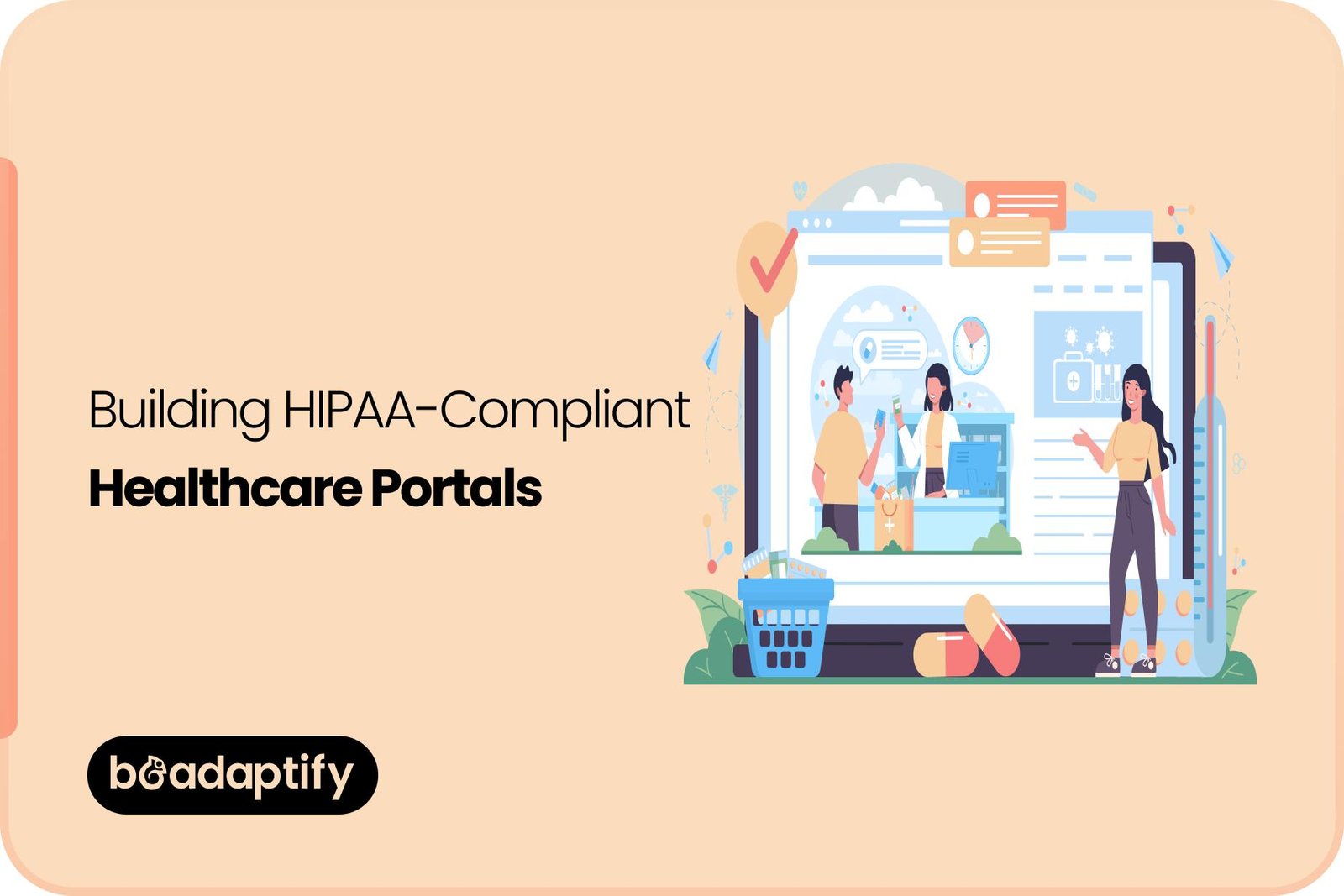
Healthcare organizations are increasingly being pushed toward digital-first operations. Patient expectations for online access, regulatory demands for data protection, and operational efficiency goals have accelerated the adoption of healthcare portals across hospitals, clinics, behavioral health centers, and specialty providers.
Patient portals, provider dashboards, administrative systems, and telehealth platforms are now being relied upon as core digital infrastructure. However, because protected health information (PHI) is involved, these platforms must comply with the Health Insurance Portability and Accountability Act (HIPAA). Compliance is not optional, it is mandatory.
HIPAA violations have been associated with financial penalties, operational disruptions, legal consequences, and reputational damage. For this reason, healthcare portals are increasingly being built using custom web development rather than generic software solutions. Custom platforms allow security, compliance, workflows, and usability to be designed together from the start.
In this guide, a detailed breakdown is provided on how HIPAA-compliant healthcare portals are built, why custom development is required, and how modern development & design services are applied to meet regulatory and operational demands.
Understanding HIPAA and Its Impact on Healthcare Portals
HIPAA was established to protect sensitive patient information and to regulate how healthcare data is accessed, stored, transmitted, and disclosed. Healthcare portals that handle PHI must comply with multiple HIPAA rules, including:
- The Privacy Rule
- The Security Rule
- The Breach Notification Rule
Each of these rules imposes strict requirements on digital systems.
What Is Considered PHI?
Protected Health Information includes any data that can identify a patient and is related to their medical condition, treatment, or payment history. This includes:
- Names, addresses, and contact details
- Medical records and diagnoses
- Appointment data
- Insurance and billing information
- Login credentials tied to healthcare records
Because healthcare portals process this data, they are classified as regulated systems under HIPAA.
Why Off-the-Shelf Healthcare Portals Often Fall Short
Many healthcare organizations initially attempt to use pre-built portal solutions. While these tools may offer basic features, critical limitations are often encountered.
Off-the-shelf healthcare portals are frequently found to be:
- Difficult to customize for specific workflows
- Limited in security configuration
- Poorly integrated with existing systems
- Inflexible when regulations evolve
- Weak in user experience design
Most importantly, compliance responsibility still rests with the healthcare organization not the software provider. As a result, custom development is increasingly being chosen to ensure HIPAA requirements are fully met.
Why Custom Web Development Is Preferred for HIPAA Compliance
Custom healthcare portals are developed with compliance as a foundational requirement rather than an afterthought. Through custom development, security controls, access policies, and audit mechanisms are embedded directly into the platform architecture.
By leveraging design & development services, portals are created that balance compliance, performance, and usability without sacrificing any of these priorities.
Key advantages of custom HIPAA-compliant portals include:
- Full control over data handling
- Tailored security architecture
- Compliance-ready workflows
- Seamless system integrations
- Scalable infrastructure
Core Features of a HIPAA-Compliant Healthcare Portal
To meet regulatory requirements and operational needs, several essential features are implemented in compliant healthcare portals.
Secure User Authentication and Access Control
Access to PHI must be restricted based on user roles. Role-based access control (RBAC) ensures that users only view data necessary for their responsibilities.
Multi-factor authentication (MFA) is commonly implemented to reduce unauthorized access risks.
Data Encryption at Rest and in Transit
HIPAA requires PHI to be protected during storage and transmission. Encryption protocols such as AES-256 and TLS are applied to safeguard data integrity and confidentiality.
Audit Logs and Activity Monitoring
Every interaction with PHI must be logged. Audit trails track user activity, including logins, data access, and changes. These logs are critical during compliance audits and investigations.
Secure Messaging and Communication
Patient-provider communication within portals must be encrypted and monitored. Secure messaging systems replace email and SMS to reduce exposure risks.
Consent and Authorization Management
Patient consent is tracked and enforced within the portal. Access permissions are dynamically adjusted based on authorization rules.
Architecture of a HIPAA-Compliant Healthcare Portal
The system architecture plays a critical role in ensuring compliance and scalability.
Secure Backend Infrastructure
Backend systems are built using secure frameworks and hosted on HIPAA-compliant cloud environments. Firewalls, intrusion detection systems, and access policies are configured at the infrastructure level.
Modular Design Approach
Modular architectures allow compliance controls to be isolated and managed independently. This approach also supports future enhancements without compromising security.
API-Driven Integration Layer
Healthcare portals are required to integrate with:
- Electronic Health Record (EHR) systems
- Billing and claims platforms
- Appointment scheduling tools
- Third-party analytics systems
Custom APIs are developed to enable secure data exchange while maintaining compliance.
The Role of UI/UX Design in Healthcare Portals
Compliance alone does not guarantee adoption. If portals are difficult to use, patients and providers are less likely to engage with them.
Through development & design services, healthcare portals are designed to be intuitive, accessible, and user-friendly.
UX design considerations include:
- Clear navigation and labeling
- Accessibility standards (WCAG compliance)
- Reduced cognitive load
- Context-aware interfaces
- Error prevention mechanisms
A well-designed portal reduces training requirements, minimizes user errors, and improves overall satisfaction.
Mobile Access and HIPAA Compliance
Healthcare access is no longer limited to desktops. Mobile portals and applications are increasingly required for both patients and providers.
When healthcare portals are extended to mobile platforms, mobile app development services are used to ensure compliance is preserved across devices.
Mobile compliance considerations include:
- Secure device authentication
- Encrypted local storage
- Session timeout enforcement
- Remote data wipe capabilities
A trusted mobile app development company ensures that mobile healthcare portals remain secure without compromising usability.
Data Storage, Backup, and Disaster Recovery
HIPAA requires data availability as well as security. Healthcare portals must ensure that PHI remains accessible during outages or failures.
Custom development enables:
- Redundant data storage
- Automated backups
- Disaster recovery planning
- Business continuity strategies
Cloud-based infrastructure is often used to meet these requirements efficiently.
Testing and Validation for HIPAA Compliance
Before deployment, healthcare portals undergo rigorous testing to validate compliance.
Testing processes include:
- Vulnerability assessments
- Penetration testing
- Access control validation
- Audit log verification
- Compliance checklist reviews
Testing is treated as an ongoing process rather than a one-time event.
Maintaining HIPAA Compliance After Launch
HIPAA compliance does not end at deployment. Continuous monitoring and maintenance are required.
Post-launch compliance activities include:
- Security updates and patching
- Regular audits and assessments
- User access reviews
- Incident response drills
- Policy updates
Through ongoing software development services, portals remain compliant as regulations and threats evolve.
Common Mistakes to Avoid in HIPAA Portal Development
Several common mistakes are frequently observed when HIPAA compliance is not prioritized early.
These include:
- Assuming hosting providers handle compliance
- Failing to encrypt backups
- Weak access control policies
- Incomplete audit logging
- Ignoring mobile security risks
Custom development helps avoid these pitfalls by addressing compliance holistically.
Measuring the ROI of HIPAA-Compliant Portals
While compliance is mandatory, additional business benefits are also realized.
Organizations typically experience:
- Reduced administrative workload
- Improved patient engagement
- Faster information access
- Lower operational risk
- Enhanced trust and credibility
These outcomes justify the investment in custom healthcare portal development.
Why Choose Beadaptify for HIPAA-Compliant Portal Development
Beadaptify specializes in building healthcare portals where compliance, security, and usability are treated as equal priorities. Instead of adapting healthcare workflows to generic tools, portals are custom-designed to support real-world clinical, administrative, and patient engagement needs.
With deep experience across software development services, and mobile app development solutions, Beadaptify delivers HIPAA-compliant platforms that integrate seamlessly with EHRs, billing systems, and third-party healthcare tools. From secure architecture to intuitive UI/UX, every layer is engineered to protect PHI while enabling efficient digital care delivery. A long-term partnership approach ensures continuous compliance, performance optimization, and scalability making Beadaptify a reliable choice for healthcare organizations navigating regulatory complexity.
Future Trends in HIPAA-Compliant Healthcare Portals
Healthcare portals continue to evolve alongside technology and regulation.
Emerging trends include:
- AI-powered patient insights
- Interoperability through FHIR APIs
- Remote patient monitoring integrations
- Behavioral health portal expansion
- Advanced analytics and reporting
Custom development ensures that portals remain adaptable as these trends mature.

Conclusion
HIPAA-compliant healthcare portals are no longer optional, they are foundational to modern healthcare delivery. Generic solutions often fail to meet compliance, usability, and scalability requirements simultaneously.
Through custom web development, healthcare organizations gain full control over security, data handling, and user experience. By leveraging professional development & design services, mobile application development services compliant portals are built to support both regulatory demands and long-term growth. In a healthcare landscape defined by trust, security, and accessibility, custom HIPAA-compliant portals provide the digital backbone required to deliver safe, efficient, and patient-centered care.
FAQs About HIPAA-Compliant Healthcare Portals
Why is custom development required for HIPAA compliance?
HIPAA compliance requires strict control over data handling, access, and auditing. Custom development allows these controls to be embedded into system architecture rather than relying on limited off-the-shelf configurations.
Can existing healthcare portals be made HIPAA compliant?
In some cases, yes. However, retrofitting compliance is often more complex and costly than building a compliant portal from the ground up using custom development.
How is PHI protected in a HIPAA-compliant portal?
PHI is protected through encryption, role-based access control, audit logging, secure authentication, and continuous monitoring across the system.
Are mobile healthcare portals also subject to HIPAA?
Yes. Any mobile application that accesses or stores PHI must meet HIPAA requirements. Secure mobile access is ensured through encrypted storage, device authentication, and controlled session management using professional mobile app development services.
How long does it take to build a HIPAA-compliant healthcare portal?
Timelines depend on complexity, integrations, and features. Most portals are developed in phases to allow early deployment while maintaining compliance throughout.
Who is responsible for HIPAA compliance—the software provider or healthcare organization?
The healthcare organization remains responsible for compliance. A qualified development partner ensures the technology meets HIPAA standards, but internal policies and usage also matter.