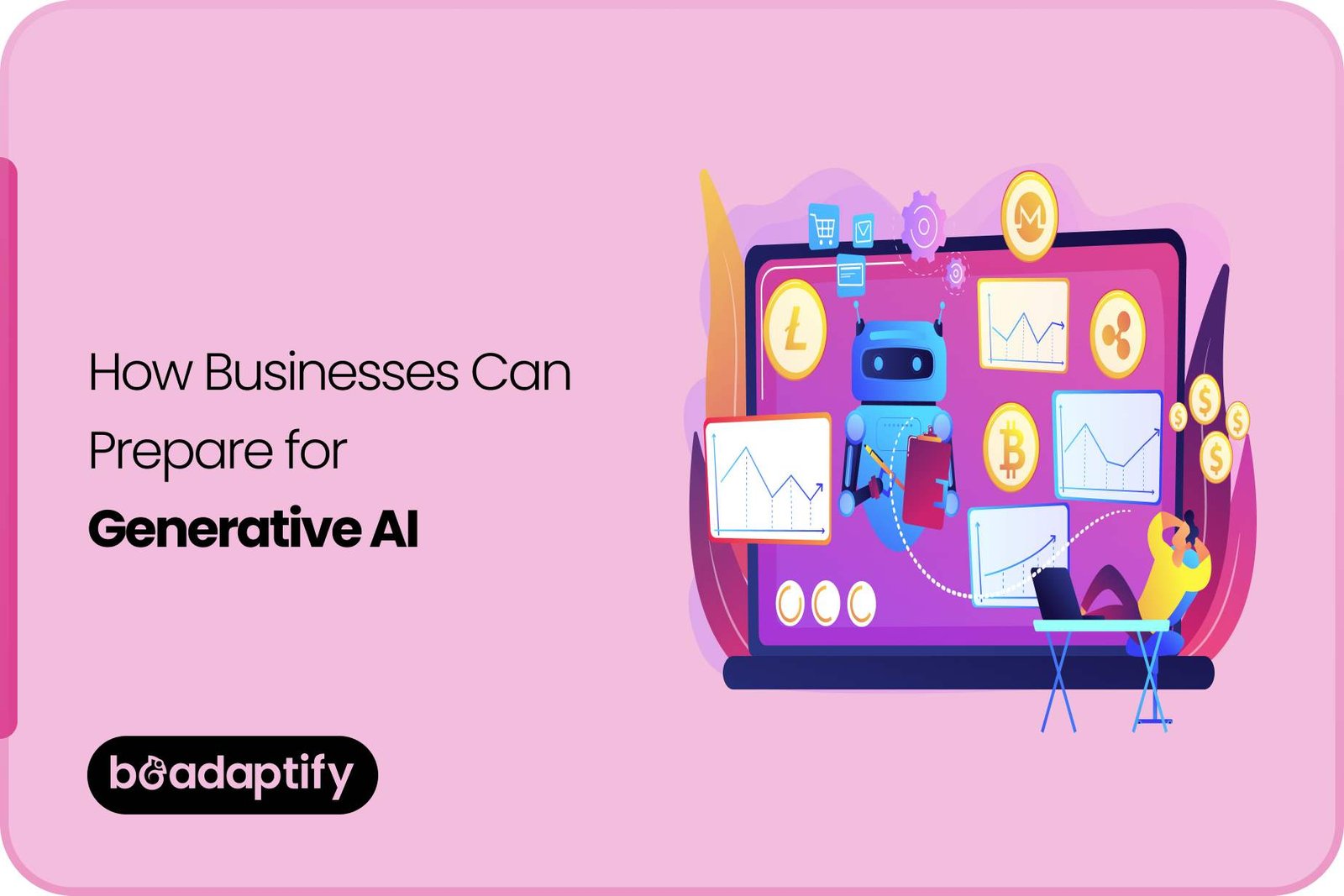
Generative AI is no longer positioned as an experimental technology reserved for research labs or early adopters. It is being actively integrated into business workflows, customer experiences, and product development pipelines across industries. As adoption accelerates, organizations that prepare strategically are being positioned to gain a sustainable competitive advantage, while those that delay are being left to react under pressure.
This guide explains how businesses can be prepared for generative AI adoption technically, operationally, ethically, and strategically while aligning innovation with long-term business value.
Understanding Generative AI and Why It Matters Now
Generative AI refers to artificial intelligence systems capable of creating new content such as text, images, code, audio, or video based on patterns learned from vast datasets. Unlike traditional AI systems that focus on classification or prediction, generative models are designed to produce original outputs.
In recent years, rapid advancements in large language models, diffusion models, and multimodal systems have significantly reduced the barrier to adoption. As a result, generative AI has been embedded into everyday business tools, including:
- Customer support systems
- Marketing and content platforms
- Software development workflows
- Data analysis and reporting tools
For many organizations, generative AI is no longer a “future initiative.” It is being introduced by competitors, vendors, and customers often faster than internal strategies are being defined.
Why Generative AI Adoption Requires Preparation
Generative AI adoption cannot be treated as a plug-and-play implementation. While APIs and off-the-shelf tools are readily available, successful adoption depends on preparedness across multiple dimensions.
Without proper preparation, AI initiatives are often met with:
- Inconsistent outputs
- Security and compliance risks
- Employee resistance
- Poor ROI
- Ethical and reputational concerns
Step 1: Establish Clear Business Objectives for AI Adoption
Before tools are evaluated or pilots are launched, business goals must be clearly defined. Generative AI should be adopted to solve specific problems not simply to follow trends.
Common objectives include:
- Improving operational efficiency
- Reducing manual workloads
- Enhancing customer experiences
- Accelerating product development
- Increasing personalization at scale
Each objective should be mapped to measurable outcomes. For example, content generation tools may be linked to reduced production time, while AI-assisted customer support may be linked to faster resolution rates.
When objectives are clarified early, AI initiatives can be aligned with broader design & development services strategies rather than existing in isolation.
Step 2: Assess Data Readiness and Infrastructure
Generative AI systems are heavily dependent on data quality, accessibility, and governance. Without a strong data foundation, AI outputs are likely to be inaccurate, biased, or inconsistent.
Key Data Readiness Factors:
- Centralized and well-structured datasets
- Clean, labeled, and up-to-date data
- Clear data ownership and access controls
- Secure storage and transmission mechanisms
Legacy systems often create silos that limit AI effectiveness. In such cases, modernization initiatives are typically required before generative AI can be deployed successfully.
This is where software development services play a critical role by enabling data integration, API development, and scalable cloud architectures that support AI workloads.
Step 3: Identify High-Impact Use Cases
Not all business processes benefit equally from generative AI. High-impact use cases should be prioritized based on feasibility, risk level, and expected value.
Common High-Value Use Cases:
- Automated content creation and summarization
- Code generation and testing assistance
- Chatbots and virtual assistants
- Document processing and knowledge management
- Personalized recommendations
Early success is more likely when AI is introduced into low-risk, high-volume workflows. These wins help build organizational confidence and support broader adoption efforts.
Step 4: Evaluate Build vs. Buy Decisions
Businesses must decide whether generative AI capabilities should be built internally or integrated through third-party platforms. Each approach carries trade-offs.
Buying AI Solutions:
- Faster implementation
- Lower upfront development costs
- Limited customization
- Vendor dependency
Building Custom AI Solutions:
- Greater control and customization
- Better alignment with internal workflows
- Higher initial investment
- Longer development timelines
In many cases, a hybrid approach is adopted where foundational models are licensed, and custom layers are built on top by an experienced software development company.
Step 5: Strengthen Security and Compliance Frameworks
Generative AI introduces new security challenges, particularly when sensitive data is processed or generated automatically.
Key concerns include:
- Data leakage through prompts or outputs
- Unauthorized model access
- Inaccurate or misleading content generation
- Regulatory non-compliance
To mitigate risks, the following practices should be implemented:
- Role-based access controls
- Prompt logging and monitoring
- Output validation workflows
- Compliance audits aligned with industry regulations
Security considerations should be embedded into AI architecture from the beginning, rather than addressed reactively.
Step 6: Prepare the Workforce for AI Collaboration
Generative AI is not intended to replace human workers but to augment their capabilities. However, resistance often emerges when employees feel threatened or unprepared.
Successful adoption is supported when:
- Clear communication is provided about AI’s role
- Training programs are introduced early
- AI tools are positioned as productivity enhancers
Upskilling initiatives should focus on:
- Prompt engineering fundamentals
- AI-assisted decision-making
- Ethical AI usage guidelines
When employees are empowered to collaborate with AI systems, adoption becomes smoother and more sustainable.
Step 7: Address Ethical and Responsible AI Considerations
Generative AI systems can unintentionally amplify bias, misinformation, or harmful content if safeguards are not implemented.
Responsible AI adoption requires:
- Bias evaluation and mitigation strategies
- Transparency in AI-generated outputs
- Human-in-the-loop validation processes
- Clear accountability frameworks
Ethical governance should be treated as a continuous process, not a one-time checklist. Businesses that prioritize responsible AI are more likely to earn long-term trust from customers and stakeholders.
Step 8: Redesign Processes Around AI Capabilities
Generative AI delivers the most value when processes are redesigned not simply automated.
For example:
- Content workflows may shift from creation to review
- Customer service agents may transition into AI supervisors
- Developers may focus more on architecture than repetitive coding
Process redesign is often supported through design & development services, ensuring that AI tools are embedded naturally into user journeys and internal systems.
Step 9: Start with Pilots, Then Scale Strategically
AI pilots allow organizations to validate assumptions, measure impact, and identify risks before scaling across departments.
Effective pilots are:
- Limited in scope
- Closely monitored
- Designed with clear success metrics
Once validated, AI initiatives can be scaled incrementally, supported by robust infrastructure and governance models.
Step 10: Measure ROI and Continuously Optimize
Generative AI adoption should be treated as an evolving capability rather than a fixed implementation.
Ongoing optimization should include:
- Performance benchmarking
- Cost monitoring
- Model updates and retraining
- User feedback integration
KPIs may include productivity gains, cost reductions, customer satisfaction improvements, and time-to-market acceleration.
The Role of a Software Development Company in AI Readiness
Preparing for generative AI adoption often requires expertise beyond internal capabilities. A trusted software development company can support businesses by:
- Assessing AI readiness
- Designing scalable architectures
- Developing secure integrations
- Customizing AI workflows
- Ensuring long-term maintainability
Why Beadaptify Is the Right Partner for AI-Driven Transformation
Preparing for generative AI requires more than experimentation, it demands scalable systems, secure data architecture, and long-term technical planning. At Beadaptify, AI readiness is approached as a business transformation initiative, not just a technology upgrade.
Our team works closely with organizations to modernize infrastructure, redesign workflows, and align AI adoption with measurable business goals. From data integration and system modernization to AI-enabled product development, solutions are designed to be practical, secure, and scalable. As a trusted software development company, Beadaptify delivers end-to-end software development services and design & development services that ensure AI initiatives are implemented responsibly and efficiently without disrupting existing operations.
What Sets Beadaptify Apart
- AI-Ready Architecture Design
- Secure & Compliant Development
- Business-First AI Strategy
- Custom Development Expertise
- Future-Proof Technology Stack
- End-to-End Support
Final Thoughts
Generative AI adoption is not a single decision, it is a strategic journey. When approached with clarity, preparation, and the right technical partners, AI can be transformed from a disruptive force into a powerful business ally. Organizations that invest early in readiness across data, people, processes, and platforms are being positioned to lead in an AI-driven future.

FAQs About Generative AI Adoption
What does it mean to prepare for generative AI adoption?
Generative AI preparation involves ensuring that business systems, data, security policies, and teams are ready to integrate AI responsibly and effectively.
Do businesses need custom software before adopting AI?
In many cases, yes. Legacy systems often limit AI capabilities. Custom software development enables scalable integration and better control over AI workflows.
Is generative AI adoption expensive?
Costs vary based on use cases and complexity. Proper preparation helps reduce long-term costs by preventing failed implementations and rework.
Which business functions benefit most from generative AI?
High-impact areas include content creation, customer support, software development, analytics, and internal knowledge management.
How can AI risks be minimized?
Risks are reduced through strong governance, human-in-the-loop processes, security controls, and ethical AI frameworks.
Should AI be built internally or outsourced?
A hybrid approach is often recommended leveraging external expertise from a software development company while maintaining internal oversight.
How long does AI preparation typically take?
Initial readiness assessments can take weeks, while full implementation may span several months depending on complexity and scale.
Can small businesses prepare for generative AI too?
Yes. Scalable AI strategies allow small and mid-sized businesses to adopt AI gradually without excessive upfront investment.