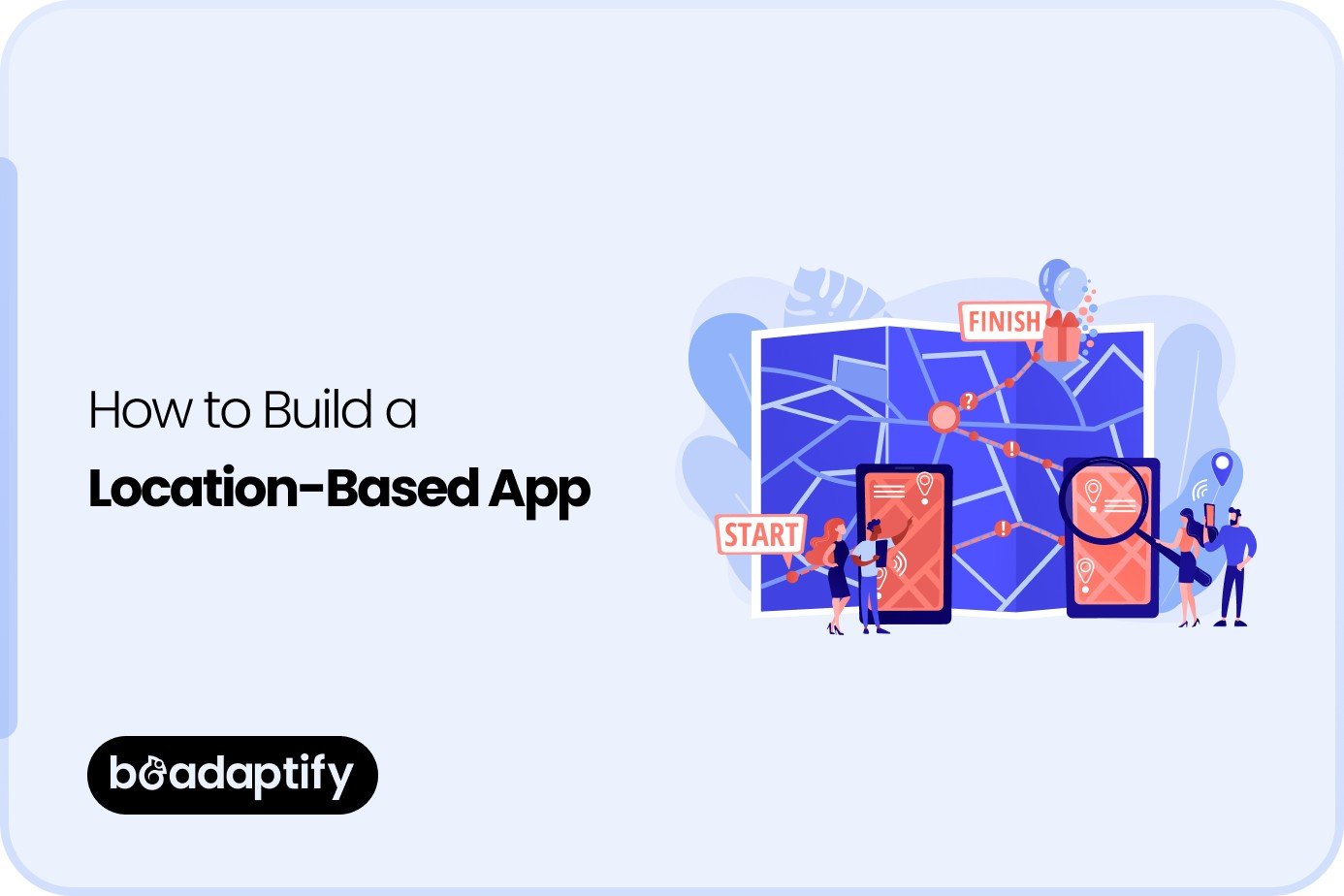
Location-based apps have become a core part of the digital experience. In 2026, they are being used across industries such as travel, food delivery, fitness, logistics, healthcare, real estate, mobility, retail, event management, and social networking. Users are no longer interacting with location technology only through maps and navigation. Instead, location is being used to personalize offers, track deliveries, find nearby services, improve safety, enable on-demand experiences, and support real-time decision-making.
Because of this, location-based app development is no longer being treated as a niche category. It is being seen as a practical product strategy for businesses that want to connect digital services with real-world context. Whether a company is building a delivery platform, a local discovery app, a ride-booking service, a field operations platform, or a fitness tracker, location intelligence can become one of the most valuable parts of the user experience.
At the same time, building a location-based app in 2026 is more complex than simply adding a map and enabling GPS. Modern products are being expected to handle real-time tracking, route optimization, geofencing, privacy permissions, battery efficiency, address search, place discovery, notification logic, and personalized recommendations. User expectations are also rising. People want apps that feel fast, relevant, accurate, and trustworthy. If location feels slow, inaccurate, invasive, or confusing, the experience is usually abandoned quickly.
This guide explains how to build a location-based app in 2026, including the essential development steps, the most important features, and the key trends that are shaping the space.
Why Location-Based Apps Matter More in 2026
Location-based apps matter more than ever because digital experiences are increasingly being expected to respond to real-world context. Static apps are no longer enough in many categories. Users want software that understands where they are, what is nearby, how conditions are changing, and what action should happen next.
For example, a travel app may recommend attractions near the current location. A delivery app may track the courier in real time. A retail app may trigger local offers when a user enters a specific area. A healthcare platform may help mobile staff navigate assigned visits. A logistics platform may monitor assets in motion. A social app may suggest nearby events or people. These experiences are possible because location is being used as a dynamic layer of intelligence rather than just as a point on a map.
Businesses are increasingly investing in this category because location can improve:
- user convenience
- operational efficiency
- real-time service visibility
- local relevance
- route planning
- engagement and retention
- business intelligence
- monetization opportunities
However, those benefits are only achieved when the app is planned properly. Location-based products are usually expected to balance three important things at the same time: accuracy, performance, and privacy.
What Is a Location-Based App?
A location-based app is a mobile application that uses the geographic position of a user, device, vehicle, asset, or place to deliver functionality, content, or services. This may involve real-time positioning, historical route data, proximity detection, or spatial analysis.
Some apps use location continuously, such as navigation and delivery tracking products. Others use it occasionally, such as nearby search, check-ins, localized offers, or event discovery.
Location-based apps can rely on different sources and technologies, including:
- GPS
- Wi-Fi positioning
- cell tower triangulation
- Bluetooth beacons
- geofencing
- map APIs
- geocoding and reverse geocoding
- route optimization services
- place and landmark databases
The type of location technology used depends on the business case, the accuracy needed, and how often updates are required.
Common Types of Location-Based Apps
Before development begins, the app category should be defined clearly because different use cases require different product structures.
Navigation and Route Planning Apps
These apps are built to help users move from one location to another efficiently. They often include maps, directions, ETA calculation, route alternatives, traffic awareness, and turn-by-turn navigation.
Delivery and Courier Tracking Apps
These apps are used to track orders, drivers, and estimated arrival times. Real-time location is often central to the user experience.
Ride-Hailing and Mobility Apps
Mobility apps rely heavily on real-time location for driver discovery, pickup matching, trip monitoring, and fare estimation.
Local Discovery Apps
These apps help users find nearby restaurants, stores, services, attractions, events, or facilities. Search relevance and place data are especially important here.
Fitness and Activity Apps
These apps track walking, running, cycling, or outdoor movement. Route visualization, distance measurement, and performance summaries are common features.
Logistics and Fleet Management Apps
These platforms are built to monitor vehicles, drivers, and assets. They may include route history, geofences, dispatch logic, and operational dashboards.
Real Estate and Property Search Apps
These apps use location to show nearby listings, neighborhood insights, commute analysis, and map-based search results.
Safety and Emergency Apps
Some apps use location for SOS sharing, family tracking, worker safety monitoring, or emergency response coordination.
Each type of product has different expectations around update frequency, map depth, privacy controls, and backend logic.
Step-by-Step Process to Build a Location-Based App in 2026
1. Define the Core Use Case
The first step should be to define exactly why location is being used in the app. This is critical because too many products add location as a feature without tying it to a clear user benefit.
A useful starting point is to ask:
- What user problem is being solved with location?
- Is real-time tracking required, or is occasional location enough?
- Will users benefit from nearby discovery, route guidance, alerts, or monitoring?
- Will the app use the user’s location, a driver’s location, an asset’s location, or all of them?
- How accurate does the location need to be?
If the use case is not clear, the product usually becomes cluttered or invasive. Good location-based apps make location feel useful, not excessive.
2. Choose the Right App Model
The next step is to decide whether the app will be:
- consumer-facing
- business-facing
- marketplace-based
- internal operational software
- real-time tracking-heavy
- discovery and recommendation-focused
For example, a consumer food delivery app and a fleet operations app may both use real-time maps, but their workflows, permissions, admin needs, and UX priorities are completely different.
This decision shapes feature planning, backend architecture, and estimated development cost.
3. Plan the User Experience Around Context
Location-based apps should not be designed like generic apps with a map screen added later. The user experience should be planned around location context from the beginning.
This usually includes:
- how users grant location access
- when location is requested
- what is shown before location permission is approved
- how map-based interactions are handled
- how nearby results are displayed
- how location updates affect the interface
- how battery usage and background activity are managed
- how privacy choices are explained
This is where strong design & development services matter a great deal. A location feature may be technically correct but still feel frustrating if permission prompts, map flows, or location-driven results are not designed clearly.
4. Select the Right Technology Stack
Location-based apps in 2026 often rely on multiple technology layers working together.
The stack may include:
- native or cross-platform mobile development
- mapping SDKs
- geolocation APIs
- geocoding and reverse geocoding services
- places and landmark APIs
- backend infrastructure
- notification systems
- analytics tools
- geofencing logic
- route optimization or ETA services
The right stack depends on the product type. A delivery tracking app may require more real-time architecture, while a local discovery app may need stronger place-search logic and recommendation systems.
A custom mobile app development company can help select the stack based on product complexity, budget, platform goals, and long-term scalability.
5. Build the Core Location Engine
This is the technical foundation of the product. The app must determine how location will be captured, stored, refreshed, and used.
Important decisions usually include:
- foreground vs background location access
- precise vs approximate location usage
- refresh frequency
- geofence creation and management
- movement thresholds
- battery optimization logic
- offline behavior
- error handling for weak signals
The app should never collect more location data than is actually needed. In 2026, privacy expectations are stronger, and users expect clarity around why location is required.
6. Develop the User-Facing Features
Once the location foundation is in place, the user experience can be built around actual workflows.
Common location-based user features may include:
- nearby search
- map view and list view toggle
- live tracking
- route preview
- saved places
- check-ins
- location-based reminders
- personalized local suggestions
- distance and ETA display
- geofence-triggered notifications
At this stage, performance and clarity are especially important. Location-based apps often fail not because the concept is weak, but because the interface becomes too busy or too confusing.
7. Build the Admin and Operational Layer
Many location-based products require more than a mobile front end. They also need backend visibility and control systems.
Admin or business-facing tools may include:
- user location monitoring
- route history
- delivery or staff dashboards
- geofence control
- event logs
- support tools
- analytics and reporting
- operational alerts
- performance metrics
This is especially important in logistics, mobility, workforce management, and delivery applications.
8. Test for Accuracy, Performance, and Edge Cases
Testing a location-based app is more complex than testing a static product. It must be tested across different movement conditions, devices, permission states, and network quality.
Testing should usually cover:
- location permission scenarios
- approximate vs precise behavior
- background updates
- map rendering performance
- route calculation
- GPS drift
- geofence entry and exit behavior
- poor network conditions
- battery impact
- failed location fetch scenarios
- urban vs indoor vs outdoor conditions
Without strong QA, location-based apps often fail in real-world conditions even if they work well in demo environments.
Must-Have Features for a Location-Based App in 2026
The exact feature set depends on the product category, but several features are commonly expected.
Real-Time Location Tracking
This is critical for use cases such as ride-booking, delivery, fleet monitoring, and family safety. It allows users or admins to see live movement and estimated progress.
Interactive Maps
Maps are often the visual core of the experience. Users should be able to zoom, search, explore, and understand location-based information quickly.
Geofencing
Geofencing allows virtual boundaries to be created around a physical space. Actions can then be triggered when a user or device enters or exits that boundary.
This is useful in:
- retail promotions
- attendance tracking
- safety zones
- asset movement alerts
- location-based reminders
Search by Place or Address
A location-based app should usually support easy search through addresses, landmarks, saved places, or nearby points of interest.
Geocoding and Reverse Geocoding
Address conversion is often essential. Users may type an address and expect coordinates to be found, or the app may convert coordinates into a readable place name.
Nearby Recommendations
Nearby search results can improve discovery and engagement. Restaurants, services, listings, venues, stores, and landmarks can be shown based on the user’s current or selected location.
Route and ETA Calculation
For mobility, logistics, or delivery apps, estimated arrival time and route display are often expected.
Push Notifications Based on Location
Notifications can be triggered by:
- entering a defined area
- leaving a location
- approaching a destination
- nearby opportunities or events
- delivery progress milestones
Saved Locations and Favorites
Users often want to save home, office, favorite venues, or repeated locations for convenience.
Privacy Controls
A modern location-based app should provide clear control around permissions, accuracy level, and how data is used.
Trends Shaping Location-Based App Development in 2026
1. Privacy-First Location Design
Privacy has become one of the most important trends in location-based product design. Users are increasingly aware of how sensitive location data can be, and platforms now offer stronger controls over location sharing.
Apps are expected to explain why location is needed, when it is used, and what level of accuracy is required. Approximate location options and permission transparency are now a major part of user trust.
Because of this, privacy-first design is not just a compliance issue. It is a product requirement.
2. Geofencing Is Becoming More Strategic
Geofencing is being used more widely in 2026 not only for marketing, but also for operations, logistics, attendance, and intelligent automation.
Location-triggered behavior is becoming smarter, especially when combined with contextual rules, scheduling, and user segmentation.
3. Location Intelligence Is Growing Beyond Navigation
Location is increasingly being used for business intelligence, not just mapping. Apps can now use location data to improve demand planning, local recommendations, movement analysis, and real-world behavior insights.
This trend is especially important in retail, logistics, real estate, and field operations.
4. Hyperlocal Experiences Are Becoming More Valuable
Users increasingly expect apps to understand local context. Hyperlocal product experiences are being built around:
- nearby inventory
- local offers
- neighborhood recommendations
- city-specific content
- region-aware service availability
This trend makes location a growth tool, not just a utility layer.
5. AI and Location Are Being Combined
AI is being used more often to interpret location context rather than just display it. For example:
- smarter route suggestions
- context-aware recommendations
- demand forecasting
- predictive ETA
- anomaly detection in movement patterns
This trend is making location-based apps more intelligent and more personalized.
Cost to Build a Location-Based App in 2026
Cost depends on scope, update frequency, number of roles, and technical complexity.
Key cost factors usually include:
- iOS, Android, or both
- native or cross-platform approach
- real-time tracking requirements
- background location support
- map and places API usage
- geofencing
- route optimization
- admin dashboards
- analytics needs
- integration complexity
- privacy and security requirements
A broad estimate may look like this:
- Basic location-based app: $15,000 to $35,000
- Mid-level app with maps, nearby search, and geofencing: $35,000 to $80,000
- Advanced tracking or logistics app: $80,000 to $180,000+
The more real-time logic, user roles, and operational systems are involved, the higher the cost will usually be.
How Long Does It Take to Build a Location-Based App?
Timeline depends on the feature set, but broad estimates may look like this:
- Simple MVP: 2 to 3 months
- Mid-complexity app: 3 to 5 months
- Advanced real-time or enterprise-grade platform: 6 months or more
Timeline may increase when:
- permissions and privacy logic are complex
- real-time tracking is required
- multiple user roles exist
- geofencing or analytics layers are extensive
- backend and dashboard systems are included
Why Work with a Mobile App Development Partner
Building a location-based app in 2026 requires more than adding GPS to an app idea. It requires:
- product strategy
- UX planning
- privacy-aware permission design
- map and API integration
- real-time architecture
- geolocation testing
- strong backend coordination
The right partner can help define the use case clearly, reduce wasted development effort, improve location accuracy, and build a product that scales more smoothly after launch.
Why Choose Beadaptify for Location-Based App Development?
Building a location-based app requires more than adding maps or GPS tracking to a mobile product. It requires a clear understanding of user behavior, geolocation workflows, privacy expectations, real-time performance, and scalable backend architecture. At Beadaptify, location-based applications are built with a strong focus on usability, accuracy, and long-term growth. As a trusted mobile app development company, we help businesses turn location-driven ideas into high-performing digital products that support discovery, tracking, navigation, local engagement, and operational visibility.
Our broader mobile application development services are designed to support the full lifecycle of the product, from strategy and UX design to engineering, testing, and launch support. Through integrated design & development services, we ensure that each app is not only technically strong but also intuitive, privacy-aware, and ready for real-world use at scale.

Final Thoughts
Location-based app development in 2026 is being shaped by more than maps and GPS. It is being shaped by privacy expectations, real-time service demands, geofencing opportunities, AI-enhanced context, and the growing value of hyperlocal digital experiences. Businesses that want to build in this space should not think only about “adding location.” They should think about how location improves the user journey, simplifies decision-making, and creates practical value in the real world.
The strongest products are the ones that make location feel useful, accurate, and trustworthy. That requires clear planning, the right features, and a strong technical foundation. With the support of a capable mobile app development company, reliable & full mobile application development services, thoughtful design & development services, and the right strategy to hire mobile app developers, a location-based app can become far more than a map-driven tool. It can become a scalable product that connects the digital experience with real-world action.
FAQ On Location-Based App
What features should a location-based app include?
A modern location-based app usually includes maps, real-time location tracking, geofencing, nearby search, route guidance, geocoding, notifications, saved locations, and privacy controls.
How much does it cost to build a location-based app in 2026?
The cost depends on app complexity, supported platforms, real-time tracking needs, map integrations, admin dashboards, and backend development. A basic app costs less, while advanced tracking or logistics platforms require a higher investment.
How long does it take to develop a location-based app?
A simple MVP may take a few months, while a more advanced location-based app with real-time updates, multiple user roles, and operational dashboards may take much longer.
Which industries benefit from location-based app development?
Industries such as travel, logistics, food delivery, mobility, real estate, healthcare, retail, fitness, and event services often benefit from location-based app development.
Why are privacy controls important in location-based apps?
Privacy controls are essential because users want transparency around how their location data is collected, used, and stored. Strong privacy design also helps improve trust and compliance readiness.
Why should businesses work with a mobile app development company for location-based apps?
A professional mobile app development company can help manage product strategy, geolocation architecture, UX design, API integrations, testing, and launch readiness more effectively.