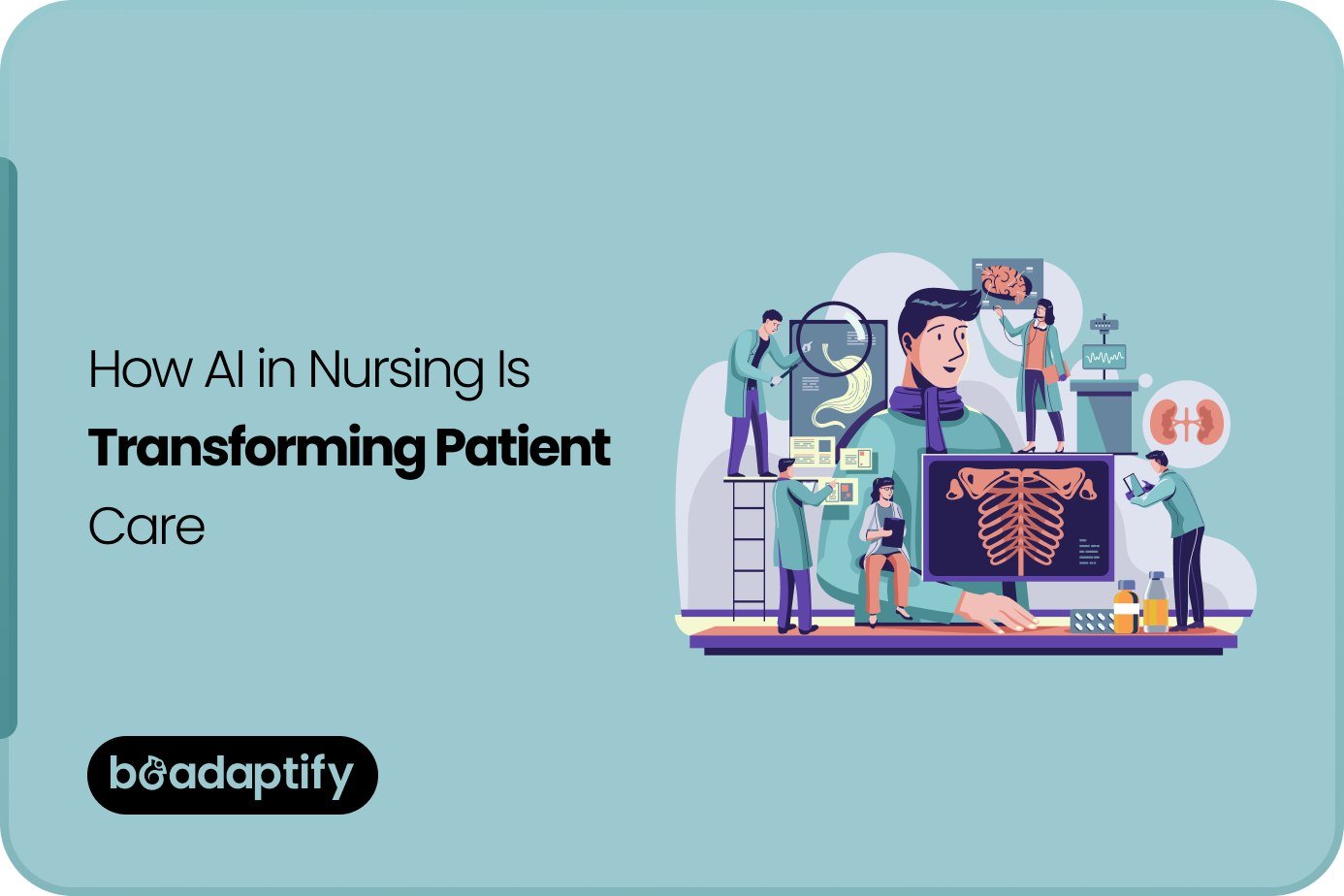
Artificial intelligence is no longer being discussed as a distant healthcare innovation. In 2026, it is being integrated into real clinical workflows, operational systems, documentation processes, monitoring tools, and decision-support environments across the care continuum. In nursing and patient care, this shift is becoming especially important because frontline care teams are being asked to do more under greater pressure. Rising patient complexity, staffing strain, documentation burden, care coordination challenges, and increasing expectations around quality and safety are all pushing healthcare organizations to look for better digital support.
AI is being adopted in this environment not to replace nursing judgment, empathy, or patient relationships, but to strengthen the systems around them. When used well, AI can help surface risks sooner, reduce repetitive administrative work, improve visibility into patient status, support more timely interventions, and give nurses more usable information at the point of care. It can also help health systems improve staffing decisions, streamline communication, identify care gaps, and personalize support for patients beyond the bedside.
This matters because nursing sits at the center of patient care. Nurses are often the clinicians who notice early deterioration, coordinate across disciplines, educate patients, respond to changes in condition, and carry much of the real-time operational workload of care delivery. If AI is improving care, it is often doing so by improving the information, timing, and workflow conditions in which nurses work. That is one of the biggest reasons AI is revolutionizing nursing and patient care rather than simply digitizing it.
At the same time, AI in healthcare is not being embraced without caution. Questions around bias, explainability, accountability, privacy, safety, workflow burden, and overreliance are becoming more visible. In nursing, these questions matter deeply because trust, ethics, and patient advocacy are foundational to practice. This means AI adoption in nursing must be approached thoughtfully. Technology should be designed to support care, not distort it. Nurses should be involved in implementation, not positioned as passive end users of systems designed without clinical context.
This article explores how AI is transforming nursing and patient care in 2026, where its biggest impact is being seen, which opportunities are emerging, what risks still require attention, and why thoughtful product development now matters more than ever.
Why AI Matters So Much in Nursing Right Now
AI matters so much in nursing because the nursing environment is one of the most information-heavy and time-sensitive areas in healthcare. Patient care depends on constant observation, rapid communication, careful prioritization, and accurate documentation. Much of this work is cognitively demanding even before staffing challenges, care transitions, and administrative load are added.
In many healthcare settings, nurses are expected to manage large volumes of charting, medication administration, patient education, escalation protocols, discharge coordination, interdisciplinary communication, and emotional support at the same time. This creates a setting where even small reductions in unnecessary workload or small improvements in decision support can have meaningful impact.
AI is being adopted in this context because it can help process patterns faster than manual review alone. It can identify concerning trends in vital signs, summarize relevant information, support workload planning, automate parts of documentation, and improve the timing of alerts or next-step recommendations. When applied responsibly, this can create more space for human care rather than less.
AI also matters because patient care is becoming more continuous and more data-rich. Remote monitoring, connected devices, digital health tools, EHR integration, and predictive analytics are creating more clinical signals than clinicians can always review efficiently without support. AI is increasingly being used to turn large volumes of data into prioritized, actionable insight.
How AI Is Reducing Documentation Burden
One of the most visible areas of change is documentation. Documentation remains essential for clinical communication, safety, compliance, and continuity of care, but the burden associated with it has long been a major source of frustration across healthcare. In nursing, this burden can reduce time available for direct patient interaction and increase cognitive fatigue during already demanding shifts.
AI is being used to improve this area in several ways. Clinical note summarization, structured chart assistance, voice-enabled data capture, ambient documentation support, and automated extraction of relevant clinical details are all being explored or implemented to reduce manual entry. Instead of requiring every detail to be typed or clicked through repetitive interfaces, AI-supported systems can help generate draft documentation, suggest structured fields, or summarize patient changes for review.
This does not mean documentation is being handed over entirely to AI. Final responsibility still belongs to clinicians, and nurse review remains essential. However, the amount of repetitive work can be reduced significantly when the system is designed well. The goal is not to remove documentation, but to reduce unnecessary friction around it.
When documentation burden is lowered, several downstream benefits may also be created. More time can be returned to patient interaction. Shift transitions can become clearer. Important changes in patient status may be easier to identify. Burnout related to administrative overload may also be reduced over time.
How AI Is Supporting Clinical Decision-Making
AI is also changing how clinical information is surfaced to nurses at the point of care. Nursing decisions are often made under time pressure and are shaped by rapidly changing information. In these conditions, delayed recognition of deterioration, overlooked trends, or information overload can create risk.
AI-supported decision systems can help by identifying patterns across vital signs, lab values, medication data, intake and output, mobility changes, pain patterns, and prior clinical history. These systems may generate risk scores, highlight unusual trends, or surface patients who may require closer attention.
This kind of support is especially valuable in situations where deterioration may not be obvious in one isolated data point, but becomes more visible across multiple signals over time. For example, subtle changes in respiratory rate, oxygen demand, or mental status may become more actionable when pattern recognition is applied to the full data picture.
Again, this is not the same as replacing clinical judgment. AI is not becoming the nurse. Rather, it is being used as a tool that helps organize and prioritize attention. Nurses still interpret the situation, validate relevance, and decide what action should be taken. The value lies in helping the right information become visible earlier.
How AI Is Improving Early Detection and Patient Monitoring
Patient monitoring is another area where AI is creating major change. In many hospitals and care settings, deterioration is not missed because staff do not care. It is missed because warning signs may be subtle, data may be fragmented, and clinicians may be responsible for many patients at once.
AI-supported monitoring tools are being designed to identify these early risk patterns sooner. Changes in vitals, cardiac rhythms, oxygenation trends, mobility, sleep, fall risk, and symptom patterns can be analyzed in more continuous ways than traditional manual review allows. This can help support earlier escalation and more proactive intervention.
Remote patient monitoring is also expanding this impact beyond inpatient settings. Patients with chronic disease, post-surgical needs, heart failure, diabetes, pulmonary conditions, or high-risk recovery needs can increasingly be monitored through connected devices and digital workflows. AI can assist by flagging abnormal trends, prioritizing outreach, or identifying patients who may need clinician review before a crisis develops.
For nursing, this creates a major opportunity. Instead of reacting only when a visible event occurs, teams can increasingly work with systems that help identify which patients may need attention sooner and why.
How AI Is Supporting Staffing and Workforce Planning
AI is not only influencing bedside workflows. It is also being used to support staffing decisions, workload forecasting, and patient-flow planning. In nursing, staffing quality is strongly connected to patient outcomes, safety, efficiency, and workforce wellbeing. However, scheduling and assignment decisions are often difficult because demand changes, acuity shifts, and staffing shortages create constant variability.
AI-assisted staffing systems can help analyze historical census patterns, peak demand times, acuity mix, documentation trends, discharge timing, and patient flow signals to support better planning. Schedule optimization can also be improved when shift demand, staff skill mix, and patient complexity are reviewed together instead of being managed through static templates alone.
This does not mean staffing becomes a purely algorithmic function. Human oversight remains essential, particularly because fairness, flexibility, unit culture, and contextual judgment all matter. But AI can help identify patterns and support staffing decisions with stronger operational visibility.
When staffing is aligned more intelligently, nursing workload may become more balanced, patient flow may improve, and avoidable bottlenecks may be reduced.
How AI Is Personalizing Patient Education and Engagement
Patient care is not only about treatment. It also depends on understanding, engagement, adherence, follow-up, and confidence. Nurses play a major role in patient education, discharge preparation, and ongoing care communication. AI is beginning to support this work by helping personalize how information is delivered.
Educational content can now be tailored more effectively to language, literacy level, diagnosis, recovery stage, medication needs, and likely questions. Digital assistants, triage chat systems, discharge support tools, and mobile care pathways can help reinforce guidance after the clinical encounter. In some settings, follow-up questions can be answered more consistently through AI-supported tools, reducing confusion and improving continuity.
This is particularly useful for chronic disease management, discharge education, post-operative instructions, maternal care, medication adherence, and home recovery support. Patients often forget large portions of what they are told in stressful care moments. AI-supported engagement tools can help repeat, personalize, and reinforce education in more accessible ways.
For nursing, that means educational work can be extended beyond the bedside through better-designed digital systems rather than being limited to one short interaction.
How AI Is Helping with Administrative Coordination
A large amount of nursing-related effort is consumed not only by bedside tasks but also by coordination work. Orders must be followed up. Consultations must be tracked. Handoffs must be clarified. Discharges must be coordinated. Supplies, support services, case managers, and interdisciplinary teams must often be aligned across many moving parts.
AI can help here by improving workflow orchestration. Task prioritization, communication summaries, discharge readiness support, appointment coordination, and care-gap identification can all be made more efficient when data and workflow patterns are analyzed together. In many settings, this can reduce missed follow-ups and improve continuity.
This kind of administrative support may not look dramatic compared with more visible AI use cases, but it can create meaningful time savings and reduce process breakdowns that affect both nurses and patients.
How AI Is Expanding Through Medical Devices and Digital Tools
AI in nursing and patient care is not limited to software dashboards alone. It is also expanding through medical devices, digital monitoring tools, imaging support, smart alerts, and connected care platforms. As more AI-enabled medical devices and digital health tools become part of routine care, nursing teams are increasingly interacting with AI not as a separate concept, but as a practical component of clinical infrastructure.
This trend is likely to continue because device-level AI can support pattern recognition, workflow prioritization, patient monitoring, and more responsive care delivery. However, it also reinforces the need for nurse involvement in implementation and governance. If these systems are not usable, explainable, and clinically relevant, they can create new burdens rather than new value.
Risks and Challenges That Must Still Be Managed
AI is not automatically beneficial just because it is advanced. In nursing and patient care, several risks still need to be managed carefully.
Bias and Inequity
If AI systems are trained on incomplete, unrepresentative, or biased data, the outputs may reinforce disparities rather than reduce them. This can affect triage, prioritization, documentation language, risk scoring, and access-related decisions.
Overreliance
If clinicians are encouraged to trust AI outputs without sufficient review, poor recommendations may go unchallenged. Nursing care depends on critical thinking, situational awareness, and patient-specific judgment. These cannot be replaced by automation.
Poor Workflow Fit
A technically sophisticated system may still fail if it does not fit real nursing workflows. Excessive alerts, weak interface design, poor timing, and confusing outputs can all increase burden rather than reduce it.
Privacy and Data Governance
AI systems often require access to large volumes of sensitive patient and operational data. Strong governance, secure infrastructure, and clear accountability are essential.
Explainability and Trust
If nurses cannot understand why a system is making a recommendation, it becomes harder to trust and harder to use responsibly. Clinical teams need tools that support action, not black-box confusion.
These concerns make one point very clear: AI success in healthcare depends not only on algorithms, but also on implementation quality, ethical oversight, and frontline usability.
Why Nurse Involvement Is Essential
Nurses must be involved in AI implementation because they understand the realities of patient care in ways that product teams, administrators, and data scientists may not. If nursing workflows are not represented during design and rollout, AI systems may optimize for the wrong outcomes.
Nurse involvement is important in:
- identifying real workflow pain points
- validating usability
- evaluating alert burden
- defining safe escalation logic
- shaping documentation support
- reviewing ethical concerns
- improving patient communication design
Nurses are not simply users of these systems. They are key stakeholders in determining whether the systems are clinically useful, ethically acceptable, and operationally realistic.
The Role of Product Design and Software Development
As AI becomes more deeply embedded into nursing and patient care, the quality of product design is becoming increasingly important. A useful model is not enough if the software around it is poorly designed. If insights are hard to find, if alerts are mistimed, if the interface is confusing, or if the workflow interrupts care rather than supporting it, adoption will suffer.
This is why healthcare organizations are increasingly turning to a skilled software product development company that understand the need for strong design & development services in clinical environments. Mobile access also matters because many care workflows are increasingly distributed, which is why well-structured mobile app development solutions are becoming more relevant in nursing support tools, remote monitoring products, patient engagement platforms, and care coordination systems.
The product layer is where AI becomes usable. It is where trust is built, workflow fit is tested, and value is either realized or lost.
What the Future Looks Like
AI in nursing and patient care is likely to become more embedded, more ambient, and more workflow-aware over the next several years. Instead of existing as a separate feature, it will increasingly be woven into documentation, monitoring, communication, staffing, education, and operational systems.
The most successful systems will likely be those that:
- reduce friction without reducing judgment
- improve visibility without overwhelming users
- support equity rather than deepen bias
- extend care quality rather than distance clinicians from patients
- fit into workflow instead of disrupting it
In that future, nursing will not be made less important by AI. It will likely become even more central, because the quality of care will increasingly depend on how well technology is integrated into the human realities of patient support.
Why Choose Beadaptify for Healthcare AI Product Development?
Building AI-powered healthcare software requires more than technical development. It requires a clear understanding of clinical workflows, patient care priorities, data sensitivity, usability, and long-term scalability. At Beadaptify, digital healthcare solutions are developed with a strong focus on practical value, thoughtful user experience, and real-world adoption. As a trusted software product development company, we help healthcare organizations build AI-enabled tools that support nursing workflows, patient monitoring, communication, and operational efficiency.
Our software development services are designed to support strategy, product planning, architecture, interface design, development, testing, and post-launch refinement. Through strong design & development services and scalable mobile app development services, we ensure that healthcare products are not only technically strong but also intuitive, secure, and aligned with better patient and clinician experiences.

Final Thoughts
AI is revolutionizing nursing and patient care not because it can replace clinicians, but because it can improve the systems around clinical work. Documentation can be made lighter. Monitoring can become more proactive. staffing can be supported more intelligently. Patient education can become more personalized. Operational coordination can become more efficient. Early warning signals can become easier to see.
At the same time, the promise of AI will only be realized if safety, ethics, usability, and nurse leadership remain central. Healthcare does not need more technology for its own sake. It needs better tools that make care more timely, humane, equitable, and sustainable. That is why thoughtful implementation matters. With the support of a capable & high-quality software product development services, practical design & development services, and well-planned mobile application development services, AI can be shaped into tools that truly support nurses and improve patient care in 2026 and beyond.
FAQs About AI in Healthcare
How is AI being used in nursing and patient care?
AI is being used in nursing and patient care to support documentation, patient monitoring, staffing decisions, workflow coordination, personalized education, and clinical decision-making.
Can AI replace nurses in healthcare?
No. AI is not designed to replace nurses. It is being used to support nursing workflows, reduce repetitive tasks, improve visibility into patient data, and help teams make more informed decisions.
What are the main benefits of AI in nursing?
The main benefits include reduced documentation burden, earlier detection of patient risks, improved monitoring, better care coordination, stronger patient engagement, and more efficient staffing support.
What are the risks of AI in patient care?
The main risks include bias, poor workflow fit, overreliance on automation, privacy concerns, and lack of explainability if systems are not designed and implemented carefully.
Why is nurse involvement important in AI implementation?
Nurse involvement is important because nurses understand real clinical workflows, patient needs, and care challenges. Their input helps ensure that AI tools are useful, safe, and aligned with actual nursing practice.
How does AI improve patient monitoring?
AI can improve patient monitoring by analyzing patterns in patient data, identifying early warning signs, flagging risks sooner, and supporting more proactive intervention.