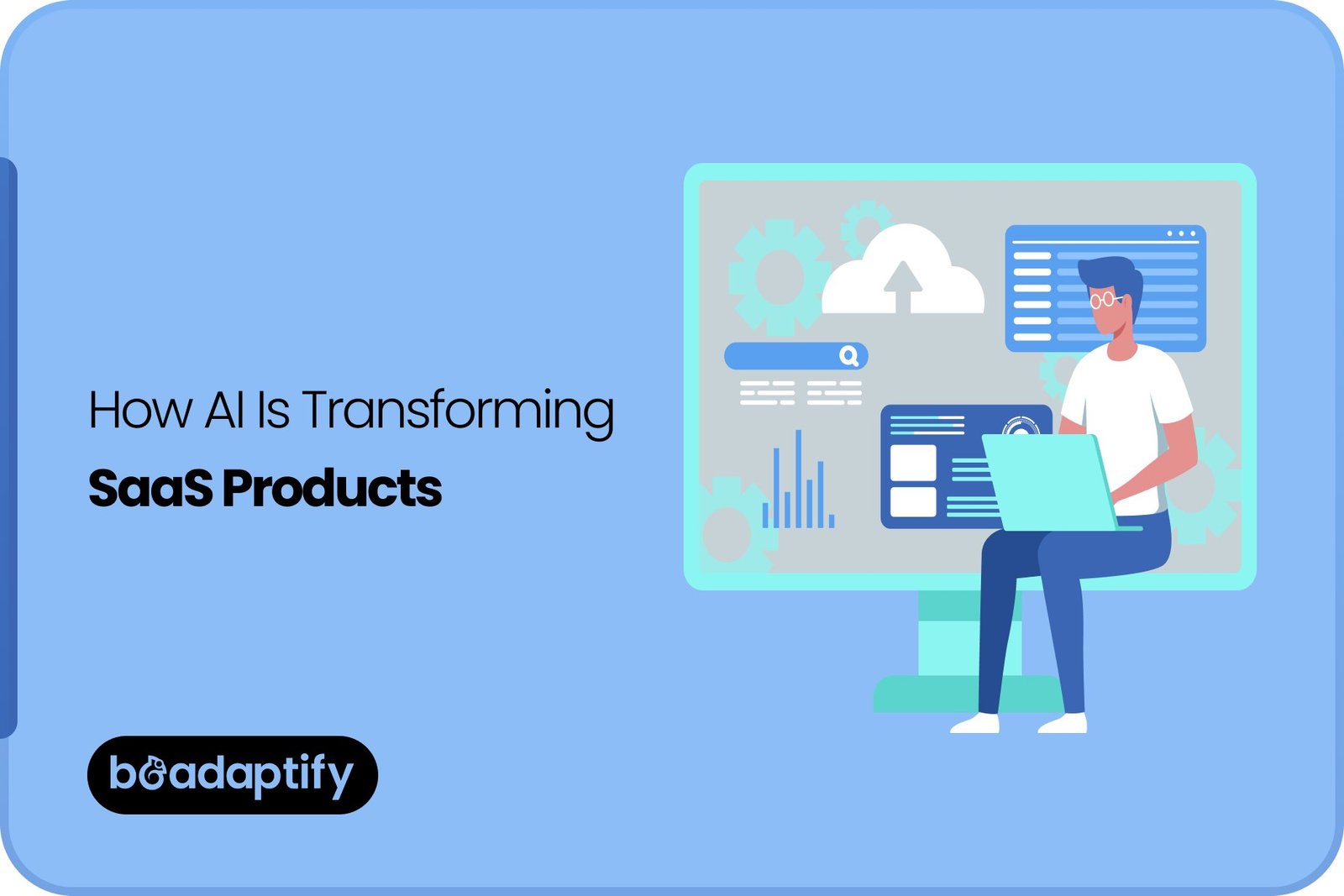
Artificial Intelligence (AI) has been steadily reshaping industries over the past decade, but its impact on Software as a Service (SaaS) development and product innovation has been particularly transformative. Across startups and enterprise environments alike, AI is being embedded into every layer of the SaaS lifecycle from ideation and architecture to deployment, optimization, and long-term product evolution.
In modern digital ecosystems, expectations for speed, personalization, scalability, and predictive capabilities are continuously being elevated. As a result, traditional development models are being restructured, workflows are being automated, and new innovation frameworks are being adopted. It is increasingly being observed that AI is not simply enhancing SaaS platforms, it is redefining how they are conceptualized, built, delivered, and evolved.
This article explores how AI is transforming SaaS development and product innovation at every stage, while highlighting the growing role of the modern Software development company in navigating this technological shift.
The Evolution of SaaS in the Age of AI
SaaS platforms were initially built around central principles such as accessibility, cloud-based infrastructure, subscription models, and remote scalability. However, as user expectations have evolved, static platforms are being replaced by intelligent systems that can learn, adapt, and optimize performance autonomously.
AI capabilities are now being integrated directly into SaaS architectures. Data is being analyzed in real time. User behavior is being modeled predictively. Interfaces are being dynamically adjusted. Decisions are being supported or even automated by machine learning algorithms.
As a result, SaaS products are no longer being treated as fixed digital tools. They are being engineered as adaptive ecosystems.
A Software development company operating in this environment is expected to combine traditional engineering expertise with AI architecture planning, data engineering, and model deployment strategies. Software development services are no longer limited to coding and infrastructure; they are being expanded to include AI integration, training pipelines, and continuous learning frameworks.
AI-Driven Product Ideation and Market Validation
In earlier development cycles, product ideation was largely guided by market research, surveys, interviews, and competitor analysis. While these approaches are still being used, AI-driven analytics platforms are now being leveraged to extract deeper insights from large-scale datasets.
Consumer sentiment is being analyzed using natural language processing (NLP). Emerging trends are being identified through predictive modeling. Market gaps are being uncovered by analyzing usage patterns across industries. Instead of relying solely on intuition or limited data samples, product strategies are being shaped by real-time intelligence. Demand forecasting models are being trained to simulate adoption curves. Pricing strategies are being optimized through algorithmic analysis. Feature prioritization is being guided by AI-powered usage data.
Within a forward-thinking Software development company, AI-based validation tools are being integrated into early discovery phases. This ensures that SaaS products are not only technically feasible but also strategically aligned with evolving market dynamics.
Intelligent Software Architecture and Development
AI is significantly influencing how SaaS architectures are designed and implemented.
1. Automated Code Generation
AI-powered development assistants are being utilized to accelerate coding processes. Boilerplate code is being generated automatically. Bugs are being identified in real time. Security vulnerabilities are being flagged before deployment.
While human expertise remains critical, development efficiency is being increased through AI-assisted coding environments. This allows software development services to be delivered faster without compromising quality.
2. Predictive System Design
System scalability is being forecasted using AI simulations. Infrastructure loads are being predicted based on user growth patterns. Cloud resource allocation is being optimized automatically.
Rather than reacting to performance bottlenecks, intelligent systems are being configured to anticipate them. SaaS products are therefore being designed with predictive resilience.
3. AI-Enhanced DevOps
Continuous integration and deployment pipelines are being improved through machine learning. Deployment risks are being assessed automatically. Anomalies are being detected before outages occur.
By integrating AI into DevOps workflows, product reliability is being significantly enhanced. A Software development company that embraces AI-driven DevOps is able to provide higher uptime guarantees and performance stability.
Personalization at Scale
One of the most visible transformations brought by AI in SaaS is personalization. Traditional SaaS platforms offered standardized user experiences. Today, interfaces are being customized dynamically based on behavioral data.
User journeys are being mapped through machine learning models. Content recommendations are being generated algorithmically. Dashboards are being reorganized based on usage patterns. Notifications are being optimized for engagement timing.
In sectors such as fintech, healthcare, education, and eCommerce, AI-driven personalization is becoming a competitive necessity.
A mobile app development company, for instance, is increasingly expected to embed recommendation engines and adaptive user flows into mobile SaaS applications. Mobile app development services are no longer limited to front-end interface creation; they are being extended to include AI-based personalization frameworks.
Data as the Core of AI-Powered SaaS
AI transformation is fundamentally driven by data. Without robust data infrastructure, intelligent SaaS systems cannot function effectively.
1. Data Engineering Integration
Data pipelines are being designed to capture, clean, and process structured and unstructured data in real time. Event tracking mechanisms are being embedded across platforms. Data warehouses are being optimized for machine learning workloads. Software development services now frequently include data architecture planning as a core component.
2. Predictive Analytics
Customer churn is being predicted before it occurs. Revenue forecasts are being generated using historical and behavioral datasets. Support tickets are being categorized and resolved through AI-based classification models. Instead of being reactive, SaaS products are becoming proactive.
3. AI-Driven Business Intelligence
Dashboards are being enhanced with predictive insights. Automated reporting systems are being created. Decision-making is being augmented with scenario modeling. Product teams are being empowered with deeper insights, leading to more informed innovation cycles.
AI in UX and Design Innovation
Design processes are also being reshaped by AI technologies. User interface prototypes are being generated using AI-driven design systems. A/B testing is being automated and optimized through real-time analytics. Heatmaps are being analyzed to refine interaction flows.
In advanced design & development services, AI tools are being used to simulate user behavior before a product is launched. Conversion optimization strategies are being tested algorithmically. By combining AI with human-centered design, SaaS platforms are being made more intuitive, accessible, and engaging.
Intelligent Customer Support and Automation
Customer support systems are being transformed through AI-powered chatbots, virtual assistants, and automated ticket routing systems. Instead of manual triaging, customer inquiries are being categorized and resolved through machine learning models. Sentiment analysis is being applied to detect frustration or urgency. Support documentation is being generated dynamically.
For a mobile app development company building SaaS platforms, integrating conversational AI is increasingly seen as a competitive differentiator. Support teams are being augmented not replaced by AI. Efficiency is being increased while maintaining personalized experiences.
Security and Compliance Through AI
Security challenges in SaaS environments are becoming more complex. AI is being deployed to address these risks. Threat detection systems are being trained to recognize unusual behavioral patterns. Fraud detection algorithms are being refined continuously. Access management is being automated based on contextual risk assessment.
Compliance monitoring is also being enhanced. Regulatory requirements are being tracked automatically. Audit logs are being analyzed through anomaly detection systems. A Software development company providing enterprise-grade Software development services is increasingly expected to integrate AI-driven security frameworks into SaaS solutions.
AI-Powered Product Innovation Cycles
Innovation cycles are being accelerated significantly through AI integration. Feature usage data is being analyzed continuously. Feedback loops are being shortened. Product improvements are being deployed more frequently. AI-based experimentation platforms are enabling controlled feature rollouts. Performance metrics are being evaluated in real time. Iteration cycles are being compressed from months to weeks or even days. Product innovation is no longer episodic; it is continuous.
The Role of AI in Mobile SaaS Transformation
Mobile-first SaaS strategies are being strengthened through AI capabilities. Voice recognition is being integrated into mobile interfaces. Biometric authentication is being enhanced through AI security layers. Offline usage patterns are being analyzed to optimize performance.
A mobile app development company delivering modern mobile app development services is now expected to incorporate AI into mobile SaaS ecosystems seamlessly. Mobile SaaS platforms are being transformed into intelligent assistants rather than static tools.
AI and Hyperautomation in SaaS Operations
Hyperautomation, the automation of complex business processes through AI is becoming central to SaaS transformation. Workflow automation is being expanded through AI decision engines. Document processing is being automated using computer vision. Workflow bottlenecks are being identified through predictive analytics.
Operational efficiency is being maximized. By offering advanced design & development services integrated with AI-based automation, organizations are being empowered to streamline operations and reduce manual overhead.
Challenges in AI-Driven SaaS Development
While AI offers immense benefits, several challenges are being encountered.
- Data Privacy Concerns – Sensitive user data must be handled responsibly.
- Model Bias Risks – Algorithms must be trained carefully to avoid unintended biases.
- Infrastructure Complexity – AI workloads demand scalable cloud resources.
- Talent Gaps – Skilled AI engineers are required to implement advanced solutions.
Why Beadaptify Is the Right Partner for AI-Driven SaaS Growth?
In a market where SaaS platforms are being expected to evolve faster than ever, choosing the right technology partner has become a strategic decision rather than a tactical one. At Beadaptify, digital products are not simply developed, they are architected for intelligent scalability, performance resilience, and long-term innovation.
As a forward-thinking Software development company, solutions are engineered with an AI-first mindset. Instead of treating artificial intelligence as an afterthought, AI capabilities are embedded directly into the foundation of each product. Scalable cloud-native architectures are designed, data pipelines are structured for predictive analytics, and intelligent automation is integrated across workflows to ensure SaaS platforms remain adaptive and future-ready.
Advanced design & development services are also provided to ensure that functionality is aligned with user experience. Interfaces are crafted with clarity, usability, and engagement in mind. By combining engineering precision with thoughtful design strategy, SaaS platforms are positioned to convert, retain, and scale effectively.
The Future of AI in SaaS
AI adoption in SaaS is expected to deepen further. Autonomous SaaS platforms may soon be developed systems that self-optimize, self-heal, and self-scale without manual intervention.
Generative AI is likely to play a larger role in content-driven SaaS applications. Edge AI may enhance mobile SaaS performance. AI governance frameworks may become standardized across industries. Software development services will continue evolving toward AI-native engineering models. In this environment, a mobile app development company and broader Software development company ecosystem must continuously adapt to emerging AI paradigms.
Conclusion
AI is not merely being layered onto SaaS platforms, it is fundamentally redefining how SaaS development and product innovation are approached. From intelligent ideation and automated development to predictive analytics and hyper-personalization, AI is being embedded into every stage of the SaaS lifecycle. Efficiency is being increased. User experiences are being enhanced. Innovation cycles are being accelerated.
Organizations seeking competitive advantage must collaborate with a forward-looking Software development company capable of delivering comprehensive Software development services, advanced design & development services, and intelligent mobile app development services.
As AI continues to mature, SaaS platforms will become more adaptive, predictive, and autonomous. Product innovation will no longer be driven solely by human intuition it will be supported, enhanced, and accelerated by intelligent systems. The transformation is already underway. And in the evolving SaaS landscape, AI-driven development is no longer optional, it is foundational.

FAQs About AI changing SaaS
How is AI changing SaaS product development?
AI is being integrated into SaaS platforms to automate processes, enhance personalization, improve predictive analytics, and optimize system performance. Development cycles are being shortened, user behavior is being analyzed in real time, and innovation is being driven by data-backed insights rather than assumptions.
Why should a Software development company adopt AI in SaaS projects?
A modern Software development company is expected to deliver scalable, intelligent, and secure platforms. By adopting AI, development accuracy is being improved, security vulnerabilities are being detected early, and user experiences are being personalized at scale. AI adoption also allows Software development services to remain competitive in a rapidly evolving digital ecosystem.
What role does AI play in mobile SaaS applications?
AI is being embedded into mobile SaaS products to enable voice recognition, predictive recommendations, biometric authentication, and intelligent notifications. A mobile app development company that integrates AI into mobile app development services is able to deliver smarter, more adaptive applications.
Can AI improve SaaS security and compliance?
Yes. AI-driven threat detection systems are being deployed to identify unusual patterns and prevent cyberattacks. Compliance monitoring is being automated, and fraud detection systems are being enhanced through machine learning algorithms.
How does AI impact design & development services?
AI is being used to analyze user interaction data, automate A/B testing, optimize UI/UX flows, and predict conversion patterns. Advanced design & development services are now integrating AI tools to improve usability and enhance digital product performance.
Is AI integration expensive for SaaS startups?
While AI integration requires initial investment in infrastructure and data systems, long-term operational costs are often reduced through automation and predictive efficiency. SaaS startups are increasingly partnering with specialized Software development services providers to implement scalable AI solutions strategically.
What industries benefit most from AI-powered SaaS?
Industries such as healthcare, fintech, education, eCommerce, logistics, and enterprise operations are experiencing significant transformation through AI-enabled SaaS platforms.