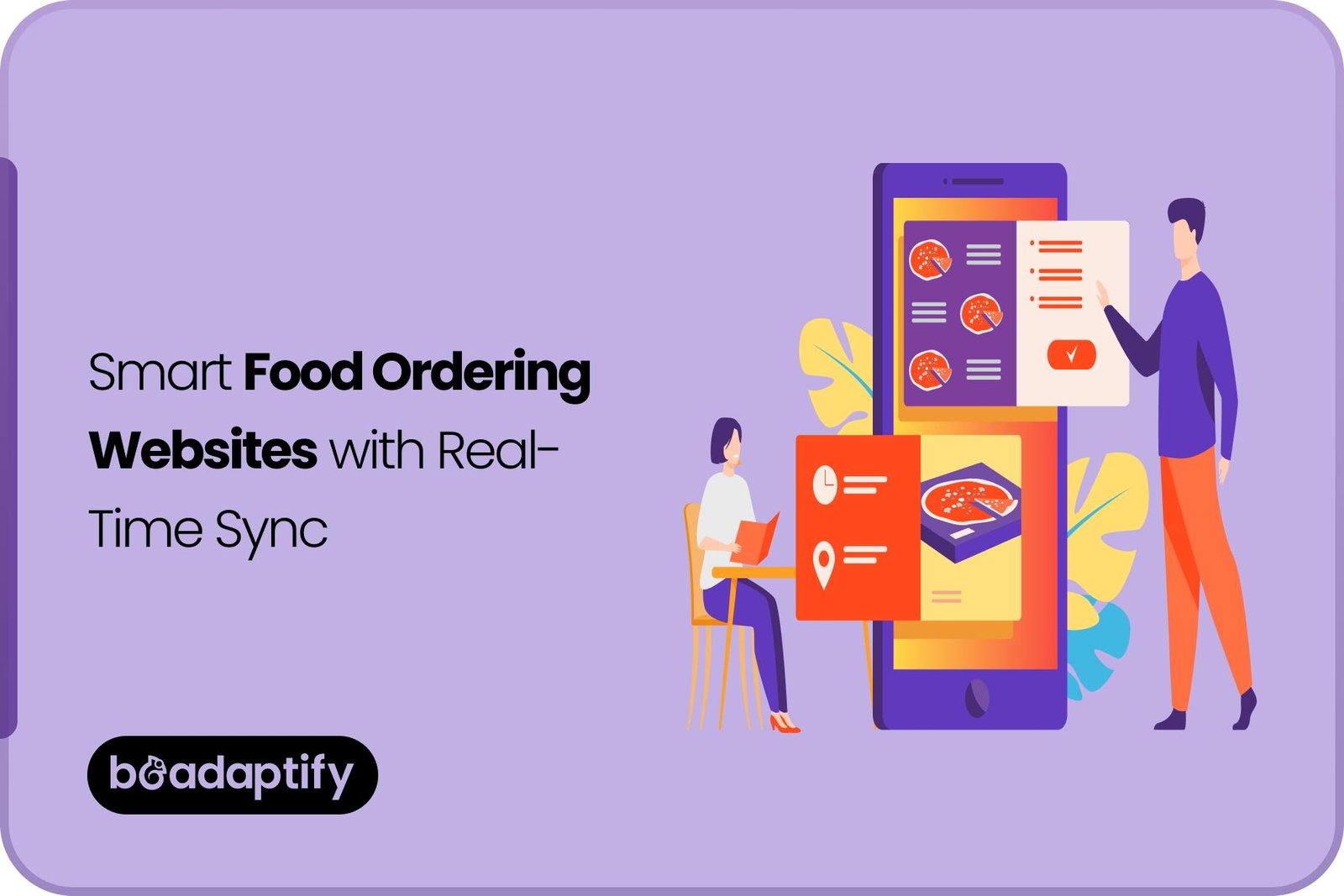
The food and beverage industry has been reshaped by digital convenience. Customers now expect accurate menus, instant availability updates, and seamless ordering experiences across devices. As a result, generic ordering platforms are increasingly being replaced by custom food ordering application with real-time inventory synchronization.
When inventory is not synced accurately, customers encounter out-of-stock items after checkout, staff face operational confusion, and businesses lose trust. To prevent these issues, real-time inventory sync is being adopted as a core feature in modern food ordering systems.
In this guide, the complete process of building a custom food ordering website with real-time inventory sync is explored covering architecture, features, challenges, costs, and best practices.
Why Custom Food Ordering Application Are Being Prioritized
Third-party food ordering platforms often come with high commissions, limited customization, and restricted control over customer data. Because of these limitations, many restaurants and food brands are choosing custom-built platforms.
By developing a proprietary ordering system, the following advantages are achieved:
- Full ownership of customer data
- Better brand consistency and UI control
- Seamless integration with internal systems
- Accurate inventory management
- Reduced dependency on aggregators
What Is Real-Time Inventory Sync in Food Ordering Systems?
Real-time inventory sync refers to the automatic updating of ingredient or item availability across all customer-facing and staff-facing systems the moment a change occurs.
When an item is ordered:
- Stock levels are updated instantly
- Availability is reflected on the website or app
- Kitchen and staff dashboards are notified
- Reordering logic can be triggered automatically
This synchronization is typically handled through APIs, background services, or event-driven architectures.
Without real-time sync, inventory discrepancies are introduced leading to canceled orders, refunds, and poor customer experience.
Core Components of a Custom Food Ordering Website
To support real-time inventory sync, several interconnected components must be designed carefully.
1. Customer-Facing Website or App
This layer handles:
- Menu browsing
- Customizations (add-ons, sizes, preferences)
- Cart and checkout
- Order tracking
Responsive web interfaces or companion mobile apps are often built using modern frontend frameworks and supported by application development services.
2. Inventory Management System
The inventory system acts as the source of truth. It tracks:
- Raw ingredients
- Prepared items
- Daily stock limits
- Supplier restocking thresholds
Inventory is usually managed through an admin dashboard and connected to both the kitchen and ordering interfaces.
3. Backend Services & APIs
The backend is responsible for:
- Order processing
- Inventory deduction logic
- Real-time notifications
- Payment processing
- Role-based access
This layer is commonly developed by teams providing mobile app development services or enterprise-grade backend solutions.
4. Database Architecture
A reliable database structure is required to ensure fast reads and writes. Common approaches include:
- Relational databases for orders and transactions
- NoSQL databases for real-time inventory updates
- Caching layers for performance
Concurrency handling is critical to avoid race conditions during peak ordering hours.
How Real-Time Inventory Sync Works (Step-by-Step)
A typical real-time sync flow is outlined below:
- A customer places an order
- The backend validates item availability
- Inventory quantities are reduced instantly
- Updated availability is pushed to all active sessions
- Kitchen and staff dashboards receive updates
- Reorder thresholds are evaluated automatically
This process is handled in milliseconds when implemented correctly.
Key Features Required for Real-Time Inventory Food Platforms
To ensure accuracy and scalability, the following features are typically included:
Live Menu Availability
Menu items are shown or hidden automatically based on stock levels.
Ingredient-Level Tracking
Instead of tracking only finished items, ingredients are tracked to prevent partial stock failures.
Automatic Stock Alerts
Notifications are sent when items fall below predefined thresholds.
Multi-Outlet Inventory Sync
For franchises or cloud kitchens, inventory is synced across locations with centralized control.
Order Throttling
When kitchen capacity is exceeded, ordering is paused automatically.
Custom Platform vs Third-Party Food Apps
Feature |
Third-Party Platforms |
Custom Food Ordering Website |
|---|---|---|
| Inventory Accuracy | Limited | Real-time sync |
| Branding Control | Minimal | Full control |
| Commission Fees | High | None |
| Custom Features | Restricted | Fully customizable |
| Data Ownership | Platform-owned | Business-owned |
| Scalability | Platform-dependent | Business-driven |
Technology Stack Commonly Used
Although stacks may vary, the following technologies are frequently selected:
- Frontend: React, Vue, or Next.js
- Backend: Node.js, Laravel, Django
- Databases: PostgreSQL, MongoDB, Redis
- Real-Time Layer: WebSockets, Firebase, Pub/Sub
- Payments: Stripe, Razorpay, PayPal
Selection is influenced by scalability requirements and integration needs.
Custom Food Ordering Website Development Process
1. Discovery & Requirement Analysis
Business workflows, menu structure, inventory logic, and integrations are analyzed to define a scalable system architecture.
2. UX/UI Design & Prototyping
User journeys for customers, staff, and admins are designed to ensure simplicity, speed, and clarity.
3. Backend Development & Inventory Logic
Real-time inventory engines, APIs, and order-processing workflows are developed with concurrency handling.
4. Frontend & Mobile App Development
Customer-facing application and apps are built using responsive frameworks and modern mobile app development services.
5. Testing, Deployment & Optimization
The platform is tested for performance, accuracy, and security before launch, followed by continuous optimization.
Challenges in Implementing Real-Time Inventory Sync
Despite its benefits, several challenges are commonly encountered:
High Concurrency Handling
During peak hours, multiple orders may target the same items simultaneously. Locking mechanisms or atomic transactions must be used.
Network Reliability
Offline handling and retry logic must be implemented for unstable environments.
Data Consistency Across Channels
Inventory must remain consistent across web, mobile, POS, and admin dashboards.
Performance Optimization
Excessive database writes can slow systems if not optimized.
These challenges are typically addressed by experienced food delivery app development services providers.
Role of POS and Kitchen Display Integrations
Real-time inventory sync becomes significantly more powerful when integrated with:
- POS systems
- Kitchen Display Systems (KDS)
- Supplier management tools
Orders placed online are routed directly to the kitchen, and inventory updates are reflected without manual intervention.
Security and Compliance Considerations
To protect business and customer data, the following practices are applied:
- Secure API authentication
- Role-based access control
- Encrypted payment processing
- Regular security audits
These measures are standard in professional software development services.
Cost of Building a Custom Food Ordering Website
The cost varies based on complexity, features, and scale.
Typical Cost Factors
- UI/UX design complexity
- Real-time infrastructure
- Third-party integrations
- Number of outlets
- Mobile app inclusion
Estimated Cost Range
- Basic system: $15,000 – $25,000
- Advanced real-time system: $30,000 – $60,000+
Costs are often reduced long-term by eliminating aggregator commissions.
Why Custom Development Outperforms Ready-Made Solutions
Custom platforms provide:
- Tailored workflows
- Better performance
- Full data ownership
- Easier scalability
Best Practices for Long-Term Success
To ensure longevity and scalability, the following best practices are recommended:
- Modular backend architecture
- Real-time monitoring dashboards
- Automated testing pipelines
- Scalable cloud infrastructure
- Continuous performance optimization
Why Choose Beadaptify for Food Ordering Platform Development?
Beadaptify specializes in building custom food ordering platforms that prioritize accuracy, performance, and operational efficiency. Instead of relying on generic templates, systems are engineered to match real-world kitchen workflows and business logic.
With expertise across food delivery app development services, Beadaptify delivers platforms that integrate seamlessly with POS systems, inventory tools, and payment gateways. Every solution is designed to scale with growing order volumes, multiple locations, and evolving customer expectations making Beadaptify a trusted partner for modern food businesses.
Final Thoughts
Building a custom food ordering website with real-time inventory sync is no longer optional for food businesses aiming to scale efficiently. When implemented correctly, it eliminates operational friction, improves customer satisfaction, and strengthens brand independence.
By leveraging professional mobile application development services and robust backend architecture, a future-ready food ordering platform can be delivered, one that adapts to demand, minimizes errors, and supports sustainable growth.
FAQs About Custom Food Ordering Website
What is real-time inventory sync in food ordering systems?
Real-time inventory sync ensures that menu availability updates instantly whenever an order is placed, stock is modified, or ingredients run low preventing overselling and order cancellations.
Can real-time inventory sync work across multiple outlets?
Yes. Custom platforms are designed to support multi-location inventory management with centralized control and outlet-level visibility.
Is real-time inventory sync possible without a POS system?
Yes. Inventory can be managed through a custom admin dashboard, though POS integration improves automation and accuracy.
Can a food ordering website also include a mobile app?
Absolutely. Many platforms are paired with mobile apps built by a application development company to offer a seamless cross-device ordering experience.
How secure are custom food ordering platforms?
Security measures include encrypted payments, secure APIs, role-based access, and compliance-ready architectures implemented through professional software development services.
How long does it take to build a custom food ordering website?
Development timelines depend on features and integrations, but most platforms are delivered in phases to allow early launch and continuous improvement.
Is a custom platform better than third-party food apps?
Custom platforms offer full control over branding, data, pricing, and inventory without high commission fees or platform restrictions.