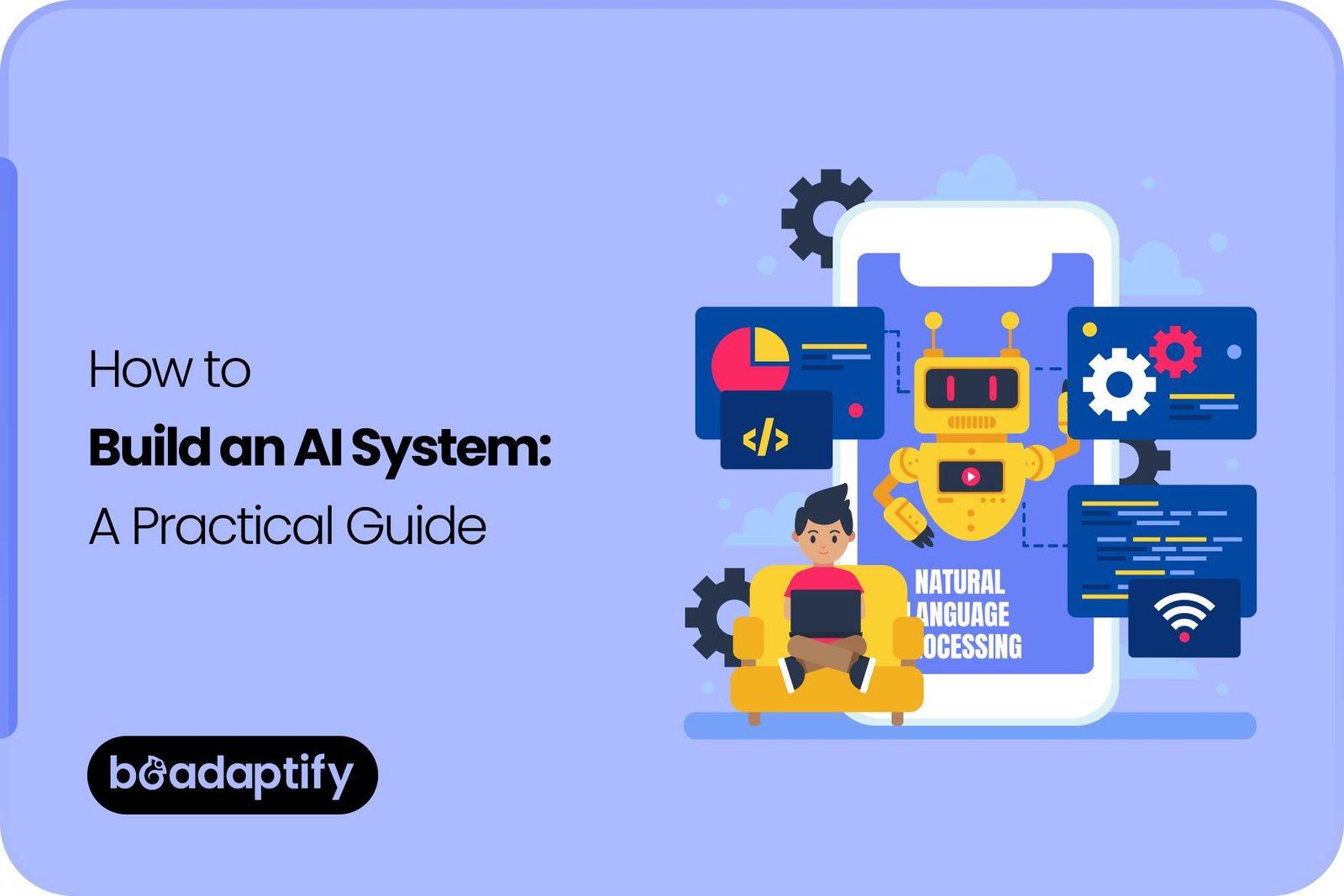
Artificial Intelligence (AI) is no longer a futuristic concept, it has become a core component of modern business strategy. Across industries, AI systems are being used to automate processes, enhance decision-making, personalize user experiences, and unlock new revenue opportunities.
In 2026, businesses are increasingly investing in AI to remain competitive in a data-driven economy. However, building an AI system is not a straightforward process. It requires a combination of data strategy, technology expertise, infrastructure planning, and continuous optimization. To successfully implement AI solutions, organizations often collaborate with an experienced software development company that offers end-to-end software development and advanced mobile app development services for AI-powered applications.
This guide provides a practical, step-by-step approach to building an AI system in 2026, covering architecture, development stages, tools, challenges, and best practices.
What Is an AI System?
An AI system refers to a software-based solution that uses algorithms and data to perform tasks that typically require human intelligence. These tasks may include pattern recognition, decision-making, language processing, and predictive analysis.
AI systems are commonly used for:
- Recommendation engines
- Chatbots and virtual assistants
- Fraud detection systems
- Predictive analytics
- Image and speech recognition
Modern AI systems rely on machine learning (ML), deep learning, and data analytics to deliver intelligent outputs.
Why Businesses Are Investing in AI in 2026
AI adoption is being driven by several key business benefits.
Automation of Repetitive Tasks
Routine processes can be automated, reducing manual effort and operational costs.
Data-Driven Decision Making
AI systems analyze large datasets to provide actionable insights.
Enhanced Customer Experience
Personalized recommendations and intelligent interfaces improve user engagement.
Competitive Advantage
Businesses leveraging AI can innovate faster and respond to market changes more effectively.
Types of AI Systems
AI systems can be categorized based on their functionality, use cases, and the type of intelligence they simulate. In modern business environments, different types of AI systems are implemented to solve specific problems and improve operational efficiency.
1. Predictive AI Systems
Predictive AI systems are designed to analyze historical data and identify patterns that can be used to forecast future outcomes. These systems are widely used in industries such as finance, healthcare, and eCommerce. For example, customer behavior can be predicted to improve marketing strategies, while financial risks can be assessed using predictive models. These systems rely heavily on machine learning algorithms and require large datasets for accurate predictions.
2. Conversational AI Systems
Conversational AI includes chatbots and virtual assistants that interact with users through text or voice. These systems use Natural Language Processing (NLP) to understand and respond to human language. In 2026, conversational AI is being used extensively in customer support, healthcare consultations, and eCommerce platforms. Advanced systems are capable of handling complex queries, improving user engagement and reducing support costs.
3. Recommendation Systems
Recommendation engines are used to suggest products, services, or content based on user preferences and behavior. These systems are commonly seen in platforms such as streaming services, online marketplaces, and social media applications. By analyzing user data, recommendation systems help increase engagement, improve conversion rates, and enhance personalization.
4. Computer Vision Systems
Computer vision systems are designed to interpret and analyze visual data such as images and videos. These systems are used in applications like facial recognition, medical imaging, surveillance, and autonomous vehicles. Deep learning models are typically used to detect objects, identify patterns, and process visual information.
5. Natural Language Processing (NLP) Systems
NLP systems are focused on understanding, analyzing, and generating human language. These systems are used for sentiment analysis, language translation, document processing, and content generation. Businesses use NLP to gain insights from text data, automate communication, and improve decision-making.
6. Autonomous AI Systems
Autonomous systems are designed to operate independently with minimal human intervention. These systems are used in robotics, self-driving vehicles, and industrial automation. They rely on real-time data processing, decision-making algorithms, and adaptive learning.
Step-by-Step Guide to Building an AI System
Building an AI system involves multiple stages, each requiring careful planning and execution.
Step 1: Define Business Objectives
The process begins by identifying the problem that the AI system is intended to solve. Clear objectives must be established, such as:
- Improving customer engagement
- Reducing operational costs
- Enhancing decision-making
Defining objectives ensures that the AI system aligns with business goals.
Step 2: Data Collection and Preparation
Data is the foundation of any AI system. Relevant data must be collected from various sources, including:
- Internal databases
- Customer interactions
- Third-party APIs
Once collected, the data must be cleaned, structured, and prepared for analysis. Poor data quality can negatively impact AI performance.
Step 3: Choose the Right AI Model
The appropriate AI model must be selected based on the use case.
Common models include:
- Supervised learning models
- Unsupervised learning models
- Neural networks
- Deep learning architectures
The choice of model influences both performance and development cost.
Step 4: Design System Architecture
AI systems require a robust architecture that supports data processing, model training, and deployment.
Key components include:
- Data pipelines
- Model training infrastructure
- APIs for integration
- Storage systems
A scalable architecture ensures that the system can handle increasing data volumes.
Step 5: Model Training and Testing
The selected model is trained using prepared datasets. During training, the model learns patterns and relationships within the data. Testing is conducted to evaluate accuracy and performance. Model tuning may be required to improve results.
Step 6: Integration with Applications
AI systems must be integrated into web or mobile applications. Through professional mobile app development services, AI features can be embedded into mobile apps, enabling real-time interactions. APIs are commonly used to connect AI models with frontend interfaces.
Step 7: Deployment
Once the model is tested, it is deployed in a production environment. Cloud platforms are often used for deployment due to scalability and reliability.
Step 8: Monitoring and Optimization
AI systems require continuous monitoring to ensure performance. Data drift, model accuracy, and system performance must be tracked. Regular updates and retraining improve system effectiveness over time.
Technology Stack for AI Development
AI systems rely on a combination of technologies.
Programming Languages
- Python
- R
- Java
Frameworks and Libraries
- TensorFlow
- PyTorch
- Scikit-learn
Cloud Platforms
- AWS
- Google Cloud
- Microsoft Azure
Through expert software development services, these technologies are integrated into scalable AI solutions.
Role of Mobile App Development in AI Systems
Mobile applications play a critical role in the deployment and accessibility of AI systems. As mobile usage continues to dominate digital interactions, AI capabilities are increasingly being integrated into mobile platforms to enhance user experiences and provide real-time insights. Through advanced mobile app development services, AI systems are embedded into applications that users interact with daily. This integration enables businesses to deliver intelligent features directly to users.
Real-Time User Interaction
AI-powered mobile apps allow users to interact with intelligent systems in real time. Features such as chatbots, voice assistants, and recommendation engines provide instant responses and personalized experiences.
Personalization and User Engagement
AI systems analyze user behavior and preferences to deliver personalized content, product recommendations, and notifications. This improves engagement and increases user retention.
Data Collection and Processing
Mobile applications serve as a primary source of data for AI systems. User interactions, location data, and behavioral patterns are collected and processed to improve AI accuracy and performance.
Enhanced Accessibility
AI-powered mobile apps make advanced technologies accessible to a broader audience. Users can access services such as healthcare consultations, financial insights, and language translation directly from their smartphones.
Integration with IoT and Wearables
Mobile apps act as a bridge between AI systems and connected devices. Data from wearable devices and IoT sensors can be processed through mobile applications, enabling real-time monitoring and analysis.
Cost of Building an AI System in 2026
The cost of AI development varies based on several factors.
Factors Influencing Cost
- Complexity of the AI model
- Volume of data
- Infrastructure requirements
- Integration complexity
- Development team expertise
Estimated Cost Range
- Basic AI solutions: $20,000 – $50,000
- Mid-level systems: $50,000 – $150,000
- Advanced AI platforms: $150,000 – $500,000+
Challenges in AI System Development
Despite the benefits of AI, several challenges must be addressed during development. These challenges can impact performance, cost, and overall project success.
Data Quality and Availability
AI systems depend heavily on data. Incomplete, inconsistent, or biased data can lead to inaccurate results. Ensuring high-quality data is one of the most critical challenges in AI development.
High Development Costs
Building AI systems requires specialized expertise, infrastructure, and tools. Costs can increase significantly for complex models and large datasets.
Integration Complexity
Integrating AI systems with existing applications and business processes can be technically challenging. Compatibility issues and data synchronization problems may arise.
Model Accuracy and Performance
Achieving high accuracy requires continuous training and optimization. Models must be fine-tuned to improve performance and reduce errors.
Security and Privacy Concerns
AI systems often handle sensitive data, making them vulnerable to security risks. Compliance with data protection regulations is essential to avoid legal and ethical issues.
Lack of Skilled Talent
AI development requires expertise in data science, machine learning, and software engineering. Finding skilled professionals can be a challenge for many organizations.
Ethical and Regulatory Challenges
AI systems must be designed to avoid bias and ensure fairness. Regulatory frameworks are evolving, and compliance must be maintained throughout development.
Best Practices for Building AI Systems
To ensure successful AI implementation, several best practices should be followed.
Define a Clear Use Case
AI development should begin with a clearly defined problem. A focused use case ensures that the system delivers measurable value.
Invest in High-Quality Data
Data quality directly impacts AI performance. Data should be cleaned, structured, and validated before model training.
Choose the Right Technology Stack
Selecting appropriate tools and frameworks improves efficiency and scalability. The technology stack should align with project requirements.
Start Small and Scale Gradually
It is recommended that AI projects begin with a minimum viable solution. Once validated, the system can be expanded with additional features.
Focus on Scalability
AI systems should be designed to handle increasing data volumes and user demand. Cloud infrastructure can support scalability.
Implement Continuous Monitoring
AI models must be monitored to detect performance issues and data drift. Regular updates and retraining improve accuracy.
Ensure Security and Compliance
Security measures should be integrated throughout the development process. Compliance with data protection regulations must be maintained.
Collaborate with Experts
Working with a professional software development company ensures access to skilled developers, advanced tools, and best practices.
Future Trends in AI Development
AI technology continues to evolve, and several trends are shaping its future in 2026 and beyond.
Generative AI Expansion
Generative AI systems are being used to create content, automate design processes, and generate code. These systems are becoming more sophisticated and widely adopted.
Edge AI
AI processing is being moved closer to the data source, reducing latency and improving performance. Edge AI is particularly useful for IoT and real-time applications.
Explainable AI (XAI)
Transparency in AI decision-making is becoming increasingly important. Explainable AI helps users understand how decisions are made, improving trust and compliance.
AI-Powered Automation
Automation is being enhanced through AI, enabling businesses to streamline operations and reduce manual effort.
AI Integration Across Industries
AI is being integrated into various industries, including healthcare, finance, retail, and manufacturing, driving innovation and efficiency.
Low-Code and No-Code AI Platforms
Low-code platforms are making AI development more accessible, allowing businesses to build solutions without extensive coding expertise.
AI and Cybersecurity
AI is being used to detect and prevent cyber threats, enhancing system security and protecting sensitive data.
Why Businesses Trust Beadaptify for AI Development?
Building an AI system requires expertise in data science, software architecture, and scalable development. At Beadaptify, AI solutions are developed with a strong focus on performance, accuracy, and long-term business value. As a trusted software development company, we provide comprehensive software development services that help businesses design and deploy intelligent systems tailored to their goals. Our expertise in mobile app development services ensures that AI-powered features can be seamlessly integrated into mobile applications, enhancing user experience and engagement.
By combining advanced technologies with intuitive design & development services, scalable and future-ready AI systems are delivered that support automation, analytics, and innovation. With a strategic and results-driven approach, Beadaptify enables businesses to unlock the full potential of artificial intelligence.

Conclusion
AI systems are transforming the way businesses operate in 2026. From automation and analytics to personalized user experiences, AI is driving innovation across industries. Building an AI system requires careful planning, data management, and technical expertise.
By partnering with Beadaptify, a trusted software development company and leveraging professional development services, businesses can develop scalable AI solutions that deliver real value. As AI continues to evolve, organizations that invest in intelligent systems will be better positioned to compete in the digital economy and achieve long-term success.
FAQs About Building AI System
How long does it take to build an AI system?
The development timeline depends on complexity. Simple AI solutions may take a few weeks, while advanced systems can take several months.
What is the cost of building an AI system?
AI development costs typically range from $20,000 to $500,000+, depending on data requirements, model complexity, and infrastructure.
What technologies are used to build AI systems?
Common technologies include Python, TensorFlow, PyTorch, cloud platforms, and data analytics tools integrated through professional development services.
Can AI systems be integrated into mobile applications?
Yes. Through advanced mobile app development services, AI features such as chatbots, recommendations, and analytics can be integrated into mobile apps.
Why should businesses hire a software development company for AI projects?
A professional software development company provides expertise in data science, architecture design, and scalable development, ensuring efficient and reliable AI implementation.
What are the main challenges in AI development?
Challenges include data quality issues, high costs, integration complexity, and compliance with data privacy regulations.