When businesses begin planning a new digital product, one of the first and most pressing questions is, “How much will it cost?” Software development is one of the most significant investments a company can make, whether it’s a startup launching a minimum viable product (MVP) or an enterprise building a large-scale internal system. Yet, estimating software development costs is rarely straightforward. Costs vary dramatically depending on scope, complexity, team size, technology stack, and even the location of the development team.
This is where software cost estimation comes into play. Understanding software costing and estimation isn’t just about creating a financial plan—it’s about reducing risk, improving resource allocation, and ensuring projects stay on track. Inaccurate estimates often lead to budget overruns, timeline delays, and frustrated stakeholders. Accurate software project budget estimation, on the other hand, builds confidence and sets realistic expectations for both clients and development teams.
In this detailed guide, we’ll explore everything you need to know about cost estimation in software project management, from the factors that influence pricing to proven estimation methods. We’ll also dive into best practices for calculating time, budget, and scope so you can create a reliable software development cost estimate for your project.
Why Software Cost Estimation Matters
Software development isn’t just writing code. It includes planning, design, testing, deployment, and ongoing support. Each stage requires time, people, and resources, which all contribute to the software development estimate.
Without accurate cost estimation for software development, businesses risk:
-
Budget overruns that eat into profitability.
-
Timeline delays that harm competitive advantage.
-
Scope creep where new features keep inflating the project.
-
Mismatched expectations between clients and development teams.
Why Software Cost Estimation is So Challenging
Software development is inherently complex because it is not a one-size-fits-all service. A small mobile app with a simple user interface may cost only a fraction of what a large enterprise platform requires. When business leaders search for “how to calculate the cost of software development,” they are often surprised by the range of answers they receive. One company might estimate $40,000, while another quotes $150,000 for the same idea.
The reason for this discrepancy is that cost estimation for a software project depends on countless variables. A project’s scope, the number of features, required integrations, the level of customization, and the need for security or compliance measures all impact the final number. On top of that, hiring a software development company in the USA will cost more than working with an offshore software development company in Eastern Europe or Asia. developer rates alone can shift a project’s price by more than 60%.
This is why businesses need a structured approach to estimating software development costs, one that goes beyond guesswork and provides clarity.
Key Factors That Influence Software Development Cost Estimation
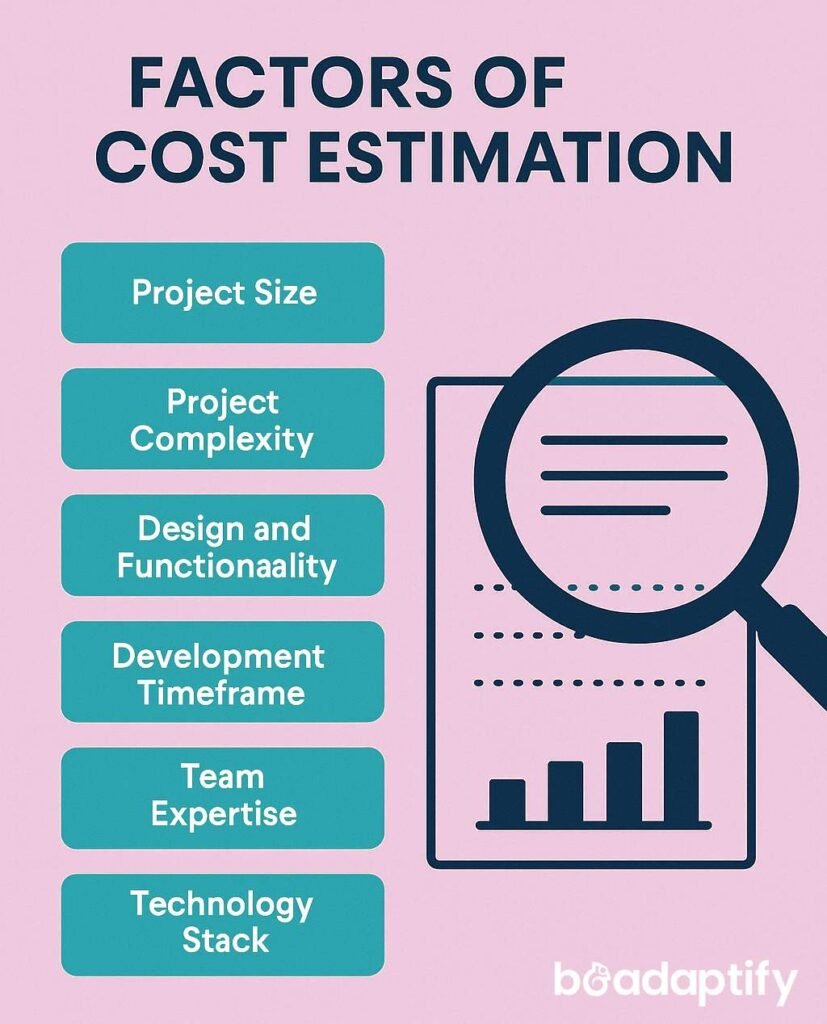
Accurate software cost estimation depends on several interrelated factors. Each factor directly affects both time and cost, and overlooking any of them can lead to significant underestimation. Here are the most important ones:
1. Project Scope & Complexity
- Number of features to be developed.
- Whether the software is an MVP, mid-size app, or large enterprise system.
- Complexity of workflows, integrations, and automation.
- Need for advanced capabilities (AI, blockchain, AR/VR, IoT).
2. Development Team Size & Expertise
- Small teams may lower cost but extend the timeline.
- Senior developers or architects increase costs but reduce risk.
- Inclusion of specialized roles: UI/UX, DevOps, QA testers, product managers.
- Engagement model (in-house, outsourcing, or hybrid).
3. Team Location & Hourly Rates
- USA/Western Europe: $80–$150/hr.
- Eastern Europe: $40–$80/hr.
- India/Southeast Asia: $25–$60/hr.
- Offshore teams can reduce overall budget but require strong communication processes.
4. Technology Stack
- Licensing costs for proprietary tools or third-party APIs.
- Open-source frameworks may reduce costs but require specialized knowledge.
- Cloud vs. on-premise infrastructure.
5. UI/UX Design Requirements
- Minimalistic designs are cheaper, while research-driven, custom designs require more time.
- Iterative design with usability testing adds cost but improves adoption.
6. Testing & Quality Assurance
- Basic manual testing vs. automated testing frameworks.
- Performance, security, and compliance testing for enterprise apps.
- Longer QA cycles improve stability but increase budget.
7. Project Management & Communication
- Agile vs. waterfall project management approaches.
- Frequency of client meetings and feedback loops.
- Tools (Jira, Trello, Slack) and communication overhead.
8. Maintenance & Post-Launch Support
- Ongoing updates, bug fixes, and feature enhancements.
- Scaling infrastructure for larger user bases.
- Average annual maintenance cost = 15–25% of initial development cost.
Methods of Cost Estimation in Software Project Management
Different estimation for software projects methods suit different scenarios. Experienced software development companies often combine multiple methods for accuracy.
1. Expert Judgment
- Relies on senior developers or project managers.
- Based on intuition and prior project experience.
- Fast but subjective, works best with supporting data.
2. Analogous Estimation
- Compares the new project with past, similar projects.
- Example: A SaaS dashboard project costs $40K; a new one with 20% more features may be ~$50K.
- Useful for high-level early budgeting.
3. Parametric Estimation
- Uses quantifiable data, e.g.:
- Cost per line of code.
- Cost per function point.
- Average hourly effort for a feature type.
- Provides more scientific estimates but requires detailed data sets.
4. Bottom-Up Estimation
- Breaks project into modules → features → tasks.
- Each task is estimated individually, then rolled up.
- Most accurate method but time-consuming.
- Commonly used in enterprise software development services.
5. Top-Down Estimation
- Sets an overall budget first, then allocates resources across tasks.
- Works for projects with strict budget caps.
- Less precise but helps align with client’s financial limits.
6. Three-Point Estimation (PERT)
- Calculates average using:
- Optimistic estimate (O).
- Pessimistic estimate (P).
- Most likely estimate (M).
- Formula: (O + 4M + P) ÷ 6.
- Helps account for uncertainty and risk.
7. Agile Estimation (Story Points / Velocity)
- Breaks tasks into user stories.
- Estimates relative complexity instead of exact hours.
- Uses sprint velocity to project timelines and budgets.
- Flexible and adapts to changing requirements.
Step-by-Step Guide: How to Calculate the Cost of Software Development
Here’s a structured way to build a realistic software project cost estimation:
1. Gather and Define Requirements
- Create a detailed Software Requirements Specification (SRS).
- Identify must-have vs. nice-to-have features.
- Include functional and non-functional requirements (e.g., scalability, compliance).
2. Choose Engagement Model
- Fixed Price – Suitable for well-defined, small projects.
- Time & Material – Best for evolving requirements.
- Dedicated Team – Works for long-term, large projects needing flexibility.
3. Break Down Project into Tasks
- Use Work Breakdown Structure (WBS).
- Estimate tasks for design, backend, frontend, QA, project management, DevOps.
4. Estimate Development Time
- Assign hours to each task.
- Use bottom-up or agile story point estimation.
- Factor in communication and feedback cycles.
5. Assign Hourly Rates
- Multiply total estimated hours by hourly rate based on team’s region and skill level.
6. Add Additional Costs
- Licenses (software tools, APIs).
- Cloud hosting or infrastructure.
- Project management software.
- Security and compliance audits.
7. Calculate Total Development Cost
- Formula:
Total Cost = (Total Development Hours × Hourly Rate) + Additional Expenses.
8. Include Risk Buffer
- Add 10–20% contingency for scope changes, delays, or technical challenges.
9. Validate Estimates
- Cross-check using different estimation methods (e.g., bottom-up + three-point).
- Compare with historical project data.
10. Review with Stakeholders
- Present transparent breakdown to clients or investors.
- Align expectations before development begins.
Example of Software Project Cost Estimation
To put this into perspective, consider a mobile app development project. The backend requires around 400 hours, the frontend about 350 hours, UI/UX design 120 hours, testing and QA 150 hours, and project management another 80 hours. This totals roughly 1,100 hours.
If you work with a custom software development company in the USA charging $100 per hour, your project may cost around $110,000. However, the same project completed by an offshore software development company charging $40 per hour may cost closer to $44,000. This example highlights why businesses often turn to offshore software development companies when looking for cost efficiency, without necessarily sacrificing quality.
Estimating Time in Software Development
Time estimation is just as critical as cost. After all, time and cost are directly linked. Estimating software development time involves mapping out the entire lifecycle: requirements gathering, design, development, testing, and deployment. It also requires factoring in iterations, revisions, and communication cycles.
Agile development approaches often simplify this with story points and sprints, making it easier to track progress and adjust estimates as the project evolves. For larger enterprise projects, milestone-based time estimation provides a clearer roadmap for delivery.
Best Practices for Accurate Cost Estimation
Over the years, software product development companies have developed several best practices for software project cost estimation. The most important is documentation. Clearly defined requirements minimize ambiguity and miscommunication. Involving stakeholders early also ensures alignment on goals and prevents scope creep later.
Historical data is invaluable. By referencing similar projects, companies can refine estimates with greater accuracy. Agile practices should also be adopted wherever possible, as they allow for ongoing adjustments in software development estimating. Finally, validation through multiple estimation methods helps balance out weaknesses in any single approach.
The Role of Software Development Companies
Choosing the right partner is perhaps the most important step in ensuring accurate software project budget estimation. A trusted software development services company will not only build your product but also guide you through the estimation process. They’ll conduct workshops, define milestones, clarify scope, and present transparent cost structures.
Working with an enterprise software development company offers advantages for large-scale projects with complex requirements, while startups may prefer the agility and cost-effectiveness of an offshore software development company. Either way, accurate estimates require collaboration and trust between both parties.
Conclusion
Accurately estimating the cost of a software development project is one of the most important steps in project planning. It requires careful consideration of scope, technology, team composition, and methodology. Businesses must not only calculate the immediate costs of design and development but also factor in long-term support and maintenance.
By using proven methods of cost estimation in software project management, applying best practices, and working with a reliable software development company, organizations can avoid costly surprises and ensure their digital investments pay off. Whether you’re a startup working with a custom software development company, an enterprise seeking enterprise software development services, or a business exploring options with an offshore software development company, the key to success lies in a realistic and transparent software development cost estimate.
If you still require assistance with estimating the cost of custom software development, or if you are simply seeking a professional and reputable custom software development company, feel free to contact us.
We are a custom software development company that provides solution-oriented solutions for different industries and fields. We possess highly experienced and professional developers who can provide quality software solutions according to your requirement and expectations. We also provide a complimentary consultation and a clear pricing model, which gives you a detailed and transparent breakdown of the project cost.

FAQs on the Cost of Software Development
What are the main elements that influence software development pricing?
At Beadaptify, we look at several core elements when building a software cost estimate. These include project size and complexity, the number of features, the technology stack, design requirements, and security standards. In short, the clearer the requirements, the more accurate the cost estimation will be.
How does the region or country of the development team affect project cost?
Location plays a significant role in software development cost estimation. Developers in the U.S. or Western Europe may charge between $80–$150 per hour, while skilled offshore teams in India or Eastern Europe often range from $25–$60 per hour. At Beadaptify, we provide flexible engagement models, allowing businesses to choose the balance between budget and expertise that fits their project best.
What is the average cost of software development?
Costs vary widely, but small apps often range from $10,000–$30,000, while enterprise projects can exceed $500,000.
How accurate are estimates?
Early estimates often carry a margin of error of 20–30%. As requirements become clearer, estimates become more precise.
Is it better to build an in-house development team or work with an outsourcing partner?
Both approaches have advantages. Hiring full-time developers offers long-term control but requires ongoing overhead for salaries, tools, and training. Outsourcing to Beadaptify, a custom software development company provides access to a diverse pool of experts, reduces hiring risks, and speeds up time-to-market.
How do you estimate time for development?
By breaking the project into tasks, assigning hours or story points, and accounting for revisions and QA.
Can budgets be fixed?
Yes, but only when the requirements are stable. Fixed-price contracts are not recommended for highly dynamic projects.