In 2026, mobile applications have continued to dominate the digital landscape as startups increasingly rely on mobile-first experiences to validate ideas, attract early adopters, and generate long-term revenue. With competition at an all-time high, a strategic and well-structured approach to mobile app development for startups has become essential. The path from concept to launch requires clarity, planning, user-centric design, and smart execution—especially when resources are limited and investors expect predictable progress.
This guide explores modern strategies for startup mobile app development in 2026. Practical, long-term, and actionable steps are outlined to help founders understand how an idea is transformed into a scalable mobile product. The content is written to support early-stage founders, product owners, and entrepreneurs asking foundational questions such as:
- How to start an app?
- How to build an app for my business?
- How to start an app company or app business?
- What does app development for startups cost and involve?
By understanding the startup development cycle, founders can avoid common mistakes, reduce unnecessary spending, and create a product that supports long-term brand success.
Why Mobile App Development Has Become Crucial for Startups in 2026
Mobile adoption has continued accelerating, with users now spending more time in mobile apps than on mobile browsers or desktop platforms. This shift has positioned mobile development as a critical foundation for new digital businesses. Startups in industries such as healthcare, fintech, logistics, education, SaaS, and real estate increasingly rely on mobile-first approaches to acquire users quickly and validate business models.
Mobile app development for startups is no longer limited to creating a functioning product. Instead, it has become a strategic tool for capturing early engagement, retaining customers, monetizing services, and raising funding. Investors often evaluate product maturity, UI/UX quality, scalability, and user retention patterns before approving additional capital—making startup application development a key driver of valuation.
Because of this, modern founders are expected to invest in structured startup mobile app development practices from the earliest stages. Without proper planning and user-first execution, even the most innovative ideas risk failure due to poor user experience or flawed technical architecture.
1. Understanding the Startup App Development Lifecycle in 2026
A strong foundation must be established before development begins. Many startup failures occur not because of poor app execution but because initial assumptions were never validated. The modern app development lifecycle for startups includes the following stages:
Stage 1: Market & Idea Validation
Before a single line of code is written, the idea must be validated. Startups must answer key questions such as:
- Is there real market demand?
- What problem is being solved?
- Who are the primary users?
- What alternatives currently exist?
- How does the app provide measurable value?
Validation can be achieved using prototypes, user interviews, competitive analysis, or a simple landing page for lead collection.
This step reduces the risk of building features that do not align with user needs.
Stage 2: Defining the MVP (Minimum Viable Product)
In 2026, MVP development remains a core strategy for app development for startups. An MVP allows early product release with essential features only, keeping the initial build simple while gathering critical user data.
The MVP answers:
- How to start an app with minimal risk?
- What features must exist for users to adopt the product?
Instead of attempting to build every feature at once, an MVP focuses on delivering value quickly.
Stage 3: UI/UX Planning and Wireframing
A strong user experience is considered non-negotiable in 2026. With thousands of apps competing for attention, startups must prioritize seamless, intuitive, and visually appealing design.
UI/UX design services through a professional team ensure that:
- Navigation flows are intuitive
- Design aesthetics align with brand personality
- User behavior patterns are understood early
- The product feels modern and trustworthy
Wireframes and prototypes help founders visualize their ideas and test them before development begins—saving valuable resources.
Stage 4: Development & Architecture Planning
This phase marks the beginning of the technical build. Most modern startup application development is handled in agile sprints, enabling incremental progress and continuous feedback.
Key considerations include:
- Choosing the right tech stack
- Planning the backend architecture
- Implementing scalable APIs
- Deciding between native or cross-platform development
Partnering with a mobile app development company ensures that scalability, security, and future feature expansion are planned correctly.
Stage 5: Testing and Quality Assurance
Testing ensures that bugs are eliminated, workflows function correctly, and the app performs consistently across devices.
Testing includes:
- Functional testing
- UI/UX testing
- Performance testing
- Device compatibility testing
- Security testing
Startups that skip QA often suffer from poor app store ratings and high uninstall rates.
Stage 6: Launch & Deployment
After passing all QA checks, the app is deployed to the App Store and Google Play. The launch is treated as the beginning—not the end—of the product lifecycle.
Marketing, user onboarding, and performance tracking are prioritized during this stage.
Stage 7: Post-Launch Iteration & Growth
Startups must rely heavily on user feedback to shape future builds. Features added during this stage typically include:
- User engagement tools
- Personalization modules
- Advanced analytics
- Revenue models (subscriptions, ads, purchases)
Continuous iteration supports long-term product-market fit.
2. Choosing the Right Development Approach for Startup Success
Different approaches exist for building a mobile app in 2026. The right approach depends on budget, app complexity, and long-term business goals.
Native Development
Native development provides top-tier performance and deep hardware access. It is ideal for applications requiring advanced features like high-performance gaming, audio/video streaming, or AR.
Cross-Platform Development
Cross-platform development through Flutter or React Native has become highly popular for startups due to reduced cost and faster development timelines.
Benefits include:
- A single codebase for both platforms
- Lower maintenance cost
- Faster feature rollout
- Consistent UI across devices
This approach is ideal for budget-conscious founders asking:
“How to build an app for my business without overspending?”
No-Code/Low-Code Solutions
These tools enable early prototyping or MVP creation but may not support long-term scalability. They are typically used to validate an idea quickly before transitioning to a full custom build.
3. Cost of App Development for Startups in 2026
Startup app development costs vary based on app type, complexity, features, and development region.
Cost Breakdown by Complexity
| App Complexity Level | Estimated Cost (2026) |
|---|---|
| Simple Startup App | $10,000 – $35,000 |
| Moderate Startup App | $35,000 – $75,000 |
| Advanced Startup App | $80,000 – $250,000+ |
Costs are influenced by backend needs, UI/UX requirements, integrations, and real-time features.
Cost Breakdown by App Type
| App Category | Estimated Cost |
|---|---|
| Marketplace App | $50,000 – $150,000 |
| Social Media App | $80,000 – $200,000 |
| FinTech App | $100,000 – $250,000+ |
| Healthcare App | $60,000 – $180,000 |
| On-Demand App | $70,000 – $150,000 |
| SaaS App | $60,000 – $200,000 |
Startups are encouraged to build an MVP first, reducing unnecessary costs while accelerating market entry.
4. The Role of UI/UX in Startup Mobile App Development
Great products are defined not only by functionality but by the experience they deliver. With user expectations rising, UI/UX has become one of the most influential components for mobile application development for startups.
Key factors include:
- Simplicity and clarity
- Onboarding effectiveness
- Conversion-driven design
- Visual consistency
- Accessibility
Professional UI/UX design services ensure that applications retain users and convert them into loyal customers.
5. Choosing the Right Mobile App Development Partner
A startup’s success depends heavily on the expertise of its development team. A mobile application development company offers:
- Faster time-to-market
- Better architecture planning
- Predictable development timelines
- Access to UI/UX, QA, and engineering teams
- Scalable resources
High-quality development & design services reduce risk and ensure the product grows smoothly.
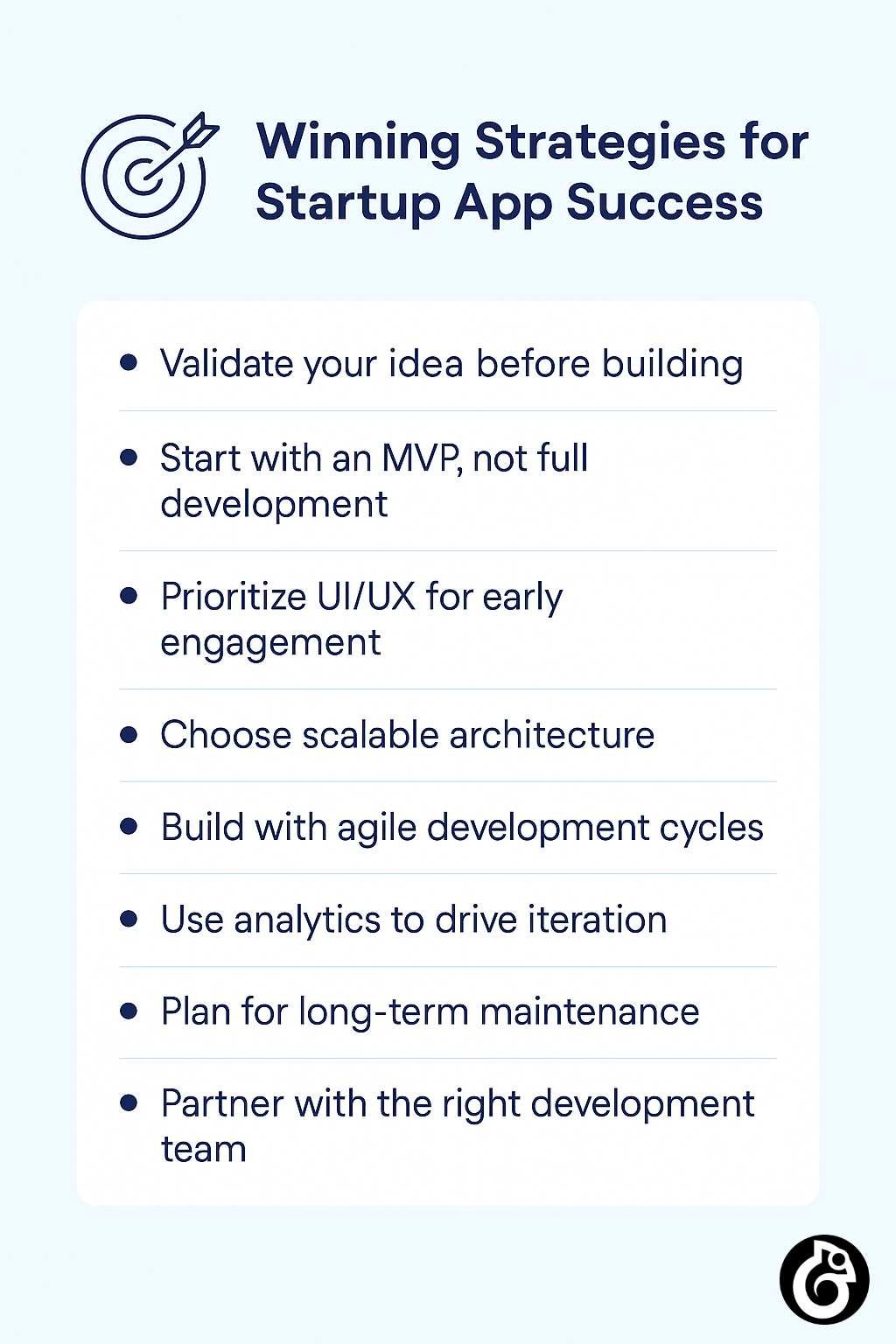
6. Essential Strategies for Startup App Success in 2026
The following strategies have proven to be essential for long-term results:
Start Small, Scale Smart
A smaller feature set allows startups to avoid unnecessary expenses while testing user demand. Once product-market fit is validated, scaling becomes logical and cost-efficient.
Invest in Strong UI/UX Early
A polished interface enhances brand credibility. Good design separates successful apps from those that fail to attract engagement.
Prioritize Core Features Over “Nice-to-Haves”
Feature overload often delays launches and inflates budgets. MVP-focused development prevents this.
Adopt Agile Development
Agile processes provide flexibility, transparent progress, and continuous improvement.
Use Analytics to Guide Decisions
User behavior insights help startups prioritize updates and remove unused features.
Plan for Maintenance and Long-Term Growth
Post-launch support is essential for bug fixes, security updates, and performance optimization.
7. Monetization Models for Startup Apps in 2026
Startups must consider revenue generation early. Common models include:
- Subscriptions
- In-app purchases
- Advertisements
- Pay-per-use
- Freemium models
- Transaction fees
Clear monetization strategies support long-term sustainability.
8. Marketing & Launch Strategy for Startup Apps
A strong launch strategy includes:
- App Store Optimization (ASO)
- Social media campaigns
- Influencer collaboration
- Paid ads
- Email onboarding flows
- Community-building initiatives
Marketing should begin before development completion.
Conclusion
Mobile app development for startups in 2026 requires strategic planning, user-centric design, careful budgeting, and continuous iteration. By validating ideas early, focusing on MVP development, choosing the right technology stack, and partnering with a reliable mobile application development company, startups can reduce risk and create scalable, profitable digital products.
Founders asking “How to start an app business?” or “How to start an app company?” can build successful applications by following structured development processes and investing in professional design & development services to ensure long-term sustainability.

FAQ on Mobile App Development for Startups
How much does app development for startups typically cost in 2026?
App development for startups in 2026 is generally priced between $10,000 and $250,000+, depending on app complexity, design requirements, backend architecture, and the development region. MVP-focused builds fall on the lower end, while feature-rich or enterprise-level products require larger budgets.
What is the best way to start an app with limited resources?
The best approach involves creating an MVP (Minimum Viable Product). This allows the idea to be tested with real users before investing heavily in full-scale development. MVP strategies help reduce financial risk while providing valuable feedback to guide future enhancements.
Do startups need a mobile application development company to build their app?
While some startups attempt in-house development, most choose a mobile application development company because it ensures access to UI/UX experts, engineers, QA testers, and project managers. This reduces the risk of delays, technical debt, and structural deficiencies.
How long does startup mobile app development take?
Simple startup apps take 6–12 weeks, moderate apps take 3–6 months, and advanced, multi-feature products may require 6–12 months or more. Timelines depend on features, technology stack, integration needs, and feedback cycles.
What technology stack is recommended for startup application development?
The choice depends on project goals. Many startups prefer Flutter or React Native for rapid cross-platform development, while others use native iOS/Android, depending on performance or hardware requirements. Backend systems typically include Node.js, Python, Firebase, or cloud-native solutions.