In 2025, the web development ecosystem continues to evolve at an unprecedented pace. As businesses demand faster, scalable, and more secure web solutions, the choice of a backend framework has become one of the most important technical decisions in the development process.
To ensure seamless functionality, performance, and long-term scalability, developers and businesses rely on frameworks that streamline the complex tasks of server-side coding. These frameworks form the backbone of modern applications managing databases, APIs, authentication, and business logic.
In this guide, the top backend frameworks powering the web development in 2025 are explored in detail, along with their core features, benefits, and ideal use cases.
Understanding Backend Frameworks
Before diving into the backend frameworks list, it’s important to understand their purpose in web development.
A backend framework is a collection of pre-written code libraries, tools, and components used to build and manage server-side logic. It handles tasks such as user authentication, database management, routing, and API creation.
These frameworks provide a structured approach to backend development services, enabling faster delivery, consistency, and easier maintenance. They also ensure that security and scalability standards are maintained throughout the application’s lifecycle.
The Importance of Choosing the Right Backend Framework
Choosing the best backend framework 2025 can determine how effectively a web application performs. When the right technology stack is chosen, applications load faster, handle more users efficiently, and integrate easily with frontend interfaces.
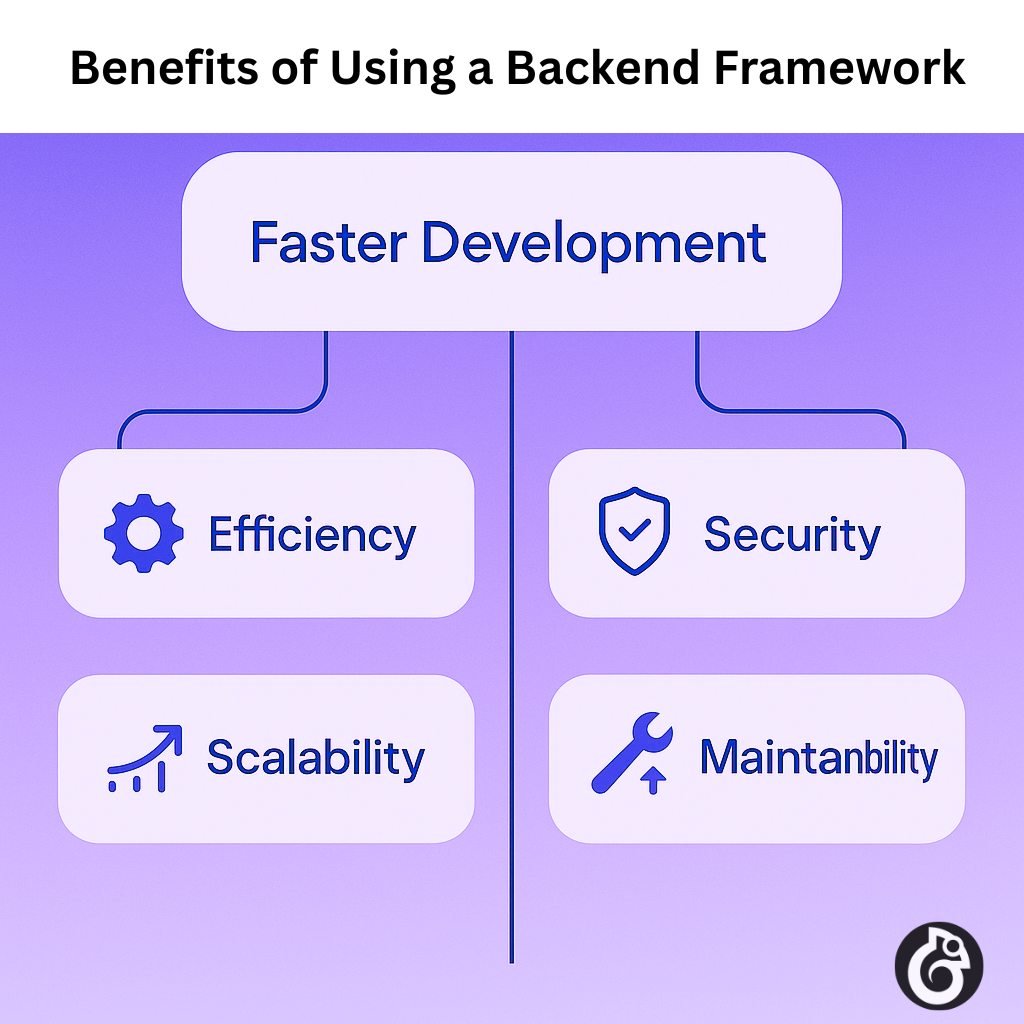
Some of the major reasons a proper backend framework selection matters include:
- Performance Optimization: The right framework ensures optimal request handling, caching, and load balancing.
- Security: Built-in protection against SQL injection, CSRF, and XSS attacks.
- Scalability: Frameworks allow easy expansion as the user base grows.
- Faster Development: Pre-built modules, ORM tools, and routing systems speed up project timelines.
- Maintainability: Standardized structures make it easier for teams to collaborate.
When handled by an experienced backend development company, the right framework can drastically reduce development time and improve product quality.
Key Criteria for Evaluating Backend Frameworks
The following criteria are commonly used by every professional web development company and software development company while selecting a framework for new projects:
- Performance and Speed: How efficiently the framework processes requests and responses.
- Scalability: Ability to manage growth without major architectural changes.
- Community Support: Active developer ecosystem ensures consistent updates and support.
- Learning Curve: Frameworks with comprehensive documentation are easier for teams to adopt.
- Integration Capabilities: Support for third-party libraries, APIs, and frontend frameworks.
- Security Features: Availability of built-in mechanisms to handle vulnerabilities.
Top Backend Frameworks Powering Web Development in 2025
Below is the backend frameworks list that defines the technology landscape for modern digital products this year.
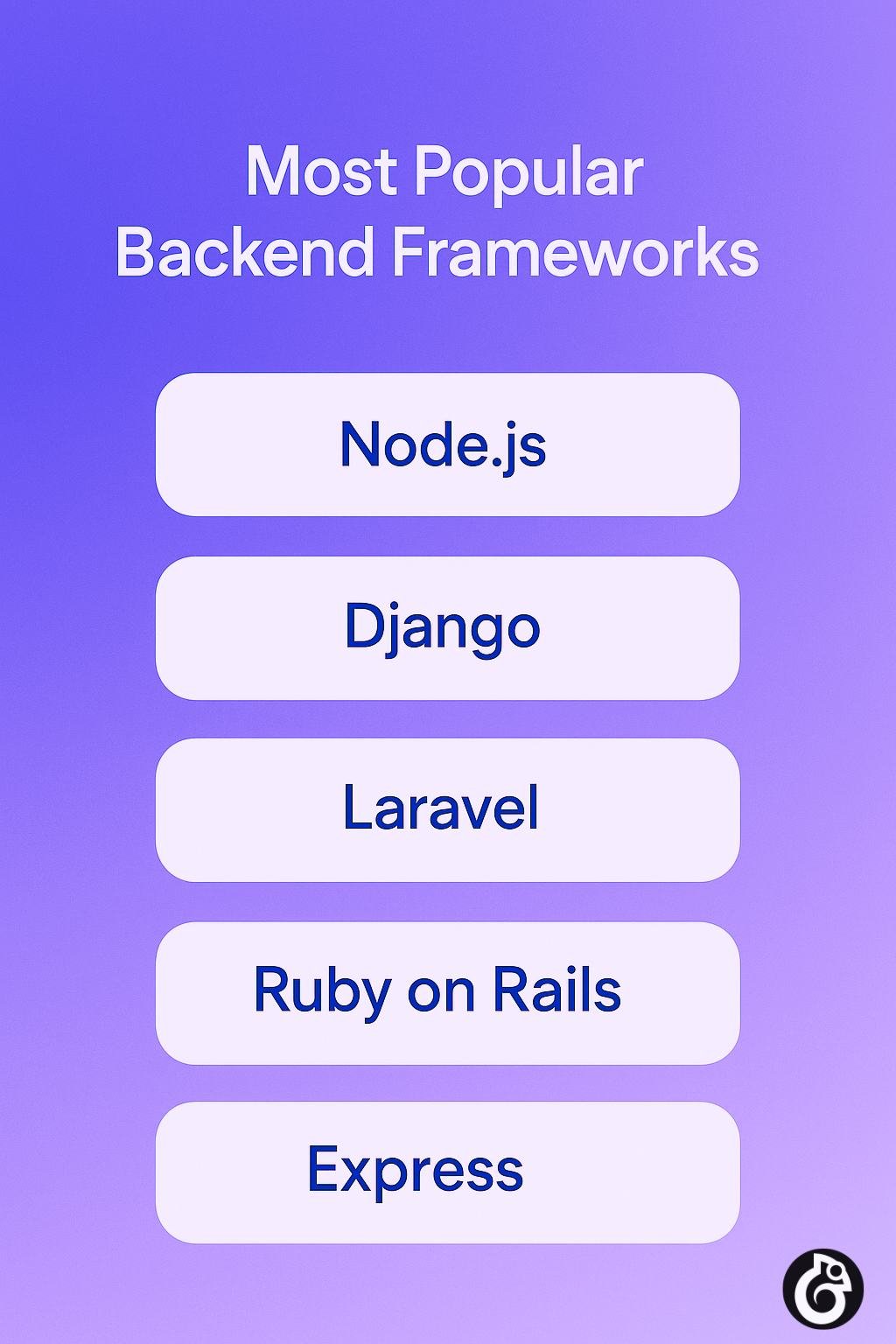
1. Node.js — The Powerhouse of Real-Time Web Apps
Node.js continues to dominate the list of top backend frameworks in 2025. Known for its asynchronous, event-driven architecture, it enables developers to handle high-performance, non-blocking I/O operations efficiently.
Built on the V8 JavaScript engine, Node.js allows both frontend and backend code to be written in the same language, simplifying development workflows for businesses relying on full-stack teams.
Key Features:
- Single-threaded event loop for speed and scalability
- Excellent for real-time applications (e.g., chat, IoT, streaming)
- Rich ecosystem through NPM (Node Package Manager)
- Built-in support for JSON APIs
Use Cases:
- Real-time applications (e.g., messaging and gaming)
- Microservices architecture
- Data-intensive enterprise solutions
2. Laravel — The Elegant PHP Framework
Laravel continues to be one of the most popular backend frameworks for developers in 2025. Built on PHP, Laravel simplifies coding through elegant syntax, extensive libraries, and built-in tools for authentication, routing, and caching.
Key Features:
- MVC architecture for clean code structure
- Eloquent ORM for efficient database management
- Blade templating engine for faster rendering
- Built-in security tools and CSRF protection
Use Cases:
- E-commerce platforms
- SaaS applications
- Content-driven portals
3. Django — The Secure Python Framework
Developed in Python, Django remains among the top backend frameworks powering the web development in 2025. Its “batteries-included” philosophy provides developers with everything needed to build large-scale web applications out of the box.
Key Features:
- Follows the DRY (Don’t Repeat Yourself) principle
- Built-in admin interface for quick management
- Strong security and scalability features
- ORM system simplifies database queries
Use Cases:
- AI-powered applications
- Healthcare and financial web platforms
- Enterprise-grade solutions
4. Spring Boot — Enterprise-Grade Java Framework
Spring Boot, built on the Spring ecosystem, remains a core choice for enterprises requiring secure, large-scale, and high-performance applications. It simplifies Java-based development through pre-configured setups and microservice-ready components.
Key Features:
- Simplified dependency management
- Auto-configuration for faster setup
- Integrated testing tools
- Excellent support for microservices and APIs
Use Cases:
- Banking and financial applications
- Large enterprise systems
- Cloud-native microservices
5. Ruby on Rails — Convention Over Configuration
Ruby on Rails remains one of the most popular backend frameworks for startups and rapid prototyping in 2025. Built on Ruby, it emphasizes simplicity, productivity, and developer happiness.
Key Features:
- Convention-driven architecture reduces boilerplate code
- Integrated testing tools for higher reliability
- Scalability options with cloud hosting
- Rapid application development
Use Cases:
- MVPs (Minimum Viable Products)
- Social platforms and content-driven sites
- E-commerce applications
6. ASP.NET Core — Microsoft’s High-Performance Solution
ASP.NET Core by Microsoft is one of the best backend frameworks 2025 for building cross-platform and cloud-ready applications. Its modular, lightweight design supports both Windows and Linux servers.
Key Features:
- Excellent integration with Azure cloud services
- Built-in dependency injection
- Advanced security and identity management
- High performance with .NET runtime optimization
Use Cases:
- Enterprise portals
- Cloud and SaaS-based products
- API-driven web applications
7. Express.js — The Minimal Node.js Framework
Express.js, a fast and minimalist web framework for Node.js, remains a preferred choice among developers in 2025. It is often considered one of the top backend frameworks for lightweight, modular applications.
Key Features:
- Simplified routing and middleware
- High flexibility and modular structure
- Perfect for RESTful APIs and microservices
- Integration with any frontend technology
Use Cases:
- Single-page applications (SPAs)
- RESTful APIs
- Real-time chat or IoT services
8. Flask — Lightweight Python Framework
Flask, another Python-based framework, is loved for its flexibility and simplicity. It’s considered one of the most popular backend frameworks among developers who prefer lightweight, microservice-oriented applications.
Key Features:
- Minimal and easy-to-learn structure
- Built-in development server and debugger
- Integration with AI/ML libraries
- Flexible plugin support
Use Cases:
- Small to medium web applications
- Microservices
- Data visualization dashboards
9. CakePHP — Legacy Meets Modern PHP Development
CakePHP remains relevant in 2025 for developers seeking structured, MVC-based PHP frameworks. It simplifies web app development with code generation tools and built-in validations.
Key Features:
- MVC architecture
- ORM-based data interaction
- Form handling and validation
- Security and caching tools
Use Cases:
- CMS-based systems
- eCommerce websites
- Custom business applications
10. NestJS — The Modern TypeScript Framework
NestJS has emerged as one of the top backend frameworks powering the web development in 2025, combining the best of object-oriented and functional programming with TypeScript support.
Key Features:
- TypeScript integration for cleaner, maintainable code
- Modular architecture supporting microservices
- Built-in dependency injection
- Strong testing and scalability tools
Use Cases:
- Enterprise-grade APIs
- Real-time applications
- Serverless applications
Comparison Table: Backend Frameworks Overview
| Framework | Language | Strengths | Ideal Use Case |
|---|---|---|---|
| Node.js | JavaScript | High scalability, real-time apps | Streaming, IoT, APIs |
| Laravel | PHP | Elegant syntax, security, ORM | E-commerce, SaaS |
| Django | Python | Security, scalability, speed | Enterprise apps, AI tools |
| Spring Boot | Java | Enterprise systems, microservices | Banking, large orgs |
| Ruby on Rails | Ruby | Rapid development | Startups, MVPs |
| ASP.NET Core | C# | Cross-platform, performance | SaaS, enterprise |
| Express.js | JavaScript | Lightweight, fast | REST APIs, microservices |
| Flask | Python | Simple, flexible | Data-driven apps |
| CakePHP | PHP | MVC, robust tools | CMS, web portals |
| NestJS | TypeScript | Modular, modern | Scalable APIs |
Emerging Trends in Backend Development (2025 and Beyond)
- AI and Automation: Frameworks now support AI integration for predictive analytics.
- Serverless Architecture: Backend frameworks are adapting to AWS Lambda and Google Cloud Functions.
- Microservices Architecture: Modularization is prioritized for scalability.
- API-First Development: RESTful and GraphQL APIs dominate backend ecosystems.
- Cloud-Native Solutions: Frameworks are optimized for multi-cloud deployments.
Choosing the Best Backend Framework 2025 for Your Project
The decision depends on project requirements, business goals, and technical capabilities.
When selecting a framework, a professional backend development should evaluate:
- Scalability and performance requirements
- Integration needs with existing systems
- Preferred programming language
- Availability of developer expertise
- Long-term maintenance plans
By collaborating with a web development company offering full-stack development & design services, businesses can ensure that both backend and frontend components work harmoniously to deliver optimal user experiences.
The Role of Backend Frameworks in Modern Business Growth
The backend serves as the digital engine driving every successful web application. From user authentication to data storage and security, it ensures reliability and performance.
When managed by experts from a software development company, backend frameworks empower organizations to:
- Handle millions of requests efficiently
- Ensure security and compliance
- Reduce time-to-market through reusable code
- Integrate seamlessly with third-party systems
Modern frameworks have simplified innovation by allowing companies to focus on customer experience rather than server-side complexities.
How Professional Backend Development Services Add Value
Engaging a specialized backend development company provides structured expertise in selecting, configuring, and deploying the most suitable framework.
Their responsibilities include:
- Architecture planning
- Database design and API setup
- Performance optimization
- Ongoing maintenance and scalability planning
Partnering with an company like Beadaptify ensures that backend development services are aligned with long-term business goals through consistent innovation, transparency, and performance-driven execution.

Final Thoughts
As 2025 progresses, backend technologies continue to shape how businesses operate online. Choosing from the top backend frameworks powering the web development in 2025 is no longer a technical decision alone, it’s a strategic one.
Frameworks such as Node.js, Laravel, Django, Spring Boot, and NestJS are enabling businesses to deliver faster, safer, and more scalable solutions than ever before. When combined with the expertise of a trusted backend development company, these technologies become powerful enablers of growth, innovation, and digital transformation.
FAQs on Backend Frameworks
How do backend frameworks impact web application performance?
The use of modern backend frameworks significantly enhances web application speed, stability, and scalability. By managing database queries, caching, and load balancing efficiently, these frameworks ensure smoother user experiences. Professional backend development services focus on optimizing framework selection and architecture design to maximize overall system performance.
Can backend frameworks be customized for specific business needs?
Yes, most backend frameworks for web development are designed to be flexible and customizable. Features, modules, and APIs can be tailored to match specific business workflows.
How is the future of backend development evolving in 2025 and beyond?
The future of backend development is being shaped by automation, microservices, and serverless architectures. AI-driven frameworks, real-time analytics, and cloud-native infrastructure are being widely adopted. Partnering with an innovative software development company that offers end-to-end development & design services ensures that projects remain future-ready and scalable as technologies continue to advance.
How can businesses choose the right backend framework for their project?
The choice should be made after evaluating project requirements, team expertise, and scalability goals. Consulting with a professional backend development company can simplify this decision. Such agencies assess whether Node.js, Laravel, Django, or other technologies best align with project objectives and long-term business plans.