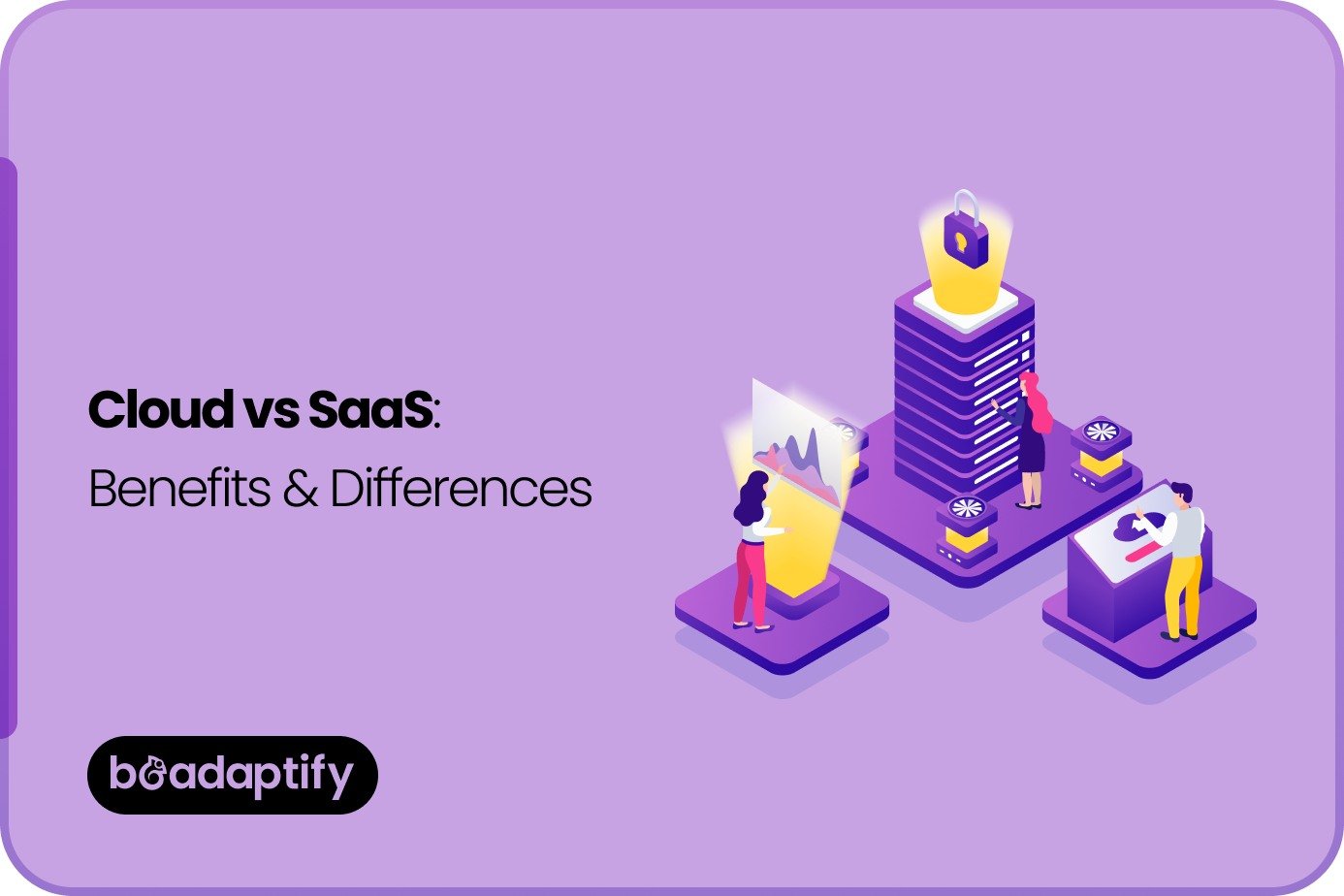
Cloud and SaaS are often used interchangeably in business conversations, but they do not mean the same thing. In 2026, that distinction matters more than ever because technology decisions are being made with greater attention to cost, flexibility, security, control, and long-term scalability. When businesses misunderstand the difference between cloud and SaaS, they often make poor purchasing decisions, misjudge implementation effort, or select the wrong architecture for their operational goals.
At a high level, cloud computing refers to the on-demand delivery of computing resources such as servers, storage, networking, databases, software, and platforms over the internet. SaaS, or Software as a Service, is one delivery model within cloud computing. In other words, SaaS is part of the cloud ecosystem, but cloud is much broader than SaaS. This is one of the most important ideas to understand before comparing the two.
The distinction becomes especially relevant when businesses are deciding whether software should be purchased as a ready-made subscription product, built as a custom solution on cloud infrastructure, or supported through a hybrid architecture. In many cases, one option will offer speed and simplicity, while the other will offer deeper customization and control. The right choice depends on the business model, technical maturity, budget structure, compliance needs, and growth plans of the organization.
This guide explains the key differences between cloud and SaaS, outlines major use cases, and explores the business benefits of each model in 2026.
What Is Cloud Computing?
Cloud computing is the delivery of computing services over the internet. These services can include infrastructure, storage, virtual machines, data processing, networking, analytics, databases, development platforms, and software applications. Instead of buying and maintaining all hardware and systems internally, organizations can access what they need on demand through a cloud provider.
The cloud model is usually valued because it allows businesses to scale resources, reduce infrastructure burden, and access services more flexibly. However, cloud is not one single product category. It includes different layers of service, and each layer shifts responsibility differently between the provider and the customer.
The most common cloud service models are:
- Infrastructure as a Service (IaaS)
- Platform as a Service (PaaS)
- Software as a Service (SaaS)
This means that SaaS is one form of cloud delivery, but not the only form.
Cloud computing may also be deployed through different structures such as:
- public cloud
- private cloud
- hybrid cloud
The word “cloud” therefore describes an operating model and a delivery structure, not just a specific type of software.
What Is SaaS?
SaaS, or Software as a Service, is a cloud-based software delivery model in which applications are accessed through the internet, usually by subscription. Instead of purchasing software licenses, installing products on local infrastructure, and managing updates internally, businesses subscribe to software that is hosted and maintained by the provider.
In the SaaS model, the vendor usually manages:
- hosting
- maintenance
- software updates
- core infrastructure
- availability
- baseline security responsibilities
The user or customer generally focuses on:
- using the application
- configuring workflows
- managing data and user access
- integrating the product with internal operations
SaaS is often preferred because it reduces setup time and operational complexity. It is especially useful when a business wants to deploy a standard business function quickly without building custom infrastructure from scratch.
Common examples of SaaS include:
- CRM platforms
- project management tools
- accounting software
- HR systems
- email marketing platforms
- collaboration tools
- customer support software
In simple terms, SaaS is usually the fastest way to start using software, while broader cloud solutions often offer more flexibility and control.
The Most Important Difference Between Cloud and SaaS
The most important difference is that cloud is a broader category, while SaaS is one specific model inside that category.
Cloud can provide raw infrastructure, managed development platforms, or fully managed software. SaaS only refers to the software layer. If a company uses cloud servers to host a custom-built internal platform, that company is using cloud computing but not necessarily SaaS. If a company subscribes to a third-party CRM product accessed through a browser, that company is using SaaS.
This difference affects:
- how much control the business has
- who manages the infrastructure
- how customization is handled
- how security responsibilities are divided
- how fast deployment can happen
- how software costs are structured
Cloud is often selected when custom systems, deep integrations, or flexible infrastructure control are needed. SaaS is often selected when a standard business capability can be adopted quickly with lower operational overhead.
Cloud vs SaaS: Control and Ownership
One of the clearest differences between cloud and SaaS is the level of control that is provided.
In a SaaS Model
In SaaS, the application is usually owned and operated by the vendor. Customers access the software through a subscription model, but full product control is not provided. The business may be allowed to configure settings, workflows, permissions, and integrations, but the core product is still controlled by the vendor.
This means the vendor decides:
- update schedules
- major feature releases
- core system architecture
- hosting environment
- product roadmap direction
The customer benefits from less technical burden, but also has less freedom.
In a Broader Cloud Model
When cloud infrastructure or platform services are used directly, the business usually has more control. It may choose how applications are built, deployed, hosted, scaled, and secured. The business can create custom logic, define its own data structures, and adapt systems more deeply.
This means cloud is often more suitable when:
- custom workflows are essential
- unique business logic must be built
- product differentiation matters
- industry-specific compliance must be handled carefully
- integration needs are complex
This is where a professional software development company becomes especially important, because greater control usually requires stronger engineering planning.
Cloud vs SaaS: Customization
Customization is another major difference.
SaaS Customization
SaaS products are often customizable only within the boundaries defined by the vendor. This may include:
- user roles
- workflow settings
- form customization
- dashboard configuration
- template changes
- integrations with other tools
This level of customization is often enough for standard operational needs. However, deep system-level changes are usually not available unless the SaaS vendor explicitly supports them.
Cloud-Based Customization
Cloud-based architectures allow much greater flexibility. Businesses can build software from the ground up or modernize existing platforms using cloud resources. This allows them to define exactly how the product should behave.
This is especially valuable when:
- no off-the-shelf product fits the workflow well
- the business model is unique
- the product itself is a competitive differentiator
- customer experience must be highly controlled
- internal systems must be tightly integrated
In these cases, software product development services are often used to create cloud-based systems tailored to operational and strategic requirements.
Cloud vs SaaS: Speed of Deployment
Deployment speed is one of the biggest reasons businesses choose SaaS.
SaaS Deployment Speed
SaaS products are usually faster to adopt because the infrastructure and core product already exist. In many cases, businesses can begin using the software almost immediately after account setup, configuration, and onboarding.
This makes SaaS attractive when:
- teams need software quickly
- there is little appetite for long implementation cycles
- the workflow is common across many businesses
- internal technical resources are limited
Cloud Deployment Speed
Cloud-based custom development generally takes more time because the system has to be designed, built, tested, and deployed. While cloud infrastructure can accelerate development compared to on-premise setups, a cloud-based custom platform is still usually slower to launch than a SaaS subscription.
However, this slower start may be worthwhile when long-term flexibility, differentiation, and scalability are more important than immediate setup speed.
Cloud vs SaaS: Cost Structure
Cost is one of the most misunderstood parts of this comparison.
SaaS Cost Structure
SaaS products are usually paid for through recurring subscription pricing. This may be based on:
- number of users
- number of seats
- usage volume
- feature tier
- storage or automation limits
SaaS often has a lower upfront cost because the business is not funding full product development or infrastructure ownership. However, over time, recurring subscriptions can become expensive, especially if usage grows or multiple tools are combined.
Cloud Cost Structure
Cloud-based systems often involve higher initial cost because design, development, architecture, integrations, and testing must be funded. But the cost structure can become more strategic over the long term when the product is tailored closely to the business and avoids ongoing SaaS sprawl.
Cloud cost may include:
- development cost
- hosting
- database usage
- compute and storage
- monitoring
- security tooling
- support and maintenance
For some businesses, SaaS is more economical. For others, especially those with large teams or unique workflows, custom cloud solutions may become more efficient over time.
Cloud vs SaaS: Security and Responsibility
Security responsibility is handled differently across cloud and SaaS models.
SaaS Security
In SaaS, more of the operational burden is handled by the vendor. The provider usually manages hosting, maintenance, infrastructure protection, and product-level patching. However, customers still remain responsible for how the software is used, which users have access, how data is governed internally, and how integrations are controlled.
This means SaaS reduces some security burden, but not all of it.
Cloud Security
In cloud environments, responsibility is usually shared more actively between the provider and the customer, depending on whether infrastructure, platform, or software services are being used. If the business is building its own product on cloud infrastructure, it usually carries much more responsibility for application security, configuration, identity management, and governance.
This makes cloud more flexible, but also more demanding from a technical and operational perspective.
For organizations with stricter compliance or security requirements, this is often a major factor in deciding whether SaaS is enough or whether a custom cloud-based system should be built.
Cloud vs SaaS: Scalability
Both models support scalability, but they do so differently.
SaaS Scalability
SaaS is scalable in the sense that it allows more users, more seats, or more usage to be added quickly. This is useful when businesses need growth without engineering effort. However, the limits of SaaS scalability are defined by the vendor’s product structure and pricing model.
Cloud Scalability
Cloud-based custom systems offer much deeper scalability because the architecture can be designed around the exact product and business requirements. Infrastructure can be scaled, services can be distributed, databases can be optimized, and application performance can be tuned more directly.
This is one reason businesses with complex products or rapidly growing user bases often invest in enterprise software development services instead of relying only on off-the-shelf SaaS.
Common Use Cases for SaaS
SaaS is usually the right fit when the business problem is standard, common, and not deeply differentiating.
Common SaaS Use Cases
- CRM and sales management
- email marketing
- accounting and invoicing
- customer support software
- HR and payroll tools
- team collaboration
- document management
- project management
These are areas where businesses often do not need to build a unique product from scratch. A proven SaaS product can usually be deployed faster and maintained more easily.
SaaS works especially well when:
- the workflow is common
- fast deployment matters
- internal IT complexity should be reduced
- the business prefers predictable recurring cost
- deep product ownership is not essential
Common Use Cases for Cloud-Based Custom Solutions
Cloud is often the better choice when the system being built is a strategic business asset rather than a generic support tool.
Common Cloud-Based Use Cases
- customer-facing digital platforms
- enterprise internal tools with unique workflows
- industry-specific platforms
- data-heavy products
- AI-enabled applications
- marketplaces
- logistics systems
- financial or healthcare platforms
- custom B2B SaaS products
In these cases, generic SaaS is often too rigid or too shallow. A custom cloud solution gives the business greater control over user experience, business logic, integrations, and long-term product growth.
This is where a skilled software product development company and structured design & development services can create more long-term value than a subscription-only model.
Business Benefits of SaaS
SaaS provides several clear business advantages.
Faster Time to Value
Because setup is usually quicker, teams can begin using software sooner.
Lower Initial Investment
There is usually no need to build the product from scratch.
Reduced Technical Burden
Maintenance, updates, and infrastructure management are handled by the provider.
Predictable Subscription Model
Recurring pricing can make budgeting easier, especially for smaller teams.
Simpler Access and Distribution
Users can often log in from anywhere with internet access and supported devices.
These benefits make SaaS especially attractive for startups, SMBs, and teams trying to move fast without heavy technical overhead.
Business Benefits of Cloud-Based Solutions
Cloud-based solutions offer a different set of advantages.
Deeper Customization
The product can be built around the business instead of forcing the business to adapt to the product.
Better Control
The organization can define architecture, integrations, workflows, and scalability on its own terms.
Stronger Differentiation
Custom cloud systems can become strategic assets that support competitive advantage.
More Flexible Integration
Internal systems, customer platforms, and data tools can be connected more deeply.
Long-Term Product Ownership
The business owns the product logic and roadmap rather than depending on a third-party vendor’s priorities.
These benefits are especially valuable when software is part of the core business model rather than just an operational utility.
When Should a Business Choose SaaS?
SaaS is usually the better choice when:
- the problem is standard and well understood
- fast deployment matters more than deep customization
- internal IT resources are limited
- a quick operational solution is needed
- product ownership is not strategically important
If the goal is to solve a common business function efficiently, SaaS is often the right answer.
When Should a Business Choose Cloud-Based Custom Development?
Cloud-based development is usually the better choice when:
- workflows are unique
- the product itself is part of the business strategy
- existing SaaS tools do not fit properly
- deep integration is required
- long-term flexibility matters more than immediate setup speed
- differentiation is important
Should Cloud and SaaS Be Seen as Competing Models?
Cloud and SaaS should not always be seen as competing choices. In many businesses, they are used together.
For example:
- a business may use SaaS for HR, accounting, and CRM
- while also building a custom cloud-based customer platform
- and integrating both into a broader digital ecosystem
This hybrid approach is common because not every system needs the same level of control. Some workflows are well served by SaaS. Others are too strategic or too specialized and require cloud-based custom development. The smarter decision is often not cloud vs SaaS in absolute terms, but where SaaS should be used and where custom cloud systems should be built.
Why Beadaptify Is the Right Software Development Partner?
Choosing between cloud and SaaS requires more than understanding technical definitions. It requires a clear view of business goals, workflow complexity, integration needs, scalability expectations, and long-term product strategy. At Beadaptify, software solutions are built with a focus on usability, flexibility, and long-term business value. As a trusted enterprise software development company, we help businesses evaluate when a SaaS model is enough and when a custom cloud-based product should be built.
Our enterprise software development services and software product development services are designed to support architecture planning, user experience design, custom development, and scalable system integration. Through strong design & development services, we ensure that products are not only technically sound but also aligned with business operations, user expectations, and future growth.
Final Thoughts
Cloud and SaaS are closely related, but they are not the same thing. Cloud is the broader delivery model for computing resources and services over the internet, while SaaS is one specific cloud-based model in which software is delivered as a subscription-ready application managed by the vendor.
Understanding this difference matters because each model offers different trade-offs in control, customization, speed, cost, scalability, and security responsibility. SaaS is often the better choice when speed, simplicity, and standardization are priorities. Cloud-based custom development is often the better choice when deeper product ownership, unique workflows, and long-term flexibility matter more.
In 2026, the most effective businesses are not choosing based on buzzwords. They are choosing based on fit. Some functions are best handled by SaaS. Others are better served through cloud-based custom systems built by a trusted software development company, supported by specialized enterprise software development services and shaped through scalable software product development services and strategic design & development services. The right model is not the one that sounds more advanced. It is the one that best supports the business you are trying to build.

FAQ About Cloud vs SaaS
Is SaaS part of cloud computing?
Yes. SaaS is one cloud delivery model. Other cloud service models include infrastructure and platform-based services.
When should a business choose SaaS?
SaaS is usually the better option when fast deployment, lower upfront cost, and reduced technical management are priorities for standard business functions.
When should a business choose a cloud-based custom solution?
A cloud-based custom solution is often the better choice when the business needs unique workflows, deeper integrations, stronger control, and long-term product ownership.
Is SaaS cheaper than custom cloud development?
SaaS often has a lower initial cost, but long-term expenses may increase depending on subscription pricing, scale, and the number of tools being used. Custom cloud development usually requires a higher upfront investment but may offer more strategic value over time.
Can businesses use both cloud and SaaS together?
Yes. Many businesses use SaaS for standard functions such as CRM or HR while also building custom products or internal systems on cloud infrastructure.