AI in patient portals is changing how patients interact with healthcare providers. From AI-powered virtual assistants and intelligent appointment scheduling to predictive analytics and remote patient monitoring, new capabilities are being introduced to make digital healthcare platforms more responsive to patient needs. Similarly, AI in healthcare apps is helping providers automate repetitive administrative activities, improve patient engagement, and gain meaningful insights from healthcare data.
As healthcare expectations continue to evolve, AI-powered patient portals are becoming an important part of modern healthcare technology solutions. These platforms are being designed to provide more than basic online access to medical services. They are increasingly being developed to support personalized patient experiences, streamline communication, and assist healthcare professionals with better access to relevant information.
For healthcare organizations, hospitals, clinics, and digital health startups, investing in AI healthcare app development can create opportunities to improve operational efficiency and deliver more convenient digital services. With the right software product development strategy, intelligent features can be integrated into existing platforms or introduced through entirely new healthcare applications.
This article explores how AI is transforming patient portals and healthcare apps, the essential features businesses should consider, the benefits and implementation challenges, and the future of AI-powered digital healthcare.
What Are AI-Powered Patient Portals and Healthcare Apps?
AI-powered patient portals and healthcare applications are digital platforms that use artificial intelligence technologies to improve how patients access healthcare services and how providers manage patient interactions.
Traditional patient portals generally allow users to perform basic activities, such as viewing medical records, booking appointments, checking test results, requesting prescription refills, and communicating with healthcare providers. Although these capabilities have improved healthcare accessibility, many traditional platforms still depend on manual processes and limited personalization.
An AI-powered patient portal introduces intelligent capabilities that can help users navigate healthcare services, retrieve relevant information, receive personalized notifications, and interact with virtual assistants. These capabilities can be supported by technologies such as:
- Machine Learning (ML): Used to identify patterns in healthcare data and support predictive analytics.
- Natural Language Processing (NLP): Used to understand patient questions and improve conversational interactions.
- Generative AI: Used to summarize information, generate responses, and support healthcare communication.
- Predictive Analytics: Used to identify potential trends and risks from relevant patient data.
- Conversational AI: Used to power virtual healthcare assistants and automated patient support.
- Intelligent Automation: Used to streamline appointment management, administrative tasks, and routine workflows.
For example, when a patient logs into a smart patient portal, an AI-powered assistant may help locate appointment information, explain how to access available medical documents, or direct the patient to the appropriate healthcare service. Similarly, healthcare providers may be supported through automated documentation workflows and intelligent information retrieval.
The objective is not to replace healthcare professionals. Instead, artificial intelligence in healthcare is being used to make digital services more accessible, improve administrative efficiency, and support better-informed interactions between patients and providers.
How AI Is Transforming Patient Portals and Healthcare Apps
AI is introducing new capabilities across patient portals and healthcare applications. From improving patient communication to supporting data-driven healthcare operations, several applications are changing how digital healthcare platforms are developed and used.
1 AI-Powered Virtual Healthcare Assistants
Virtual healthcare assistants are among the most recognizable applications of AI in healthcare apps. These assistants can be integrated into patient portals to help users access information, navigate platform features, and receive answers to common administrative questions.
Unlike conventional chat interfaces that rely entirely on predefined responses, conversational AI systems can use natural language processing to understand different ways of asking questions.
For example, a patient may ask:
- When is my next appointment?
- How can I download my medical report?
- Where can I find my prescription information?
- How can I request an appointment with a specialist?
An AI-powered virtual healthcare assistant can help users locate relevant portal information and guide them through supported processes.
These assistants can also be made available outside regular administrative working hours, helping patients access basic support when human representatives are unavailable.
However, patient-facing assistants should be designed with appropriate safeguards. Medical advice, diagnosis, treatment decisions, and urgent symptoms should be handled through qualified healthcare professionals and established clinical pathways rather than unrestricted AI-generated responses.
2 Intelligent Appointment Scheduling and Management
Appointment scheduling is one of the most common activities performed through patient portals. However, traditional scheduling systems can involve multiple manual steps, including checking availability, selecting providers, confirming appointments, and sending reminders.
AI can make these processes more efficient through intelligent appointment management.
AI-powered scheduling features can be designed to:
- Suggest suitable appointment slots based on provider availability.
- Send personalized appointment reminders.
- Help patients reschedule or cancel appointments.
- Identify scheduling conflicts.
- Support appointment waitlists.
- Automate routine booking confirmations.
For example, if a patient needs to reschedule an appointment, an intelligent scheduling assistant can display available alternatives and guide the patient through the process.
Predictive analytics may also be used to identify appointment patterns and estimate no-show risks. Healthcare organizations can then evaluate appropriate reminder strategies to improve scheduling efficiency.
These capabilities can improve patient convenience while reducing administrative workload for hospitals, clinics, and healthcare service providers.
3 Personalized Patient Experiences
Personalization is becoming an important part of modern digital healthcare. Patients have different medical histories, healthcare requirements, treatment schedules, and communication preferences. A generic portal experience may not address these individual needs effectively.
AI-powered patient engagement can help make healthcare applications more relevant by organizing information and presenting suitable content based on authorized patient data and preferences.
For example, a patient managing a long-term condition may be shown relevant appointment reminders, educational resources, and follow-up instructions. Another patient recovering from surgery may receive access to recovery-related guidance and scheduled follow-up information.
Personalized patient experiences can include:
- Relevant health information and educational resources.
- Personalized appointment and follow-up reminders.
- Individualized portal dashboards.
- Relevant medication and prescription notifications.
- Health progress summaries.
- Communication preferences based on user settings.
Such features can make patient portals easier to navigate and encourage more consistent interaction with digital healthcare services.
However, personalization should be implemented with appropriate consent, privacy controls, and clinical oversight. Recommendations should not be presented as individualized medical advice unless they have been appropriately validated and approved for that purpose.
4 Automated Patient Communication
Communication between patients and healthcare providers is essential for delivering effective healthcare services. However, high volumes of routine questions, appointment requests, and administrative messages can place pressure on healthcare support teams.
AI-powered healthcare solutions can help streamline these interactions through conversational interfaces, automated notifications, and intelligent message management.
For instance, AI can be used to classify incoming patient messages, identify their general purpose, and direct them to the appropriate department or support team. Routine administrative questions can be handled through approved automated responses, while more complex concerns can be escalated to human representatives.
Common applications include:
- Appointment confirmation messages.
- Follow-up notifications.
- Prescription refill reminders.
- General portal navigation assistance.
- Administrative query routing.
- Multilingual communication support.
When healthcare chatbot development is approached carefully, communication can become more accessible and consistent. It can also help healthcare organizations manage routine requests without requiring every interaction to be handled manually.
5 Predictive Analytics and Health Insights
Predictive analytics in healthcare involves analyzing relevant historical and current data to identify patterns that may help healthcare professionals understand potential risks and trends.
When integrated into healthcare applications, these capabilities can support the analysis of information collected from electronic health records, clinical systems, and approved monitoring devices.
For example, an appropriately validated predictive model may help identify patterns associated with a patient’s risk of developing certain complications. Healthcare professionals can then review the available information and determine whether further assessment is required.
Potential applications include:
- Identifying patients who may require additional follow-up.
- Supporting chronic disease management programs.
- Analyzing patient health trends.
- Identifying potential readmission risks.
- Supporting population health management.
- Helping clinicians review relevant patient information.
Predictive insights should be treated as decision-support information rather than definitive diagnoses. Their reliability depends on data quality, clinical validation, appropriate model selection, and ongoing monitoring.
6 Remote Patient Monitoring Through AI Integration
Remote patient monitoring is becoming an important component of connected healthcare. Through wearable devices, smart medical equipment, and mobile applications, relevant health information can be collected outside traditional clinical environments.
AI can help analyze this information and identify patterns that may require attention.
For example, a remote patient monitoring application may collect data such as:
- Heart rate.
- Blood pressure.
- Blood glucose levels.
- Oxygen saturation.
- Physical activity.
- Sleep patterns.
When this information is integrated into a healthcare application, AI-based analytics can help identify unusual readings or changes in recorded patterns. Configured alerts can then be sent to healthcare teams for review.
This approach can be useful in chronic disease management, post-operative monitoring, and certain forms of long-term care.
Remote patient monitoring should be designed with reliable device integrations, appropriate consent, data security, and clearly defined escalation procedures. AI-generated alerts should not be treated as a substitute for emergency services or professional medical assessment.
7 Smart EHR and Medical Record Management
Electronic health records (EHR) contain important information about patient histories, medications, diagnoses, laboratory results, and clinical encounters. However, navigating large volumes of medical information can be time-consuming for healthcare professionals.
AI can support smarter medical record management by improving information retrieval, organizing relevant data, and assisting with documentation workflows.
For example, AI-powered search functionality may help authorized users locate specific information within patient records more efficiently. Generative AI may also be used to prepare draft summaries of lengthy medical documents for review by qualified professionals.
Potential applications include:
- Automated document classification.
- Medical record summarization.
- Intelligent information search.
- Clinical documentation assistance.
- Duplicate information identification.
- EHR data organization.
Electronic health records (EHR) integration is therefore an important consideration during patient portal development. Seamless integration can help ensure that authorized information is made available across connected healthcare systems without creating unnecessary data silos.
Any AI-generated clinical documentation or summaries should be reviewed for accuracy before being used in patient care.
8 AI-Powered Medication and Treatment Reminders
Medication adherence can be difficult for patients who manage multiple prescriptions or follow complex treatment schedules. Healthcare applications can help address this challenge through intelligent reminders and medication management features.
AI can be used to organize medication schedules, identify missed reminder patterns, and support personalized notification preferences.
For example, a patient may receive reminders based on a prescribed medication schedule and preferred notification settings. If a reminder is missed, the application may provide a follow-up notification according to predefined rules.
Other useful capabilities include:
- Medication schedule management.
- Prescription refill reminders.
- Treatment follow-up notifications.
- Medication history access.
- Appointment-linked reminders.
- Personalized notification settings.
These features can help patients manage their healthcare routines more conveniently. However, medication recommendations, dosage changes, and treatment adjustments must remain under the direction of qualified healthcare professionals.
9 Intelligent Patient Support and Navigation
Healthcare platforms often contain multiple sections, services, documents, and communication channels. Patients may sometimes struggle to locate the information they need.
AI-powered search and navigation can simplify this experience by allowing users to interact with healthcare applications through natural language.
For example, instead of manually navigating multiple sections, a patient may ask where laboratory reports are available or how to contact a particular department.
An intelligent assistant can interpret the request and direct the user to the appropriate portal section, provided the requested information is accessible and the user is authorized to view it.
These features can improve accessibility, reduce navigation complexity, and create a more convenient digital healthcare experience.
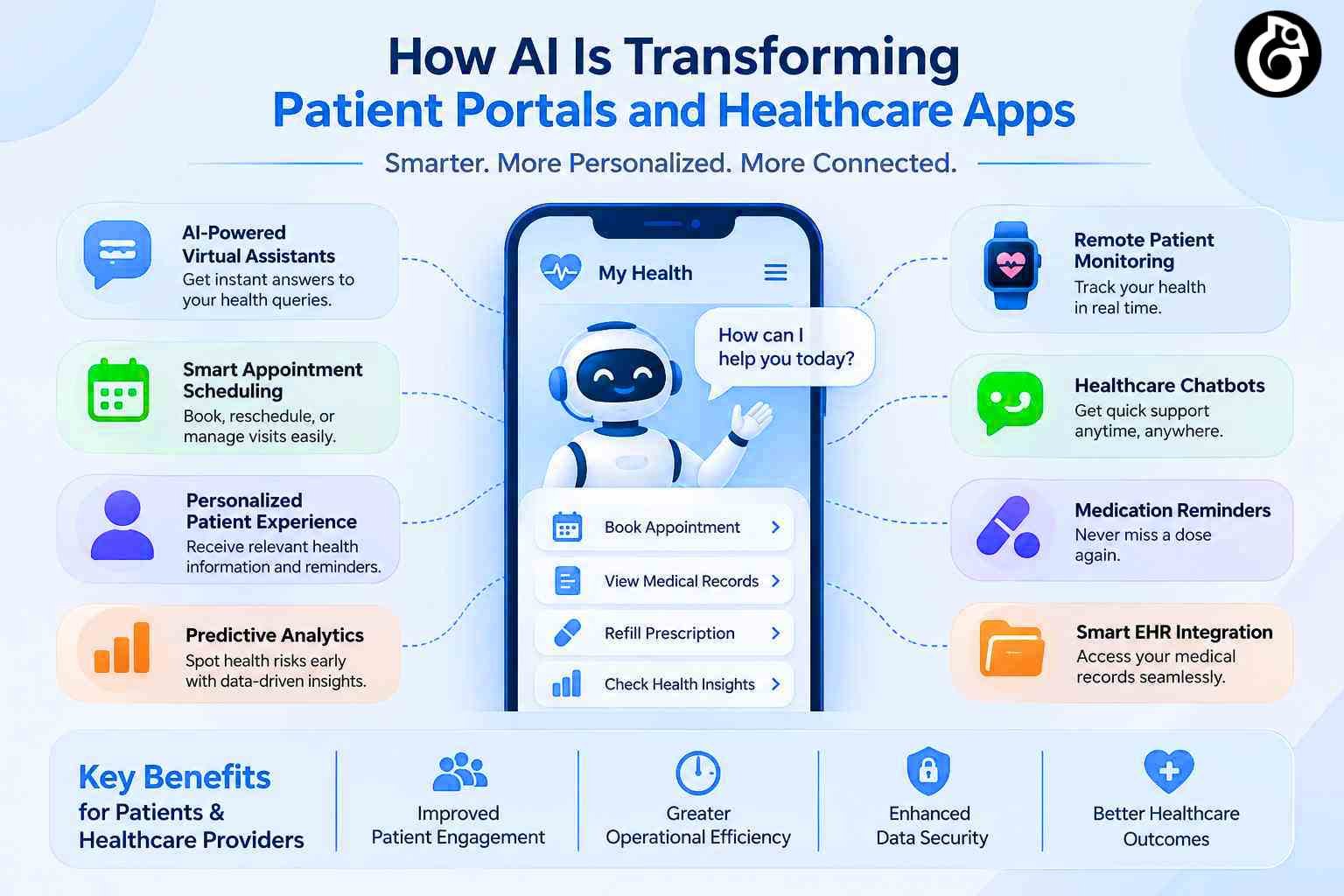
Key Benefits of AI-Powered Patient Portals for Healthcare Providers and Patients
The adoption of AI-powered patient portals can create benefits for both healthcare organizations and patients. When implemented with appropriate technical and clinical safeguards, AI can improve digital interactions while supporting more efficient healthcare operations.
Improved Patient Engagement
AI-powered patient engagement features can make healthcare platforms more interactive and convenient. Through personalized reminders, virtual assistants, and relevant information, patients can be encouraged to interact with their healthcare providers and manage routine activities through digital channels.
Reduced Administrative Workload
Healthcare organizations manage several repetitive activities, including appointment coordination, routine communication, and information retrieval. Healthcare automation can help streamline suitable administrative workflows and allow staff to focus more attention on activities requiring human judgment.
Faster Access to Healthcare Information
AI-powered search, document organization, and virtual assistance can help patients and authorized healthcare professionals locate relevant information more efficiently.
More Personalized Healthcare Experiences
Relevant reminders, personalized dashboards, and tailored educational resources can make healthcare applications more useful for different patient groups.
Better Operational Efficiency
Intelligent scheduling, automated notifications, and workflow management can help healthcare organizations improve administrative processes and make better use of available resources.
Improved Support for Remote Care
AI integration with connected devices and remote monitoring platforms can help healthcare teams review relevant patient information and identify changes that may require attention.
Essential AI Features to Include in Modern Healthcare Apps
When planning AI healthcare app development, the selection of features should be based on the application’s purpose, target users, clinical requirements, and operational needs.
Not every healthcare application requires every AI capability. A patient portal designed for a small clinic may need a different feature set from an enterprise hospital platform.
The following features can be considered during the planning and development process:
AI feature |
Purpose |
Potential benefit |
|---|---|---|
| AI-powered chatbot | Answers common administrative questions | More accessible patient support |
| Voice-enabled assistant | Supports voice-based navigation | Improved accessibility |
| Predictive analytics | Identifies relevant data patterns | Better-informed clinical review |
| Smart appointment scheduling | Assists with appointment management | Reduced scheduling effort |
| Personalized dashboard | Displays relevant patient information | Improved user experience |
| AI-powered search | Helps locate portal information | Faster information access |
| Remote monitoring integration | Analyzes connected device data | Better monitoring workflows |
| Intelligent notifications | Sends relevant reminders | Improved patient engagement |
| Medical record summarization | Creates draft summaries for review | More efficient information review |
| Multilingual assistance | Supports communication in different languages | Greater accessibility |
Along with these features, healthcare applications should include essential platform capabilities such as secure authentication, role-based access, consent management, audit logs, data encryption, and reliable system integrations.
How AI Integration Improves Different Types of Patient Portals
AI can be integrated into different healthcare platforms depending on the services they provide and the needs of their users.
Hospital and Healthcare System Portals
Hospital portals can use AI to support appointment management, patient communication, medical record access, and administrative workflows. Intelligent navigation can also help patients locate departments, services, and relevant information.
Physician and Clinic Portals
Clinic portals can benefit from automated scheduling, patient query management, follow-up reminders, and information retrieval. These features can help smaller healthcare providers manage routine digital interactions more efficiently.
Personal Health Record Portals
Personal health record platforms can use AI to organize health information, generate understandable summaries, and help users navigate their records. Appropriate consent and access controls should be maintained when information is collected from multiple healthcare sources.
Telehealth and Virtual Care Platforms
Telehealth app development can be enhanced through AI-powered scheduling, virtual assistants, automated administrative workflows, and remote monitoring integrations. These capabilities can support digital consultations and improve the overall virtual care experience.
Chronic Disease Management Portals
Applications designed for chronic disease management can integrate connected devices, patient-reported information, and predictive analytics to support ongoing monitoring and follow-up workflows.
Insurance and Healthcare Member Portals
Healthcare insurance platforms can use AI to assist with policy navigation, document classification, claim-related queries, and customer support. Sensitive decisions involving coverage or claims should remain subject to appropriate review and regulatory requirements.
Challenges of Integrating AI Into Patient Portals and Healthcare Apps
Although AI offers several opportunities for healthcare digital transformation, its implementation requires careful planning. Healthcare applications handle sensitive personal information and may influence decisions related to patient care. Therefore, technical performance, security, reliability, and compliance must be prioritized.
Patient Data Privacy and Security
Healthcare applications process sensitive information, including medical histories, prescriptions, laboratory reports, and personal details. Unauthorized access or data exposure can create serious risks.
Strong encryption, secure authentication, role-based access controls, audit logging, and appropriate consent mechanisms should be implemented. Applicable regulations, including HIPAA in the United States and relevant data protection laws in other regions, should be considered according to the application’s operating locations and responsibilities.
Accuracy and Reliability of AI-Generated Information
Generative AI systems can sometimes produce inaccurate or misleading responses. In healthcare environments, such errors may have significant consequences.
AI-powered applications should therefore be designed with clear limitations, validated information sources, human oversight, and escalation procedures. Clinical recommendations and medical decisions should not be generated or acted upon without appropriate validation and professional involvement.
Integration With Existing Healthcare Systems
Many healthcare organizations already use EHR platforms, hospital management systems, billing software, laboratory systems, and third-party applications.
Integrating AI into these environments can be challenging because of differences in data formats, APIs, workflows, and security requirements. A well-planned integration strategy should be developed to support interoperability and reliable information exchange.
Data Quality and Interoperability
AI systems depend on the quality and consistency of the information used during development and operation. Incomplete, outdated, duplicated, or inconsistent healthcare data can affect model performance.
Data validation, standardization, and appropriate interoperability frameworks should be considered before AI capabilities are introduced.
User Trust and Adoption
Patients and healthcare professionals may hesitate to use AI-powered features if their purpose and limitations are unclear.
Healthcare applications should provide transparent explanations of AI functionality, communicate when users are interacting with automated systems, and make human assistance accessible whenever required.
Ongoing Maintenance and AI Model Monitoring
AI implementation is not a one-time development activity. Models and integrations should be monitored for accuracy, performance, security, and changing requirements.
Regular testing, updates, feedback collection, and model evaluation should be included in the long-term maintenance strategy.
Best Practices for Developing AI-Powered Healthcare Applications
A successful healthcare application should be developed around actual patient and provider requirements rather than the number of AI features included.
The following practices can help businesses build more reliable and scalable healthcare platforms.
Start With Clearly Defined Requirements
The development process should begin by identifying the problems that need to be addressed. These may include patient communication delays, manual appointment management, limited portal accessibility, or inefficient information retrieval.
Clearly defined objectives can help determine which AI capabilities should be prioritized.
Prioritize Security and Privacy From the Beginning
Security should be incorporated into the application’s architecture rather than treated as a final development step. Authentication, authorization, encryption, consent management, and auditability should be considered from the planning stage.
Select Appropriate AI Models and Technologies
Different use cases require different AI technologies. Natural language processing may be suitable for conversational assistants, while machine learning may be more appropriate for specific predictive analytics applications.
Model selection should be based on performance, cost, data requirements, explainability, privacy, and clinical suitability.
Ensure Seamless EHR and Third-Party Integrations
Healthcare applications should be designed to communicate reliably with relevant healthcare systems. Standards such as HL7 and FHIR may be considered where applicable to support structured health information exchange.
Focus on User-Friendly Interfaces
Healthcare applications are used by people with different levels of digital literacy and accessibility requirements. Simple navigation, readable content, accessible controls, and clear communication should be prioritized.
This is where professional UI/UX design services become particularly important. A well-designed interface can make complex healthcare functionality easier to understand and use.
Keep Healthcare Professionals Involved
AI-powered healthcare applications should be developed with input from clinicians, administrators, compliance specialists, and patients.
Clinical workflows should be reviewed by qualified professionals, and appropriate human oversight should be maintained for decisions that may affect patient care.
Begin With an MVP and Expand Gradually
Instead of implementing multiple complex AI features at once, businesses can begin with a focused minimum viable product (MVP).
For example, an initial patient portal may include an AI-powered administrative assistant, smart appointment scheduling, and personalized notifications. Additional capabilities can be introduced after user feedback and performance have been evaluated.
This approach can make development more manageable and help businesses validate their software product development strategy before investing in larger-scale implementation.
How Much Does It Cost to Develop an AI-Powered Patient Portal or Healthcare App?
The cost of developing an AI-powered patient portal or healthcare application depends on the platform’s complexity, selected features, integrations, security requirements, and development timeline.
A basic patient portal with limited AI functionality will generally require a different investment from an enterprise healthcare platform featuring predictive analytics, remote patient monitoring, advanced EHR integration, and multiple user roles.
The following estimates can be used as preliminary planning ranges. Actual costs will depend on the project scope, development location, technology choices, and compliance requirements.
Development level |
Estimated cost |
Estimated timeline |
|---|---|---|
| Basic healthcare app with limited AI features | $30,000–$60,000 | 3–5 months |
| Mid-level AI-powered patient portal | $60,000–$120,000 | 5–8 months |
| Advanced healthcare application | $120,000–$200,000 | 8–12 months |
| Enterprise healthcare platform | $200,000–$250,000+ | 12–18+ months |
Factors Affecting Development Costs
AI Feature Complexity: Conversational assistants, predictive analytics, automated documentation, and personalized recommendations may require different levels of AI development and validation.
UI/UX Design: The number of user roles, dashboard complexity, accessibility requirements, and platform design can influence the overall investment.
Third-Party Integrations: Connecting EHR systems, payment gateways, wearable devices, laboratory systems, and external healthcare services can increase development effort.
Security and Compliance: Encryption, access controls, audit trails, privacy requirements, and regulatory validation should be considered during planning.
Platform Requirements: Developing web portals, iOS applications, Android applications, or a combination of platforms will affect the total project scope.
Maintenance and Optimization: Ongoing infrastructure costs, AI model monitoring, security updates, and technical support should also be included in the overall budget.
For businesses planning to launch a healthcare product, MVP development services can provide a practical starting point. A focused MVP can be used to validate essential features and gather user feedback before a larger investment is made.
The Future of AI in Patient Portals and Healthcare Apps
The future of AI-powered healthcare applications is expected to be shaped by more connected systems, improved personalization, intelligent automation, and advances in AI-assisted information processing.
Several developments are likely to influence the next generation of digital healthcare platforms.
More Advanced Conversational Healthcare Assistants
Conversational AI is expected to become more integrated into patient portals, helping users navigate services, locate information, and complete supported administrative activities through natural language.
Greater Focus on Preventive Healthcare
Predictive analytics and connected health devices may support more proactive healthcare workflows by helping professionals identify patterns that require further assessment.
More Personalized Digital Health Experiences
Healthcare applications may increasingly organize content, reminders, and information around individual preferences and authorized health data.
Connected Healthcare Ecosystems
Improved integration between patient portals, EHR platforms, telehealth applications, wearable devices, and healthcare systems may help create more connected digital experiences.
Intelligent Administrative Automation
AI-powered workflow automation may continue to streamline appointment management, document processing, patient communication, and other repetitive administrative activities.
Increased Focus on Responsible AI
As AI becomes more integrated into healthcare, transparency, explainability, privacy, clinical validation, and human oversight will become increasingly important.
The future of artificial intelligence in healthcare will therefore depend not only on more advanced AI models but also on how responsibly and effectively these technologies are integrated into real-world healthcare environments.
How Beadaptify Can Help Build AI-Powered Healthcare Apps
Developing a successful AI-powered healthcare application requires a combination of technical expertise, user-focused design, secure architecture, and an understanding of healthcare workflows.
At Beadaptify, businesses can be supported through end-to-end software product development, from initial product planning and interface design to application development, AI integration, and ongoing improvements.
Whether an organization wants to develop a new patient portal or introduce intelligent capabilities into an existing healthcare application, the right development approach can help create a more connected and scalable digital healthcare experience.
Custom Healthcare App Development
Healthcare applications can be developed around specific operational requirements, patient needs, and business objectives. Custom healthcare app development can include patient portals, telehealth platforms, appointment management systems, and connected healthcare solutions.
AI Integration Into Existing Platforms
Existing patient portals can be enhanced with AI-powered chatbots, intelligent search, automated communication, predictive analytics, and workflow automation based on the platform’s requirements.
User-Centered Healthcare Interface Design
Healthcare platforms should be easy to navigate for patients, providers, and administrative teams. Through professional UI/UX design services, intuitive interfaces and accessible user journeys can be created for different healthcare applications.
Secure and Scalable Software Development
Healthcare applications should be designed with appropriate security controls, reliable integrations, and scalable architecture. Beadaptify software product development services can support the development of custom digital products aligned with evolving business requirements.
MVP Development for Healthcare Startups
For startups and businesses exploring new healthcare products, an MVP-first approach can help validate the product concept and essential features before a larger launch. Additional capabilities can then be introduced based on user feedback and business priorities.
With the right combination of healthcare app development, AI integration, and design & development services, businesses can create digital healthcare products that are more accessible, efficient, and adaptable to changing patient expectations.

Conclusion
AI is transforming patient portals and healthcare apps by introducing intelligent capabilities that improve patient communication, simplify healthcare workflows, support remote monitoring, and make digital services more personalized.
From virtual healthcare assistants and automated appointment scheduling to predictive analytics and EHR integration, AI-powered healthcare solutions are creating new opportunities for healthcare providers and digital health businesses.
However, successful implementation requires more than adding AI features. Data privacy, security, clinical accuracy, interoperability, accessibility, and human oversight must be considered throughout the development process.
For healthcare organizations planning their next digital initiative, investing in AI healthcare app development can be an opportunity to improve patient experiences and modernize existing operations. With a clear product strategy and the right software product development partner, intelligent healthcare applications can be developed to support both current requirements and future growth.
FAQs on AI Transform Patient Portals & Healthcare Apps
How is AI transforming patient portals and healthcare apps?
AI is transforming patient portals and healthcare apps through virtual assistants, intelligent appointment scheduling, personalized notifications, predictive analytics, and automated administrative workflows. These capabilities can improve patient engagement, simplify access to healthcare information, and help providers manage routine operations more efficiently.
What are the benefits of AI-powered patient portals?
AI-powered patient portals can provide more personalized digital experiences, improve access to information, automate routine communication, reduce administrative workload, and support remote patient monitoring. They can also help healthcare providers organize information and streamline selected workflows while maintaining appropriate clinical oversight.
What AI features should be included in a healthcare app?
Useful AI features may include conversational chatbots, intelligent appointment scheduling, personalized dashboards, predictive analytics, automated reminders, AI-powered search, medical record summarization, and remote monitoring integrations. The right feature set should be selected according to the application’s purpose and user requirements.
Is it safe to integrate AI into patient portal applications?
AI can be integrated into patient portals safely when appropriate security, privacy, and governance measures are implemented. Data encryption, secure authentication, access controls, consent management, audit logging, model validation, and human oversight should be included. Applicable healthcare regulations must also be considered based on the application’s location and use.
How much does it cost to develop an AI-powered healthcare app?
The development cost depends on the application’s complexity, AI features, integrations, platform requirements, and security needs. A basic healthcare application with limited AI functionality may cost approximately $30,000–$60,000, while advanced or enterprise-level platforms may require $120,000–$250,000 or more. A detailed estimate should be prepared after the project requirements have been evaluated.