When a new digital product is being planned, one of the first technology decisions is often whether a web app or mobile app should be built first. Both options can provide valuable business opportunities, but the right choice will depend on the target audience, business model, required features, budget, development timeline, and long-term product strategy.
A web application can be accessed through a browser across multiple devices, while a mobile application is designed specifically for smartphones and tablets. Although both can be used to deliver similar services, differences can be found in accessibility, performance, user engagement, development costs, maintenance, and device capabilities.
For businesses that are still validating an idea, the decision becomes even more important. A web application may allow an idea to be tested with a broader audience at a comparatively lower initial investment. On the other hand, a mobile application may be more appropriate when frequent engagement, device-specific features, personalization, or mobile-first experiences are central to the product.
So, should my business build a web app or mobile app first? The answer should not be based simply on which technology is more popular. Instead, the product requirements and business objectives should be evaluated before development is started.
What Is the Difference Between a Web App and a Mobile App?
A web application is software that is accessed through a web browser. It can be opened through browsers such as Chrome, Safari, Edge, or Firefox without requiring a traditional app-store installation. Responsive web applications can also be designed to adapt to desktops, tablets, and smartphones.
A mobile application, in comparison, is developed specifically for mobile operating systems such as Android or iOS. It can be distributed through app stores and can take advantage of device capabilities such as cameras, GPS, biometrics, push notifications, sensors, and offline storage.
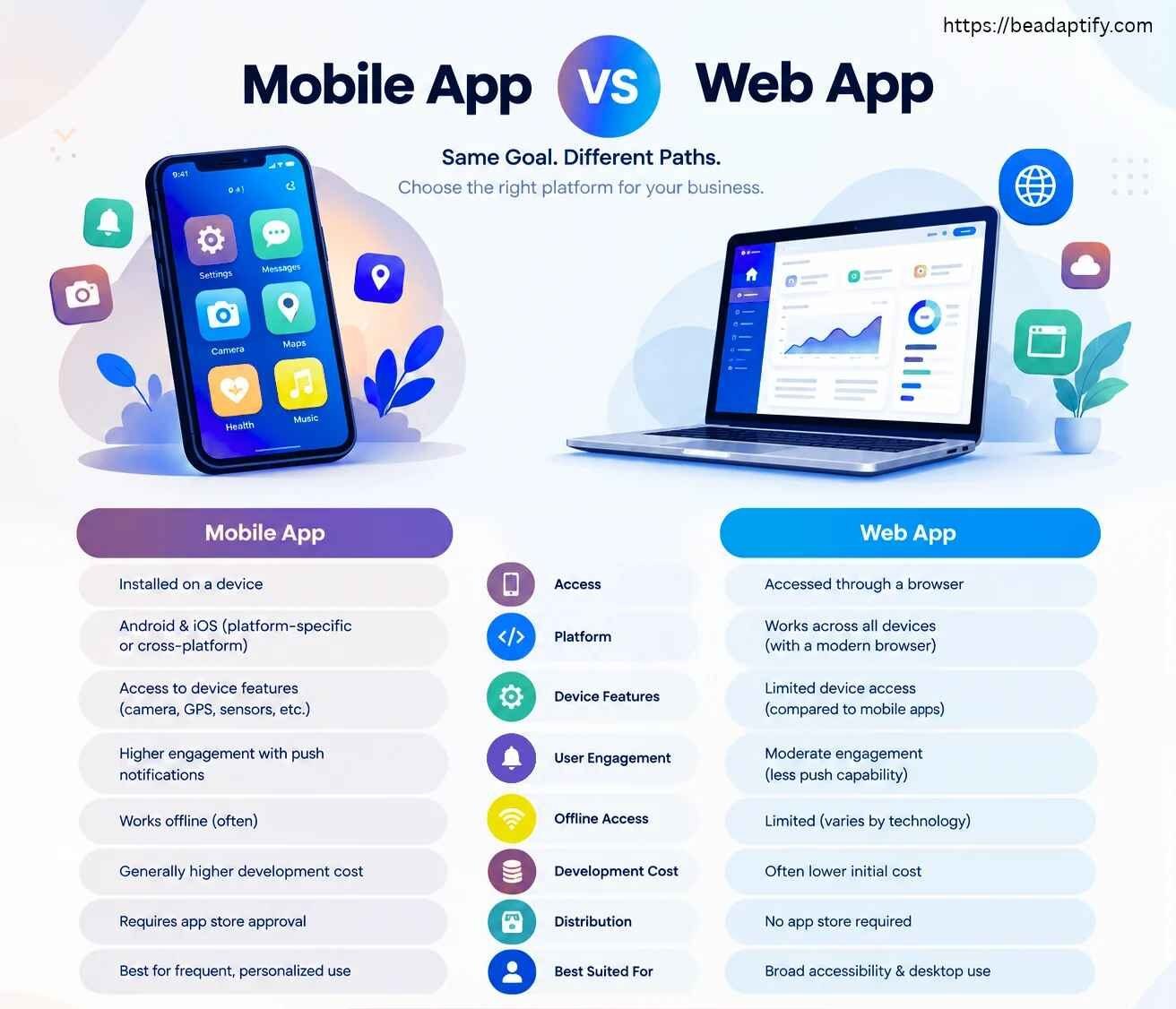
The main differences can be summarized across several areas:
Factor |
Web App |
Mobile App |
|---|---|---|
| Accessibility | Browser-based | Installed on a device |
| Installation | Usually not required | Usually required |
| Platform reach | Multiple devices through browsers | Android/iOS-specific development |
| Device features | More limited | Extensive access to device capabilities |
| Updates | Usually deployed centrally | Often distributed through app updates |
| User engagement | Moderate | High potential through notifications |
| Development | Often one responsive platform | Native or cross-platform development |
| Offline functionality | Limited but possible | Generally stronger |
| App-store presence | Not required | Usually required |
| Maintenance | Centralized | Platform-dependent |
This comparison does not mean that one approach is universally better. The appropriate solution will be determined by how the product is expected to be used.
Web App vs Mobile App: Which Is Better for a New Business?
For a new business, a web application can often be a practical starting point because a wider audience can be reached without requiring users to download an application. A browser-based product can also be launched across multiple operating systems with a single responsive experience. However, web app vs mobile app: which is better for a new business? The answer depends on the product’s core use case.
A web app may be preferred when:
- Broad accessibility is required.
- Users are expected to access the product from different devices.
- The product needs to be validated quickly.
- Development resources are limited.
- Search visibility and browser accessibility are important.
- Desktop usage is expected to be significant.
- Frequent app-store updates are undesirable.
A mobile app may be preferred when:
- Frequent user engagement is expected.
- Push notifications are important.
- GPS, camera, Bluetooth, or biometrics are required.
- Offline functionality is important.
- Personalized mobile experiences are central to the product.
- Users are expected to interact with the product several times a day.
Therefore, the decision should be connected to the customer journey rather than being based purely on technology preferences.
When Is a Web App Better Than a Mobile App for a Business?
A web app can be a stronger choice when accessibility and rapid market reach are the primary priorities. For example, a SaaS platform used by employees, an online booking system, a business dashboard, an analytics platform, or a B2B application may benefit significantly from web-based access. Users can be provided with login credentials and can access the application from computers, tablets, or smartphones.
The advantages of building a web app first can include:
1. Wider Accessibility
A web application can be accessed from almost any modern device with a compatible browser. Customers do not necessarily need to visit an app store or install additional software.
2. Faster Deployment
Changes can generally be deployed centrally. Once an update has been released, users can access the latest version through the browser.
3. Lower Initial Platform Complexity
A responsive web application can serve multiple operating systems without requiring separate native applications. This can simplify the initial development process.
4. Easier Product Validation
For startups, a web application can be used to validate an idea before significant resources are committed to native mobile development.
5. Stronger Desktop Experience
When users need dashboards, reports, data entry, administration, or complex workflows, a larger browser-based interface may be more convenient. For these reasons, businesses that are still validating their product-market fit may find web development to be an effective first step.
When Should a Business Choose Mobile App Development Over Web App Development?
Mobile app development should be considered first when the customer experience depends heavily on smartphone capabilities or frequent mobile engagement. For example, fitness applications, food delivery platforms, ride-sharing services, social networking applications, location-based services, mobile banking applications, and field-service applications can benefit from mobile-first experiences.
Several factors can make mobile development more suitable.
Push Notifications
Notifications can be used to communicate order updates, appointment reminders, promotions, messages, alerts, and other time-sensitive information.
Device Capabilities
A mobile application can be connected to capabilities such as GPS, cameras, microphones, biometric authentication, contacts, Bluetooth, and sensors.
Personalized Experiences
Mobile applications can be designed around individual users, allowing personalized recommendations, saved preferences, location-based features, and behavioral experiences to be delivered.
Offline Functionality
Certain mobile applications can continue providing selected functionality when connectivity is unavailable. Data can be synchronized when a connection becomes available again.
Frequent Engagement
When customers are expected to interact with a product regularly, a mobile application can provide a convenient experience through a dedicated icon and notifications. Therefore, when should a business choose mobile app development over web app development? It should generally be considered when mobile interaction is central to the value proposition rather than simply being an additional access channel.
What Are the Advantages of Building a Web App First?
Building a web application first can provide several strategic advantages, particularly for startups and businesses entering a new market. The product can be launched to a broader audience, feedback can be collected, and business assumptions can be validated before additional platforms are developed.
A web-first approach can also reduce early development complexity. Instead of simultaneously maintaining Android, iOS, and web products, the initial product can be focused on one responsive platform. This approach can be especially useful when an MVP app development strategy is being followed. Core features can be introduced first, user behavior can be measured, and additional functionality can be prioritized based on actual demand.
What Are the Advantages of Building a Mobile App First?
A mobile-first strategy can be beneficial when smartphones represent the primary channel through which customers interact with the business. A dedicated application can provide stronger engagement through notifications, personalization, device integration, and mobile-specific interfaces.
Mobile applications can also provide a more controlled user experience. The interface, navigation patterns, performance, permissions, and interactions can be optimized specifically for the target device.
For consumer-facing businesses where frequent interaction is expected, this can create significant long-term value. However, the additional development and maintenance requirements of Android and iOS should be considered before a mobile-first strategy is selected.
Is It Cheaper to Build a Web App or Mobile App?
In many cases, a web application can require a lower initial investment than developing separate native applications for Android and iOS. However, the actual cost will depend heavily on functionality, integrations, design complexity, security requirements, backend infrastructure, and development methodology.
A basic web application may be developed with a comparatively smaller scope, while a complex web platform involving real-time communication, payments, AI, analytics, and enterprise integrations can become highly sophisticated. Similarly, a mobile application can range from a simple MVP to a large-scale platform requiring native development, advanced animations, offline capabilities, push notifications, payment integration, and extensive backend infrastructure.
Therefore, how much does it cost to build a web app vs a mobile app? cannot be answered with one universal figure.
A more useful comparison should consider:
- Number of features
- UI/UX complexity
- Backend requirements
- Third-party integrations
- Authentication and security
- Number of platforms
- Development team structure
- Testing requirements
- Maintenance requirements
- Cloud and infrastructure costs
Cost should therefore be evaluated against expected business value rather than being treated as the only deciding factor.
Web App vs Mobile App Development: Time to Market
Time to market can be an important consideration for startups and businesses operating in competitive markets. A responsive web application can sometimes be released faster because a single platform can be used to reach multiple device categories. However, development speed will still depend on product complexity.
Mobile development can require additional work when native applications are developed separately for Android and iOS. Cross-platform frameworks can reduce duplication, but platform-specific testing and optimization will still be required. Businesses that need to validate an idea quickly may therefore benefit from launching a focused MVP before expanding to additional platforms.
Should Startups Build an MVP Web App or Mobile App First?
For startups, an MVP should be built around the most important customer problem rather than around a large list of features. If the core customer journey can be completed effectively through a browser, an MVP web app may be appropriate. If the product depends on location, camera access, notifications, mobile payments, or frequent smartphone interaction, an MVP mobile application may be more suitable.
The objective should be to validate assumptions with the smallest practical product.
An MVP can then be used to measure:
- User acquisition
- Engagement
- Retention
- Conversion
- Feature usage
- Customer feedback
- Revenue potential
- Operational efficiency
Once sufficient evidence has been collected, additional platforms can be developed with greater confidence.
Can a Web App Be Converted Into a Mobile App Later?
Yes, a web application can often be followed by mobile application development. However, it should not be assumed that a web application can simply be converted into a mobile app without additional engineering.
The backend, APIs, authentication systems, database architecture, business logic, and design system can potentially be reused. However, the mobile interface should generally be redesigned around mobile interaction patterns.
If a mobile application is expected to be developed later, the initial architecture should therefore be planned with scalability and API-based integration in mind. A well-designed backend can make future expansion into Android and iOS considerably easier.
Can a Responsive Web App Replace a Mobile App?
A responsive web app can replace a mobile app in certain use cases, but it should not be treated as a universal substitute. For applications that mainly require forms, dashboards, content, account management, booking, analytics, or basic transactions, a responsive web experience may be sufficient.
However, when deep device integration, push notifications, offline functionality, or frequent engagement is required, a dedicated mobile application may provide a better experience. The decision should therefore be based on user expectations and functional requirements.
Which Has Better ROI: a Web App or Mobile App?
There is no universal answer to which platform provides better ROI. A web application may provide better ROI when customer acquisition depends on accessibility, rapid deployment, broad device support, and lower initial development complexity.
A mobile application may generate stronger ROI when customer retention depends on frequent engagement, personalized experiences, notifications, and device-specific capabilities.
ROI should be measured using business-specific indicators such as:
- Customer acquisition cost
- Customer lifetime value
- Conversion rate
- Retention rate
- Monthly active users
- Revenue per user
- Operational cost savings
- Support cost reduction
- Engagement rate
A platform that costs less to develop but fails to meet customer expectations may ultimately provide lower ROI than a more expensive solution that generates stronger retention and revenue.
What Factors Should Businesses Consider Before Choosing Web or Mobile App Development?
Before development is started, several strategic factors should be evaluated.
Target Audience
The devices used by the target audience should be identified. If customers primarily access services from smartphones, mobile-first development may be appropriate.
Product Type
The nature of the product should also be considered. SaaS platforms, internal dashboards, marketplaces, booking systems, social applications, and location-based products can have very different requirements.
Required Features
Features such as GPS, camera access, push notifications, offline mode, Bluetooth, biometrics, and background processing can influence the platform decision.
Budget
The available development budget should be evaluated against the expected business outcome. A phased approach can be considered when a full multi-platform launch cannot be justified initially.
Time to Market
When rapid validation is required, a web-based MVP can sometimes provide a practical starting point.
Scalability
The future product roadmap should be considered from the beginning. APIs, modular architecture, cloud infrastructure, and reusable backend services can be established to support future expansion.
User Experience
The platform should match how customers naturally interact with the product. UI/UX design services can be used to create user journeys that are optimized for the selected platform.
The Role of Web Development Services in Building a Web App
Bespoke web development services can be used to transform a business concept into a secure, responsive, and scalable web application.
The development process can include:
- Business and technical analysis
- Information architecture
- UI/UX design
- Frontend development
- Backend development
- API development
- Database integration
- Authentication
- Security implementation
- Quality assurance
- Deployment
- Maintenance
For businesses that need specialized expertise, the option to hire web developers can provide access to professionals who can work with modern frontend frameworks, backend technologies, databases, APIs, cloud infrastructure, and security requirements.
The Role of Mobile App Development Services
When a mobile-first product is selected, professional mobile app development services can be used to build applications optimized for Android, iOS, or both platforms.
Development can include:
- Mobile UI/UX design
- Native or cross-platform development
- API integration
- Push notifications
- Payment integration
- Device feature integration
- Offline functionality
- App security
- Testing across devices
- App-store deployment
- Ongoing maintenance
Businesses can also hire mobile app developers when specialized experience is needed for native or cross-platform application development.
How Mobile App Development Solutions Can Support Business Growth
Modern custom mobile app development solutions can be designed beyond basic application functionality. APIs, cloud infrastructure, analytics, automation, AI, payment systems, CRM platforms, and other enterprise technologies can be connected to create a comprehensive digital ecosystem.
For example, a retail application can be integrated with inventory and payment systems, while a healthcare application can be connected with appointment scheduling, patient records, notifications, and telehealth services. The solution should therefore be designed around the complete business workflow rather than only the mobile interface.
Design & Development Services for a Successful App Strategy
Regardless of whether a web or mobile platform is selected, technology and design should be planned together. Custom design & development services can help ensure that the interface, backend architecture, user journey, integrations, and business objectives remain aligned.
A strong development strategy should include:
- Business requirement analysis
- User research
- Platform selection
- Feature prioritization
- UI/UX design
- Technical architecture
- MVP development
- Testing and validation
- Deployment
- Continuous optimization
This approach can prevent a platform from being selected simply because it is technically popular.
Web App vs Mobile App: Which Should Your Business Build First?
The answer ultimately depends on the business model and customer journey.
A web app should generally be considered first when:
- Broad accessibility is important.
- Desktop usage is expected.
- Rapid validation is required.
- Development resources are limited.
- The product can function effectively through a browser.
- Search and browser accessibility provide business value.
A mobile app should generally be considered first when:
- Smartphone usage is central to the product.
- Frequent engagement is expected.
- Push notifications are important.
- Device capabilities are required.
- Offline access is valuable.
- Personalization and mobile-first interactions are core to the product.
For some businesses, the best strategy may not be to choose one platform permanently. A phased approach can be followed in which one platform is launched first and the second is introduced after product-market validation.
A Practical Decision-Making Framework
Before making the final decision, the following questions can be asked:
1. Where are customers spending most of their time?
If customers primarily use smartphones, mobile development should receive greater consideration.
2. Does the product require device-specific capabilities?
If GPS, camera, biometrics, Bluetooth, or push notifications are essential, a mobile application may be more appropriate.
3. Is rapid market validation required?
If yes, a focused web MVP may provide a practical starting point.
4. Is desktop functionality important?
If complex dashboards or workflows are required, a web application may offer a stronger experience.
5. What is the long-term product roadmap?
Future mobile, web, AI, and third-party integrations should be considered before the initial architecture is finalized.
6. What does the target audience expect?
Customer expectations should be treated as a major decision factor.
7. What level of investment can be justified?
Development costs should be compared with potential revenue, engagement, and operational benefits.
Conclusion
The question of web app vs mobile app should be answered through business requirements rather than technology trends. A web application can provide broad accessibility, faster validation, and centralized deployment, while a mobile application can deliver stronger engagement, device integration, personalization, and mobile-first experiences. For startups, a focused MVP can be used to validate the concept before significant resources are invested in multiple platforms. For established businesses, the decision should be based on existing customer behavior, operational requirements, technical infrastructure, and long-term digital strategy.
Whether a web application, mobile application, or phased multi-platform approach is selected, the development process should be supported by a scalable architecture and a user-centered product strategy. With the right design & development services, businesses can build digital products that are not only launched successfully but are also positioned for long-term growth. Ultimately, the best platform is not the one with the most features, it is the one that solves the target customer’s problem most effectively while supporting the business’s growth objectives.

FAQs on Web App vs Mobile App
Should my business build a web app or mobile app first?
The decision should be based on the target audience, business goals, required features, budget, and expected user behavior. A web app can be preferred for broad accessibility and faster validation, while a mobile app can be more suitable when frequent engagement and device-specific features are required.
Is it cheaper to build a web app or mobile app?
A web app can often require a lower initial investment, particularly when one responsive application can serve multiple devices. However, the actual cost will depend on features, integrations, UI/UX complexity, security, backend requirements, and development approach.
What are the advantages of building a web app first?
A web app can provide wider accessibility, faster deployment, easier product validation, and centralized updates. It can also be used to test an MVP before investment is made in native Android and iOS applications.
When should a business choose mobile app development over web app development?
Mobile app development can be preferred when push notifications, GPS, camera access, biometrics, offline functionality, personalization, or frequent smartphone engagement are important to the product experience.
Can a web app be converted into a mobile app later?
Yes. A web application can be followed by mobile app development, particularly when a scalable backend, APIs, and reusable business logic have been established. However, the mobile interface and device-specific functionality will generally need to be developed separately.