The global eCommerce industry has transformed how businesses sell products, connect with customers, and manage transactions. From emerging startups and direct-to-consumer (D2C) brands to established retailers and enterprise organizations, online stores have become an essential part of modern business operations.
However, as online competition continues to increase, simply launching an eCommerce website may no longer be enough to establish a competitive advantage. Businesses are increasingly investing in customized shopping experiences, advanced product management systems, seamless payment processing, and scalable digital commerce solutions.
This is where custom eCommerce development becomes valuable.
Unlike standard website templates or basic online store builders, custom eCommerce solutions can be designed around specific business requirements. Features, integrations, workflows, and user experiences can be tailored to support different business models and customer expectations.
But how much does custom eCommerce development cost in 2027?
In the United States, a custom eCommerce website can cost approximately $5,000 to $100,000 or more, depending on its complexity, functionality, design requirements, integrations, and technology stack. Enterprise platforms and large multi-vendor marketplaces may require investments ranging from $100,000 to several hundred thousand dollars.
For businesses operating in other international markets, development costs may vary according to developer rates, project scope, infrastructure requirements, and regional business needs.
In this guide, the estimated development costs, essential features, pricing factors, development stages, and ongoing expenses will be explained to help businesses plan their eCommerce investments effectively.
What Is Custom eCommerce Development?
Custom eCommerce development refers to designing and building an online shopping platform according to a business’s specific requirements. Instead of relying entirely on pre-built templates and standard functionality, the website’s design, features, workflows, and integrations are developed or customized to support the intended business model.
A custom eCommerce platform can be developed for different types of businesses, including:
- Direct-to-consumer (D2C) brands
- Fashion and apparel retailers
- Electronics and lifestyle stores
- Grocery and food businesses
- Wholesale and B2B companies
- Multi-vendor marketplaces
- Subscription-based businesses
- Enterprise retail organizations
For example, a fashion retailer may require advanced product filters, size recommendations, personalized product suggestions, and inventory synchronization. Similarly, a B2B company may need customer-specific pricing, bulk ordering, quotation management, and account-based purchasing.
These requirements can be accommodated through custom eCommerce development, where the platform is structured around the business’s operational needs. Businesses do not always need to build an entire commerce platform from scratch. Depending on their requirements, specialized solutions can also be developed using platforms such as Shopify, WooCommerce, or Webflow. The right approach should be selected after the required functionality, customization level, and long-term business objectives have been evaluated.
Average Cost of Custom eCommerce Website Development in 2027
The cost of developing a custom eCommerce website is influenced by the scope and complexity of the project. A platform with a customized storefront and standard shopping functionality will generally require a smaller investment than an enterprise solution with advanced integrations, multiple user roles, and complex business workflows.
For businesses targeting the United States and other international markets, the following ranges can be used for initial budgeting.
| eCommerce platform type | Estimated development cost |
|---|---|
| Basic custom eCommerce store | $5,000 – $15,000 |
| Mid-level custom eCommerce website | $15,000 – $40,000 |
| Advanced eCommerce platform | $40,000 – $100,000 |
| Enterprise eCommerce solution | $100,000 – $300,000+ |
| Multi-vendor marketplace | $75,000 – $250,000+ |
Note: These are indicative project-planning estimates in USD, not fixed market prices or quotations. Actual costs can vary significantly according to the development location, team structure, required features, integrations, technology, and project scope. Taxes, hosting, third-party subscriptions, and ongoing maintenance may be charged separately.
Custom eCommerce Development Cost by Project Complexity
Basic Custom eCommerce Store: $5,000 – $15,000
A basic custom eCommerce website is generally suitable for startups and small businesses that want to establish an online sales channel with a relatively straightforward purchasing process.
The following features may be included:
- Customized website design
- Product catalog and categories
- Product detail pages
- Shopping cart and checkout
- Payment gateway integration
- Customer registration and login
- Order management
- Basic admin dashboard
- Responsive website design
- Basic SEO configuration
This type of solution can be used when a business has a limited product catalog and does not require complicated integrations or advanced automation.
Mid-Level Custom eCommerce Website: $15,000 – $40,000
A mid-level platform is generally developed for growing businesses that need more customization, improved shopping experiences, and additional operational capabilities.
The following functionality may be included:
- Fully customized UI/UX design
- Advanced product filtering and search
- Wishlist and product comparison
- Customer reviews and ratings
- Discount and coupon management
- Inventory management
- Shipping and delivery integration
- Multiple payment options
- Email and SMS notifications
- Sales and performance analytics
- Basic CRM or third-party integrations
This development level can be considered by established retailers and growing D2C brands that want to improve customer engagement and streamline daily operations.
Advanced eCommerce Platform: $40,000 – $100,000
Advanced eCommerce platforms are developed when standard shopping functionality is no longer sufficient to support business operations.
More complex features and integrations may be required, including:
- AI-powered product recommendations
- Advanced product personalization
- Subscription and recurring payments
- Multiple warehouse management
- ERP and CRM integration
- Advanced inventory synchronization
- Loyalty and reward programs
- Multi-language and multi-currency support
- Automated order processing
- Advanced reporting dashboards
- Custom business workflows
The additional engineering, integration, and testing requirements increase the overall development investment.
Enterprise eCommerce Solution: $100,000 – $300,000+
Enterprise eCommerce platforms are generally designed for businesses operating across multiple regions, handling large product catalogs, or processing substantial order volumes.
The platform may include:
- Headless eCommerce architecture
- Custom commerce engine
- Advanced security infrastructure
- Multiple storefronts
- Multi-region operations
- Complex pricing and discount rules
- ERP, CRM, and PIM integrations
- Advanced analytics and reporting
- High-availability infrastructure
- Role-based access management
- Automated business workflows
- Scalable cloud infrastructure
The final cost may exceed this range when extensive integrations, complex architecture, or enterprise-level operational requirements are involved.
Key Factors That Affect Custom eCommerce Development Costs
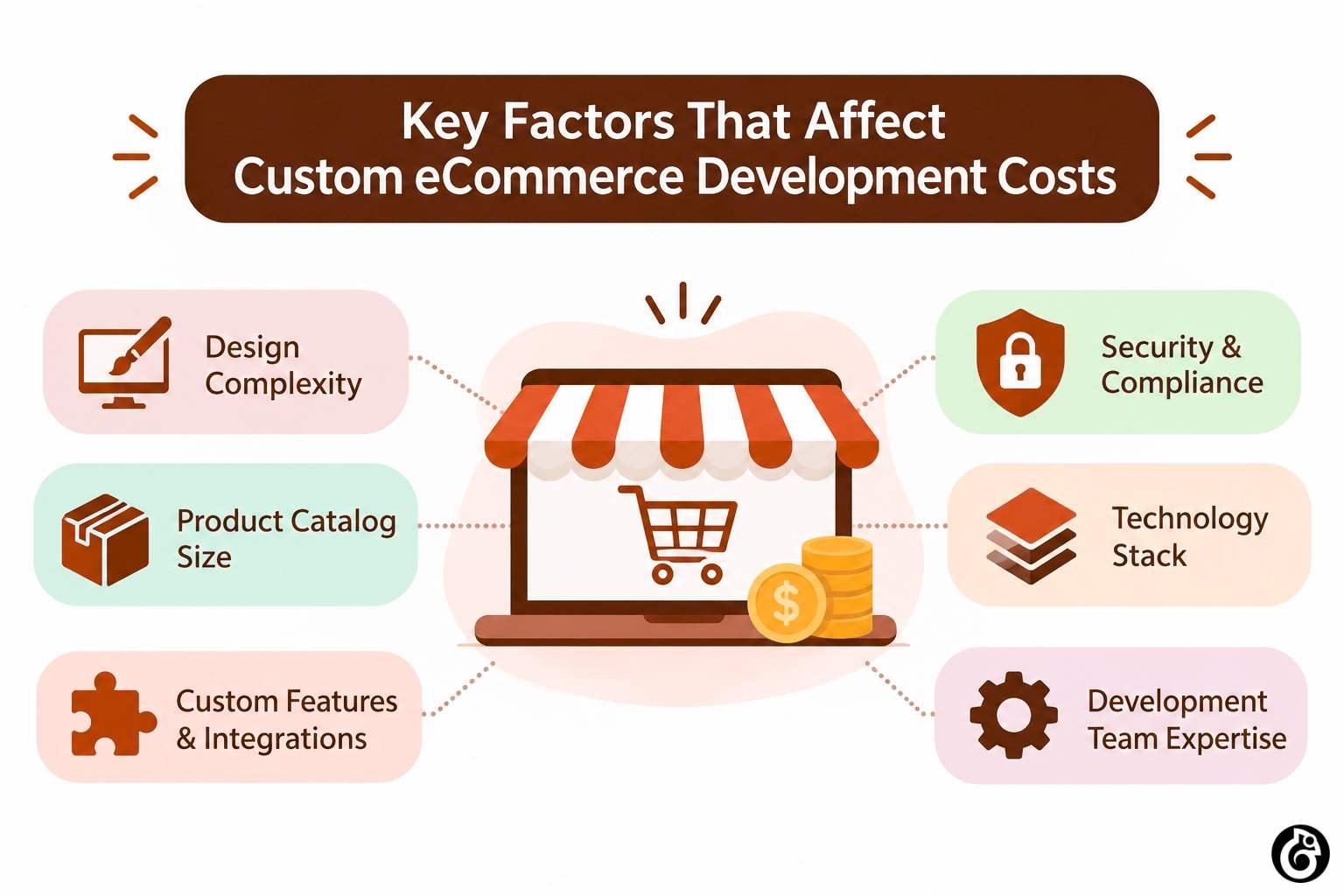
Several factors are considered when an eCommerce development budget is prepared. Two projects with similar product catalogs may have considerably different costs because of differences in functionality, integrations, design, and infrastructure.
1. UI/UX Design Complexity
The user interface and shopping experience directly influence how customers interact with an online store. A simple theme-based layout may require less design effort, whereas a completely customized shopping experience requires additional research, wireframing, prototyping, and interface development.
The following design elements may affect the budget:
- Custom homepage and landing pages
- Product listing and detail page layouts
- Shopping cart and checkout experience
- Mobile-first interface design
- Personalized customer dashboards
- Interactive product displays
- Accessibility improvements
Investment in professional UI/UX design services can help ensure that the shopping experience remains intuitive, consistent, and easy to navigate.
For businesses targeting US and international customers, localization and accessibility should also be considered. Currency display, regional shipping information, measurement formats, language preferences, and accessibility requirements may influence the design and implementation process.
2. Number of Products and Catalog Complexity
The size and structure of a product catalog can influence development and data management costs.
A store with a few dozen products may require relatively straightforward catalog management. However, a business selling thousands of products with multiple variations, specifications, and categories may require more advanced functionality.
Additional development work may be required for:
- Product attributes and variations
- Bulk product imports
- Advanced category management
- Product tagging and filtering
- Inventory synchronization
- Dynamic pricing
- Product bundles and configurable products
The more complex the product catalog becomes, the more attention must be given to database structure, search performance, and catalog management.
3. Custom Features and Functionality
Every additional feature introduces design, development, integration, and testing requirements.
For example, a standard checkout process can be implemented with comparatively less effort. However, a customized checkout involving multiple delivery options, promotional rules, payment conditions, and business-specific calculations will require additional development.
Features such as subscription management, product configurators, personalized recommendations, and loyalty systems can also increase project complexity.
4. Third-Party Integrations
Modern eCommerce platforms are frequently connected with external services to simplify business operations.
Common integrations include:
- Payment gateways such as Stripe, PayPal, and Adyen
- Shipping services and delivery providers
- CRM platforms
- ERP systems
- Inventory management software
- Marketing automation tools
- Email and SMS notification services
- Analytics and reporting tools
The cost of integration depends on API availability, documentation, customization requirements, data synchronization, and testing.
For example, connecting a standard payment gateway may be relatively straightforward. However, integrating an enterprise ERP system with real-time inventory, pricing, and order synchronization can require considerably more engineering effort.
5. Technology Stack and eCommerce Platform Selection
The technologies selected for an eCommerce platform can influence development costs, performance, scalability, and future maintenance.
Depending on the project requirements, different frontend, backend, database, and cloud technologies may be considered.
Technology layer |
Common Technologies |
|---|---|
| Frontend | React.js, Next.js, Vue.js |
| Backend | Node.js, Laravel, Python |
| Database | PostgreSQL, MySQL, MongoDB |
| Cloud infrastructure | AWS, Google Cloud, Azure |
| Payment integration | Stripe, PayPal, Adyen |
| Search functionality | Elasticsearch, OpenSearch |
The appropriate technology stack should be selected according to the expected traffic, business logic, integration requirements, and long-term product roadmap.
The commerce platform also needs to be evaluated carefully. For example, Shopify development services may be suitable for businesses that need a scalable hosted storefront with established commerce features. WooCommerce development services can be considered when greater control over a WordPress-based store and its content management experience is required.
For design-focused websites with relatively straightforward commerce requirements, Webflow development services may also be considered. However, the platform’s commerce capabilities and limitations should be evaluated before it is selected for a complex online store.
The choice between these platforms and fully custom development should be based on the required features, flexibility, integrations, and expected growth.
6. Security and Compliance Requirements
Security is particularly important for eCommerce platforms because customer information, account details, and transaction-related data are handled throughout the shopping process.
Depending on the business and its operating regions, the following security measures may be required:
- SSL/TLS encryption
- Secure authentication
- Role-based access control
- Data encryption
- Payment security
- Fraud detection
- Regular security testing
- Backup and recovery systems
- Privacy and data protection compliance
Businesses serving US customers may need to consider applicable state privacy laws and payment security requirements. Organizations serving customers in the European Union may also need to account for GDPR obligations. The specific requirements should be evaluated according to the business’s location, customer base, and data-processing activities.
Additional security requirements may increase the initial development budget, but they should be considered an essential part of building a reliable eCommerce platform.
Cost Breakdown of Custom eCommerce Website Development
A custom eCommerce project involves several development stages. Each stage contributes to the overall budget and should be considered when the project estimate is prepared.
The following table provides indicative cost ranges for an international project budget, expressed in USD.
Development component |
Estimated Cost |
|---|---|
| Business analysis and planning | $500 – $2,000 |
| UI/UX design and prototyping | $1,000 – $5,000 |
| Frontend development | $2,000 – $10,000 |
| Backend development | $3,000 – $15,000 |
| Admin dashboard development | $1,000 – $5,000 |
| Payment gateway integration | $300 – $2,000 |
| Third-party API integrations | $500 – $5,000+ |
| Testing and quality assurance | $750 – $4,000 |
| Deployment and configuration | $300 – $1,500 |
These are indicative component-level estimates. They should not be added together as a fixed quotation because some project components overlap, and the scope may vary significantly.
What Is Included in Each Development Stage?
Business Analysis and Planning
The project requirements are evaluated, business objectives are identified, and the platform’s functionality is planned. User roles, product workflows, integrations, and technical requirements are also defined.
UI/UX Design and Prototyping
The website structure, navigation, layouts, and customer journeys are designed. Wireframes and interactive prototypes may be created before development begins.
Frontend Development
The customer-facing interface is developed. Product pages, category listings, search, shopping cart, checkout, and responsive layouts are implemented.
Backend Development
The server-side functionality is developed to manage users, products, orders, payments, inventory, and business rules. APIs and database structures are also configured.
Admin Dashboard Development
A centralized dashboard is created to manage products, categories, orders, customers, discounts, and website content.
Testing and Deployment
The website is tested across devices and browsers. Payment flows, integrations, security, performance, and checkout functionality are verified before the platform is deployed.
5. Essential Features and Their Estimated Development Costs
The features selected for an eCommerce website have a direct impact on the total development budget. Some features are essential for every online store, while others are introduced according to the business model.
Feature |
Estimated Additional Cost |
|---|---|
| Customer registration and login | $300 – $1,000 |
| Product catalog management | $500 – $1,500 |
| Advanced product filters | $500 – $1,500 |
| Shopping cart and checkout | $750 – $2,000 |
| Wishlist and product comparison | $300 – $1,000 |
| Payment gateway integration | $300 – $2,000 |
| Order tracking | $500 – $1,500 |
| Inventory management | $750 – $2,500 |
| Customer reviews and ratings | $300 – $1,000 |
| Loyalty and reward program | $1,000 – $3,000 |
| AI-based product recommendations | $2,000 – $10,000+ |
| Multi-vendor functionality | $5,000 – $25,000+ |
Feature estimates are indicative and depend on whether functionality is built from scratch, adapted from existing services, or connected through third-party APIs. Complex features may require substantially more investment.
Which Features Should Be Prioritized?
For a new eCommerce business, the initial focus should be placed on features that directly support product discovery, purchasing, and order management.
The following functionality should generally be prioritized:
- User registration and authentication
- Product catalog and search
- Shopping cart and checkout
- Payment gateway integration
- Order management
- Inventory management
- Responsive design
- Admin dashboard
Advanced capabilities such as AI recommendations, loyalty programs, subscription management, and multi-vendor functionality can be introduced when the business requirements justify the additional investment.
Custom eCommerce Development vs. Ready-Made Platforms
Before investing in a custom eCommerce website, businesses should evaluate whether a ready-made platform can meet their requirements.
Solutions such as Shopify and WooCommerce can be used to launch online stores with standard shopping functionality. Webflow can also be considered for design-led commerce experiences with suitable catalog and transaction requirements. However, custom development may be more appropriate when specific business workflows or technical requirements cannot be handled efficiently through existing platform features.
Comparison Factor |
Ready-made Platforms |
Custom eCommerce Development |
|---|---|---|
| Initial investment | Generally lower | Generally higher |
| Development time | Usually shorter | Depends on project complexity |
| Design flexibility | Theme and customization dependent | Extensive customization |
| Feature flexibility | Platform and plugin dependent | Built around business needs |
| Integrations | Available apps and plugins | Custom API integrations possible |
| Scalability | Depends on platform and architecture | Can be planned around growth requirements |
| Maintenance | Platform and plugin updates | Requires dedicated maintenance |
| Ownership and control | Subject to platform terms | Greater control over custom code and architecture |
When Should a Business Choose a Ready-Made Platform?
A ready-made platform may be suitable when:
- A business needs to launch quickly.
- Standard shopping functionality is sufficient.
- The product catalog is relatively simple.
- The initial development budget is limited.
- Extensive customization is not required.
When Should a Business Choose Custom eCommerce Development?
Custom development may be the better option when:
- Unique business workflows are required.
- Complex pricing or product configurations are involved.
- Multiple systems need to be integrated.
- A specialized customer experience is required.
- Advanced inventory or order management is needed.
- Greater control over architecture and functionality is important.
Custom development should not automatically be considered the better choice for every business. The decision should be based on actual requirements, expected growth, and the total cost of ownership.
Hidden Costs to Consider Before Building an eCommerce Website
The initial development quotation does not always represent the complete investment required to operate an online store.
Several recurring and additional expenses should be included in the budget.
Domain and Hosting
A domain name and hosting environment are required to make the website accessible. Hosting costs will depend on traffic, storage, performance requirements, and infrastructure selection.
Payment Gateway Charges
Payment providers may charge transaction-based fees. These charges depend on the provider, payment method, transaction value, and applicable commercial terms.
Third-Party Software and Subscriptions
Premium plugins, email marketing tools, analytics services, search solutions, and other subscriptions may introduce recurring expenses.
Website Maintenance
Regular maintenance is required to keep the platform secure and functional. Updates, bug fixes, backups, monitoring, and performance improvements should be planned.
Marketing and SEO
Additional investment may be required for search engine optimization, content creation, paid advertising, email campaigns, and conversion optimization.
Product Photography and Content
Professional product images, descriptions, category content, and promotional materials may also contribute to the overall launch budget.
Estimated Ongoing eCommerce Website Costs
Expense |
Indicative Cost |
|---|---|
| Domain renewal | $10 – $50/year |
| Hosting and infrastructure | $30 – $1,000+/month |
| Maintenance and support | $200 – $2,000+/month |
| Third-party tools and subscriptions | $50 – $500+/month |
| SEO and marketing | Depends on campaign scope |
These are planning estimates, not fixed service prices. Enterprise infrastructure, high traffic, premium subscriptions, and dedicated support arrangements may require larger budgets. Payment processing charges are separate and generally depend on transaction volume.
How to Reduce Custom eCommerce Development Costs
A well-planned development strategy can help reduce unnecessary expenses without compromising the quality of the platform.
The following practices can be considered:
1. Define the Project Scope Clearly
The project requirements should be documented before development begins. Essential features, optional functionality, integrations, and future improvements should be identified separately.
This helps prevent unnecessary scope changes and reduces the possibility of unexpected development expenses.
2. Start with an MVP
A Minimum Viable Product (MVP) can be developed with the core functionality required to launch and test the online store.
Instead of implementing every advanced feature initially, the first version can focus on product discovery, checkout, payments, and order management.
Once customer feedback and business requirements have been evaluated, additional functionality can be introduced.
MVP development services can be useful when an eCommerce business needs to validate its business model before committing to a larger development investment.
3. Prioritize Features Based on Business Value
Not every feature needs to be included in the first release. Features that directly support sales, customer experience, and operational efficiency should receive priority.
Advanced analytics, AI-powered personalization, and complex automation can be introduced in later development phases.
4. Choose the Right Technology Stack
The technology stack should be selected according to the actual project requirements rather than trends alone.
A suitable architecture can help reduce unnecessary infrastructure expenses, simplify maintenance, and support future enhancements.
5. Plan Integrations in Advance
Third-party integrations should be identified during the planning stage. Their API requirements, licensing costs, and data synchronization needs should be evaluated before development starts.
This can help reduce integration-related rework and unexpected expenses.
6. Invest in Quality Testing
Insufficient testing may result in payment failures, checkout errors, security issues, and poor customer experiences.
By including quality assurance throughout the development process, expensive post-launch corrections can be minimized.
How Long Does It Take to Build a Custom eCommerce Website?
The development timeline depends on the number of features, design complexity, integrations, and testing requirements.
The following estimates can be used for initial project planning.
Project Type |
Estimated Development Timeline |
|---|---|
| Basic custom eCommerce store | 6–10 weeks |
| Mid-level eCommerce platform | 10–16 weeks |
| Advanced eCommerce platform | 4–7 months |
| Enterprise eCommerce solution | 6–12+ months |
| Multi-vendor marketplace | 5–10+ months |
A typical development process may include:
- Requirement analysis: 1–2 weeks
- UI/UX design: 2–4 weeks
- Frontend and backend development: 4–12+ weeks
- Integrations: 1–4 weeks
- Testing and quality assurance: 2–4 weeks
- Deployment and launch: 1–2 weeks
Some stages can be performed simultaneously, so the total duration may differ from the sum of individual stage estimates.
Is Custom eCommerce Development Worth the Investment?
Custom eCommerce development can be a valuable investment when a business requires functionality, flexibility, and workflows that cannot be supported efficiently through a standard platform. A custom solution can provide several long-term advantages.
Greater Business Flexibility: Features and workflows can be designed around specific business requirements.
Improved Customer Experience: Personalized interfaces and streamlined purchasing journeys can be developed to support customer needs.
Better Integration Capabilities: The platform can be connected with ERP, CRM, inventory, logistics, and other business systems.
Scalability: The architecture can be planned to accommodate increasing product catalogs, traffic, and operational requirements.
Greater Control: Businesses can have more control over custom functionality, development priorities, and platform improvements, subject to their licensing and ownership agreements.
However, the investment should be evaluated against the expected business value. If standard platform features can support the business effectively, a ready-made solution may be more cost-efficient.
How Beadaptify Can Help with Custom eCommerce Development?
Building a successful eCommerce platform involves more than developing product pages and adding a payment gateway. A reliable solution must combine intuitive design, secure transactions, efficient backend operations, and a scalable technical foundation. At Beadaptify, custom eCommerce solutions can be planned around specific business goals, customer expectations, and operational requirements.
From initial planning to deployment, the development process can be structured to support the complete eCommerce experience.
The key areas of support include:
- Custom eCommerce Development: Online shopping platforms can be developed around specific business models and functional requirements.
- UI/UX Design: User-friendly interfaces and streamlined shopping journeys can be designed to improve usability.
- Frontend and Backend Development: Responsive storefronts, custom functionality, APIs, and admin dashboards can be developed.
- Third-Party Integrations: Payment gateways, shipping providers, CRM, ERP, and inventory systems can be integrated.
- Custom Feature Development: Advanced product catalogs, subscription functionality, personalized experiences, and business-specific workflows can be implemented.
- Maintenance and Support: Ongoing improvements, performance monitoring, and technical updates can be planned to support long-term operations.
With the right combination of design & development services and a well-defined technical strategy, businesses can build eCommerce platforms that are aligned with their current requirements and future growth plans.

Conclusion
The cost of custom eCommerce development in 2027 can range from approximately $5,000 to $100,000 or more for many custom projects, while enterprise platforms and multi-vendor marketplaces may require considerably larger investments. The final budget is influenced by several factors, including design complexity, product catalog size, custom functionality, third-party integrations, technology selection, security, and scalability requirements.
Rather than focusing only on the initial development price, businesses should evaluate the complete investment, including hosting, maintenance, integrations, and future enhancements. A clearly defined project scope, feature prioritization, and phased development approach can help ensure that the right platform is built within a realistic budget. Whether a business is launching its first online store or upgrading an existing commerce platform, the right development strategy can create a stronger foundation for long-term digital growth.
FAQs on Custom eCommerce Development Cost
What factors affect the cost of custom eCommerce development?
The major cost factors include UI/UX design, product catalog complexity, custom features, payment gateway integration, third-party APIs, technology stack, security requirements, and development team expertise.
How much does it cost to build a custom eCommerce website for a small business?
A basic custom eCommerce website for a small business may cost approximately $5,000 to $15,000. The final estimate depends on the required pages, product management functionality, payment integration, design, and administrative features.
Is custom eCommerce development more expensive than Shopify or WooCommerce?
Yes, custom eCommerce development generally requires a higher initial investment because more functionality, design, and technical architecture may need to be developed. Shopify and WooCommerce can be more cost-effective when standard shopping features are sufficient.
What features should be included in a custom eCommerce website?
Essential features generally include product catalog management, search and filters, customer registration, shopping cart, checkout, payment gateway integration, order management, inventory management, and an admin dashboard.