However, when React vs Next.js is compared, confusion is often created because both technologies are closely connected. React is used as a JavaScript library for building user interfaces, whereas Next.js is a React-based framework that provides additional features for application development, rendering, routing, and optimization.
Although both technologies can be used to develop scalable digital products, their capabilities and recommended use cases are different. The final choice should be determined by project requirements, performance expectations, SEO goals, development complexity, and long-term business objectives.
In this guide, the key differences between React and Next.js will be explored, including their features, advantages, performance, SEO capabilities, development costs, and ideal use cases. By understanding these factors, the most suitable technology can be selected for the next web development project.
What Is React?
React is an open-source JavaScript library developed by Meta for building interactive user interfaces. It is primarily used to create reusable UI components that can be combined to develop complex frontend applications.
With React, an application can be divided into smaller components, allowing individual interface elements to be developed, maintained, and reused. This component-based architecture makes large user interfaces easier to manage. React is commonly used for single-page applications (SPAs), interactive dashboards, social platforms, SaaS products, and dynamic web applications.
Key Features of React
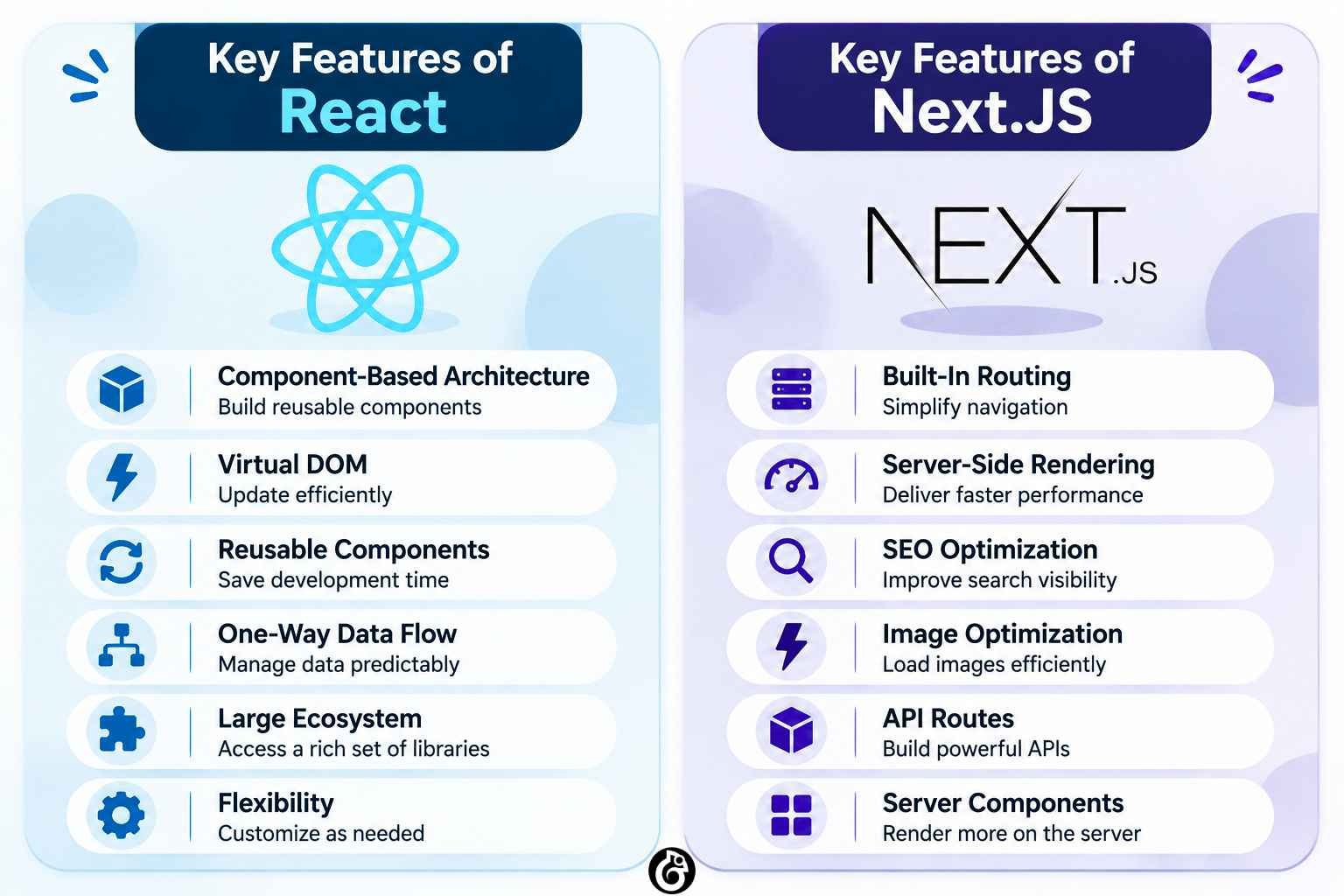
- Component-Based Architecture: Interfaces are divided into reusable components, making development and maintenance easier.
- Virtual DOM: Updates can be efficiently managed through React’s rendering process, helping improve interface responsiveness.
- Reusable Components: Common interface elements can be reused across different application sections.
- One-Way Data Flow: Data movement can be managed through a predictable parent-to-child structure.
- Large Ecosystem: A wide range of libraries and development tools is available for routing, state management, testing, and other requirements.
- Flexible Architecture: Developers are allowed to select suitable tools and libraries according to project requirements.
Advantages of React
React offers considerable flexibility because the application architecture can be customized according to specific requirements. Additional libraries can be integrated for routing, state management, API communication, and other functionality.
For applications where dynamic interactions are prioritized, React can be used to create responsive interfaces. Its reusable components can also reduce repetitive development work. React is particularly suitable when an application is expected to contain complex user interactions, personalized dashboards, or frequently updated interface elements.
What Is Next.js?
Next.js is an open-source React-based framework developed by Vercel. It is designed to simplify the development of modern web applications by providing additional capabilities on top of React. While React is mainly focused on building user interfaces, Next.js provides a more structured environment in which routing, rendering strategies, metadata management, and server-side functionality can be handled.
Multiple rendering approaches can be used depending on the requirements of individual pages. Server-side rendering (SSR), static site generation (SSG), and client-side rendering (CSR) can be incorporated into an application. Next.js is commonly used for business websites, eCommerce platforms, content-driven websites, SaaS products, and full-stack web applications.
Key Features of Next.js
- Built-In Routing: File-system-based routing is provided, reducing the need for additional routing configuration.
- Server-Side Rendering: Pages can be rendered on the server when dynamic content is required.
- Static Site Generation: Pages can be generated during the build process and delivered as static content.
- Server Components: Server Components can be used to reduce the amount of JavaScript sent to the browser.
- API Routes and Route Handlers: Backend functionality and API endpoints can be implemented within the Next.js application.
- Metadata Management: Page titles, descriptions, and other metadata can be configured for SEO.
- Image Optimization: Image handling and optimization features are provided through the Next.js Image component.
- Flexible Rendering: Different rendering strategies can be selected according to application requirements.
Advantages of Next.js
Next.js provides an integrated development environment in which several common web development requirements are already supported. Routing, rendering, metadata management, and server-side capabilities can be handled through its framework architecture.
Improved control over page rendering can also be achieved, which is particularly useful for websites where SEO and initial page delivery are important. For businesses planning to build content-rich platforms, eCommerce websites, or scalable web applications, Next.js can provide a structured foundation.
React vs Next.js: Key Differences
Although Next.js is built on React, several differences can be identified in their architecture, functionality, and development approaches.
Comparison Factor |
React |
Next.js |
|---|---|---|
| Technology Type | JavaScript library | React-based framework |
| Primary Purpose | Building user interfaces | Building complete web applications |
| Rendering | Client-side by default; server rendering APIs are also available | Supports multiple rendering strategies |
| Routing | External routing libraries are commonly used | Built-in file-system routing |
| SEO | Requires additional planning and rendering configuration | Integrated metadata and rendering capabilities |
| Performance | Depends on architecture and optimization | Provides built-in optimization and rendering options |
| Backend Support | Usually integrated with separate backend solutions | Server-side features and route handlers are available |
| Flexibility | High architectural flexibility | More structured development environment |
| Best Use Cases | Interactive dashboards and SPAs | SEO-focused websites and full-stack applications |
The main distinction is that React provides the foundation for building user interfaces, while Next.js extends that foundation with additional application-level capabilities.
React vs Next.js: Performance Comparison
Performance is one of the most important factors that should be considered when a web development technology is selected. Page loading speed, interaction responsiveness, rendering efficiency, and resource utilization can directly influence the user experience.
React Performance
React applications are commonly rendered on the client side. In a traditional client-rendered application, the browser receives the application files, executes JavaScript, and renders the interface. This approach can be effective for applications where users frequently interact with dashboards, internal tools, and personalized interfaces.
However, initial loading performance may be affected when large JavaScript bundles are delivered or when extensive data processing is required before the interface becomes usable. Performance can be improved through code splitting, lazy loading, component optimization, and suitable state management practices.
Next.js Performance
Next.js provides multiple rendering strategies, allowing performance requirements to be addressed more selectively. For example, static pages can be generated ahead of time, while dynamic pages can be rendered on the server when requests are received. Client-side rendering can also be used where interactive functionality is required.
Additional optimization capabilities, including image optimization, code splitting, and caching strategies, can be incorporated into the application.
Which Offers Better Performance?
Neither technology should automatically be considered faster in every situation. Performance is influenced by application architecture, code quality, hosting infrastructure, data requirements, and optimization practices. However, when a website requires fast initial page delivery, server rendering, and static content generation, Next.js can provide a more integrated approach.
For highly interactive applications, React can also deliver excellent performance when appropriate optimization techniques are implemented.
React vs Next.js: SEO Capabilities
Search engine visibility is an important consideration for business websites, blogs, landing pages, and eCommerce platforms. When organic traffic is expected to contribute to business growth, content accessibility, page rendering, metadata, and website structure should be considered during technology selection.
SEO with React
React can be used to build SEO-friendly websites, but additional planning may be required.
In traditional client-side rendering, the initial HTML response may contain limited page content, with much of the interface being generated after JavaScript execution. Modern search engines can process JavaScript, but rendering and indexing considerations should still be evaluated. Server-side rendering or static generation can be implemented through additional tools and architecture when required.
SEO with Next.js
Next.js provides several integrated capabilities that can support SEO requirements. Page metadata, titles, descriptions, canonical URLs, and other metadata elements can be configured. Server-side rendering and static generation can also be used to make important page content available in the initial HTML response. For content-driven websites, these capabilities can simplify the implementation of SEO requirements.
Which Is Better for SEO?
Next.js is often a convenient choice for SEO-focused websites because several relevant capabilities are provided within the framework. However, SEO results are not guaranteed by the technology alone. Content quality, website structure, page speed, internal linking, mobile usability, and technical optimization must also be addressed.
For businesses where organic search traffic is a major acquisition channel, Next.js can provide a useful foundation.
Development Flexibility and Developer Experience
The development experience can be significantly influenced by the selected technology. Project structure, configuration requirements, available libraries, and development workflows should be evaluated before implementation.
React Development Experience
React offers considerable flexibility. A development architecture can be created by selecting suitable tools for routing, state management, API integration, and styling. This flexibility is useful when a project has specialized requirements or when an existing technology stack needs to be maintained. However, additional decisions may be required because several application-level features are not included directly in React.
Next.js Development Experience
A more structured development environment is provided through Next.js. Routing, rendering, metadata, and server-side capabilities are integrated into the framework. As a result, fewer separate tools may be required for common web application requirements.
However, the framework’s conventions, rendering strategies, and server-client component boundaries must be understood before development is started. For businesses working with a front-end development company, the selected team should have practical experience with the chosen architecture to ensure that development and maintenance requirements are handled efficiently.
Scalability and Long-Term Maintenance
Scalability should not be evaluated only in terms of the number of users an application can support. Architecture, code organization, infrastructure, security, and future feature requirements must also be considered.
React Scalability
React can be used to build large-scale applications when a well-structured architecture is established. Reusable components, modular code organization, and suitable state management approaches can be implemented to support application growth. As additional features are introduced, the architecture can be expanded according to project requirements.
Next.js Scalability
Next.js can support large applications through its rendering options, routing structure, server-side capabilities, and integration with modern deployment infrastructure.
Content-heavy websites and applications with a combination of static and dynamic pages can benefit from its flexible rendering approach. For long-term maintenance, consistent coding standards, component organization, testing, and deployment practices should be established. Both technologies can support scalable digital products. The better choice will depend on how the application is expected to evolve.
React vs Next.js: Development Cost and Timeline
Development cost is another factor by which React and Next.js may be evaluated. However, the total project budget cannot be determined by the framework alone. The number of features, design complexity, backend requirements, third-party integrations, security requirements, and testing scope will have a greater influence on the overall investment.
The following estimates can be used as indicative planning ranges for projects targeting international markets.
Project Complexity |
Estimated Development Cost |
Approximate Timeline |
|---|---|---|
| Basic website or application | $5,000–$12,000 | 4–8 weeks |
| Mid-level web application | $12,000–$30,000 | 8–14 weeks |
| Advanced web application | $30,000–$70,000 | 3–6 months |
| Enterprise-level platform | $70,000–$150,000+ | 6–12+ months |
These estimates are illustrative and are not fixed market averages. Actual costs may vary according to the selected development team, project location, technical requirements, and delivery scope.
Factors That Affect Development Cost
- UI/UX Design: Custom interface design, prototyping, and user experience requirements can influence the project budget.
- Application Complexity: Advanced workflows, dashboards, and personalized features can increase development effort.
- Backend Development: Database architecture, APIs, authentication, and server-side functionality may require additional resources.
- Third-Party Integrations: Payment gateways, analytics platforms, CRM systems, and external APIs can affect implementation time.
- Performance Requirements: Advanced optimization, caching, and infrastructure planning may be required.
- Maintenance: Testing, monitoring, security updates, and future enhancements should be included in long-term planning.
When React.js development services are selected, the required routing, backend, and rendering architecture should be included in the project scope. Similarly, Next.js development services should be evaluated according to the rendering strategies, integrations, and server-side functionality required.
When Should You Choose React?
React can be selected when an application is primarily focused on interactive user interfaces and client-side functionality.
The following project types can be suitable for React:
- Interactive Dashboards: Business dashboards with frequently updated data and complex user interactions.
- Single-Page Applications: Platforms where navigation and content updates are expected to occur without full-page reloads.
- Internal Business Tools: CRM systems, project management tools, and administrative platforms.
- Social Applications: Applications where interactive feeds, messaging interfaces, and user-generated content are prioritized.
- Custom User Interfaces: Products where a highly customized frontend architecture is required.
React can also be considered when an existing backend infrastructure is already available and only the frontend layer needs to be developed.
When Should You Choose Next.js?
Next.js can be selected when a project requires an integrated framework with rendering, routing, and SEO-related capabilities.
The following project types can benefit from Next.js:
- Business Websites: Websites where search engine visibility and fast page delivery are important.
- eCommerce Platforms: Online stores where product pages, category pages, and dynamic content need to be optimized.
- Content Management Platforms: Blogs, publishing websites, and knowledge platforms with large amounts of indexed content.
- SaaS Applications: Software platforms where frontend and selected server-side functionality need to be managed within an integrated framework.
- Marketing Websites: Landing pages and service websites where metadata, performance, and organic search visibility are prioritized.
- Enterprise Web Applications: Large digital platforms where structured routing, rendering flexibility, and maintainability are required.
For businesses planning to launch a search-focused website or a full-stack digital product, Next.js can provide a practical development foundation.
React vs Next.js: Which Is Better for Startups?
For startups, technology selection should be based on the product concept, available budget, launch timeline, and future growth plans. If an application is being developed primarily as an interactive product with complex dashboards or user workflows, React may be a suitable choice.
If the startup is planning to launch a content-driven platform, marketplace, eCommerce website, or SEO-focused product, Next.js may be more appropriate. An MVP should be developed around the essential features required to validate the product idea. Unnecessary technical complexity should be avoided during the initial development stage. The selected technology should also support future improvements so that major architectural changes are not required as the product grows.
Can React and Next.js Be Used Together?
Yes. In fact, Next.js is built on React, so React is used as the foundation for Next.js applications. React components can be created and integrated into Next.js projects to build interactive interfaces. The framework’s rendering, routing, and server-side capabilities can then be used according to application requirements.
For example, a business website can be developed with Next.js for routing, metadata, and server rendering, while interactive forms, filters, dashboards, and other interface elements can be built using React components.
This combination allows the benefits of React’s component-based architecture to be used within the broader Next.js framework.
How to Choose the Right Technology for Your Web Project
Before a final decision is made, several project-specific factors should be evaluated.
1. Define Your Project Goals
The purpose of the application should be clearly established. A content-driven website may require different capabilities from an internal business dashboard.
2. Evaluate SEO Requirements
If organic traffic is expected to be a major source of visitors, rendering and metadata requirements should be considered carefully.
3. Understand Performance Expectations
Initial page loading, user interactions, data processing, and mobile performance should be evaluated before the architecture is selected.
4. Review Backend Requirements
The need for APIs, authentication, databases, server-side operations, and third-party integrations should be identified.
5. Consider Development Budget
The total cost should be estimated according to the required features, architecture, team expertise, and ongoing maintenance.
6. Plan for Future Growth
The selected technology should be capable of supporting future features, integrations, traffic growth, and business expansion. When these requirements have been evaluated, a more informed technology decision can be made.
How Beadaptify Can Help with React and Next.js Development
Choosing between React and Next.js is only one part of building a successful web application. A reliable development strategy, well-planned architecture, intuitive interface, and scalable technical foundation must also be established. At Beadaptify, web development projects can be approached by considering business objectives, target audiences, technical requirements, and long-term product goals.
From interface planning and frontend architecture to application development and optimization, the right solutions can be designed around individual project requirements. Through professional design & development services, businesses can have their digital products planned with usability, functionality, and scalability in mind. Whether a custom React application or a Next.js-powered platform is required, the technology selection can be aligned with the project’s actual needs rather than being based only on popularity.

Conclusion
The choice between React and Next.js should be determined by the specific requirements of the web project. Both technologies offer powerful capabilities, but they serve different purposes within modern web development. React is a flexible JavaScript library that is particularly suitable for interactive interfaces, single-page applications, and customized frontend experiences. Next.js extends React with integrated routing, rendering strategies, metadata management, and server-side functionality, making it a practical option for SEO-focused websites and full-stack applications.
Neither technology should be considered universally better. The right choice will depend on performance expectations, SEO requirements, development complexity, budget, and future scalability. By evaluating these factors before development begins, businesses can select a technology that supports both immediate product requirements and long-term digital growth.
FAQs on React vs Next.js
Is Next.js better than React?
Next.js may be a better choice for SEO-focused websites, content-driven platforms, and applications requiring integrated rendering and routing features. React may be more suitable for highly interactive interfaces and projects requiring a customized frontend architecture. The better option depends on project requirements.
Which is better for SEO: React or Next.js?
Next.js generally provides a more integrated approach to SEO because metadata management, server-side rendering, and static generation are supported within the framework. React can also be used for SEO-friendly websites, but additional rendering and configuration may be required.
Can Next.js be used without React?
No. Next.js is built on React, and React is required for developing Next.js applications. Next.js extends React rather than replacing it.
Is React suitable for large-scale applications?
Yes. React can be used to develop large-scale applications when a suitable architecture, component structure, state management approach, and development standards are established.
Should startups choose React or Next.js?
React may be suitable for interactive products and dashboard-focused applications, while Next.js may be preferred for SEO-focused websites, eCommerce platforms, and content-driven products. The startup’s MVP requirements, budget, and future plans should guide the decision.