Mobile applications have become an essential part of modern business strategies. From customer engagement and online shopping to financial transactions and business operations, mobile apps are being used to deliver convenient digital experiences across industries. However, before an application is developed, an important decision must be made: should it be built using native app development or cross-platform app development?
Both approaches are widely used to create applications for iOS and Android devices, but different development methods, technologies, costs, and capabilities are involved. While native applications are developed specifically for individual operating systems, cross-platform applications are generally built using a shared codebase that can be deployed across multiple platforms.
The right approach should be selected based on business objectives, target audiences, available budgets, performance expectations, and long-term product requirements. For some businesses, native development may be preferred because of its platform-specific capabilities. For others, cross-platform development may be considered a more practical option because development time and costs can be optimized.
In this guide, the differences between native and cross-platform app development will be explored, along with their advantages, limitations, costs, technologies, and business use cases.
What Is Native App Development?
Native app development is the process through which applications are created specifically for a particular operating system. Separate applications are generally developed for iOS and Android, using the programming languages and development tools supported by each platform.
For iOS applications, Swift and Objective-C are commonly used, while Kotlin and Java are primarily associated with Android development.
Since applications are developed specifically for their target platforms, operating system features and device capabilities can be accessed directly through supported APIs and development tools.
Native development is commonly selected when advanced functionality, platform-specific performance, and highly customized user experiences are required.
Advantages of Native App Development
1. High Performance
Applications can be optimized for their respective operating systems, allowing processing, animations, and interactions to be handled efficiently. This can be particularly beneficial for applications involving complex calculations, real-time processing, advanced graphics, or intensive device operations.
2. Better Platform-Specific User Experience
Interfaces can be designed according to the guidelines and interaction patterns of individual operating systems. As a result, familiar navigation, gestures, animations, and accessibility features can be delivered to users.
3. Direct Access to Device Features
Native APIs can be used to access hardware and operating system capabilities, including cameras, GPS, biometric authentication, Bluetooth, and sensors. Advanced device functionality can therefore be implemented with fewer framework-related limitations.
4. Greater Control Over Platform Features
Platform-specific development tools can be used to implement advanced functionality and optimize application behavior. This level of control can be valuable when complex technical requirements are involved.
Disadvantages of Native App Development
Despite its advantages, native development can require greater investment.
- Separate codebases are generally maintained for iOS and Android.
- Development costs can increase when two platforms are targeted.
- More time may be required for development and testing.
- Platform-specific updates and maintenance must be managed.
- Separate development expertise may be required for each operating system.
For businesses targeting both platforms, these requirements should be evaluated before a development approach is finalized.
What Is Cross-Platform App Development?
Cross-platform app development is a method through which applications are created for multiple operating systems using a shared codebase. Instead of developing completely separate applications for each platform, a common development framework is used to build and maintain much of the application logic.
Popular technologies include Flutter, React Native, and .NET MAUI.
Through this approach, applications can be deployed on both iOS and Android while much of the underlying code is shared. However, platform-specific adjustments, native modules, and individual testing may still be required depending on the application’s functionality.
Cross-platform development is frequently considered by startups and businesses that want to reach users across multiple platforms while controlling development resources.
Advantages of Cross-Platform App Development
1. Reduced Development Costs
Since much of the codebase can be shared, the need for completely separate development teams and duplicated implementation can be reduced. This can make the approach more cost-efficient when multiple platforms are targeted.
2. Faster Time to Market
Development activities can be coordinated around a shared codebase. Features can often be implemented and released across platforms more efficiently, although platform-specific testing and release requirements must still be considered.
3. Simplified Code Maintenance
A significant portion of application logic can be maintained centrally. Updates and improvements can therefore be applied across platforms without duplicating every implementation.
4. Wider Audience Reach
Applications can be launched on both iOS and Android, allowing businesses to serve a broader audience through a coordinated development process.
5. Suitable for MVP Development
For startups, an initial product can be developed and tested across multiple platforms without the investment associated with two completely independent applications. This can be especially useful when an MVP is being launched to validate market demand.
Disadvantages of Cross-Platform App Development
Cross-platform development also involves certain limitations:
- Some advanced platform-specific features may require native modules.
- Performance can vary depending on framework selection and implementation.
- Platform-specific UI adjustments may still be needed.
- Framework updates and third-party dependencies must be managed.
- Complex applications may require additional technical optimization.
Therefore, cross-platform development should not automatically be considered the best solution for every business.
Native vs. Cross-Platform App Development: Key Differences
Both approaches can be used to build successful mobile applications, but their development processes and technical characteristics differ.
Comparison Factor |
Native Development |
Cross-platform Development |
|---|---|---|
| Codebase | Separate platform-specific codebases | Mostly shared codebase |
| Performance | Optimized for the target platform | Can provide near-native performance |
| Development cost | Generally higher for two platforms | Often more cost-efficient |
| Development time | Usually longer for two platforms | Often faster for multi-platform launches |
| User experience | Platform-specific interface | Shared interface with platform-specific adjustments |
| Maintenance | Separate platform maintenance | Shared maintenance for much of the code |
| Hardware access | Direct platform APIs | Framework APIs and native modules |
| Scalability | High platform-specific flexibility | High, depending on architecture |
| Best suited for | Complex and performance-intensive apps | Multi-platform products with shared functionality |
The final selection should be based on the application’s requirements rather than on cost or development speed alone.
Performance and Application Speed: Which Approach Is Better?
Performance is one of the most important factors when a mobile application is expected to support large numbers of users or complex functionality. Native applications are generally provided with direct access to platform-specific development tools and APIs. This allows performance-sensitive components to be optimized for the operating system on which the application is running.
For example, gaming applications, advanced video editing tools, augmented reality applications, and applications involving intensive background processing may benefit from native development. However, cross-platform frameworks have improved considerably. Modern frameworks can deliver smooth interactions and strong performance when applications are designed and optimized correctly.
For standard business applications, including booking platforms, eCommerce applications, service marketplaces, and customer portals, cross-platform development may be sufficient. Therefore, performance requirements should be assessed according to the expected workload, device capabilities, and complexity of application features.
User Experience and UI/UX Design Differences
An application’s success is influenced not only by its functionality but also by the experience delivered to users. Native development allows interfaces to be created according to the individual design guidelines of iOS and Android. Platform-specific navigation, gestures, typography, and interactions can be implemented with greater control.
In cross-platform applications, a consistent design system can be maintained across multiple devices. However, platform-specific design adjustments may still be required to ensure that the application feels natural on each operating system. Before development is started, user journeys, navigation structures, accessibility requirements, and interface components should be carefully planned.
Through professional design & development services, user expectations can be translated into practical application interfaces. UI/UX requirements should be evaluated early so that design decisions can be aligned with the selected technical approach.
Native vs. Cross-Platform App Development Cost
Development cost is another major consideration when the choice between native and cross-platform development is being evaluated. Native development generally requires separate implementation efforts for iOS and Android. Cross-platform development can reduce duplicated work through a shared codebase, although its overall cost will depend on project complexity, integrations, testing, and customization.
The following estimates can be used for initial business planning.
App Complexity |
Native Development (iOS + Android) |
Cross-platform Development |
|---|---|---|
| Basic application | $15,000–$35,000 | $10,000–$25,000 |
| Mid-level application | $35,000–$80,000 | $25,000–$60,000 |
| Advanced application | $80,000–$150,000+ | $60,000–$120,000+ |
| Enterprise application | $150,000–$300,000+ | $120,000–$250,000+ |
These are indicative planning estimates in USD, not fixed industry averages or quotations. Actual costs may vary based on development location, features, integrations, security requirements, design complexity, and technology selection.
Factors That Affect Development Costs
Several elements should be evaluated before a project budget is finalized:
- Application complexity: Advanced workflows and custom functionality can increase development effort.
- UI/UX requirements: Customized interfaces, animations, and user journeys can require additional design work.
- Backend infrastructure: APIs, databases, cloud services, and server-side systems must be considered.
- Third-party integrations: Payment gateways, maps, analytics, CRM systems, and other integrations can affect budgets.
- Security requirements: Authentication, encryption, permissions, and regulatory requirements can add implementation work.
- Testing and maintenance: Device testing, bug fixes, operating system updates, and ongoing improvements should be included.
A detailed project scope should be prepared before a reliable development estimate is provided.
Development Time and Time to Market
The time required to launch an application can vary significantly according to its complexity and functionality. With native development, separate development and testing activities are generally required for iOS and Android. This can extend the overall timeline, particularly when a large feature set is involved.
With cross-platform development, much of the application can be implemented through a shared codebase. Consequently, development activities may be completed more efficiently when the same functionality is required on both platforms. For example, a basic business application may require approximately 2–4 months, while a mid-level application may take 4–7 months. Advanced applications can require 7–12 months or longer, depending on integrations and technical requirements. These timelines should be treated as planning estimates rather than guaranteed delivery schedules.
Scalability, Maintenance, and Future Updates
An application should not only be designed for its initial launch. Future growth, new features, increasing user activity, and changing business requirements should also be considered. Native development provides greater platform-specific control, which can be useful when advanced operating system capabilities are expected to be introduced over time.
Cross-platform applications can also be scaled effectively when a suitable architecture is implemented. Shared business logic and reusable components can make future development more efficient. However, maintenance requirements should not be underestimated. Even when a shared codebase is used, platform-specific updates, compatibility testing, native modules, and app-store requirements may still need to be managed. A reliable architecture should therefore be selected according to the expected product roadmap.
Popular Technologies Used for Native and Cross-Platform Development
Different programming languages and frameworks are available for building mobile applications.
Native Development Technologies
Swift: Primarily used for iOS application development. It supports Apple’s development ecosystem and is widely used for modern iPhone and iPad applications.
Kotlin: Commonly used for Android development. It provides modern language features and is supported by the Android development ecosystem.
Objective-C and Java: These technologies may also be used for maintaining existing applications and implementing specific platform requirements.
Cross-Platform Development Technologies
Flutter: Developed by Google, Flutter uses the Dart programming language and supports the development of applications for multiple platforms through a shared codebase.
React Native: Based on React and JavaScript, React Native is used to build mobile applications with reusable components and native platform integrations. Through dedicated React Native app development services, businesses can create applications for iOS and Android while maintaining much of their application logic in a shared codebase.
.NET MAUI: Microsoft’s framework allows applications to be developed for multiple platforms using C# and the .NET ecosystem. The framework should be selected based on team expertise, application requirements, third-party integrations, performance expectations, and long-term support.
When Should a Business Choose Native App Development?
Native development should be considered when application requirements are strongly dependent on platform-specific capabilities.
It may be suitable for:
- Gaming applications involving advanced graphics and processing.
- Financial applications requiring complex device-level security features.
- Healthcare applications involving specialized device integrations.
- Augmented reality and virtual reality applications.
- Applications involving advanced Bluetooth, camera, or sensor functionality.
- Products requiring highly customized platform-specific user experiences.
For example, a business developing an advanced fitness application with continuous sensor integration and complex background processing may benefit from native development. When these requirements are critical, the additional investment may be justified by the level of platform-specific control provided.
When Should a Business Choose Cross-Platform App Development?
Cross-platform development should be considered when similar functionality is required across iOS and Android and a shared codebase can support the product requirements.
It may be suitable for:
- Startup applications and MVPs.
- eCommerce and shopping applications.
- Food delivery and service booking platforms.
- Travel and hotel reservation applications.
- Business management applications.
- Social networking and community applications.
- Customer engagement and loyalty applications.
For example, a startup launching an online marketplace may need to reach both iOS and Android users while keeping initial development investment under control. In such cases, cross-platform app development services can be used to build a shared application architecture and accelerate multi-platform delivery.
Native vs. Cross-Platform: Which Is Better for Startups?
For startups, the decision is often influenced by budget, market validation, launch timelines, and future funding plans. Cross-platform development can be an effective starting point when an MVP is expected to be launched on multiple platforms. A shared codebase can reduce duplicated implementation, while product feedback can be collected from users across both operating systems.
However, native development may be more appropriate when the startup’s core product depends on advanced device functionality or platform-specific performance.
A practical strategy should be followed:
- Business objectives and target users should be identified.
- Essential MVP features should be prioritized.
- Performance and device integration requirements should be evaluated.
- Development budgets should be compared.
- The expected product roadmap should be reviewed.
- The technology should be selected based on long-term suitability.
An MVP should be built around the most important product assumptions rather than unnecessary features. This approach can help development investment remain focused while market demand is validated.
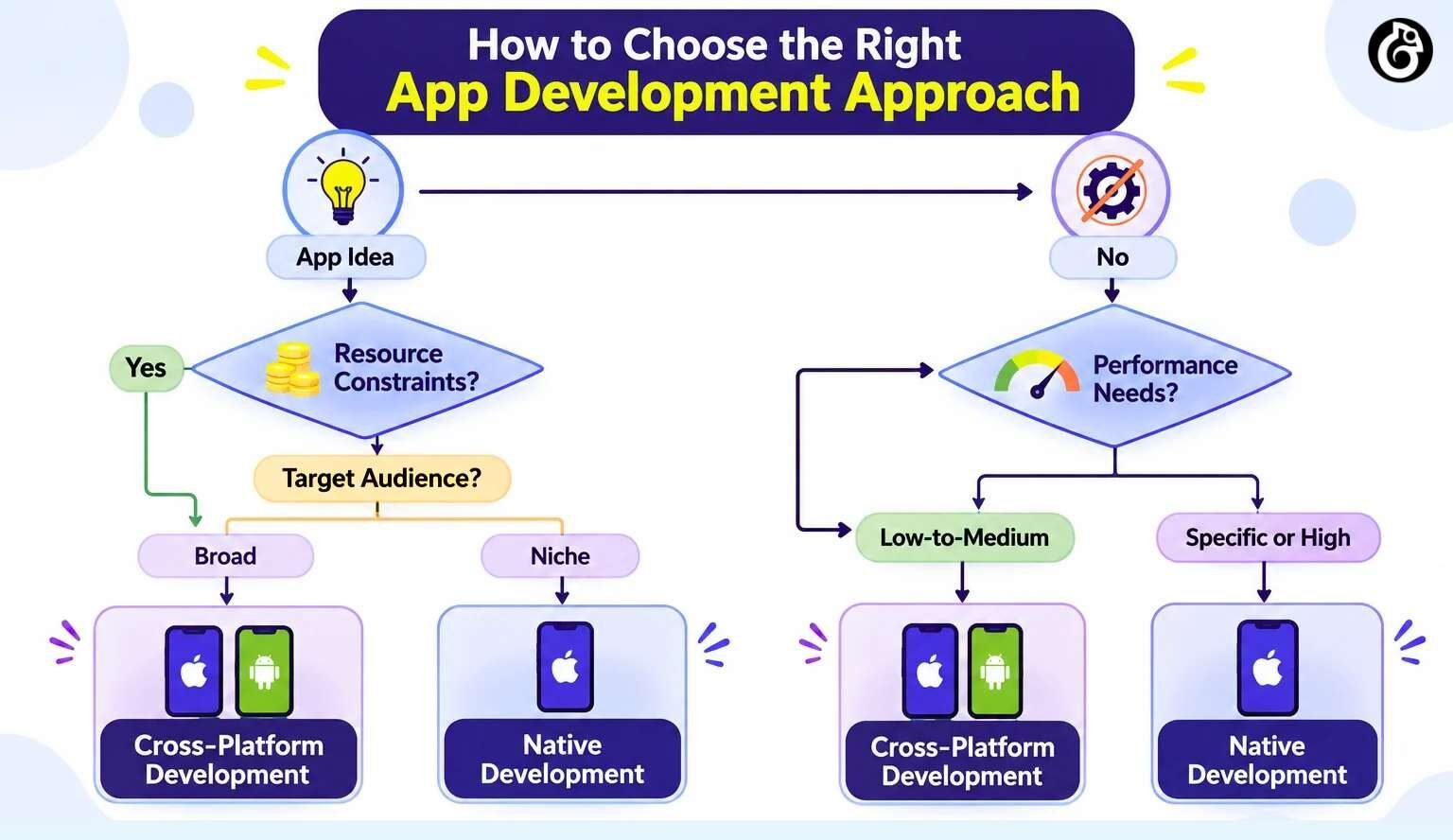
How to Choose the Right App Development Approach for Your Business
Before a development method is finalized, the following considerations should be evaluated.
1. Identify Your Target Audience
The operating systems used by the intended audience should be understood. If both iOS and Android users need to be supported, the advantages of a shared codebase should be evaluated.
2. Define Functional Requirements
The application’s core features should be documented. Advanced device integrations, complex animations, and performance-intensive operations may influence the selection.
3. Establish a Realistic Budget
Development, testing, deployment, and maintenance costs should be considered together. A lower initial development estimate should not be treated as the only deciding factor.
4. Evaluate the Launch Timeline
If a product needs to be introduced across multiple platforms within a limited period, cross-platform development may offer practical advantages.
5. Consider Long-Term Maintenance
Framework maturity, developer availability, third-party support, and future operating system compatibility should be reviewed.
6. Select an Experienced Development Partner
A reliable mobile app development company should be able to evaluate business requirements and recommend an appropriate architecture rather than simply promoting one technology.
How Beadaptify Can Help with Mobile App Development?
The right mobile application should be developed around business objectives, user expectations, and long-term growth requirements. At Beadaptify, mobile application solutions can be planned with attention to functionality, performance, design, and scalability. From initial product planning and UI/UX design to application development, testing, and deployment, the development process can be aligned with the requirements of each project.
Whether native development or a shared cross-platform architecture is required, mobile app development services can be structured around the intended audience and product roadmap. For businesses looking to launch applications across iOS and Android, the right technical approach can be evaluated before implementation begins. Through suitable framework selection, reusable architecture, and platform-specific optimization, a reliable application experience can be developed.

Conclusion
The decision between native and cross-platform app development should be based on business priorities, technical requirements, available budgets, and future product plans. Native development can be an excellent choice when advanced performance, deep hardware integration, and platform-specific experiences are required. Cross-platform development can be a practical alternative when faster multi-platform delivery, shared code maintenance, and development efficiency are prioritized.
Neither approach is universally better. The most suitable solution will depend on the features being developed, the users being served, and the business outcomes being targeted. By evaluating these factors carefully, businesses can make a more informed technology decision and build mobile applications that are capable of supporting long-term growth.
FAQs on Native vs. Cross-Platform App Development
Is native app development better than cross-platform development?
Native development may be better for applications requiring advanced performance, complex device integrations, and highly customized platform experiences. Cross-platform development may be more suitable when faster multi-platform delivery and development efficiency are prioritized.
Is cross-platform app development cheaper than native development?
Cross-platform development is often more cost-efficient because much of the code can be shared across iOS and Android. However, actual costs depend on project complexity, integrations, testing, and platform-specific requirements.
Which approach offers better app performance?
Native applications generally provide greater platform-specific optimization. However, modern cross-platform frameworks can deliver strong performance for many business applications when properly implemented.
Is Flutter or React Native better for business applications?
Both frameworks can be used to develop business applications. Flutter may be preferred when a consistent custom interface is required, while React Native may be suitable when JavaScript and React expertise is already available. The selection should be based on project requirements and team capabilities.
Can cross-platform applications access native device features?
Yes. Cross-platform applications can access supported device features through framework APIs, plugins, and native modules. Additional platform-specific development may be required for advanced functionality.
Which approach is better for startups?
Cross-platform development can be a practical option for startups when an MVP must be launched on both iOS and Android with a controlled budget. Native development may be preferred when the product depends on specialized platform capabilities.