In 2027, AI in web development is expected to play an increasingly important role in how digital products are built and maintained. Repetitive coding tasks can be automated, development workflows can be accelerated, and user experiences can be improved through intelligent recommendations and personalization.
The growing adoption of AI frontend development tools is also changing how developers work with technologies such as React, Next.js, JavaScript, and CSS. Rather than replacing traditional development practices, AI-powered solutions are being used to support technical teams and improve efficiency.
Understanding how AI is transforming frontend development in 2027 can help businesses make better technology decisions and prepare for the next generation of web applications.
What Is AI in Frontend Development?
AI in frontend development refers to the use of artificial intelligence technologies to support the creation, testing, optimization, and maintenance of user-facing interfaces. Through machine learning, generative AI, and intelligent coding assistants, different development activities can be completed more efficiently. Code suggestions can be generated, design layouts can be proposed, and potential errors can be identified before applications are released. This approach is commonly referred to as AI-powered frontend development. It combines conventional programming techniques with intelligent tools that assist developers throughout the development lifecycle.
For example, an AI assistant can be used to generate a React component from a written description. The generated code can then be reviewed, modified, and integrated into the application by a developer. The use of artificial intelligence in frontend development is therefore not limited to code generation. It is also being applied to interface design, accessibility checks, testing, and performance improvements.
How AI Is Transforming the Frontend Development Process
Several frontend development activities are being improved through AI-assisted workflows.
AI-Powered Code Generation
One of the most significant applications is AI code generation for frontend development. HTML structures, CSS styles, JavaScript functions, and reusable components can be generated from natural-language instructions.
Developers can provide a description of a required feature, after which code suggestions can be produced. This can reduce repetitive work and allow more time to be spent on architecture and complex functionality.
Automated UI Design and Prototyping
Design concepts can be converted into initial interface layouts through AI-powered tools. Suggested page structures, color combinations, and component arrangements can be generated from prompts or design references.
This approach is making AI in frontend design increasingly useful during early product development. Prototypes can be created and evaluated more quickly before final implementation begins.
Intelligent Debugging and Code Reviews
Potential errors, inefficient code patterns, and compatibility issues can be identified with AI assistance. Explanations and possible fixes can also be suggested. However, generated recommendations should be reviewed before implementation because incorrect fixes or insecure code may occasionally be produced.
Automated Testing
Test cases can be suggested for different components, user interactions, and application workflows. Repetitive testing activities can also be streamlined through AI-supported automation. As a result, more consistent testing coverage can be achieved, although manual validation and real-device testing should still be maintained.
Performance and Accessibility Optimization
AI-assisted tools can be used to identify large assets, inefficient rendering patterns, and potential accessibility problems. Recommendations for improving loading performance and interface usability can then be evaluated. These capabilities demonstrate how AI-driven frontend development can support a more efficient and quality-focused development process.
Top AI Tools for Frontend Developers in 2027
A growing range of tools is being used to support frontend development workflows. Some popular examples include:
- GitHub Copilot: Code suggestions, function generation, and assistance with repetitive programming tasks.
- Cursor: AI-assisted coding and codebase understanding within a development environment.
- ChatGPT: Code explanations, debugging assistance, component suggestions, and development guidance.
- Claude: Assistance with code analysis, technical explanations, and larger development tasks.
- v0: Generation of interface concepts and frontend components from text prompts.
- Windsurf: AI-supported coding workflows and assistance with multi-step development tasks.
- Figma AI: AI-assisted design activities, content generation, and interface exploration.
These are among the AI tools for frontend developers that can be considered when modern development workflows are being established.
The best AI tools for frontend development in 2027 will depend on project requirements, framework compatibility, security policies, and developer preferences. Tool selection should therefore be based on practical testing rather than popularity alone.
Key Benefits of AI in Frontend Development
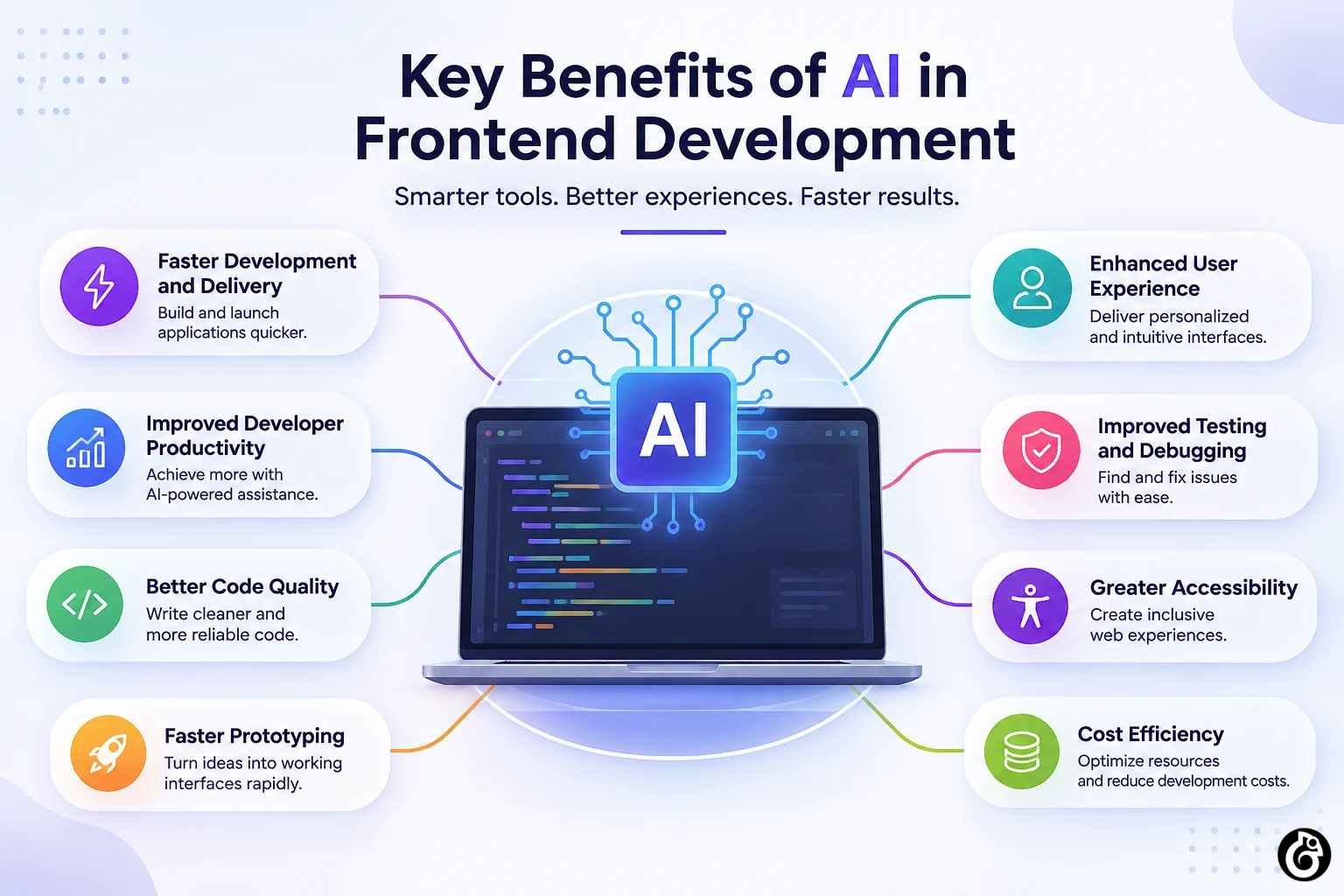
The adoption of AI-assisted workflows can provide several advantages to development teams and businesses.
Faster Development and Delivery
Reusable code, layout suggestions, and automated testing support can reduce the time required for repetitive activities. As a result, development cycles can be shortened.
Improved Developer Productivity
Routine tasks can be handled with AI assistance, allowing more attention to be given to application architecture, business logic, and complex user requirements. This explains how AI improves frontend development productivity across different project stages.
Better Code Quality
Code suggestions, error explanations, and review assistance can help identify potential issues. However, quality should still be maintained through experienced reviews, testing, and coding standards.
Faster Prototyping
Interface concepts and component variations can be generated quickly. This can make experimentation easier and reduce the time required to evaluate early product ideas.
Improved User Experience
Personalized content, adaptive layouts, and intelligent interface recommendations can be introduced to create more relevant user experiences. These are some of the important benefits of AI in frontend development, particularly when AI tools are combined with established engineering practices.
How AI Is Changing Frontend Frameworks
Modern frontend frameworks are also being supported by AI-assisted development tools. Code generation, debugging, documentation, and component creation can be improved across different technology stacks.
React: AI-generated components, hooks, and reusable UI structures can be used to accelerate React development. Businesses investing in custom applications can benefit from experienced teams offering ReactJS development services.
Next.js: AI assistance can be applied to routing, page structures, server-side rendering workflows, and application components. Next.js development services can be used to build scalable web applications with modern rendering and performance capabilities.
Vue.js and Angular: Component generation, debugging suggestions, and testing support can be introduced into development workflows using AI-enabled tools.
HTML, CSS, and JavaScript: Layout structures, styling rules, scripts, and responsive design suggestions can be generated and refined with AI assistance.
Although frameworks are not being replaced by AI, their development workflows are being enhanced through AI-assisted web development.
AI in UI/UX Design and Frontend Development
A strong connection between design and development is essential for creating effective digital experiences. AI is helping bring these activities closer together. Design references can be converted into preliminary frontend structures, while interface variations can be generated for evaluation. Responsive layouts can also be suggested for different screen sizes.
The process of how AI is changing UI/UX design and frontend development can be observed in several areas:
- Design concepts can be converted into initial interface components.
- Reusable design systems can be generated and maintained.
- Interface variations can be created for testing.
- Accessibility improvements can be recommended.
- Personalized content and layouts can be introduced.
However, usability, visual consistency, and user expectations must still be evaluated by experienced designers. Professional UI/UX design services remain important for ensuring that interfaces are intuitive, accessible, and aligned with business objectives.
Real-World Applications of AI-Powered Frontend Development
The role of AI in modern web application development can be understood through its practical applications across industries.
- eCommerce: Personalized product recommendations, intelligent search, and adaptive shopping experiences can be introduced.
- Healthcare: Patient dashboards, appointment interfaces, and personalized health information can be presented more effectively.
- Fintech: Intelligent dashboards and customized financial insights can be integrated into digital banking experiences.
- SaaS: Adaptive dashboards, smart recommendations, and automated workflows can be supported.
- Education: Personalized learning interfaces and intelligent progress tracking can be introduced.
Through these applications, AI-powered website development can be used to create more responsive and context-aware digital experiences.
Progressive web app development services can also be combined with AI-enabled features to deliver accessible, app-like experiences through modern web technologies.
Challenges and Limitations of AI in Frontend Development
Despite its advantages, AI adoption is associated with several challenges.
Incorrect code generation: AI-generated code may contain errors, outdated practices, or unsuitable implementations. Technical reviews must therefore be conducted.
Security concerns: Sensitive information should not be shared with unapproved AI tools. Generated code must also be checked for vulnerabilities.
Inconsistent user interfaces: Automatically generated layouts may not follow established design systems or accessibility requirements.
Framework compatibility: Suggested code may not always match the project’s framework version, dependencies, or architecture.
Overdependence on automation: Excessive reliance on AI can reduce code understanding and create maintenance difficulties.
For these reasons, AI-generated output should be treated as a starting point rather than production-ready code.
AI vs. Traditional Frontend Development
The difference between AI vs traditional frontend development is mainly reflected in how development activities are completed.
Area |
Traditional Development |
AI-Assisted Development |
|---|---|---|
| Code creation | Primarily manual | AI-assisted generation |
| UI prototyping | Manually designed | AI-generated suggestions |
| Debugging | Manual investigation | AI-supported analysis |
| Testing | Manually configured and automated | AI-assisted test generation |
| Documentation | Written manually | AI-generated drafts |
| Optimization | Developer-led analysis | AI-supported recommendations |
AI-assisted workflows can improve efficiency, but human expertise is still required for architecture, security, testing, and production decisions.
Can AI Replace Frontend Developers?
The question can AI replace frontend developers? has become increasingly relevant as coding tools have improved. Although repetitive coding activities can be automated, complete frontend development involves much more than writing code. Business requirements must be understood, application architecture must be planned, and user experience decisions must be evaluated.
Developers are also required to review generated code, resolve complex technical problems, manage integrations, and ensure that applications remain secure and maintainable. In the coming years, frontend developers are likely to spend more time supervising AI-assisted workflows and solving complex problems. Human expertise will continue to be important for delivering reliable digital products.
Future Trends of AI in Frontend Development Beyond 2027
The future of frontend development is expected to be influenced by more intelligent and integrated development workflows.
Some emerging frontend development trends in 2027 include:
- AI-powered development environments with deeper codebase understanding.
- Agentic AI systems capable of handling multi-step development tasks.
- Automated design-to-code workflows.
- More advanced AI-assisted testing and maintenance.
- Personalized interfaces based on user preferences and behavior.
- Greater integration of AI features into web applications.
The future of AI-powered frontend development will likely be shaped by how effectively these capabilities can be combined with secure architecture, accessible design, and reliable engineering practices.
How Businesses Can Adopt AI-Powered Frontend Development
A structured approach should be followed when AI is introduced into frontend workflows.
- Identify development requirements: Repetitive tasks and workflow bottlenecks should first be evaluated.
- Select suitable tools: AI tools should be chosen according to project needs, framework compatibility, and security requirements.
- Establish coding standards: Guidelines for generated code, documentation, and reviews should be defined.
- Integrate AI gradually: Initial implementation should be focused on low-risk activities before more complex workflows are automated.
- Validate every output: Testing, accessibility checks, and security reviews should be maintained.
- Monitor results: Productivity, performance, and code quality should be evaluated continuously.
Businesses exploring how to use AI for frontend development should prioritize measurable improvements instead of adopting tools simply because they are available.
Why Choose Beadaptify for Modern Frontend Development?
AI tools can accelerate development, but successful digital products still depend on strong technical expertise, thoughtful design, and reliable implementation. As a front-end development company, Beadaptify supports businesses in building modern, responsive, and scalable web experiences. Through tailored web development services, frontend solutions can be aligned with specific business requirements and user expectations.
From React and Next.js applications to custom web platforms, design and development activities can be coordinated to maintain consistency across the product lifecycle. Professional design & development services and UI/UX expertise can also be integrated into the process.
Businesses looking for a reliable web development company can explore solutions covering frontend architecture, performance optimization, responsive interfaces, and software product development services. Progressive web app development services can also be considered when app-like functionality is required through the web. Whether a new digital product is being planned or an existing platform is being modernized, experienced developers can help ensure that AI-assisted workflows are used responsibly. Businesses can also hire web developers with the technical expertise required to build, test, and maintain production-ready applications.

Conclusion
AI is changing frontend development by making code generation, interface design, testing, debugging, and optimization more efficient. Through AI-powered tools, repetitive activities can be reduced, while development teams can focus more attention on architecture, functionality, and user experience. However, successful implementation cannot be achieved through automation alone. Code quality, security, accessibility, and maintainability must still be carefully evaluated.
In 2027, businesses that combine AI-assisted workflows with experienced developers and effective design practices will be better positioned to build modern digital products. AI should be viewed as a development advantage that strengthens human expertise rather than a replacement for it.
FAQs on AI in Frontend Development
What are the best AI tools for frontend developers in 2027?
GitHub Copilot, Cursor, ChatGPT, Claude, v0, Windsurf, and Figma AI are popular options. The right tool should be selected according to project requirements, security needs, and technology compatibility.
Can AI generate frontend code?
Yes. AI tools can generate HTML, CSS, JavaScript, and framework-based components from written prompts. However, generated code should be reviewed and tested before production use.
How does AI improve frontend development productivity?
Productivity can be improved through faster code generation, automated documentation, debugging suggestions, reusable components, and AI-assisted testing.
How is AI changing React and Next.js development?
AI is being used to generate components, explain code, suggest improvements, assist with debugging, and support testing in React and Next.js projects. Developer review remains necessary to maintain application quality.
Is AI-assisted frontend development suitable for businesses?
Yes. AI-assisted development can be useful for startups, growing businesses, and enterprises when it is implemented with appropriate security standards, experienced developers, and structured quality checks.