Mobile applications have become an important part of modern business strategies. From customer engagement and online shopping to financial transactions and enterprise operations, mobile apps are being used to improve services, simplify processes, and create better digital experiences. However, before an application is developed, an important decision must be made: which technology should be used?
Choosing the right mobile app development technology can directly influence application performance, development costs, security, scalability, and long-term maintenance. A technology that works well for a simple business application may not be suitable for a complex enterprise platform. Similarly, a framework selected for a startup’s minimum viable product (MVP) may need to be evaluated differently when a large-scale application is being planned.
Several mobile app development technologies are available today, including Flutter, React Native, Swift, Kotlin, and Java. Each option offers different capabilities, development approaches, and platform compatibility. Therefore, the best technology for mobile app development should not be selected based only on popularity or current industry trends.
Business requirements, target audiences, application features, available budgets, and future expansion plans should be carefully evaluated before a technology stack is finalized.
In this guide, the major mobile app development platforms, frameworks, and programming technologies will be explored. The factors that should be considered during technology selection will also be explained so that a suitable approach can be chosen for long-term business growth.
Why Is Choosing the Right Mobile App Development Technology Important?
A mobile application’s success is influenced by more than its visual appearance and features. The technology used during development determines how efficiently the application operates, how easily new functionality can be introduced, and how effectively different devices can be supported.
When an unsuitable technology is selected, additional development effort may be required. Performance limitations, compatibility problems, security concerns, and expensive maintenance requirements may also be experienced.
The following areas can be directly influenced by technology selection.
1. Application Performance
Application speed and responsiveness are important for delivering a positive user experience. Slow loading times, delayed interactions, and frequent crashes can affect user satisfaction.
The selected programming language and framework determine how application logic is executed and how device resources are accessed. For applications that require advanced animations, real-time processing, or intensive device operations, performance requirements should be evaluated carefully.
2. Development Costs and Timelines
Different technologies require different development processes, tools, and skill sets. When separate native applications are developed for Android and iOS, additional development resources may be required.
By comparison, cross-platform development can allow a shared codebase to be used across multiple platforms. As a result, development time and costs may be reduced for applications that can be effectively supported through a shared architecture.
3. Scalability and Flexibility
As business requirements change, additional features, integrations, and user-management capabilities may be required. The selected technology should allow these changes to be introduced without requiring major architectural modifications. A scalable mobile app technology stack should be selected so that future enhancements can be accommodated more efficiently.
4. Security and Data Protection
Security requirements vary according to the type of application being developed. Financial, healthcare, and enterprise applications may require advanced authentication, secure data storage, encryption, and access-control mechanisms.
The selected technology should support the security practices and platform capabilities required by the business.
5. Long-Term Maintenance
Applications need to be updated as operating systems, devices, security standards, and business requirements evolve. Therefore, developer availability, framework support, documentation, and maintenance requirements should be considered before a decision is made.
Understand the Different Types of Mobile App Development Approaches
Before individual frameworks are compared, the major mobile application development approaches should be understood. Native, cross-platform, and hybrid development are commonly considered when a new mobile application is planned.
Each approach offers different advantages, and the most suitable option should be determined by the application’s requirements.
1. Native App Development
Native applications are developed specifically for an operating system. Separate development technologies are generally used for Android and iOS applications. For Android, Kotlin and Java are commonly used, while Swift and SwiftUI are used for iOS development.
Because native applications are developed for specific platforms, direct access to operating system features and device capabilities can be provided.
Advantages of native development:
- High performance can be achieved for platform-specific workloads.
- Device features such as cameras, GPS, sensors, and biometrics can be accessed through platform APIs.
- Platform-specific interface guidelines can be followed.
- Complex animations and advanced functionality can be implemented.
- Greater control over operating system integrations can be maintained.
Limitations of native development:
- Separate codebases may be required for Android and iOS.
- Higher development budgets may be needed.
- Additional developers may be required.
- Feature updates may need to be implemented separately.
- Maintenance effort may increase when multiple platform versions are supported.
Native development is often considered when performance, advanced device access, platform-specific functionality, or specialized security requirements are given high priority.
2. Cross-Platform App Development
Cross-platform development allows applications to be created for multiple operating systems using a shared codebase for a significant portion of the application. Frameworks such as Flutter and React Native are commonly used for this approach.
Instead of maintaining entirely separate applications, shared business logic and application components can be reused across Android and iOS. Platform-specific code may still be required when advanced native functionality is introduced.
Advantages of cross-platform development:
- A shared codebase can be maintained.
- Development time may be reduced.
- Feature updates can be coordinated across platforms.
- Development resources can be used more efficiently.
- Consistent user experiences can be delivered across supported devices.
Limitations of cross-platform development:
- Certain platform-specific features may require native integrations.
- Performance should be evaluated for demanding workloads.
- Framework and plugin compatibility must be monitored.
- Platform-specific interface behavior may require additional customization.
Cross-platform development is often selected for startups, eCommerce platforms, service applications, and businesses that need to reach both Android and iOS users within a controlled budget.
3. Hybrid App Development
Hybrid applications are generally built using web technologies such as HTML, CSS, and JavaScript. Web-based application interfaces are commonly displayed inside a native container or WebView.
Technologies such as Ionic and Capacitor can be used to build hybrid mobile experiences.
Hybrid development can be suitable when an existing web application needs to be extended to mobile devices or when relatively straightforward application functionality is required.
Advantages of hybrid development:
- Existing web development skills can be reused.
- Web-based components can be shared.
- Development costs may be reduced for simpler applications.
- Updates can be delivered efficiently in suitable architectures.
- Web content can be integrated with device functionality through plugins.
Limitations of hybrid development:
- Complex interactions may require additional optimization.
- Advanced animations may be more difficult to implement efficiently.
- Device-specific functionality may depend on plugins.
- Performance can vary according to the application architecture and WebView implementation.
The choice between native vs hybrid vs cross-platform mobile app development should be based on the required user experience, technical complexity, and business objectives.
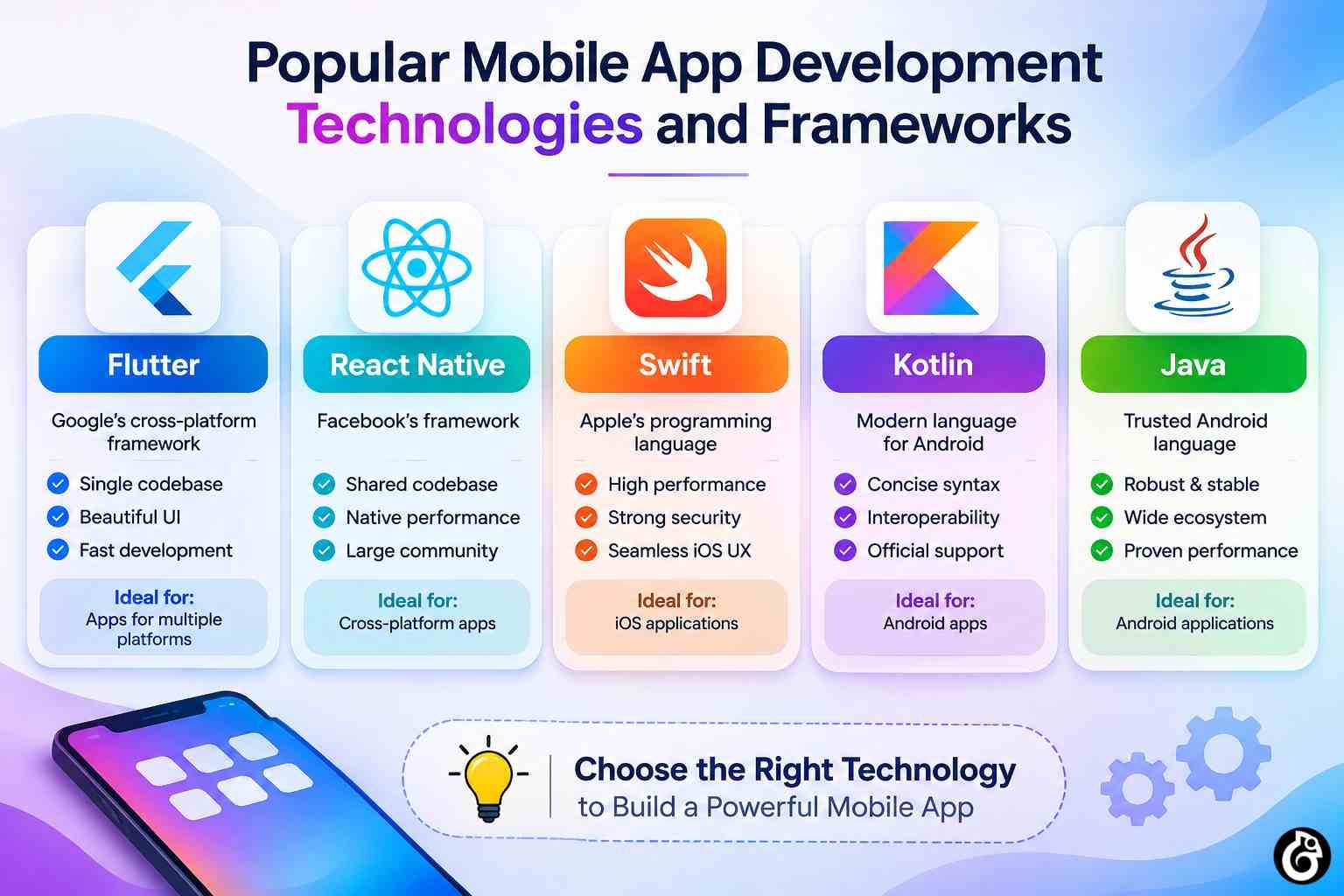
Popular Mobile App Development Technologies and Frameworks
Several programming languages and mobile app development frameworks are available. Each has been designed to address different development requirements.
The following technologies are commonly considered when mobile applications are planned.
1. Flutter
Flutter is an open-source UI framework developed by Google. Applications can be created for Android, iOS, web, and desktop platforms using a shared codebase.
The Dart programming language is used for Flutter development. A widget-based architecture is provided, through which application interfaces can be created and customized.
Key features of Flutter:
- A shared codebase can be used across supported platforms.
- Custom user interfaces can be developed through reusable widgets.
- Hot reload is provided to support faster development iterations.
- Consistent visual experiences can be created.
- Native platform integrations can be implemented when required.
When should Flutter be selected?
Flutter can be considered when a business needs applications for multiple platforms and a consistent interface is required. It can be particularly useful for eCommerce applications, booking platforms, business dashboards, and startup products.
Through professional Flutter app development services, custom applications can be developed with reusable components and platform-specific integrations where needed.
2. React Native
React Native is a cross-platform framework developed by Meta. JavaScript or TypeScript is commonly used to build mobile applications through React-based development concepts.
Native platform components are used for much of the interface rendering, while native modules can be integrated when additional device functionality is required.
Key features of React Native:
- JavaScript and TypeScript development support.
- Shared application logic across Android and iOS.
- Reusable React components.
- Native module integration.
- A large developer ecosystem.
- Support for iterative development workflows.
When should React Native be selected?
React Native can be considered when a business already uses React technologies or wants to reuse JavaScript and TypeScript expertise. It can be suitable for social applications, eCommerce platforms, service-booking applications, and business productivity tools.
The final selection should be based on the required integrations, platform behavior, and performance expectations.
3. Swift and SwiftUI
Swift is Apple’s programming language for developing applications across its platforms. SwiftUI is a declarative user-interface framework through which interfaces can be created for Apple’s operating systems.
These technologies are commonly used when iOS-specific functionality and a native user experience are required.
Key features of Swift and SwiftUI:
- Native iOS development capabilities.
- Strong integration with Apple’s development ecosystem.
- Platform-specific interface components.
- Access to Apple device capabilities.
- Support for modern application architectures.
When should Swift be selected?
Swift can be selected when an application is primarily intended for iPhone users or when advanced Apple platform functionality is required.
Through professional iOS app development services, applications can be designed and developed around Apple’s interface standards, device capabilities, and platform requirements.
4. Kotlin
Kotlin is a modern programming language officially supported for Android development. It is designed to work with the Java ecosystem and can be used to develop native Android applications.
Kotlin is widely used for creating applications that require platform-specific functionality and integration with Android APIs.
Key features of Kotlin:
- Concise and expressive syntax.
- Interoperability with Java.
- Android development ecosystem support.
- Null-safety features.
- Compatibility with modern Android development tools.
When should Kotlin be selected?
Kotlin is a suitable option when an Android application is being developed with a focus on native functionality, performance, and platform integration.
Through professional Android app development services, business-specific Android applications can be created with suitable architecture, device compatibility, and security considerations.
5. Java
Java has been used extensively for Android application development and continues to be relevant in many existing applications and enterprise environments. A large ecosystem of libraries, development tools, and documentation is available. Java can also be used alongside Kotlin in Android projects.
When should Java be selected?
Java may be considered when an existing application is already built around Java, when legacy components need to be maintained, or when a development team has strong Java expertise.
For new Android projects, Kotlin is frequently considered alongside Java, and the final choice should be determined by project requirements and team capabilities.
Also Read: Mobile App Development for Startups in 2027
8 Important Factors to Consider When Choosing Mobile App Development Technology
The best technology for mobile app development cannot be identified without understanding the business requirements. Several factors should be evaluated before a framework or programming language is finalized.
1. Business Goals and Application Requirements
The purpose of the application should be defined before technology selection begins. For example, an eCommerce application may require product catalogs, shopping carts, payment gateways, order tracking, and push notifications. A healthcare application may require appointment scheduling, patient records, secure authentication, and communication features.
A technology should be selected according to the functionality that needs to be supported.
The following questions should be considered:
- What problem will the application solve?
- Which features will be required?
- Will real-time functionality be needed?
- Will external APIs or third-party services be integrated?
- Will the application be used by customers, employees, or business partners?
When requirements are clearly documented, the suitability of different mobile app development solutions can be evaluated more accurately.
2. Target Audience and Platform Preference
The target audience should be identified before the Android and iOS development approach is selected. In some markets, Android users may represent a larger portion of the intended audience. In other markets or customer segments, iOS users may be equally important or more commercially relevant.
User research, market analysis, and customer behavior should be considered before platform decisions are made. If both Android and iOS users need to be supported, cross-platform development may provide an efficient starting point. However, separate native applications may be justified when platform-specific experiences are essential.
The decision about how to choose between Android and iOS app development technologies should therefore be based on actual audience requirements rather than assumptions.
3. Development Budget
The available budget can significantly influence technology selection. Native development may require separate teams or development resources for each platform. Cross-platform development may reduce duplicated work because a shared codebase can be maintained for many features.
However, lower initial development costs should not be treated as the only selection criterion. Licensing, integrations, testing, infrastructure, maintenance, and future upgrades should also be included in the overall budget. A realistic cost estimate should be prepared after the application’s scope and technical requirements have been evaluated.
4. Performance Requirements
The performance expectations of the application should be evaluated before a framework is selected. For example, a simple appointment-booking application may not require the same technical architecture as a high-performance gaming application or a real-time financial trading platform.
The following requirements should be reviewed:
- Application loading speed.
- Animation and interaction responsiveness.
- Background processing.
- Real-time data synchronization.
- Memory and battery usage.
- Device hardware integration.
Native development may be preferred for certain demanding workloads. However, modern cross-platform frameworks can also provide suitable performance for many business applications when they are properly architected and optimized.
5. Scalability and Future Growth
The application should be developed with future expansion in mind. As the user base increases, additional servers, APIs, database optimization, caching, and infrastructure improvements may be required. New features and integrations may also need to be introduced.
A technology stack should be selected that can support the expected growth of the application. For example, a startup may initially launch a limited MVP. Later, advanced analytics, subscription management, user roles, and enterprise integrations may be introduced. The architecture should therefore be designed so that new functionality can be accommodated without unnecessary redevelopment.
6. Security and Compliance Requirements
Security should be considered from the beginning of the development process, especially when sensitive information is handled.
Depending on the application, the following capabilities may be required:
- Secure authentication and authorization.
- Data encryption during transmission and storage.
- Role-based access control.
- Secure API communication.
- Session management.
- Biometric authentication where appropriate.
- Secure storage of sensitive information.
- Logging, monitoring, and vulnerability testing.
Healthcare, financial, and enterprise applications may also be subject to specific regulatory and contractual requirements.
The selected framework alone does not guarantee application security. Secure architecture, implementation practices, testing, and ongoing maintenance must also be provided.
7. Development Timeline
The expected launch date should be considered before a development approach is finalized. When an application needs to be launched quickly, cross-platform development may be suitable because shared components can be developed for multiple platforms.
However, the timeline will also depend on the application’s complexity, design requirements, backend architecture, integrations, and testing needs. A realistic development schedule should be prepared after the scope has been reviewed. Rushed technology decisions may create additional technical challenges later.
8. Maintenance and Developer Availability
The long-term availability of skilled developers should be considered. A framework may offer advanced capabilities, but maintenance could become difficult if experienced developers are difficult to hire or the technology has limited ecosystem support.
Documentation, community activity, third-party libraries, framework updates, and developer availability should be reviewed before selection. Maintenance requirements should also be considered for applications that are expected to operate for several years.
Flutter vs React Native vs Native Development: Which Is Better?
Flutter, React Native, and native development are among the most commonly evaluated options when business applications are planned. However, a universal winner cannot be identified because each approach is designed around different priorities.
Comparison Factor |
Flutter |
React Native |
Native Development |
|---|---|---|---|
| Development approach | Cross-platform | Cross-platform | Platform-specific |
| Main technologies | Dart | JavaScript / TypeScript | Kotlin / Swift |
| Code reuse | High | High | Limited across platforms |
| UI customization | Extensive widget-based UI | React components and native views | Platform-native UI |
| Performance | Suitable for many business apps | Suitable for many business apps | Strong platform-specific optimization |
| Native integration | Supported through platform integrations | Supported through native modules | Direct platform APIs |
| Development effort | Often reduced for multi-platform apps | Often reduced for multi-platform apps | Separate platform work may be needed |
| Suitable projects | Business apps, MVPs, eCommerce | Social, service, business apps | Complex or platform-specific apps |
When Should Flutter Be Chosen?
Flutter can be considered when a consistent user interface is required across platforms and a shared codebase is preferred. It can be suitable for applications where custom visual components, rapid development iterations, and multi-platform support are important.
When Should React Native Be Chosen?
React Native can be considered when JavaScript or TypeScript expertise is already available or when an existing React ecosystem can be reused. It can be a practical option for businesses that want to share application logic across Android and iOS while retaining access to native platform functionality.
When Should Native Development Be Chosen?
Native development can be considered when advanced operating system integrations, specialized performance requirements, or highly platform-specific functionality are required. It can also be appropriate when the application is intended for only one platform or when platform-specific behavior is central to the product.
The decision between Flutter vs React Native for business applications should be made after the expected functionality, available technical skills, and long-term product roadmap have been reviewed.
Which Mobile App Development Technology Is Best for Different Business Types?
Different industries have different application requirements. Therefore, technology selection should be aligned with the type of business and the experience that needs to be delivered.
The following examples can be used as starting points.
Business Type |
Possible Technology Choices |
Important Considerations |
|---|---|---|
| Startups and MVPs | Flutter or React Native | Faster validation and controlled development costs |
| eCommerce | Flutter, React Native, or Native | Payments, product catalogs, and user experience |
| Healthcare | Native or Cross-platform | Security, privacy, and integrations |
| Fintech | Native or carefully evaluated Cross-platform | Security, reliability, and device authentication |
| On-demand services | Flutter or React Native | GPS, notifications, and real-time updates |
| Enterprise applications | Native or Cross-platform | Integration, access control, and scalability |
| Social networking | Flutter, React Native, or Native | Messaging, media, and real-time interactions |
| Gaming | Native technologies or specialized game engines | Graphics, rendering, and performance |
Which Mobile App Development Technology Is Best for Startups?
For startups, the selection should generally be guided by product validation, development budget, launch timeline, and future growth requirements. A cross-platform framework may be suitable when an MVP needs to be launched on both Android and iOS. Flutter or React Native can be evaluated based on the team’s expertise and required integrations.
However, native development may still be appropriate when the product depends on advanced device capabilities or specialized performance. The technology should be selected to support the startup’s immediate goals without creating unnecessary limitations for future development.
How Does Technology Impact Mobile App Development Costs?
Technology selection can influence the overall cost of developing a mobile application. However, the framework alone does not determine the final project budget. Development costs are also affected by features, UI/UX complexity, backend architecture, integrations, testing, deployment, and maintenance.
The following factors should be included when a budget is prepared.
1. Development Team and Expertise
Different technologies require different technical skills. The availability and experience of developers can influence project costs. For example, native Android and iOS development may require specialized platform developers. Cross-platform development may allow a shared team to work on a larger portion of the application.
2. UI/UX Design Requirements
The complexity of the user interface can affect both design and development effort. Simple interfaces may be created with fewer custom components, while advanced dashboards, animations, and interactive workflows may require additional work.
Professional design & development services can help ensure that the selected technology is aligned with the expected user experience and application functionality.
3. Backend Development and API Integrations
Mobile applications often depend on backend systems for authentication, data storage, payments, notifications, and business operations. The number and complexity of integrations can increase the development budget regardless of the selected mobile framework.
4. Testing and Quality Assurance
Applications should be tested across supported devices, operating system versions, and screen sizes. Cross-platform applications still require platform-specific testing. Native applications also need to be tested across different devices and OS versions. Testing effort should be included in the original project estimate rather than treated as an optional final activity.
5. Maintenance and Updates
After launch, the application may require security updates, bug fixes, framework upgrades, compatibility improvements, and new features. A suitable maintenance budget should be planned so that the application can continue to operate reliably.
Indicative Mobile App Development Cost by Complexity
The following ranges can be used for early budget planning. They are illustrative estimates in USD, not fixed market prices or guaranteed quotations.
Application Complexity |
Indicative Development Cost |
Typical Project Scope |
|---|---|---|
|
Basic application |
$5,000–$15,000 | Basic screens, authentication, and limited functionality |
|
Medium-complexity application |
$15,000–$40,000 | API integrations, dashboards, and multiple user workflows |
| Advanced application | $40,000–$100,000+ |
Real-time features, complex integrations, and advanced functionality |
| Enterprise application | $100,000–$250,000+ |
Complex architecture, security, integrations, and scalability requirements |
The actual cost may vary according to the development region, project scope, design requirements, technology stack, and team experience.
Common Mistakes to Avoid When Selecting Mobile App Development Technology
A technology decision can affect an application throughout its lifecycle. Therefore, several common mistakes should be avoided.
1. Selecting Technology Only Because It Is Popular
A framework should not be selected simply because it is widely discussed or currently trending. Its suitability should be assessed against the project’s requirements, expected performance, and maintenance needs.
2. Ignoring the Target Audience
The platform preferences of the intended users should be considered. An application that is designed for a specific user group may not require equal investment across every platform at launch. Audience research should be completed before platform decisions are finalized.
3. Focusing Only on Initial Development Costs
A lower initial budget may not always result in lower long-term expenses. Maintenance, upgrades, security, integrations, and future feature development should also be considered.
4. Overlooking Scalability
An application may initially support a small number of users, but additional infrastructure and architectural capabilities may be required as adoption increases. The technology stack should be selected with realistic future requirements in mind.
5. Ignoring Security Requirements
Security should not be added only after development has been completed. Authentication, data protection, access control, and secure communication should be included in the architecture from the beginning.
6. Not Evaluating Developer Availability
The availability of experienced developers can affect project timelines and maintenance costs. A framework with an established ecosystem and suitable technical support may be easier to maintain over the long term.
7. Skipping Technical Planning
Development should not begin before the requirements, architecture, integrations, and technology options have been reviewed. A technical discovery process can help identify risks before significant development resources are committed.
How to Select a Mobile App Development Framework for a Business
A structured selection process can make technology decisions more effective. Instead of choosing a framework based on assumptions, the following steps can be followed.
Step 1: Define business objectives
The application’s purpose, target audience, and expected business outcomes should be documented.
Step 2: List the required features
Core features, advanced functionality, integrations, and device requirements should be identified.
Step 3: Identify supported platforms
The need for Android, iOS, or both platforms should be determined through audience research and business priorities.
Step 4: Compare suitable technologies
Flutter, React Native, Kotlin, Swift, and other relevant options should be compared according to performance, development effort, platform support, and technical requirements.
Step 5: Evaluate the budget and timeline
Development, testing, deployment, and maintenance costs should be estimated. The expected launch timeline should also be reviewed.
Step 6: Review scalability and security
The proposed architecture should be evaluated for future growth, data protection, and integration requirements.
Step 7: Build a prototype or MVP
When uncertainty exists, a prototype or MVP can be developed to validate the user experience and technical approach before a larger investment is made.
Step 8: Finalize the technology stack
After the technical and business requirements have been reviewed, the most suitable technology stack can be finalized.
Why Should Businesses Work With an Experienced Mobile App Development Company?
Technology selection requires both technical understanding and business analysis. A framework that appears suitable during the planning stage may create challenges when complex integrations or advanced functionality are introduced. Therefore, professional guidance should be considered before development begins. An experienced mobile app development company can help businesses evaluate different frameworks, identify technical requirements, and select an appropriate architecture.
The following activities can be supported through a professional development partnership:
- Requirement analysis: Business objectives and application functionality can be documented.
- Technology consultation: Suitable frameworks and programming languages can be compared.
- UI/UX planning: User journeys and interface requirements can be mapped.
- Architecture planning: Backend systems, APIs, and database requirements can be evaluated.
- Application development: Features can be implemented according to the approved specifications.
- Quality assurance: Performance, compatibility, and security testing can be conducted.
- Deployment and maintenance: Applications can be prepared for release and supported after launch.
When the right technical approach is selected at the beginning, unnecessary development changes can be reduced and long-term product planning can be improved.
How Beadaptify Can Help You Choose the Right Mobile App Development Technology
Choosing the right technology is an important step toward building a reliable and scalable mobile application. Beadaptify, a top mobile app development company, business requirements, application functionality, target users, and long-term objectives can be evaluated before the development approach is finalized. Through tailored mobile application development services, businesses can be supported throughout the process, from initial planning and UI/UX design to development, testing, and deployment.
Depending on the project requirements, suitable technologies and frameworks can be evaluated for Android, iOS, and cross-platform applications. Whether a startup MVP, an eCommerce application, an on-demand service platform, or an enterprise mobile solution is being planned, the development approach can be aligned with the intended business outcomes. With the right technology strategy and development expertise, a business idea can be transformed into a functional mobile application that is prepared for future growth.

Conclusion
The right mobile app development technology should be selected according to business objectives, application requirements, target audience, available budget, performance expectations, and long-term scalability. Native development can be considered when advanced platform-specific capabilities are required. Cross-platform frameworks such as Flutter and React Native can be suitable when applications need to be delivered across Android and iOS through a shared codebase. Hybrid development may be appropriate for simpler applications or projects where web technologies can be effectively reused.
There is no single framework that is best for every business. The most suitable option can only be identified after the technical requirements and business priorities have been carefully evaluated. By comparing mobile app development technologies and following a structured selection process, businesses can make more informed decisions, control development risks, and create applications that can support their long-term goals.
FAQs on Choosing Mobile App Development Technology
Which technology is best for mobile app development?
The best technology depends on the application’s requirements. Flutter and React Native can be considered for cross-platform applications, while Kotlin and Swift are commonly used for native Android and iOS development. Performance, integrations, budget, and scalability should be evaluated before a framework is selected.
How do I choose the right mobile app development framework?
Business objectives, target audience, required features, budget, development timeline, security, and maintenance needs should be evaluated. The available frameworks should then be compared against these requirements before a final decision is made.
Is Flutter better than React Native for business applications?
Both Flutter and React Native can be suitable for business applications. Flutter offers a widget-based approach and extensive UI customization, while React Native uses React concepts and JavaScript or TypeScript. The better option depends on the required functionality, developer expertise, integrations, and application architecture.
Which mobile app development technology is best for startups?
Flutter and React Native are often considered for startups because a shared codebase can be used to support Android and iOS. This can help reduce duplicated development work. However, native development may be more suitable when advanced platform-specific functionality is required.