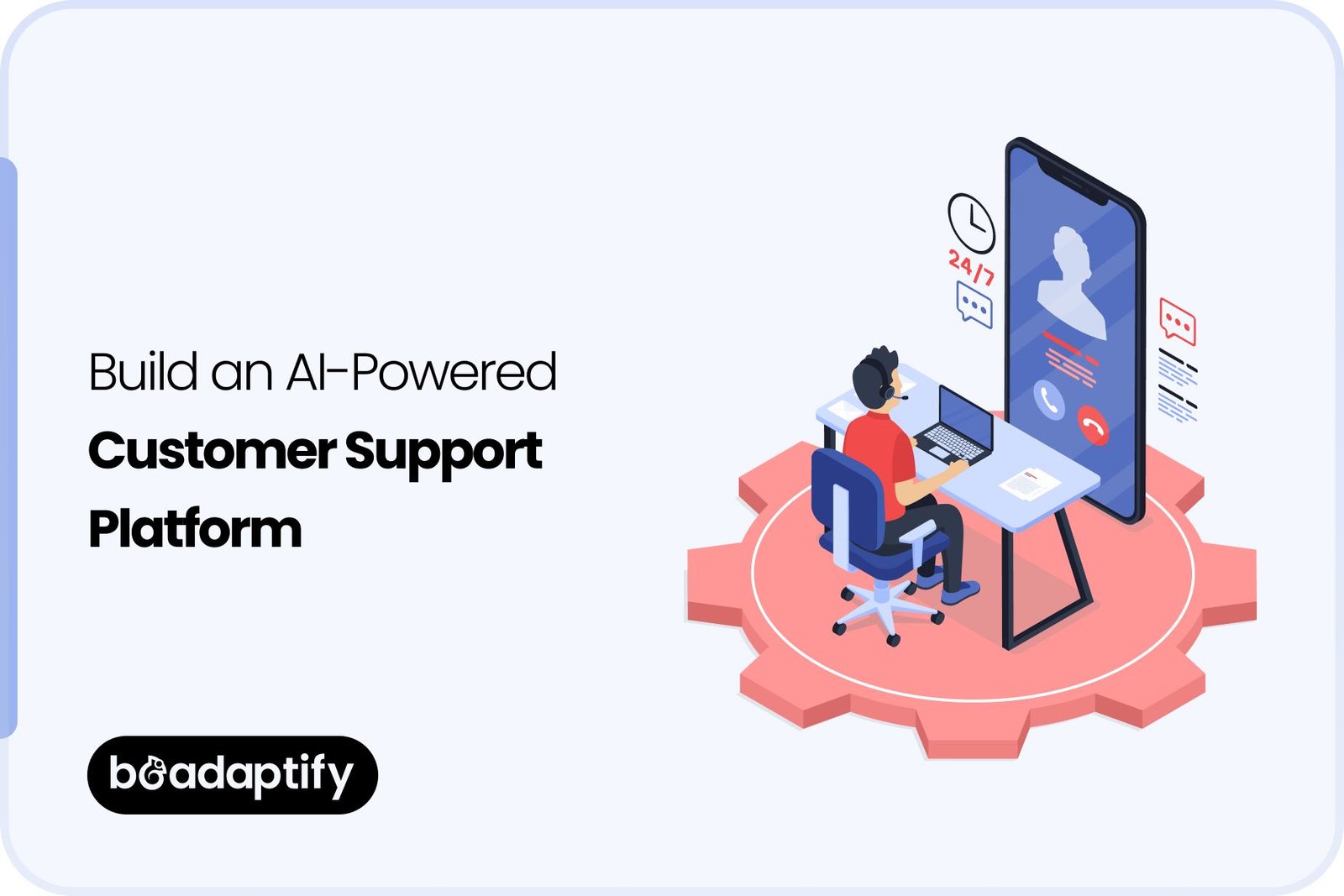
This is where an AI-powered customer support platform can make a significant difference. By combining artificial intelligence, machine learning, natural language processing, and generative AI, businesses can automate repetitive support tasks, understand customer intent, deliver contextual responses, and improve service operations.
Rather than relying entirely on human agents, intelligent customer support software can handle routine inquiries, recommend relevant solutions, categorize support tickets, and transfer complex requests to the appropriate team members.
However, building an effective platform requires more than integrating a chatbot into an existing website. The right AI architecture, knowledge management system, user experience, security measures, and third-party integrations must be considered.
In this guide, the complete process of building an AI-powered customer support platform will be explored, including essential features, development technologies, implementation steps, estimated costs, and best practices.
What Is an AI-Powered Customer Support Platform?
An AI-powered customer support platform is a software solution designed to manage customer interactions using artificial intelligence and automation technologies. It can understand customer questions, generate relevant responses, retrieve information from business databases, and assist support agents with different customer service activities.
Unlike traditional customer support software, which primarily depends on predefined rules and manual ticket management, an AI customer support system can interpret natural language and respond according to the context of a conversation.
For example, when a customer asks about an order, an AI virtual customer assistant can identify the request, retrieve order information through an integrated system, and provide an update without requiring a human agent to intervene.
Several technologies can be combined to develop these platforms:
- Artificial Intelligence: Enables intelligent decision-making and automated customer interactions.
- Machine Learning: Helps improve system performance through data and feedback.
- Natural Language Processing (NLP): Allows customer messages to be interpreted and classified.
- Large Language Models (LLMs): Generate natural, context-aware responses.
- Retrieval-Augmented Generation (RAG): Connects AI-generated responses with relevant business information.
- AI Agents: Perform specific support-related tasks by interacting with connected systems.
Together, these technologies can support customer service automation, improve response quality, and create a more consistent customer experience.
How Does an AI-Powered Customer Support Platform Work?
An AI-powered customer support platform generally works through a combination of customer input, intent recognition, information retrieval, response generation, and workflow automation.
A typical interaction can be divided into the following stages:
Step 1: Customer submits a query
A customer sends a message through a website chatbot, mobile application, email, or another supported communication channel.
Step 2: AI identifies customer intent
Natural Language Processing is used to understand the message, identify important details, and determine what the customer needs.
Step 3: Relevant information is retrieved
The system searches its connected knowledge base, CRM, order management system, or other business databases for relevant information.
Step 4: AI generates a response
A suitable AI model uses the retrieved information and conversation context to generate an appropriate response.
Step 5: The system performs an action or escalates the request
Depending on the request, the platform may retrieve order details, create a support ticket, update a record, or transfer the conversation to a human agent.
Step 6: Interaction data is analyzed
Customer feedback and interaction history can be analyzed to identify recurring problems, improve knowledge resources, and optimize support workflows.
This process allows businesses to build an automated customer support system that can manage routine requests while keeping human agents available for more complex situations.
Benefits of Building an AI-Powered Customer Support Platform
Investing in AI customer support platform development can offer several operational and customer experience advantages.
24/7 Customer Assistance
Traditional support operations are often restricted by business hours and agent availability. An AI-powered customer service platform can provide assistance at any time, allowing customers to receive answers even outside regular working hours.
Faster Response and Resolution Times
Customer inquiries can be categorized, prioritized, and answered automatically. This reduces the time spent waiting for an available support representative and helps improve overall service efficiency.
Reduced Customer Support Costs
Routine questions about account information, order status, product details, and common troubleshooting steps can be automated. As a result, human agents can spend more time handling complex requests that require personal attention.
Personalized Customer Interactions
By connecting with CRM platforms and customer databases, AI systems can use relevant customer information to deliver more contextual assistance. This can make conversations more useful and reduce the need for customers to repeat information.
Scalable Support Operations
As businesses grow, customer inquiry volumes generally increase. An intelligent customer support platform can manage a larger number of simultaneous interactions without requiring support capacity to grow at the same rate.
Improved Support Team Productivity
AI can assist agents by summarizing conversations, suggesting responses, retrieving relevant information, and organizing tickets. This improves human-AI collaboration in customer service.
Better Customer Insights
Customer sentiment analysis and interaction analytics can help businesses understand common complaints, recurring questions, and customer expectations. These insights can be used to improve products, services, and support processes.
Essential Features of an AI-Powered Customer Support Platform
The features selected during development will determine how effectively the platform can manage customer interactions. A well-designed solution should combine intelligent automation with practical tools for human support teams.
1. AI-Powered Chatbot and Virtual Assistant
An AI chatbot serves as the primary communication interface for many customer support platforms. It can answer frequently asked questions, guide customers through common processes, and collect information before creating a support ticket.
With generative AI, responses can be made more conversational and context-aware instead of being limited to predefined scripts.
2. Natural Language Processing
NLP enables the platform to understand customer messages written in everyday language. It can identify intent, extract relevant details, recognize variations in wording, and classify incoming requests.
This is particularly useful when customers describe the same problem in different ways.
3. Generative AI Response Generation
Generative AI in customer service allows the platform to create responses based on customer questions and available business information.
Rather than relying exclusively on fixed answers, the system can generate contextual explanations, summarize policies, and guide customers through relevant processes.
4. AI Ticket Classification and Routing
An AI ticket management system can automatically categorize incoming requests according to their subject, urgency, and department.
For example, billing-related inquiries can be assigned to the finance support team, while technical issues can be routed to technical specialists.
5. Omnichannel Communication
Customers may prefer different communication channels depending on their needs. An omnichannel customer support platform can bring interactions from multiple sources into a unified support environment.
Common channels include:
- Website live chat
- Mobile applications
- Social media
- In-app messaging
This helps support teams maintain consistent customer conversations across channels.
6. Intelligent Knowledge Base
An AI knowledge base integration allows the platform to retrieve relevant information from product documentation, FAQs, policies, manuals, and internal resources.
When combined with RAG, responses can be grounded in approved business information, helping reduce unsupported or inaccurate answers.
7. Customer Sentiment Analysis
Sentiment analysis can identify whether a customer message appears positive, negative, or neutral. It can also help identify conversations that may require urgent attention.
For example, repeated complaints or expressions of frustration can trigger escalation to a human support representative.
8. Human Agent Handoff
Not every customer problem should be handled automatically. A reliable platform should allow conversations to be transferred to human agents when the request is complex, sensitive, or outside the AI system’s capabilities.
The conversation history and relevant context should be shared during the handoff to avoid making customers repeat themselves.
9. CRM and Helpdesk Integration
CRM and helpdesk integrations allow the platform to retrieve customer information, manage support tickets, and maintain interaction histories.
These integrations can help create a unified view of customer activity and reduce manual data entry.
10. Analytics and Reporting Dashboard
A reporting dashboard can provide insights into:
- Total customer interactions
- Automated resolution rates
- Average response times
- Ticket volumes
- Customer satisfaction scores
- Escalation rates
- Frequently reported problems
These metrics can help businesses evaluate support performance and identify areas for improvement.
Other useful features may include multilingual support, conversation history, role-based access, secure authentication, and automated follow-up notifications.
Technologies Used to Develop an AI Customer Support Platform
Selecting the right technology stack is an important part of AI customer service software development. The technology choices should be based on the platform’s expected workload, integrations, security requirements, and future scalability.
Technology |
Role in platform development |
|---|---|
| Artificial Intelligence | Supports intelligent customer interactions |
| Machine Learning | Improves classification and prediction |
| Natural Language Processing | Understands customer messages and intent |
| Large Language Models | Generates contextual responses |
| Retrieval-Augmented Generation | Grounds responses in business knowledge |
| Vector Databases | Stores and retrieves semantic information |
| APIs and Webhooks | Connects external applications and services |
| Cloud Computing | Supports scalability and availability |
| Data Analytics | Tracks customer interactions and performance |
AI and Language Models
LLMs can be integrated to understand customer questions and generate natural-language responses. The selection of a model should consider response quality, latency, operating costs, privacy requirements, and integration capabilities.
RAG and Vector Databases
Retrieval-Augmented Generation is particularly useful when customer support responses must be based on company-specific information.
Business documents can be processed and indexed so relevant information can be retrieved when a customer submits a question. A vector database can support semantic search, helping the system identify relevant content even when the wording differs from the original documentation.
Backend and API Technologies
Backend technologies are responsible for managing user accounts, conversations, permissions, support tickets, and integrations. APIs and webhooks can connect the platform with CRM systems, payment services, order databases, and communication channels.
Cloud Infrastructure
Cloud infrastructure can support the deployment of AI models, application services, databases, and communication systems. It also allows resources to be adjusted according to usage requirements.
The final technology stack should be selected during the architecture planning stage rather than relying on a one-size-fits-all combination.
Step-by-Step Process to Build an AI-Powered Customer Support Platform
Developing a successful AI customer support platform requires a structured process. Each stage should be planned around business requirements, customer expectations, and the platform’s intended capabilities.
Step 1: Identify Business Requirements and Support Goals
The first step is to understand the existing customer support process and identify areas where AI can provide measurable value.
Businesses should evaluate:
- Average daily customer inquiry volume
- Frequently asked questions
- Common customer complaints
- Existing support channels
- Current ticket management processes
- Response and resolution times
- Customer satisfaction challenges
For example, an eCommerce business may prioritize order tracking, refund inquiries, and delivery updates. A SaaS company may focus on technical troubleshooting, subscription management, and account-related questions.
Clearly defined objectives will help determine the platform’s scope and feature requirements.
Step 2: Define the Platform’s Scope
Once business requirements have been identified, the platform’s functional scope should be established.
It should be decided whether the initial product will focus on an AI chatbot, a complete AI-powered helpdesk, an agent-assistance system, or a combination of these capabilities.
For businesses exploring the idea for the first time, beginning with a focused MVP can be a practical approach. MVP development services can help prioritize essential features, validate the concept, and reduce the risk of investing heavily before customer requirements have been tested.
Step 3: Select the Right AI Models and Technologies
The next stage involves selecting suitable AI models, NLP capabilities, RAG architecture, databases, and backend technologies.
The decision should be based on:
- Expected conversation volume
- Complexity of customer inquiries
- Required response accuracy
- Language support
- Data privacy requirements
- Integration requirements
- AI model usage costs
A simple FAQ assistant may not require the same architecture as an enterprise AI platform capable of executing multi-step customer service workflows.
Step 4: Design the Platform Architecture
A scalable architecture should be planned to support the platform’s different components.
A typical architecture may include:
- Customer-facing web or mobile interface
- Authentication and user management
- Conversation management service
- AI orchestration layer
- LLM integration
- RAG and knowledge retrieval system
- Customer and ticket databases
- CRM and helpdesk integrations
- Analytics and monitoring tools
Each component should have clearly defined responsibilities. Modular architecture can make it easier to update individual services as platform requirements evolve.
Step 5: Prepare and Integrate the Knowledge Base
The quality of an AI customer support platform depends heavily on the information available to it.
Business documentation, product guides, FAQs, troubleshooting instructions, and support policies should be reviewed and organized before integration.
The knowledge preparation process may include:
- Collecting approved business documents.
- Removing outdated or duplicate information.
- Organizing content into relevant categories.
- Splitting documents into searchable sections.
- Generating embeddings for semantic retrieval.
- Indexing information in a vector database.
- Testing retrieval accuracy using representative customer questions.
Knowledge resources should also be maintained regularly so outdated information is not used to generate customer responses.
Step 6: Develop AI Chatbots and Intelligent Support Workflows
The AI interaction layer can then be developed.
This includes implementing intent recognition, response generation, conversation memory, knowledge retrieval, and escalation logic.
For more advanced requirements, AI agents can be introduced to perform specific tasks through authorized tools and integrations.
For example, an AI agent may:
- Check order status.
- Retrieve subscription details.
- Create a support ticket.
- Update a customer record.
- Initiate an approved refund workflow.
- Schedule a service appointment.
These actions should be controlled through authentication, permissions, validation, and appropriate confirmation steps. Sensitive operations should not be performed solely on the basis of an unverified conversational request.
Step 7: Integrate CRM and Third-Party Systems
A customer support platform becomes more useful when it can access relevant business systems.
Depending on the business model, integrations may include:
- CRM platforms
- Helpdesk and ticketing software
- Email services
- WhatsApp and messaging platforms
- Payment gateways
- Order management systems
- Customer databases
- Analytics tools
Well-planned API integrations can allow customer information and support activities to be managed more efficiently.
Step 8: Design an Intuitive User and Agent Interface
The platform should be easy to use for both customers and support employees.
Customer-facing interfaces should make it simple to start conversations, find answers, and request human assistance. Agent dashboards should provide access to conversation history, ticket details, AI-generated summaries, and suggested responses.
UI/UX design services play an important role in creating these experiences. A well-planned interface can reduce navigation complexity and make AI-powered support workflows easier to manage.
Step 9: Implement Security and Data Privacy Measures
Customer support platforms may process personal information, account details, payment-related information, and private conversations. Security must therefore be included throughout the development process.
Important measures include:
- Secure authentication
- Role-based access controls
- Data encryption in transit and at rest
- Secure API communication
- Data retention policies
- Audit logs
- Sensitive information masking
- Regular vulnerability assessments
Businesses should also evaluate applicable privacy regulations and contractual requirements based on their markets and the types of data being processed.
Step 10: Test, Deploy, and Optimize the Platform
Before launch, the platform should be tested across different customer scenarios and usage conditions.
Testing should cover:
- Response accuracy
- Intent recognition
- Knowledge retrieval quality
- AI hallucination risks
- Integration reliability
- Security and access controls
- Performance under concurrent usage
- Human-agent escalation
- User experience
After deployment, performance should be monitored continuously. Customer feedback, unsuccessful queries, escalation patterns, and response quality can be used to improve the system over time.
AI Chatbots vs. AI Agents: Which Should Your Platform Use?
AI chatbots and AI agents are both useful for customer support, but they serve different purposes.
Traditional chatbots generally respond to predefined questions or follow structured conversational workflows. AI-powered chatbots can understand more flexible language and generate contextual responses.
AI agents can go a step further by using connected tools to complete specific tasks. Instead of simply explaining how an order can be tracked, an appropriately authorized AI agent may retrieve the order details and provide the latest status.
Capability |
AI Chatbot |
AI Agent |
|---|---|---|
| Answer common questions | Yes | Yes |
| Understand natural language | Yes, depending on model | Yes |
| Retrieve business information | Through integrations | Through integrations |
| Execute connected actions | Limited or workflow-based | Can perform authorized actions |
| Manage multi-step tasks | Limited | More suitable |
| Require human supervision | Depending on use case | Important for sensitive actions |
For most businesses, combining both approaches can be effective. A conversational AI interface can manage customer interactions, while AI agents handle specific tasks through controlled integrations.
Human support teams should remain available for complex complaints, sensitive requests, exceptions, and situations requiring judgment.
Essential Integrations for an AI Customer Support Platform
Third-party integrations help connect customer support activities with existing business operations.
The following integrations are commonly considered during development:
CRM Integration: Provides access to customer profiles, account details, previous interactions, and relevant sales information.
Helpdesk Integration: Allows support tickets to be created, assigned, prioritized, and tracked.
Email and Live Chat Integration: Enables customers to communicate through their preferred channels.
WhatsApp and Social Media Integration: Helps businesses manage customer interactions through popular messaging and social platforms.
Payment and Order Management Integration: Supports order tracking, payment status inquiries, and approved transaction-related workflows.
Knowledge Base Integration: Gives the AI system access to product documentation, FAQs, policies, and internal support resources.
Analytics Integration: Helps measure support performance, customer behavior, and automation outcomes.
Integration requirements should be defined early because they can significantly influence platform architecture, development timelines, and costs.
How Much Does It Cost to Build an AI-Powered Customer Support Platform?
The cost of developing an AI-powered customer support platform depends on its features, AI capabilities, architecture, integrations, security requirements, and expected usage.
A basic chatbot with a limited knowledge base will generally require a smaller investment than an enterprise platform featuring multiple AI agents, omnichannel communication, advanced analytics, and complex integrations.
The following figures can be used as preliminary development budget estimates:
Platform complexity |
Estimated development cost |
|---|---|
| Basic AI chatbot platform | $10,000–$25,000 |
| Mid-level AI support platform | $25,000–$60,000 |
| Advanced AI-powered platform | $60,000–$120,000 |
| Enterprise AI support solution | $120,000–$250,000+ |
These are indicative planning ranges, not verified market averages or fixed quotations. Actual costs will depend on project scope, team location, technology choices, integrations, and implementation requirements.
Factors Affecting Development Costs
1. AI Model Selection: Model selection, API usage, hosting, and inference requirements can influence ongoing expenses.
2. Platform Features: Advanced capabilities such as AI agents, multilingual support, sentiment analysis, and automated ticket management require additional development.
3. UI/UX Design: Customer-facing interfaces and agent dashboards must be designed around different user journeys.
4. Third-Party Integrations: Connecting CRM platforms, helpdesk systems, messaging channels, and business databases can increase development complexity.
5. Data Preparation: Knowledge base preparation, document processing, data cleaning, and retrieval configuration require dedicated effort.
6. Security and Compliance: Authentication, encryption, access management, auditing, and regulatory requirements may add to the overall budget.
7. Maintenance and Optimization: AI model usage, infrastructure, monitoring, updates, and continuous improvements should be included in the long-term budget.
For businesses with limited initial budgets, developing a focused MVP and gradually introducing advanced capabilities can help manage investment more effectively.
Common Challenges in AI Customer Support Platform Development
Although AI can improve customer service operations, several challenges must be addressed during implementation.
Inaccurate AI Responses
AI models may sometimes generate incorrect or unsupported information. RAG, approved knowledge sources, response validation, and clear escalation rules can help reduce this risk.
Poor-Quality Knowledge Base Data
Outdated or incomplete documentation can affect response accuracy. Business information should be reviewed, organized, and maintained regularly.
Data Privacy and Security Risks
Customer information must be protected through appropriate security controls, access restrictions, encryption, and data governance practices.
Complex Third-Party Integrations
Different systems may use different APIs, data formats, and authentication methods. Integration testing and reliable error-handling mechanisms are important.
AI Hallucinations
Generative AI may produce convincing answers that are not supported by available information. Responses should be grounded in trusted sources, and the platform should be designed to acknowledge uncertainty rather than invent answers.
Managing Human-Agent Handoffs
Poor escalation workflows can create frustrating customer experiences. Relevant conversation history and collected information should be transferred to human agents whenever a handoff is required.
Controlling AI Operating Costs
High conversation volumes and repeated model calls can increase operational expenses. Caching, model selection, usage monitoring, and efficient retrieval strategies can help control costs.
Best Practices for Developing an Effective AI Customer Support Platform
A successful platform should be developed around real customer needs rather than simply adding as many AI features as possible.
The following practices can help improve platform quality and long-term performance:
Start With Specific Use Cases: Identify repetitive and high-volume customer inquiries that can be automated effectively.
Build a Reliable Knowledge Base: Use accurate, approved, and regularly updated business information to support AI responses.
Use RAG for Contextual Responses: Connect language models with trusted company resources to improve answer relevance and reduce unsupported responses.
Keep Human Agents Involved: Provide a clear escalation path for complex, sensitive, or unresolved customer requests.
Prioritize Security From the Beginning: Include authentication, access controls, encryption, and privacy requirements in the initial architecture.
Monitor AI Performance: Track resolution rates, response quality, customer satisfaction, escalation rates, and unsuccessful queries.
Design for Scalability: Choose an architecture that can support additional channels, users, integrations, and AI capabilities as the business grows.
Improve Through Customer Feedback: Use customer feedback and support analytics to identify weaknesses and refine conversational workflows.
How Beadaptify Can Help Build an AI-Powered Customer Support Platform
Building an intelligent customer support platform requires the right combination of AI capabilities, reliable software architecture, seamless integrations, and user-focused design. A development partner can help businesses translate their customer service requirements into a practical and scalable digital solution.
Beadaptify supports businesses in developing custom digital products by combining AI capabilities with software engineering and user experience design.
Through its software product development services, businesses can plan and develop customer support solutions that align with their operational requirements and long-term goals.
The development process can include:
- Custom AI Platform Development: Building customer support software around specific business workflows and customer requirements.
- AI Chatbot and Agent Integration: Implementing conversational AI and task-oriented AI agents for customer service automation.
- Web Application Development: Creating responsive interfaces and scalable application architecture through professional web development services.
- UI/UX Design: Developing intuitive customer-facing chat interfaces and support agent dashboards.
- Third-Party Integrations: Connecting CRM platforms, helpdesk tools, communication channels, and business databases.
- MVP Development: Launching essential platform capabilities first and expanding the solution based on user feedback and business needs.
- Ongoing Optimization: Improving platform performance, functionality, and scalability as customer requirements evolve.
With the right combination of design & development services and a structured implementation strategy, businesses can build AI-powered customer support solutions that improve operational efficiency while delivering more convenient customer experiences.
Conclusion
AI-powered customer support platforms are changing how businesses manage customer interactions. By combining conversational AI, machine learning, generative AI, knowledge retrieval, and intelligent automation, businesses can provide faster assistance, manage repetitive inquiries, and improve support team productivity.
However, successful implementation depends on more than selecting an AI model. The platform must be built around clearly defined business requirements, reliable knowledge sources, secure integrations, intuitive interfaces, and effective human-agent collaboration.
A phased development approach can be particularly useful. Businesses can begin with essential chatbot and knowledge base capabilities, validate the solution through an MVP, and gradually introduce advanced features such as AI agents, sentiment analysis, and automated support workflows.
With the right development strategy, an AI-powered customer support platform can become an important part of a business’s digital infrastructure, supporting better customer experiences and more scalable service operations.
FAQs About AI-powered Customer Support Platform
How do you build an AI-powered customer support platform?
To build an AI-powered customer support platform, businesses should first identify their customer service requirements and define the essential features. The development process typically includes selecting AI models, designing the platform architecture, integrating a knowledge base, developing AI chatbots or agents, connecting CRM systems, implementing security measures, and testing the solution before deployment.
What features should an AI customer support platform have?
An effective AI customer support platform should include AI-powered chatbots, natural language processing, automated ticket management, knowledge base integration, omnichannel communication, sentiment analysis, CRM integration, human-agent handoff, conversation history, and analytics dashboards. Additional features can be introduced according to business requirements.
Can AI customer support platforms integrate with CRM systems?
Yes. AI customer support platforms can integrate with CRM systems through APIs and other supported integration methods. These connections allow the platform to retrieve customer profiles, access interaction history, update records, and provide more personalized support.
How can generative AI improve customer service?
Generative AI can understand customer questions and create contextual responses using relevant business information. It can also summarize conversations, recommend solutions, assist support agents, and improve knowledge discovery. When combined with RAG and reliable knowledge sources, it can provide more relevant and consistent customer assistance.
How can businesses ensure security in AI-powered customer support systems?
Businesses can improve platform security through encrypted data communication, secure authentication, role-based access controls, audit logs, data retention policies, and regular security testing. AI integrations should also follow appropriate data privacy requirements, with sensitive customer information protected throughout processing and storage.