Businesses are generating more data than ever through websites, mobile applications, customer interactions, connected devices, payment systems, and enterprise platforms. However, the value of this data can be limited when it is collected too slowly, stored in disconnected systems, or processed only through periodic reports. To make timely decisions, data must be collected, processed, and delivered to the right systems with minimal delay.
This is where a scalable data pipeline for real-time analytics becomes essential. By connecting data sources with processing engines, storage platforms, and analytical tools, organizations can transform continuous streams of information into actionable insights. Customer behavior can be monitored as it happens, operational issues can be detected earlier, and business performance can be evaluated using more current information.
However, real-time analytics requires more than simply connecting a few APIs or databases. A reliable solution must be designed around data volume, processing latency, fault tolerance, security, data quality, and future growth.
With support from a capable software development company, the right architecture can be established to accommodate increasing data volumes without compromising performance or reliability. Through well-planned enterprise software development and software product development services, real-time data pipelines can be built to support both immediate analytical requirements and long-term business objectives.
What Is a Real-Time Data Pipeline?
A real-time data pipeline is a system through which data is continuously collected, processed, and delivered to its destination as events occur or shortly afterward. Instead of waiting for scheduled batch jobs, information can be made available to dashboards, analytical applications, recommendation engines, and automated business workflows within seconds or, in some cases, milliseconds.
For example, when a customer completes an online purchase, the transaction event can be captured immediately. The event can then be validated, processed, and sent to an analytics platform where sales dashboards are updated, inventory levels are adjusted, and suspicious activity may be flagged.
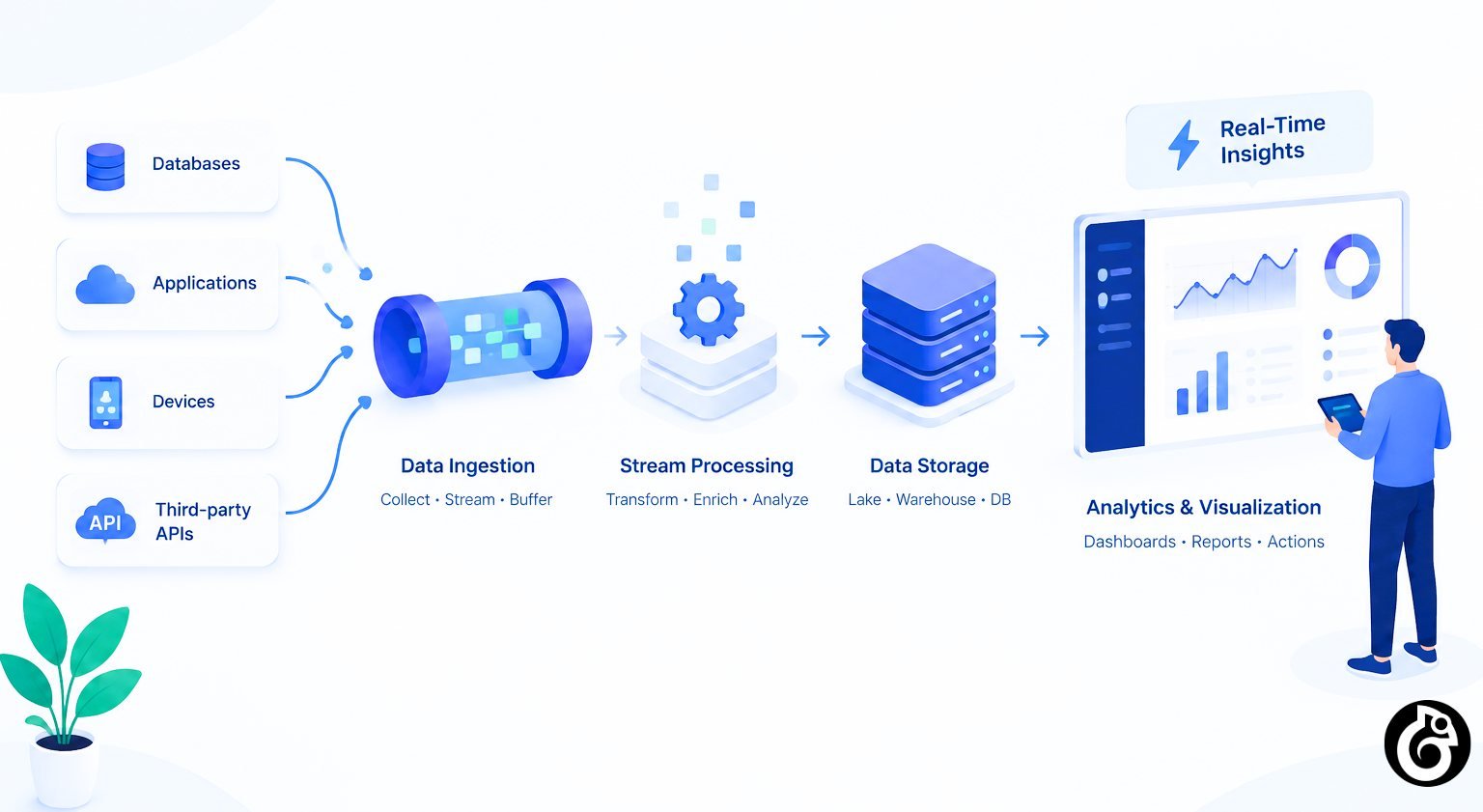
A typical real-time pipeline includes the following components:
- Data sources: Applications, databases, APIs, devices, and event streams.
- Data ingestion: Information is collected and delivered to the pipeline.
- Stream processing: Events are filtered, transformed, enriched, and aggregated.
- Data storage: Processed or raw data is stored for analytics, historical analysis, or operational use.
- Analytics and visualization: Insights are presented through dashboards, reports, or applications.
- Monitoring and governance: Data quality, security, system performance, and access are managed.
The architecture can be adapted to the specific requirements of each business. Some applications require sub-second processing, while others can operate effectively with a delay of several seconds or minutes.
Why Is Scalability Important in Real-Time Analytics?
A data pipeline that performs well with a few thousand events per minute may struggle when traffic increases significantly. Seasonal demand, product launches, marketing campaigns, connected devices, and business expansion can all produce unexpected increases in data volume. Scalability ensures that the pipeline can accommodate these changes without requiring a complete redesign.
1. Increasing Data Volumes Can Be Managed
As additional applications, customers, and devices are connected, more events are generated. A scalable architecture allows processing capacity to be expanded as required. Distributed systems, partitioned event streams, and horizontal scaling can be used to handle higher workloads.
2. Low Latency Can Be Maintained
Real-time insights are useful only when information is delivered quickly enough for the intended purpose. Processing delays can be reduced through efficient transformations, appropriate partitioning, optimized queries, and carefully selected infrastructure.
3. Service Reliability Can Be Improved
Failures can occur in individual services, network connections, databases, or processing jobs. Reliability can be strengthened through replication, durable event storage, checkpointing, retry mechanisms, and recovery procedures.
4. Infrastructure Costs Can Be Controlled
A poorly designed pipeline may require excessive computing resources or repeated data processing. Resource utilization can be improved through workload optimization, efficient data formats, autoscaling, and appropriate storage policies.
5. Future Integrations Can Be Supported
New applications and analytical tools may need to be connected as business requirements evolve. A modular architecture allows components to be extended or replaced with fewer disruptions.
Step-by-Step Process for Building a Scalable Real-Time Data Pipeline
A successful pipeline should be built around clearly defined analytical requirements rather than a technology stack selected in isolation. The following development process can be used to establish a scalable foundation.
Step 1: Define Business Requirements and Latency Targets
Before the architecture is selected, the intended business outcomes should be documented. The pipeline may be required to support live sales reporting, fraud detection, customer personalization, application monitoring, predictive maintenance, or operational alerts.
Each use case should be evaluated according to the speed, volume, accuracy, and availability of data required. For example, a fraud detection system may require a decision within milliseconds or seconds, whereas an executive dashboard may tolerate a slightly longer delay.
The following requirements should be established:
- Expected events per second and peak traffic volume.
- Acceptable end-to-end processing latency.
- Data retention and historical analysis needs.
- Required availability and recovery objectives.
- Accuracy, completeness, and data freshness expectations.
- Security, privacy, and compliance obligations.
- Expected growth in users, sources, and transactions.
Clear targets make architecture decisions easier to validate. Without measurable requirements, a pipeline may be overengineered or may fail to meet operational expectations.
Step 2: Identify and Prepare Data Sources
Data may be generated across several systems, including transactional databases, web applications, mobile applications, third-party APIs, IoT devices, and enterprise platforms. Before ingestion is implemented, the structure and behavior of each source should be understood. Data formats, event frequency, update patterns, access permissions, and failure scenarios should be documented.
Common ingestion methods include:
- Event streaming: Continuous events are published as they occur.
- Change Data Capture (CDC): Database changes are captured and delivered to downstream systems.
- API ingestion: Data is collected from external or internal services.
- Message queues: Events are temporarily buffered and delivered between services.
- Scheduled batch ingestion: Data is imported at defined intervals when immediate processing is unnecessary.
A hybrid approach may be appropriate when both historical and live data are required. Historical records can be loaded in batches, while new changes are captured through streaming or CDC.
Step 3: Select the Right Data Ingestion Technology
An ingestion layer is responsible for receiving data and making it available for downstream processing. It should be selected according to throughput, ordering requirements, durability, integration complexity, and operational constraints.
Technologies such as Apache Kafka, Apache Pulsar, cloud-managed event streaming services, and managed message queues may be considered depending on the workload.
For example, a distributed event streaming platform can be used when high-throughput event delivery, replay, and multiple independent consumers are required. A managed queue may be more suitable for simpler asynchronous processing workflows.
Several design principles should be followed:
- Events should be assigned clear schemas.
- Partitioning should be planned around workload and ordering needs.
- Durable retention should be configured where replay is required.
- Backpressure should be handled to prevent downstream overload.
- Retry and dead-letter mechanisms should be established for failed messages.
- Duplicate delivery should be anticipated where delivery semantics allow it.
The ingestion layer should not become a bottleneck as event volumes increase. Capacity planning and load testing should therefore be completed before production traffic is introduced.
Step 4: Design the Stream Processing Layer
Once events have been ingested, they must be transformed into information that can be analyzed or used by downstream applications. Stream processing may include filtering irrelevant events, validating records, standardizing formats, enriching data with reference information, calculating aggregates, and identifying patterns.
Apache Flink, Spark Structured Streaming, Kafka Streams, and cloud-managed stream processing services may be considered based on the processing requirements and the team’s operational capabilities. For example, an eCommerce pipeline may be configured to calculate sales by product category, identify abandoned checkout sessions, or detect unusual transaction patterns as events arrive.
The processing logic should be designed carefully to account for:
- Late-arriving events.
- Out-of-order data.
- Duplicate messages.
- Event-time versus processing-time calculations.
- Stateful operations and windowed aggregations.
- Processing failures and state recovery.
Event time represents when an event actually occurred, while processing time represents when the system handled it. This distinction becomes important when network delays or offline devices cause events to arrive late.
For operations that require accurate results, windowing, watermarks, deduplication, and state management should be configured according to the business rules.
Step 5: Choose the Right Storage Architecture
Processed data must be stored in a format and system that support the intended queries, retention periods, and access patterns. Different storage technologies may be used for different purposes:
Storage Type |
Common Use Case |
|---|---|
| Data lake | Large-scale raw and processed data storage |
| Data warehouse | Structured analytics and business reporting |
| Operational database | Fast access to current application records |
| Time-series database | Metrics and time-stamped measurements |
| Search engine | Text search, log exploration, and event investigation |
| Analytical database | High-performance aggregations and interactive queries |
A data lake may be used to preserve raw events for future analysis, while a warehouse may be used to provide consistent reporting datasets. An operational database may be needed when processed information must be returned to an application quickly.
The storage architecture should be designed around query patterns rather than data volume alone. Partitioning, indexing, compression, data retention, and file formats can all affect performance and cost.
Step 6: Build Reliable Data Transformation and Quality Controls
Data quality should be addressed throughout the pipeline rather than only at the reporting stage. Inconsistent formats, missing values, duplicate events, and invalid records can lead to incorrect business decisions.
Validation rules should be applied as early as practical. Required fields can be checked, timestamps standardized, identifiers validated, and unexpected values flagged.
Useful controls include:
- Schema validation and compatibility checks.
- Null-value and duplicate detection.
- Data type and format validation.
- Referential integrity checks where appropriate.
- Data freshness and completeness monitoring.
- Quarantine or dead-letter handling for invalid records.
- Reconciliation between source and destination systems.
Schema evolution should also be planned. When a source application introduces a new field or changes an existing one, downstream processing should not break unexpectedly. Versioned schemas and compatibility rules can help manage such changes.
For high-impact use cases, data quality metrics should be exposed through dashboards and alerts so that issues can be investigated before they affect business decisions.
Step 7: Design for Fault Tolerance and Recovery
Failures cannot always be prevented, but their impact can be reduced through resilient architecture.
If a processing service becomes unavailable, events should be retained long enough to allow recovery where the selected platform supports durable storage. Failed operations should be retried according to a defined policy, and messages that repeatedly fail should be isolated for investigation.
Important reliability mechanisms include:
- Replication across appropriate failure domains.
- Checkpointing and state recovery.
- Retry policies with exponential backoff.
- Dead-letter queues for repeatedly failed events.
- Idempotent processing to reduce duplicate side effects.
- Replay procedures for rebuilding downstream datasets.
- Backup and disaster recovery plans.
Delivery guarantees should be understood clearly. At-least-once delivery can result in duplicate processing, while exactly-once guarantees are generally scoped to specific processing and storage boundaries. End-to-end exactly-once behavior should not be assumed without verifying how every component handles transactions, retries, and external side effects.
For this reason, idempotency and reconciliation are often essential parts of a production-grade design.
Step 8: Implement Security and Data Governance
Real-time pipelines may process personal information, financial records, customer activity, business transactions, or confidential operational data. Security must therefore be included in the architecture from the beginning.
Data should be protected during transmission and storage through appropriate encryption controls. Authentication and authorization should be enforced for users, services, and data consumers. Access should be limited according to roles and business responsibilities.
Additional measures may include:
- Secrets management and credential rotation.
- Network segmentation and private connectivity.
- Data masking or tokenization where appropriate.
- Audit logging and access monitoring.
- Data retention and deletion policies.
- Data lineage and ownership documentation.
- Compliance reviews based on applicable regulations.
Sensitive data should not be copied into every downstream system without a clear purpose. Data minimization can reduce exposure, storage costs, and governance complexity.
Step 9: Monitor Performance and Operational Health
Once a pipeline is deployed, its performance should be measured continuously. A dashboard showing only server utilization may not reveal whether business data is arriving late or being dropped.
Monitoring should cover both infrastructure health and data delivery.
Key metrics include:
- End-to-end latency: Time from event creation to availability at the destination.
- Throughput: Number of events processed over a defined period.
- Consumer lag: The delay between produced and consumed events.
- Error rate: Percentage of failed processing operations.
- Data freshness: Age of the latest available data.
- Completeness: Whether expected records or events have arrived.
- Resource utilization: CPU, memory, storage, and network consumption.
- Recovery time: Time required to restore normal processing after a failure.
Alerts should be tied to meaningful thresholds and business impact. For example, a growing consumer lag may indicate that a downstream processor cannot keep up with incoming traffic. A data freshness alert may be more useful to a reporting team than an infrastructure alert alone.
Step 10: Test, Deploy, and Scale Gradually
Before production deployment, the pipeline should be tested under normal, peak, and failure conditions. Load testing should be used to estimate maximum sustainable throughput and identify bottlenecks. Stress testing can reveal how the system behaves beyond its expected capacity, while failure testing can help verify recovery procedures.
Testing should include:
- Functional validation of ingestion and transformation rules.
- Performance testing under realistic workloads.
- Integration testing across all pipeline components.
- Recovery testing for service interruptions.
- Data quality and reconciliation checks.
- Security and access-control testing.
- Cost and resource-utilization evaluation.
A staged rollout can be used to reduce risk. Initial traffic can be directed to a limited workload, followed by gradual expansion after performance and data quality have been verified. Autoscaling may be enabled where supported, but scaling policies should be tested carefully. Rapid scaling can increase infrastructure costs, and slow scaling may allow latency to rise during traffic spikes.
Key Technologies Used in Scalable Real-Time Data Pipelines
A suitable technology stack depends on the volume of data, processing complexity, deployment environment, team expertise, and business goals.
Pipeline Layer |
Example Technologies |
Purpose |
|---|---|---|
| Data ingestion | Apache Kafka, Apache Pulsar, managed queues | Collect and distribute events |
| Stream processing | Apache Flink, Spark Structured Streaming, Kafka Streams | Transform and analyze events |
| CDC | Debezium, database-native CDC tools | Capture database changes |
| Data lake | Cloud object storage, lakehouse platforms | Store large volumes of raw and processed data |
| Data warehouse | Cloud data warehouses | Support analytical queries and reporting |
| Orchestration | Apache Airflow, managed workflow tools | Coordinate batch and supporting workflows |
| Monitoring | Prometheus, Grafana, cloud monitoring tools | Track system health and performance |
| Data governance | Catalog, lineage, access-control tools | Manage ownership, quality, and compliance |
These tools should not all be deployed by default. A smaller managed stack may be more suitable for a modest workload, while a distributed architecture may be justified for high-throughput, multi-consumer, or complex processing requirements.
Technology selection should be driven by measurable needs rather than the number of tools available.
Common Challenges in Real-Time Data Pipeline Development
Even a carefully designed pipeline can face operational and architectural challenges.
Data Bottlenecks
Uneven partitioning, slow database writes, inefficient transformations, or overloaded consumers can limit throughput. Bottlenecks should be identified through profiling and load testing before additional infrastructure is purchased.
Duplicate or Missing Events
Retries and network interruptions can lead to duplicate processing, while inadequate retention or incorrect acknowledgments can contribute to data loss. Idempotency, durable messaging, monitoring, and reconciliation should be implemented according to the required delivery guarantees.
Growing Infrastructure Costs
High event volumes, long retention periods, unnecessary transformations, and excessive data movement can increase expenses. Cost monitoring, compression, tiered storage, workload optimization, and sensible retention policies can help control spending.
Complex Operations
Distributed pipelines can become difficult to maintain when too many tools, custom connectors, and processing stages are introduced. Components should be added only when they provide measurable value, and operational ownership should be clearly assigned.
Changing Data Schemas
Source systems evolve, and downstream consumers may depend on existing fields or formats. Schema versioning, compatibility testing, and clear ownership can reduce disruptions.
Best Practices for Building a Scalable Data Pipeline
The following practices can improve reliability, maintainability, and long-term performance:
- Start with business requirements: Define the use case, latency target, throughput, and reliability needs before choosing technologies.
- Use modular architecture: Keep ingestion, processing, storage, and analytics components independently manageable.
- Plan for backpressure: Ensure that temporary downstream slowdowns do not overwhelm the entire pipeline.
- Make processing idempotent: Reduce the impact of retries and duplicate events.
- Automate testing and deployment: Use version control, automated tests, and controlled release procedures.
- Monitor data and infrastructure: Track latency, lag, data freshness, quality, and resource consumption.
- Document recovery procedures: Ensure that replay, rollback, and disaster recovery steps can be followed consistently.
- Apply governance from the beginning: Manage permissions, lineage, retention, and sensitive data throughout the pipeline.
- Review costs regularly: Evaluate storage, processing, network, and managed-service expenses.
- Scale based on evidence: Use measured workload patterns rather than assumptions to determine capacity.
When Should a Business Work With a Software Development Company?
A real-time data pipeline may involve distributed systems, event-driven architecture, cloud infrastructure, data engineering, security, and analytics. When these elements must work together across multiple enterprise applications, specialized expertise may be required.
A software development company can help translate business requirements into a practical architecture, select suitable technologies, establish data contracts, and implement testing and monitoring processes. This can be particularly useful when the pipeline is expected to support business-critical reporting, financial transactions, customer personalization, or operational automation.
Through software product development services, organizations can receive support across architecture design, custom development, integration, testing, deployment, and ongoing optimization.
For larger environments, enterprise software development may also be required to connect the pipeline with existing ERP, CRM, data warehouse, identity management, and reporting systems. The architecture should be aligned with the organization’s security policies, operational capabilities, and long-term data strategy.
The objective should not be to create the most complex pipeline possible. Instead, the right solution should meet current analytical needs while leaving room for future growth.
How to Measure the Success of a Real-Time Data Pipeline
Pipeline performance should be evaluated against business outcomes as well as technical metrics.
Useful indicators include:
- Reduction in data processing delays.
- Improvement in dashboard freshness.
- Increase in successfully processed events.
- Reduction in failed jobs and data-quality incidents.
- Faster detection of operational issues.
- Improved response time for automated decisions.
- Lower cost per processed event.
- Reduced time required to onboard new data sources.
For example, if sales reporting previously depended on hourly batch updates, a streaming pipeline may make transaction information available within seconds. The business benefit should then be assessed by determining whether faster information improves inventory planning, campaign monitoring, or operational decisions.
Performance targets should be reviewed regularly as traffic grows and new use cases are introduced.
Why Choose Beadaptify for Data-Driven Software Development?
Building a scalable data pipeline requires a clear understanding of business workflows, data architecture, integration requirements, and long-term product goals. At Beadaptify, software solutions can be planned around the practical needs of each organization, with an emphasis on reliable architecture, usability, maintainability, and future scalability.
Through software product development services and enterprise software development expertise, businesses can plan and build data-driven applications that connect essential systems, process information efficiently, and support more informed decisions. From requirements analysis and architecture planning to custom development, integration, testing, and ongoing improvement, the development approach should be aligned with the intended business outcomes.
Whether a new analytics platform is being developed or an existing enterprise system is being extended with real-time capabilities, the right solution should be designed to support reliable data flow, responsible data management, and long-term growth.
Final Thoughts
A scalable data pipeline is an important foundation for real-time analytics. By connecting reliable ingestion, efficient stream processing, appropriate storage, strong data quality controls, and continuous monitoring, organizations can make timely information available to the systems and people who need it. Successful implementation depends on more than technology selection. Clear latency targets, fault tolerance, security, governance, testing, and cost management must be considered throughout the development process.
With a well-planned architecture and the right engineering expertise, real-time analytics can be introduced incrementally and expanded as business requirements grow. With Beadaptify, a software development company can help ensure that the resulting solution remains reliable, maintainable, and aligned with long-term enterprise objectives.

FAQs About Real-Time Analytics
How do you build a scalable data pipeline?
A scalable data pipeline is built by defining business and latency requirements, selecting suitable ingestion technologies, implementing stream processing, choosing appropriate storage, establishing data quality controls, and adding monitoring, security, and recovery mechanisms. Load testing is then used to validate performance.
Which technologies are used for real-time data processing?
Apache Kafka, Apache Flink, Spark Structured Streaming, Kafka Streams, Debezium, cloud-managed streaming services, and analytical storage platforms are among the technologies that may be used. The selection depends on throughput, latency, integration, and operational requirements.
What is the difference between batch processing and stream processing?
Batch processing handles data in groups at scheduled intervals or when a batch is ready. Stream processing handles events continuously as they arrive. Batch processing is often suitable for historical reporting, while stream processing is useful when recent information must be analyzed quickly.
How can data pipeline reliability be improved?
Reliability can be improved through durable event storage, replication, checkpointing, retries, idempotent processing, dead-letter queues, monitoring, and tested recovery procedures. Data reconciliation can also be used to identify missing or duplicated records.
Why is data quality important in real-time analytics?
Data quality is essential because incorrect, incomplete, or duplicated information can lead to misleading reports and automated decisions. Validation, schema management, deduplication, freshness checks, and reconciliation help maintain the reliability of analytical outputs.