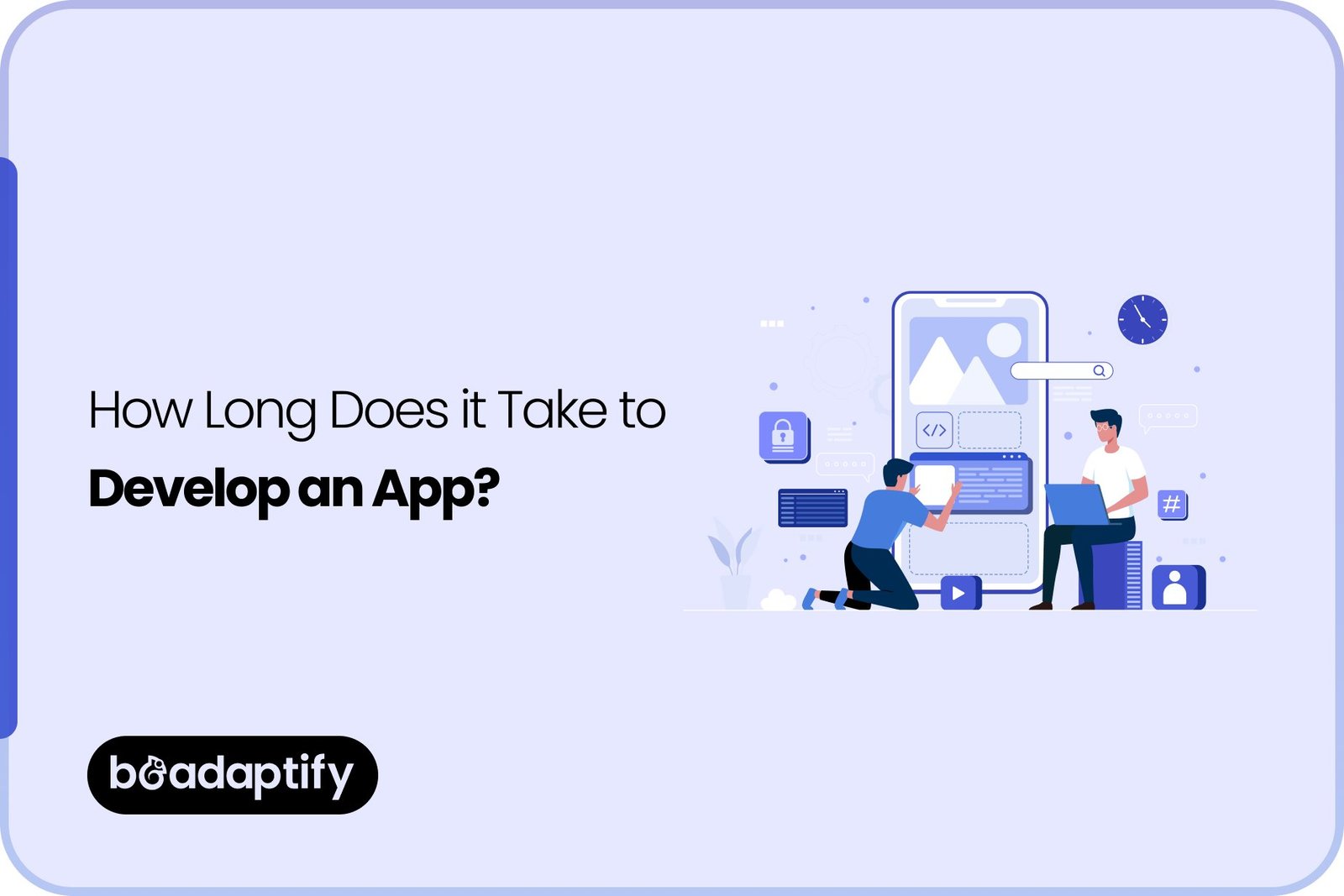
In 2026, mobile apps are being expected to do much more than support a digital presence. They are being built to drive revenue, improve customer engagement, automate operations, enable subscriptions, support internal teams, and create long-term competitive advantage. Because of that, one of the first questions businesses ask before starting is simple:
How long does it take to develop an app?
The honest answer is that app development timelines are not being determined by coding alone. They are being shaped by strategy, scope, UX design, platform choice, integrations, testing, approvals, and post-launch readiness. A basic app may be developed in a matter of weeks, while a more advanced product may require several months. A feature-rich enterprise platform may take even longer.
This is why app development in 2026 should not be viewed as a race to the fastest launch. It should be approached as a structured process where speed, quality, scalability, and business goals are balanced correctly.
At Beadaptify, businesses are often guided through this process by first identifying what kind of app is actually being built. A simple customer utility, a commerce app, an internal operations tool, a healthcare platform, and a fintech product may all be called “mobile apps,” but they require very different levels of planning and execution.
This guide explains what affects app development time in 2026, how long each phase usually takes, what timeline ranges can be expected for different types of apps, and how businesses can reduce delays without sacrificing product quality.
Why App Development Timelines Vary So Much
A common mistake is to assume that all apps follow roughly the same timeline. In reality, app development duration depends on a wide range of project variables.
The total timeline is usually influenced by:
- product complexity
- number of features
- iOS, Android, or cross-platform scope
- backend architecture
- admin panel requirements
- third-party integrations
- design quality expectations
- security and compliance needs
- stakeholder approval speed
- post-launch preparation
Because of this, two apps with similar screen counts may still take very different amounts of time to build. An app with static content and simple navigation can move quickly. An app with user accounts, payment processing, notifications, analytics, dashboards, and workflow automation will naturally take much longer.
That is why the better question is not just “How long does it take to develop an app?” but “How long does it take to develop the right version of this app for our business goals?”
Typical App Development Timeline in 2026
Although timelines vary, most app projects in 2026 fall into a few broad categories.
Simple apps
A relatively simple app with limited functionality, basic UI, and minimal backend logic is often being completed in around 1 to 2 months.
Standard custom apps
A more typical custom app with user authentication, content management, moderate integrations, and structured design work is often being completed in around 3 to 6 months.
Advanced apps
Apps with heavy backend logic, real-time functionality, deeper integrations, marketplace logic, or advanced user roles are often being completed in around 6 to 12 months.
Enterprise or highly regulated apps
Large-scale, compliance-sensitive, or multi-system applications may take 9 to 18 months or more, depending on scope and security requirements. These ranges are useful for planning, but real timelines are better understood when the process is broken into stages.
The App Development Process and How Long Each Stage Usually Takes
1. Discovery and strategy
Every successful app begins with product clarity. Before design or development starts, the business goals, core problem, audience, success metrics, and feature priorities need to be defined.
This stage may include:
- business requirement gathering
- feature prioritization
- target user analysis
- competitor research
- platform planning
- technical roadmap definition
For simpler apps, this phase may take a few days to 2 weeks. For more complex products, it may take 2 to 4 weeks or more.
This stage is often underestimated, but when it is rushed or skipped, delays usually appear later through scope changes, design confusion, and technical rework.
2. Wireframing and user flow planning
Once the strategy is clearer, the next step usually involves mapping how users will move through the app. Core actions, screens, and pathways are being organized into flows before high-fidelity design begins.
This phase helps answer questions like:
- What should the onboarding journey look like?
- How many steps should checkout or booking require?
- How should navigation be structured?
- Which actions are primary, and which are secondary?
Wireframing and flow planning may take 1 to 2 weeks for smaller apps and 2 to 4 weeks for larger or more complex products. This step is important because it reduces confusion during design and development.
3. UI/UX design
The visual and interactive experience of the app is then being created. In 2026, design is not being treated as decoration. It is being treated as a core part of conversion, retention, and usability.
The design phase often includes:
- visual concept development
- component design
- responsive screen design
- clickable prototypes
- interaction patterns
- design system setup
For a basic app, this phase may take 1 to 3 weeks. For custom products with more screens, stronger branding, and advanced UX patterns, it may take 3 to 6 weeks or more. A cleaner design process usually leads to faster development because fewer decisions are being made mid-build.
4. Frontend development
Frontend development includes building the screens and user interactions that customers or employees will actually use. This includes navigation, forms, button logic, transitions, content display, and all user-facing functionality.
Timeline length depends on:
- number of screens
- complexity of the interface
- number of user states
- animation and interaction detail
- platform requirements
Frontend work may take 2 to 4 weeks for smaller apps and 4 to 10 weeks or more for standard to advanced products. If an app is being built for both iOS and Android separately, more time is usually required than for a single-platform build.
5. Backend development
Many apps require a backend system to manage data, authentication, business logic, notifications, reporting, and integrations. In some projects, backend work is relatively simple. In others, it becomes the most time-consuming layer of the product.
Backend development may include:
- database architecture
- API development
- user account systems
- admin dashboards
- business rules
- payment handling
- content management
- reporting and analytics logic
A lightweight backend may take 2 to 4 weeks, while more advanced backend systems may take 2 to 4 months or longer. Apps that include marketplaces, bookings, subscriptions, or role-based dashboards often require far more backend effort than businesses initially expect.
6. Third-party integrations
Integrations are now a major part of app development. Most custom apps are being connected to external tools and systems rather than operating in isolation.
These may include:
- payment gateways
- maps and geolocation
- push notification tools
- chat systems
- CRM platforms
- analytics tools
- marketing automation systems
- inventory or ERP systems
- customer support tools
Simple integrations may add a few days. Complex or business-critical integrations may add weeks. This is one of the main reasons timelines can expand unexpectedly if requirements are not fully defined in advance.
7. Quality assurance and testing
Testing is one of the most important parts of the process. An app that launches quickly but fails under real-world conditions is not truly “faster” in any meaningful sense.
Testing generally includes:
- functional testing
- device testing
- operating system testing
- bug identification and resolution
- usability review
- performance checks
- security validation
For small apps, QA may take 1 to 2 weeks. For more complex apps, it may run continuously throughout development and intensify in the last 2 to 4 weeks before launch. Testing time should never be treated as optional padding. It is part of product quality.
8. App store submission and launch preparation
Before the app goes live, launch preparation must be completed. This includes store assets, screenshots, metadata, versioning, policy checks, environment setup, and release monitoring.
This stage usually includes:
- Apple App Store submission
- Google Play submission
- app descriptions and assets
- build configuration
- analytics setup
- crash monitoring
- production environment readiness
Depending on review times and whether changes are requested, this stage may take several days to 2 weeks.
Timeline by App Type
Different product categories tend to follow different delivery patterns.
MVP app
A focused MVP with core functionality only can often be developed in 6 to 12 weeks, especially when scope is disciplined and approval loops are short.
Ecommerce app
A custom ecommerce app with product browsing, checkout, payments, and account features is often developed in around 3 to 6 months, depending on platform complexity.
Marketplace app
A two-sided marketplace with buyer and seller flows, listings, payments, messaging, and admin tools often requires around 4 to 8 months or more.
Healthcare or fintech app
These apps often require stronger security, compliance support, and more careful QA, which can extend the timeline to 6 to 12 months or longer.
Enterprise operations app
Internal workflow apps can sometimes move faster if the UX is simpler, but if they include permissions, automation, approvals, or dashboard logic, they often require 3 to 9 months.
How Platform Choice Affects Timeline
iOS only
A single-platform iOS app may take less time than a dual-platform rollout, especially if the experience is relatively focused.
Android only
Android-only apps can move similarly, though broader device testing may add more QA effort.
Native iOS and native Android
Building both platforms natively often increases timeline because two separate codebases are being developed and tested.
Cross-platform app
A cross-platform strategy can reduce total delivery time for many projects, especially for MVPs or standard business apps. However, cross-platform development is not automatically fast. Complexity, performance goals, and integration requirements still matter. The right platform decision should be based on business goals, audience behavior, budget, and timeline priorities.
What Usually Causes App Development Delays
In many projects, delays are not caused by engineering alone. They are caused by planning, coordination, and decision-making issues.
Common delay factors include:
- unclear requirements at the start
- too many features added during development
- slow stakeholder approvals
- underestimating backend complexity
- changing design direction mid-project
- delayed content or business logic decisions
- integration requirements discovered too late
- insufficient testing time
How to Reduce Timeline Without Sacrificing Quality
Start with an MVP
The fastest path is often not to build everything, but to build the right core version first. An MVP helps businesses validate faster and reduce initial complexity.
Prioritize features
Core features should be clearly separated from future enhancements. This keeps the launch scope focused.
Approve designs before development begins
The more design ambiguity remains during build, the more development slows down.
Use existing tools where appropriate
Authentication, notifications, analytics, and payments do not always need to be custom-built from scratch.
Launch in phases
A phased rollout often helps businesses go live earlier while reducing delivery pressure.
Work with the right team
The right partner can usually identify risks earlier, simplify unnecessary complexity, and guide the product toward a more efficient launch plan.
Should You Hire Mobile App Developers or Work With a Company?
This depends on the structure of the business and the nature of the project.
When it makes sense to hire mobile app developers
Choosing or bring in mobile app developers for hire can work well when:
- a strong internal product owner is already in place
- scope is clearly defined
- ongoing long-term development capacity is needed
- internal management of delivery is possible
When it makes sense to work with a mobile app development company
Working with a mobile application development company is often the better option when:
- product strategy, design, development, and QA are all needed
- the app is complex or high-stakes
- structured delivery is important
- multiple specialists need to work together
- long-term scalability matters
At Beadaptify, the right delivery model is usually being shaped around business readiness, internal team capacity, and the goals of the product itself.
What Businesses Should Expect in 2026
Businesses planning an app in 2026 should expect that users are less tolerant of weak digital experiences than they were in previous years. A mobile app is now expected to be:
- fast
- intuitive
- secure
- visually polished
- stable across devices
- ready for continuous improvement
That means timelines may sometimes feel longer than overly optimistic promises suggest. But realistic timelines usually lead to stronger launch outcomes.
Businesses should also expect app development to be increasingly iterative. Instead of waiting to launch a perfect version of everything, successful teams are often launching strategically, gathering feedback, and improving continuously.
Realistic App Development Timeline Summary
To simplify expectations, the following timeline model is useful:
- simple app: 1 to 2 months
- standard custom app: 3 to 6 months
- advanced app: 6 to 12 months
- enterprise or highly regulated app: 9 to 18+ months
These are not strict rules, but they are useful for setting realistic expectations.
Why Beadaptify Is the Right Mobile App Development Partner?
At Beadaptify, mobile apps are developed with a strong focus on strategy, usability, scalability, and business outcomes. App development is not approached as a one-size-fits-all process. Instead, each product is planned around the specific goals, audience needs, and technical requirements of the business. As a trusted mobile app development company, Beadaptify delivers structured mobile app development services that help businesses move from concept to launch with clarity and confidence.
From discovery and UX design to development, testing, and post-launch support, every stage is handled with a performance-driven approach that reduces risk and supports long-term growth. For businesses that want flexible engagement models, our team also supports brands looking to hire mobile app developers for dedicated app development support. The result is a mobile product that is built not just to launch, but to grow and perform over time.
Final Thoughts
So, how long does it take to develop an app in 2026? A smaller app may be completed in a matter of weeks. A more typical custom app may take several months. A complex, integrated, or compliance-heavy platform may take much longer. The most important thing to understand is that timeline should not be judged by speed alone. A quick launch only creates value if the product is stable, user-friendly, and built on the right foundation.
At Beadaptify, app development timelines are approached through clarity, not guesswork. By combining product planning, structured & scalable mobile app development solutions, and the right team model for each project, businesses are able to launch with more confidence and fewer surprises.
FAQs on App Development Time
How long does it usually take to develop an app in 2026?
App development timelines in 2026 usually depend on the complexity of the product. A simpler app may take a few weeks, while a custom business app may take several months. More advanced platforms can take much longer depending on features, integrations, and compliance needs.
What affects the app development timeline the most?
The biggest factors usually include project scope, number of features, platform choice, backend complexity, UI/UX requirements, third-party integrations, testing needs, and the speed of stakeholder approvals.
How long does it take to build an MVP app?
An MVP app is often developed faster than a full product because only essential features are included. In many cases, an MVP can be built in a few weeks to a few months depending on the scope and delivery model.
Does building for both iOS and Android take longer?
Yes, building for both platforms generally increases development time, especially if the app is being developed natively. Cross-platform approaches may reduce the overall timeline, but complexity still depends on features and integrations.
Can app development be launched faster without sacrificing quality?
Yes, timelines can often be reduced by prioritizing core features, starting with an MVP, using proven integrations, and working with an experienced app development company that follows a structured process.