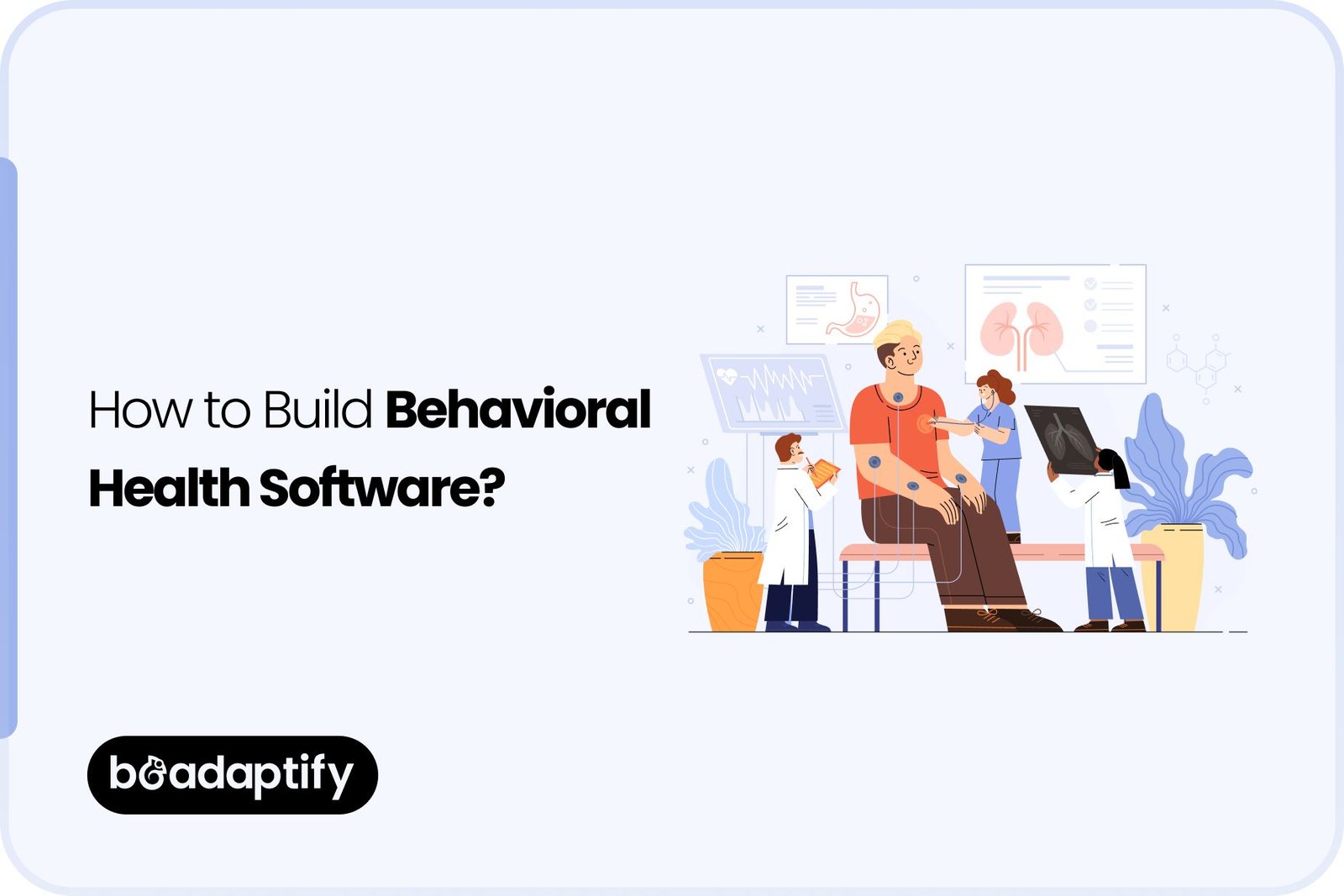
Behavioral health software is being built very differently in 2026 than it was just a few years ago. What was once treated as a digital extension of scheduling and documentation is now being approached as a much broader care, operations, and engagement platform. Organizations are no longer looking only for software that stores notes or books appointments. They are looking for systems that support intake, care coordination, secure communication, remote engagement, outcomes tracking, billing workflows, and interoperability with the wider healthcare ecosystem. At the same time, compliance pressure has increased. HIPAA security expectations remain central, 42 CFR Part 2 rules continue to matter for substance-use-related records, and interoperability expectations around standards such as FHIR are becoming more important in health software planning.
That combination of product ambition and compliance pressure means behavioral health software can no longer be built like a generic SaaS app. The product may still look like a modern digital platform on the surface, but underneath it, decisions are being shaped by data sensitivity, patient trust, provider workflows, documentation needs, and system integration requirements. In many cases, these products include both patient-facing and provider-facing experiences, which means web, mobile, admin, and analytics layers are all being developed together. For multi-tenant platforms, dashboards, and workflow systems, it often makes sense to hire SaaS developers. These delivery decisions matter because behavioral health products usually need more than one skill profile to be built correctly.
This guide explains how behavioral health software should be built in 2026, which features matter most, what cost factors shape the budget, which compliance requirements influence the architecture, and how a modern behavioral health platform should be planned from MVP to scale.
What Behavioral Health Software Means in 2026
Behavioral health software is being used to support mental health, substance use treatment, therapy operations, counseling services, psychiatry workflows, care coordination, and digital support tools for patients and providers. It may be built for private practices, treatment centers, digital health startups, hospital behavioral health units, teletherapy platforms, payers, employer wellness products, or hybrid care organizations.
The term is broad because the product category is broad. A behavioral health product may be:
- a therapy scheduling and documentation platform
- a telebehavioral health system
- a patient engagement app
- a digital intake and assessments system
- a remote support or check-in tool
- a provider operations dashboard
- a digital care coordination platform
- a medication and treatment adherence app
- a SaaS platform for multi-location behavioral health organizations
The important thing to understand is that behavioral health software is not being defined only by the treatment area. It is being defined by the workflows, user roles, and sensitivity of the information being handled.
Why Behavioral Health Software Is Being Prioritized
Behavioral health organizations are under pressure from multiple directions. Patient demand is high. Provider capacity is often limited. Operational teams are expected to move faster. Reporting and compliance burdens remain significant. Patients also increasingly expect digital access, mobile communication, and more convenient care pathways.
As a result, software is being used to reduce friction in areas such as:
- patient intake
- appointment management
- secure communication
- outcomes tracking
- treatment coordination
- claims and billing administration
- digital engagement between visits
- documentation and operational visibility
At the same time, public-sector and health IT efforts have continued to focus on interoperability and behavioral health technology adoption, which reinforces the need for stronger digital infrastructure in this sector. ONC continues to position FHIR as a widely used API-focused interoperability standard, and federal behavioral health initiatives have also emphasized improved health IT adoption in behavioral health settings.
This means the business case for behavioral health software is not only about modernization. It is also about access, efficiency, continuity, and better digital coordination.
Core Product Types in Behavioral Health Software
Before features are planned, the product type should be defined clearly. Different behavioral health products require different architectures and team structures.
Provider-facing platforms
These systems are being built for therapists, psychiatrists, case managers, billing teams, intake coordinators, and administrators. They often include calendars, clinical documentation, role-based access, billing workflows, internal communication, and reporting dashboards.
Patient-facing apps
These products are being built for engagement, scheduling, assessments, journaling, reminders, therapy homework, educational resources, telehealth access, secure messaging, and treatment support. In these cases, it often makes sense to hire mobile app developers or partner with a team experienced in mobile application solutions because user experience, privacy, and adherence behaviors matter heavily.
Multi-tenant behavioral health SaaS platforms
Organizations that serve many clinics, therapists, treatment centers, or enterprise buyers often need SaaS architecture rather than a one-off custom portal. These products usually require tenant separation, role management, admin layers, reporting, integrations, and billing logic. In these situations, businesses often choose to hire SaaS developers or work with a software product development company that already understands platform architecture.
Hybrid care ecosystems
Some behavioral health systems combine provider-facing software, patient apps, analytics dashboards, telehealth, payments, intake forms, and integrations into one connected product. These are often the most demanding systems to build because they span multiple user types and multiple risk areas.
Essential Features of Behavioral Health Software
Feature planning should be driven by workflow, not by feature inflation. The right feature set depends on the target user, care model, and business model. However, certain core capabilities are often expected.
1. Secure user authentication and access control
Because behavioral health data is highly sensitive, authentication and role-based access are essential. Different users should be allowed to see only the information and functions relevant to their role. Patients, therapists, supervisors, admins, billing teams, and care coordinators often need different permission levels.
This is one area where technical quality and compliance awareness intersect directly. Access control is not just a convenience feature. It is part of the product’s security posture.
2. Digital intake and onboarding
Behavioral health software often begins at intake. New patient forms, consent collection, screening questionnaires, insurance data capture, and initial history gathering are frequently being digitized to reduce manual work and improve access.
A strong intake experience often includes:
- digital forms
- conditional logic
- document upload
- signatures and consent capture
- appointment preference selection
- insurance intake support
- assessment routing
The intake experience has a large effect on conversion and administrative efficiency.
3. Scheduling and appointment management
Appointment scheduling remains foundational. Patients expect easier self-service, while clinics need more visibility into provider availability, cancellations, no-shows, waitlists, and rescheduling.
Features may include:
- provider calendars
- patient self-scheduling
- reminders via SMS, email, or app
- waitlist logic
- recurring sessions
- intake-to-booking workflows
- telehealth session links
When this works well, operational friction is reduced significantly.
4. Telebehavioral health support
Video sessions are still an important part of behavioral health software, especially in hybrid models. The software may need to support:
- secure video sessions
- in-session notes access
- pre-session reminders
- post-session follow-ups
- troubleshooting instructions
- mobile and desktop access
This often increases both technical complexity and compliance requirements.
5. Clinical notes and documentation
Provider-facing systems usually require documentation support. Depending on the use case, this may include progress notes, treatment plans, assessments, care summaries, internal tasks, and document storage.
Documentation workflows should be designed for actual provider use rather than generic database entry. If notes take too long to complete or navigate, adoption is weakened.
6. Outcomes tracking and assessments
Behavioral health organizations increasingly want visibility into symptom trends, treatment response, program completion, and engagement. That often means the software needs to support:
- standardized assessments
- repeated check-ins
- score tracking
- visual progress trends
- outcome reporting
- program engagement metrics
This can create value for both care quality and internal decision-making.
7. Secure messaging and communication
Patients and providers often need light-touch communication between sessions. Secure messaging can support reminders, clarifications, care coordination, and engagement. However, this feature must be designed carefully so expectations, escalation boundaries, and privacy protection are clear.
8. Billing, claims, and payment workflows
For many organizations, billing is one of the biggest operational pain points. Behavioral health software may need to support insurance claims, self-pay workflows, invoices, receipts, payment tracking, superbills, or integration with billing tools.
9. Reporting and analytics
Operational visibility matters for growth and accountability. Dashboards may be required for:
- appointment utilization
- provider productivity
- no-show rates
- intake conversion
- patient engagement
- revenue trends
- outcomes measures
- compliance logs
These capabilities are especially important in larger group practices or SaaS-based operational platforms.
10. Mobile engagement features
For patient-facing products, mobile is often central rather than secondary. Behavioral health apps are commonly used for:
- reminders
- journaling
- check-ins
- homework between sessions
- appointment access
- secure communication
- digital self-help content
Advanced Features That May Be Added in 2026
As behavioral health products mature, more advanced capabilities are often added.
These may include:
- AI-assisted documentation support
- care pathway automation
- personalized content delivery
- therapist matching logic
- risk-flag workflows
- wearable or device integrations
- interoperability with EHR-adjacent systems
- multi-location admin controls
- multi-tenant SaaS billing
- population-level outcomes analytics
These features usually should not all be included in version one. However, they should influence how the product architecture is designed.
Compliance Requirements That Shape Behavioral Health Software
Behavioral health software cannot be built as if compliance is a later legal review step. Compliance requirements shape architecture, permissions, data handling, workflows, and product design decisions from the beginning.
HIPAA security expectations
The HIPAA Security Rule requires administrative, physical, and technical safeguards to protect electronic protected health information and ensure its confidentiality, integrity, and availability. That means behavioral health software must be designed with secure handling of health-related data in mind.
In practical product terms, this usually affects:
- authentication
- access controls
- audit trails
- encryption
- secure transmission
- environment management
- incident response readiness
- backup and recovery logic
HHS has also continued to publish cybersecurity guidance and proposed updates intended to strengthen security expectations, including stronger contingency and restoration requirements in its 2024 proposed rule materials.
42 CFR Part 2 considerations
If the product handles substance use disorder treatment records, 42 CFR Part 2 can become especially important. HHS’s January 2026 fact sheet on the final rule explains that the updated rule allows a single patient consent for future uses and disclosures for treatment, payment, and healthcare operations, while aligning certain areas more closely with HIPAA. That does not remove the need for careful data-handling design; it reinforces the need to understand the applicable boundaries.
Interoperability and FHIR
If the product is expected to exchange data with external health systems, standards-based interoperability becomes important. ONC continues to describe FHIR as a widely used API-focused standard for representing and exchanging health information and as part of a more connected health ecosystem.
This affects architecture planning, especially when future integrations are expected.
Information blocking and data access environment
Healthcare technology environments are increasingly shaped by data access and information-sharing expectations. Behavioral health organizations may face more pressure over time to participate in structured exchange environments, which makes interoperability-aware architecture a long-term advantage.
Development Process: How Behavioral Health Software Should Be Built
1. Product discovery
The process should begin with a clear definition of:
- target users
- business goals
- care model
- workflow pain points
- compliance boundaries
- feature priorities
- integration needs
This stage is often where businesses decide whether they need a full product build immediately or should begin with support from an MVP development company.
2. MVP definition
For many teams, a full-scale version one is not the best starting point. A carefully scoped MVP can reduce cost, shorten time-to-market, and validate whether the workflow is actually being solved correctly.
A behavioral health MVP might focus on:
- secure onboarding
- scheduling
- telehealth access
- basic documentation
- simple messaging
- patient reminders
- one analytics layer
That is where MVP development services can be especially valuable.
3. UX and workflow design
Behavioral health products are often used in emotionally sensitive, time-limited, or administratively complex contexts. UX should therefore be designed with clarity, privacy, and low friction in mind.
4. Architecture and development
Frontend, backend, mobile, analytics, and admin layers are then built according to the scoped roadmap. This may involve both web and mobile products depending on the platform type.
5. QA, security review, and launch preparation
Testing should include:
- workflow validation
- permissions review
- security testing
- device testing
- integration testing
- load and stability testing
6. Post-launch iteration
Behavioral health software usually improves significantly after launch because workflows are refined through actual usage, operational feedback, and analytics.
Cost of Building Behavioral Health Software in 2026
Cost depends on product type, scope, compliance requirements, integrations, and delivery model.
Basic MVP behavioral health product
A smaller product with limited workflows and carefully scoped features may cost roughly $25,000 to $60,000, depending on web vs mobile scope and UX quality.
Mid-range custom product
A more complete behavioral health platform with patient and provider workflows, secure messaging, telehealth, reporting, and custom backend logic may cost roughly $60,000 to $180,000.
Advanced or enterprise-grade platform
A larger system with multi-location operations, heavy compliance layers, reporting, interoperability planning, role complexity, and mobile + SaaS delivery may cost $180,000 to $500,000+.
The biggest cost drivers usually include:
- number of user roles
- patient-facing mobile scope
- telehealth and messaging
- reporting complexity
- claims or billing workflows
- integrations
- security architecture
- admin tooling
- analytics
- multi-tenant SaaS architecture
This is why the product should be scoped carefully and why many organizations first engage MVP development services before committing to a larger platform roadmap.
What Drives ROI in Behavioral Health Software
ROI should not be measured only through direct revenue. In behavioral health software, value is often created across operations, access, and retention.
1. Reduced administrative burden
Digital intake, reminders, scheduling, and reporting can reduce manual effort significantly.
2. Better patient engagement
Mobile support, reminders, check-ins, and easier access can improve adherence and continuity.
3. Improved provider efficiency
Cleaner workflows, documentation support, and better visibility can reduce friction for clinicians and staff.
4. Stronger operational reporting
Data can be used to identify drop-offs, no-show patterns, intake bottlenecks, and utilization opportunities.
5. Scalable service delivery
Digital tools can help organizations serve more users without scaling operational complexity at the same rate.
6. Faster product-market validation
For startups, an MVP can help validate a behavioral health product before larger investments are made.
Should You Build In-House or Use a Product Partner?
This depends on internal capacity and product ambition.
In-house may work when:
- a strong product team already exists
- long-term internal ownership is planned
- a healthcare tech team is already being built
A partner model may work better when:
- speed matters
- multiple skill sets are needed together
- healthcare workflow and product strategy support are needed
- mobile and SaaS capabilities are both required
- the product is being validated through an MVP first
Why Choose Beadaptify for Behavioral Health Software Development?
At Beadaptify, behavioral health software is developed with a strong focus on security, workflow clarity, scalability, and long-term product value. These platforms are not treated like generic applications. They are built around the real needs of providers, patients, care teams, and healthcare businesses that require trust, efficiency, and strong digital infrastructure. As a trusted software development company, Beadaptify delivers tailored services for organizations building modern behavioral health platforms, patient engagement tools, provider systems, and operational dashboards.
Whether the need is to hire developers for patient-facing experiences, hire SaaS developers for scalable care platforms, or work with an MVP development company to validate a new product idea, the development approach is structured around performance, usability, and growth readiness. Through specialized software product development services, Beadaptify helps businesses turn complex behavioral health ideas into practical, secure, and future-ready digital products.
Final Thoughts
Building behavioral health software in 2026 requires much more than feature planning. It requires a strong understanding of user trust, operational workflows, security obligations, and long-term product scalability. The right solution is rarely a generic platform. It is usually a carefully structured product built around real behavioral health needs.
For some teams, the best path is to begin with an MVP and validate workflow fit through a trusted MVP development company. For others, the right move is to build a larger multi-role platform through a specialized development company. In mobile-first engagement products, it may make sense to hire mobile app developers. In operational or platform-led products, it may make sense to hire SaaS developers. Across all of these paths, the common need is strong execution through thoughtful structured software product development services, and scalable mobile application solutions.
When behavioral health software is built carefully, it can do much more than digitize operations. It can improve access, reduce friction, support continuity, and create a stronger digital foundation for care.

FAQs About Behavioral Health Software
What features are usually included in behavioral health software?
Common features often include digital intake, appointment scheduling, telehealth support, secure messaging, clinical documentation, outcomes tracking, billing workflows, reporting dashboards, and patient engagement tools.
How much does behavioral health software cost to build?
The cost depends on product scope, number of user roles, mobile requirements, reporting complexity, integrations, compliance needs, and platform architecture. A smaller MVP costs less than a full multi-role behavioral health platform.
Why is compliance important in behavioral health software development?
Behavioral health software often handles highly sensitive patient data, which means privacy, security, access control, auditability, and data-handling processes must be considered carefully during product planning and development.
Should behavioral health software be built as an MVP first?
In many cases, yes. Starting with an MVP helps validate the workflow, reduce initial cost, and launch faster with core features before expanding into a larger platform. This is why many businesses work with an MVP development services.