The web development landscape in 2025 is faster, smarter, and more user-centric than ever. With artificial intelligence, automation, and immersive interfaces becoming mainstream, businesses are expected to build responsive, dynamic, and scalable web applications that perform seamlessly across platforms.
Yet amidst this technological evolution, ReactJS remains the go-to choice for developers and enterprises worldwide. Despite the emergence of newer frameworks and meta-libraries, ReactJS continues to dominate the web ecosystem due to its unmatched balance of performance, flexibility, and community strength. This raises an important question: Why ReactJS still dominates web development in 2025 and what’s next for it?
A Brief Evolution of ReactJS
ReactJS, introduced by Facebook in 2013, revolutionized front-end development by introducing component-based architecture and virtual DOM. What began as an internal tool to simplify UI rendering became one of the most powerful frameworks in the world.
Over the years, ReactJS has evolved significantly:
- 2015: React Native extended its reach to mobile app development.
- 2017: React Fiber improved rendering and performance.
- 2019–2022: Hooks and Concurrent Mode made state management and async rendering easier.
- 2023–2025: Server Components, React 19, and improved integration with frameworks like Next.js solidified its ecosystem dominance.
Today, React is not just a front-end library, it’s the core of modern web architecture, empowering scalable and interactive applications across industries.
Why ReactJS Still Dominates Web Development in 2025
There are many frameworks Angular, Vue, Svelte, and even new players like Qwik and Solid.js, but ReactJS continues to outperform and outlast competitors for several reasons.
Here’s why ReactJS remains a market leader:
- Mature Ecosystem: Over a decade of refinement and massive community support.
- Scalability: Perfect for startups and enterprises alike.
- Cross-Platform Reach: With React Native, code reuse bridges web and mobile seamlessly.
- Adaptability: Works efficiently with headless CMS, APIs, and microservices.
- Community-Driven Innovation: Every update is backed by thousands of contributors worldwide.
ReactJS open-source strength, combined with its flexibility, continues to make it the first choice for businesses partnering with a ReactJS development company to build future-ready web apps.
Key Advantages That Keep ReactJS Ahead
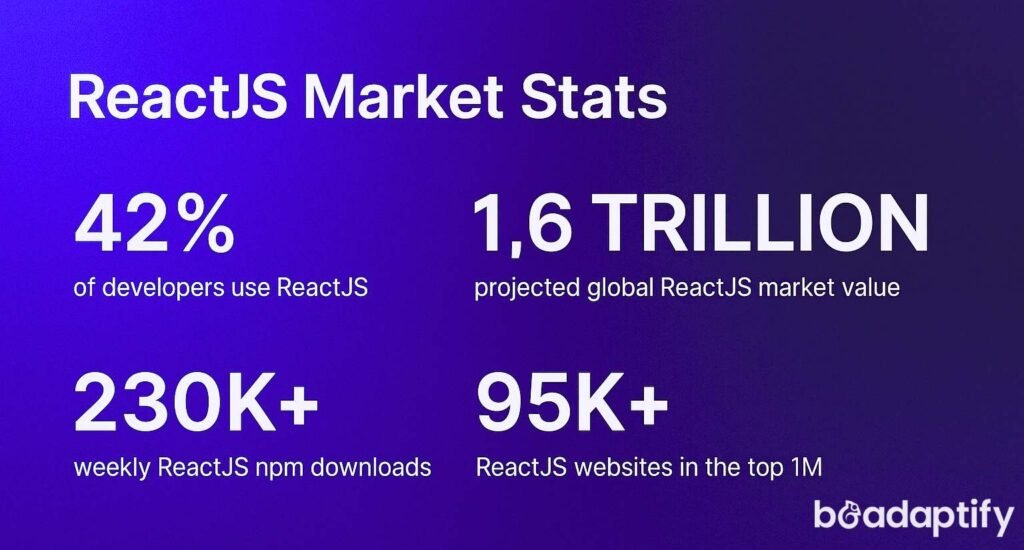
4.1 Component-Based Architecture
ReactJS encourages developers to build reusable, modular UI components. This lowers development time, enhances scalability, and ensures maintainable codebases, making it ideal for modern digital products.
4.2 Virtual DOM for Faster Rendering
React Virtual DOM technology improves rendering speed by only updating the parts of the UI that change. In 2025, this remains a key differentiator for performance-sensitive applications.
4.3 One-Way Data Binding
React unidirectional data flow ensures predictable state management and debugging simplicity. Combined with React Hooks and tools like Redux or Recoil, data flow in large apps remains clean and consistent.
4.4 SEO-Friendly Structure
ReactJS applications, especially those using Next.js, are optimized for SEO through server-side rendering (SSR) and static site generation (SSG). This makes React a preferred choice for marketing-driven web apps that need visibility on Google.
4.5 Integration with Modern Tools
From TypeScript and GraphQL to Tailwind CSS and Vite, React works smoothly with nearly every tool in the front-end ecosystem, making it the most versatile choice in 2025.
ReactJS vs. Other Frameworks in 2025
| Feature | ReactJS | Angular | Vue.js | Svelte |
|---|---|---|---|---|
| Performance | Excellent with Virtual DOM | Moderate | Fast | Very Fast |
| Learning Curve | Moderate | Steep | Easy | Moderate |
| Community | Largest in the world | Large | Growing | Smaller |
| Scalability | High | High | Medium | Medium |
| Cross-Platform | React Native | Ionic | NativeScript | Limited |
| Corporate Adoption | Widely used (Meta, Netflix, Airbnb) | Enterprise-level apps | Startups | Niche apps |
While frameworks like Vue and Svelte are growing, ReactJS balance of maturity, flexibility, and enterprise adoption keeps it leading. Many businesses rely on a ReactJS development services company to ensure stable, scalable products with long-term maintainability.
Why Choose ReactJS For Web Development in 2025
If your business aims to build an application that’s fast, adaptable, and future-proof, ReactJS remains the best choice.
Here’s why:
- Proven Stability: A decade of enterprise use with constant updates.
- Faster Time-to-Market: Prebuilt components and reusable architecture save months.
- Cost-Effective Maintenance: Shared code between web and mobile (React Native).
- Performance Optimization: Virtual DOM and hooks-based rendering make apps responsive.
- Strong Talent Pool: Easier hiring due to React global popularity.
In 2025, hiring a ReactJS development services company means tapping into a mature technology that powers global apps from startups to Fortune 500s.
How ReactJS Fits Into Modern Tech Stacks
React versatility allows seamless integration into modern tech stacks, making it an essential tool for both front-end development companies and full-stack product teams.
Common Stack Pairings in 2025:
- Frontend: ReactJS + Next.js + Tailwind CSS + TypeScript
- Backend: Node.js + Express + MongoDB
- Headless CMS: Strapi, Sanity, or Contentful
- DevOps: Docker, Vercel, and AWS Amplify
This interoperability makes React ideal for Custom ReactJS development services, where applications need flexibility without vendor lock-in.
Emerging Trends Shaping ReactJS in 2025
React continues to evolve with new technologies and methodologies. Some of the trends defining its trajectory include:
Server Components
Introduced in React 18, Server Components allow developers to render parts of the UI on the server, improving load times and SEO performance.
AI-Assisted Front-End Development
With AI tools like GitHub Copilot and ChatGPT integrations, ReactJS development services are becoming faster and more intelligent. Code completion, UI suggestions, and testing automation reduce development cycles.
Micro-Frontends
ReactJS is widely used in micro-frontend architectures, where different teams manage independent parts of large applications without dependency conflicts.
Cross-Platform Ecosystem
The line between web and mobile continues to blur, and React Native keeps expanding React reach into wearable and TV applications.
Security-First Development
2025 emphasizes cybersecurity in UI frameworks, and React strict data binding and controlled rendering offer a secure foundation for enterprise apps.
Business Benefits of Using ReactJS
For companies evaluating front-end frameworks, the advantages of ReactJS extend beyond technical features.
9.1 Reduced Time to Market
Reusable components and virtual DOM enable rapid prototyping, letting businesses launch MVPs faster.
9.2 Lower Maintenance Costs
Since the same component logic can power web, mobile, and PWA apps, long-term costs are significantly lower.
9.3 SEO & Accessibility Support
React compatibility with server-side rendering helps businesses maintain a strong digital presence and accessibility compliance.
9.4 Scalability for Growth
With modular architecture and easy team onboarding, apps can evolve without major reworks.
Businesses partnering with a web development company that specializes in ReactJS gain the ability to scale confidently while keeping control over quality and performance.
When to Choose ReactJS for Your Next Project
ReactJS is a perfect fit when your project requires:
- Dynamic UI with high user engagement.
- Integration with RESTful APIs or GraphQL.
- Real-time updates (chat, dashboards, analytics).
- Scalable architecture for long-term evolution.
- Cross-platform presence (web + mobile).
If your project falls into these categories, it’s time to work with a ReactJS development company that understands your vision and delivers performance-driven solutions.
Partnering With the Right ReactJS Development Company
Not all agencies are equal when it comes to React. Choosing the right partner determines how well your digital product performs in the real world.
Here’s what to look for in a ReactJS development services company:
- Proven Portfolio: Case studies of complex, high-traffic applications.
- Experienced Developers: Deep knowledge of React 18+, Hooks, and SSR.
- UI/UX Integration: Teams skilled in design & development services to ensure seamless user journeys.
- Scalability Focus: Ability to manage long-term growth with micro-frontends or multi-platform support.
- Transparency: Agile workflows, regular updates, and open communication.
The Future of ReactJS: What’s Coming Next
ReactJS future looks promising, with new innovations already shaping 2025 and beyond.
Server-Side Evolution
React will become even more powerful with enhanced server rendering offering hybrid SSR/SSG capabilities for better SEO and load times.
React and WebAssembly
Integration with WebAssembly will unlock near-native performance, improving heavy computation apps like analytics dashboards and visual editors.
AI-Powered UI Generation
As AI tools advance, ReactJS development services will merge machine learning with design auto-generating layout suggestions, code, and optimization recommendations.
Enhanced Toolchain
Frameworks like Remix and Next.js 15 are deepening integration with React server components, providing out-of-the-box performance optimization. React isn’t fading, it’s evolving into the backbone of the modern internet.
How Beadaptify Delivers ReactJS Excellence
As a leading ReactJS development services company, Beadaptify helps businesses turn bold ideas into scalable, high-performing digital experiences. Our Core Capabilities:
- Custom ReactJS development services for startups and enterprises.
- Front-end development services that prioritize performance and user experience.
- End-to-end design & development services to align aesthetics with technology.
- Modernized architectures for legacy React apps using Hooks and Context APIs.
Our front-end development company approach is simple: clarity in design, precision in code, and commitment to measurable results.
Beadaptify team blends creative vision with engineering excellence, delivering solutions trusted by brands across industries from tech to healthcare and eCommerce.
Final Thoughts
So, why ReactJS still dominates web development in 2025? Because it hasn’t stopped evolving. ReactJS continues to provide the perfect mix of stability, innovation, and developer experience, making it the cornerstone of modern web and app development.
Whether you’re building an enterprise dashboard, eCommerce platform, or SaaS product, React offers the speed, scalability, and ecosystem needed to succeed. In the coming years, the frameworks around it may evolve, but React adaptability, performance, and support network ensure it remains the industry standard.

FAQs on ReactJS Development in 2025
Is ReactJS better than Angular or Vue in 2025?
Yes, ReactJS still leads frameworks like Angular and Vue in 2025 due to its community size, scalability, and ecosystem maturity. React reusable components and one-way data flow make it easier to maintain large projects. For most businesses, hiring a ReactJS development services company ensures a smoother and more efficient project lifecycle.
How does ReactJS benefit front-end development?
ReactJS simplifies front-end development by promoting reusable UI components, faster rendering through Virtual DOM, and easy integration with APIs and backend systems. Partnering with a front-end development company ensures that your interface is optimized for speed, scalability, and seamless user experience.
Can ReactJS handle large-scale enterprise projects?
Yes. ReactJS modular design and robust state management make it ideal for enterprise applications with complex workflows. Many global brands use React for scalable platforms, and Custom ReactJS development services can tailor the framework to handle enterprise-grade security, performance, and integration needs.
What industries use ReactJS most in 2025?
ReactJS is widely adopted in industries like eCommerce, FinTech, SaaS, healthcare, and media. Its flexibility supports fast updates, user interactivity, and real-time data, key traits for businesses depending on high engagement. Many of these industries rely on web development companies with React expertise to stay ahead of competitors.
How does ReactJS improve SEO for web apps?
ReactJS supports server-side rendering (SSR) and static site generation (SSG) through frameworks like Next.js, allowing search engines to crawl content more effectively. This leads to faster page loads, better ranking, and improved user experience—one reason it’s a top choice for web development services focused on visibility and performance.
Does Beadaptify offer full ReactJS and front-end solutions?
Yes, Beadaptify is a full-service ReactJS development services company specializing in front-end development services and modern design & development services. Contact us now to know more.