Laravel has continued to evolve as one of the most robust and developer-friendly PHP frameworks, making it a preferred choice for modern web applications, enterprise platforms, eCommerce systems, and SaaS products. As digital transformation accelerates, the demand for content-driven platforms has increased significantly, pushing businesses and developers to look for CMS solutions that offer flexibility, security, scalability, and seamless integration capabilities.
In 2026, Laravel-based CMS platforms have gained even more traction due to Laravel’s advanced ecosystem, active community support, and modular architecture. Whether used for corporate websites, headless CMS implementations, multi-tenant SaaS platforms, or full-scale digital ecosystems, Laravel CMS platforms offer performance and customization capabilities that traditional CMS platforms struggle to match.
This guide explores the top Laravel CMS platforms to watch and use in 2026, highlighting their features, strengths, use cases, and benefits for businesses seeking scalable content management solutions. The analysis has been written to support decision-makers, founders, CTOs, and businesses evaluating CMS solutions for long-term growth.
Why Laravel CMS Platforms Continue to Rise in 2026
Before exploring the top CMS systems, it must be understood why Laravel remains a preferred backend framework for modern applications. Several trends have contributed to its continued dominance:
1. Security and Reliability
Laravel’s built-in features such as CSRF protection, encrypted cookies, input validation, and hashing, have strengthened its position as a secure backend development framework. Businesses have continued to prioritize security, especially in sectors such as finance, healthcare, education, and enterprise systems.
2. Modular and Scalable Architecture
Laravel provides a clean, modern MVC architecture. This has made it easier for a backend development company to build scalable and maintainable codebases that support long-term expansion.
3. Rich Ecosystem and Rapid Development
Packages such as Eloquent ORM, Blade templating, Horizon, Forge, Vapor, and Nova have created an environment where developers can build high-performance applications quickly and reliably.
4. Headless CMS and API-Driven Applications
The shift toward headless and decoupled architectures has made Laravel CMS platforms even more relevant. Many 2026 CMS systems built on Laravel now support advanced API layers, making them ideal for mobile applications, React front-ends, and cross-platform digital ecosystems.
5. Enterprise-Level Customization
Unlike traditional CMS platforms with rigid structures, Laravel CMS solutions provide full customization, allowing businesses to maintain unique workflows, multi-user permissions, and complex data structures.
These advantages explain why businesses continue to invest in Laravel development services and why Laravel CMS platforms remain highly recommended for modern digital projects.
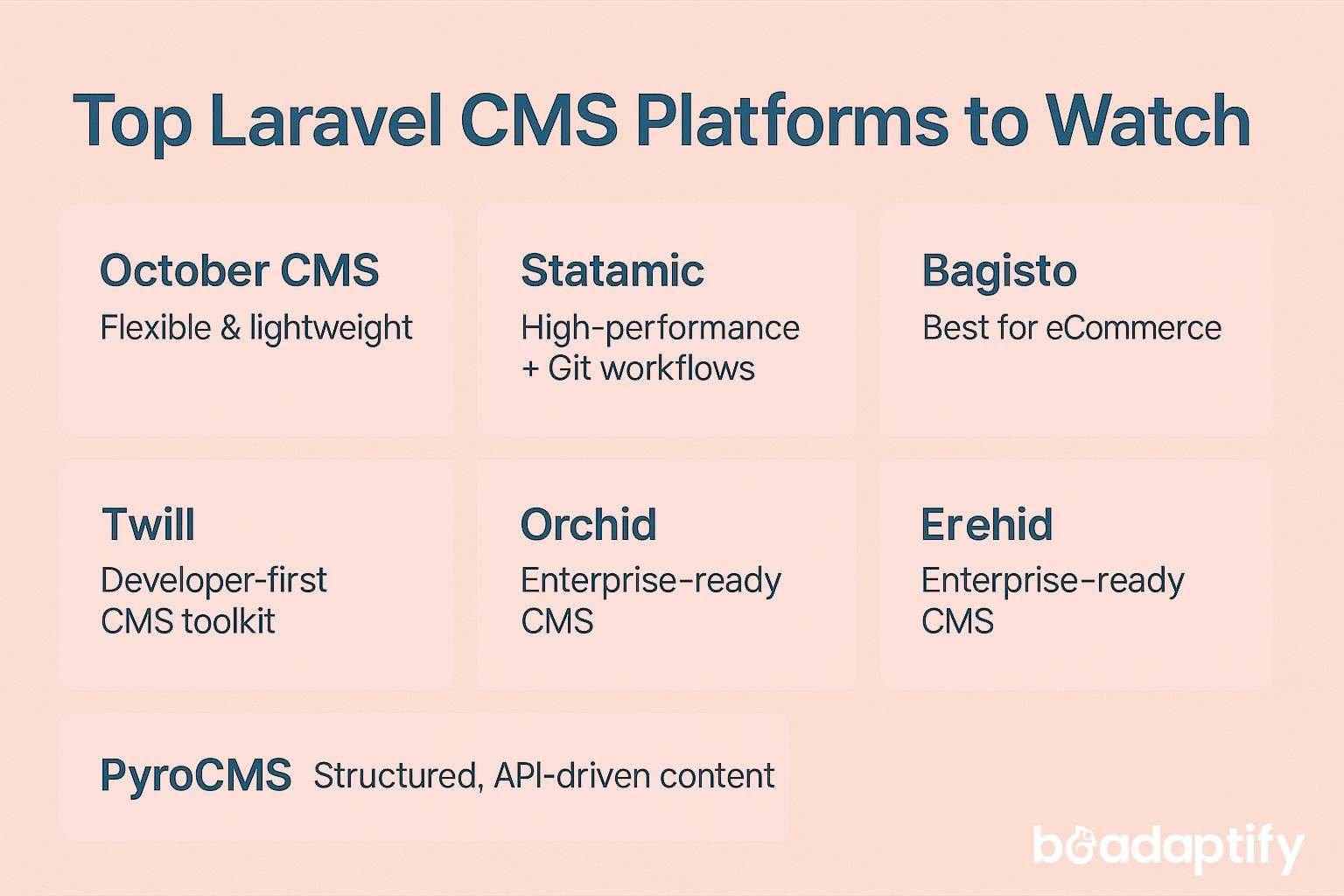
Top Laravel CMS Platforms to Watch and Use in 2026
Below is a curated list of the most reliable, forward-thinking, and scalable Laravel CMS platforms used by developers, enterprises, and digital agencies.
1. October CMS (October 3.x & Future Releases)
October CMS has remained one of the most popular Laravel-based CMS platforms due to its simplicity, extensibility, and elegant architecture. Its separation of content, logic, and presentation allows developers to create highly modular applications.
Key Features
- Clean, uncluttered backend UI
- Flat-file templating for fast performance
- Powerful plugin ecosystem
- Headless CMS capabilities
- Intuitive content editing experience
Advantages
October CMS is favored by UI/UX design services teams because of its flexibility in theming and page structure. Backend developers appreciate its modular architecture, which allows new features to be added without disrupting existing functionality.
Best Use Cases
- Corporate websites
- Marketing websites
- Custom platform development
- Blogs and editorial systems
2. Statamic CMS (Laravel + Flat-File Hybrid)
Statamic has continued gaining traction as a high-performance, flat-file CMS powered by Laravel. By combining dynamic Laravel capabilities with flat-file storage, Statamic offers speed advantages that database-heavy CMS platforms cannot match.
Key Features
- No database required (optional database mode available)
- Visual content editor
- Structured content with collections and blueprints
- Multi-site and multi-language support
- Git-based publishing workflows
Advantages
Statamic is ideal for teams looking for speed, security, and collaboration workflows that integrate with Git. This makes it highly suitable for enterprise-grade web development services where stability is critical.
Best Use Cases
- High-performance websites
- Multi-tenant sites
- Headless CMS applications
- Agencies managing portfolios and content-heavy sites
3. Bagisto (Laravel eCommerce CMS)
Bagisto remains the top Laravel-based eCommerce CMS in 2026. Its modular structure and multi-inventory system allow businesses to build customizable online stores without compromising functionality.
Key Features
- Multi-vendor marketplace support
- Inventory management
- Product attributes and categories
- Customizable storefront
- API-ready architecture
Advantages
Bagisto is used widely by eCommerce companies due to its scalability. Large retail brands and emerging startups benefit from its flexibility and developer-friendly codebase.
Best Use Cases
- eCommerce marketplaces
- Retail and wholesale stores
- Multilingual or multi-currency websites
- Custom checkout and payment workflows
4. Twill (Laravel CMS by AREA17)
Twill is positioned as a modern CMS toolkit designed specifically for developers who need full control over their content management workflows. It has been widely adopted by digital agencies due to its polished UI and developer-first philosophy.
Key Features
- Modular CMS toolkit
- Flexible block-based editor
- Role permissions and workflow management
- Built-in media management
- Vue.js-powered admin panel
Advantages
Twill excels due to its focus on custom content structures. A development & design services team can create tailored experiences without relying on rigid templates.
Best Use Cases
- Custom enterprise CMS platforms
- Portfolio websites
- News and editorial applications
- Complex multi-content systems
5. Laravel Nova (Admin Panel + CMS Extensions)
Although Nova is not a CMS by default, it is often used to build full CMS systems due to its elegant administrative UI and robust resource management tools.
Key Features
- Highly customizable admin panel
- Resource-driven architecture
- Metrics, filters, actions, and lenses
- Extensible with custom tools
- Perfect for dashboards
Advantages
Nova empowers backend development services teams to create powerful admin dashboards, data management panels, and custom CMS systems.
Best Use Cases
- Admin dashboards
- Internal management systems
- Lightweight CMS platforms
- CRM and ERP systems
6. Orchid CMS (Enterprise-Level Laravel CMS)
Orchid has emerged as a strong contender for enterprise Laravel CMS development in 2026. Its architecture emphasizes data management, customizable screens, and role-based access control.
Key Features
- Screen and layout builders
- Form fields and filters
- Multi-role user management
- Advanced permissions
- Customizable query structures
Advantages
Orchid is ideal for large-scale backend systems requiring sophisticated data handling. It is used heavily in SaaS development and enterprise-grade platforms.
Best Use Cases
- Enterprise dashboards
- Admin-heavy workflows
- Multi-role applications
- Data-intensive CMS systems
7. PyroCMS
PyroCMS has remained relevant in 2026 due to its modular structure and API-driven design. Its Streams Platform allows dynamic content modeling without complex migrations.
Key Features
- Stream-based content modeling
- RESTful API
- Module and addon ecosystem
- Multi-site capability
- Clean admin panel
Advantages
PyroCMS is useful for teams needing a structured backend development environment without heavy customization work.
Best Use Cases
- Corporate CMS
- Multi-website management
- Custom web apps
- Headless or decoupled CMS architecture
Comparison Table: Top Laravel CMS Platforms in 2026
| CMS Platform | Best For | Difficulty Level | Headless Support | Notable Strength |
|---|---|---|---|---|
| October CMS | Marketing & content websites | Easy | Yes | Flexibility & simplicity |
| Statamic | High-performance sites | Medium | Yes | Speed + Git workflows |
| Bagisto | eCommerce platforms | Medium | Yes | Multi-vendor support |
| Twill | Custom CMS builds | Medium/High | Yes | Developer-first blocks |
| Laravel Nova | Admin dashboards | Medium | Partial | Highly customizable |
| Orchid | Enterprise admin systems | High | Yes | Strong role management |
| PyroCMS | Structured content apps | Medium | Yes | Content modeling |
How to Choose the Right Laravel CMS for Your Business in 2026
When selecting the right Laravel CMS, several factors must be evaluated:
1. Project Complexity
A simple corporate website may benefit from October CMS, while data-heavy enterprise systems may require Orchid or Nova.
2. Customization Requirements
If flexibility is required, a platform like Twill offers extensive customization.
3. eCommerce Needs
Bagisto remains the strongest eCommerce-focused Laravel CMS.
4. Headless Architecture
Statamic, October CMS, and PyroCMS support headless workflows and modern API-driven ecosystems.
5. Scalability
Enterprise applications often rely on Orchid, Nova, or custom-built CMS solutions.
A professional laravel development company can help compare requirements and recommend the most suitable platform.
Future of Laravel CMS Platforms in 2026 and Beyond
Laravel CMS platforms are expected to evolve with new trends:
1. More API-Driven Content Systems
Headless CMS development will continue growing, making Laravel an ideal backend due to its routing, authentication, and API rates.
2. AI-Assisted Content Creation
CMS platforms may integrate AI modules for content suggestions, SEO optimization, and automation.
3. Increased Multi-Tenant Support
Businesses launching SaaS platforms will rely on Laravel CMS systems with multi-tenant architecture.
4. Better UI/UX for Admin Panels
Custom dashboards built using UI/UX design services will gain more prominence.
5. More Customizable Modular Architecture
Modular builds will help better scale enterprise systems.
Conclusion
Laravel CMS platforms continue to dominate the digital ecosystem in 2026 due to their scalability, flexibility, and modern architecture. Each CMS discussed, October CMS, Statamic, Bagisto, Twill, Nova, Orchid, and PyroCMS offers unique strengths tailored to specific business needs.
A business evaluating CMS options should consider long-term scalability, customization requirements, API integrations, and editorial workflows before choosing a platform. Partnering with Beadaptify, a laravel development company offering design & development services ensures that the chosen CMS is aligned with business goals, technical requirements, and user experience standards.

FAQ About Laravel CMS platforms
What makes Laravel CMS platforms ideal for modern businesses?
Laravel CMS platforms are preferred because they offer scalability, strong security features, modular architecture, and seamless API integration. These qualities enable businesses to build flexible digital ecosystems that support long-term growth.
Which Laravel CMS is best for eCommerce?
Bagisto is widely used for eCommerce because it includes multi-vendor support, inventory management, product variations, and API-ready architecture. It is considered the top choice for startups and enterprises requiring customizable online stores.
Is October CMS still relevant in 2026?
Yes. October CMS continues to be used because of its simplicity, clean architecture, extensibility, and intuitive content editing. It remains a strong option for marketing websites, content platforms, and custom web applications.
What Laravel CMS is best for enterprise applications?
Orchid and Laravel Nova are often chosen for enterprise-level projects because they offer advanced permission control, data management screens, and customizable admin panels suitable for backend operations and large-scale workflows.
Is Statamic a good choice for headless CMS development?
Yes. Statamic provides excellent headless CMS support with its API capabilities, structured content collections, and Git-based workflow. It is often chosen for high-performance websites and multi-channel publishing environments.