Patient portals have become an important part of modern healthcare delivery. Through a patient portal, appointments can be managed, medical records can be accessed, prescriptions can be reviewed, test results can be viewed, and communication with healthcare providers can be streamlined through a single digital platform.
As healthcare organizations continue to adopt digital technologies, the demand for customized patient portals is expected to increase in 2026. However, the cost of developing a patient portal can vary significantly depending on its features, security requirements, integrations, technology stack, design complexity, and development approach.
In 2026, patient portal development costs can typically range from $30,000 to more than $250,000, depending on the scope and complexity of the platform. A basic patient portal with essential features can be developed at a comparatively lower cost, while an enterprise-grade healthcare platform with advanced integrations, AI capabilities, telemedicine, analytics, and strict compliance requirements can require a substantially larger investment.
This guide explains the major factors that influence patient portal development costs, the features that affect pricing, development stages, challenges, and best practices that should be considered before a patient portal is developed.
What Is a Patient Portal?
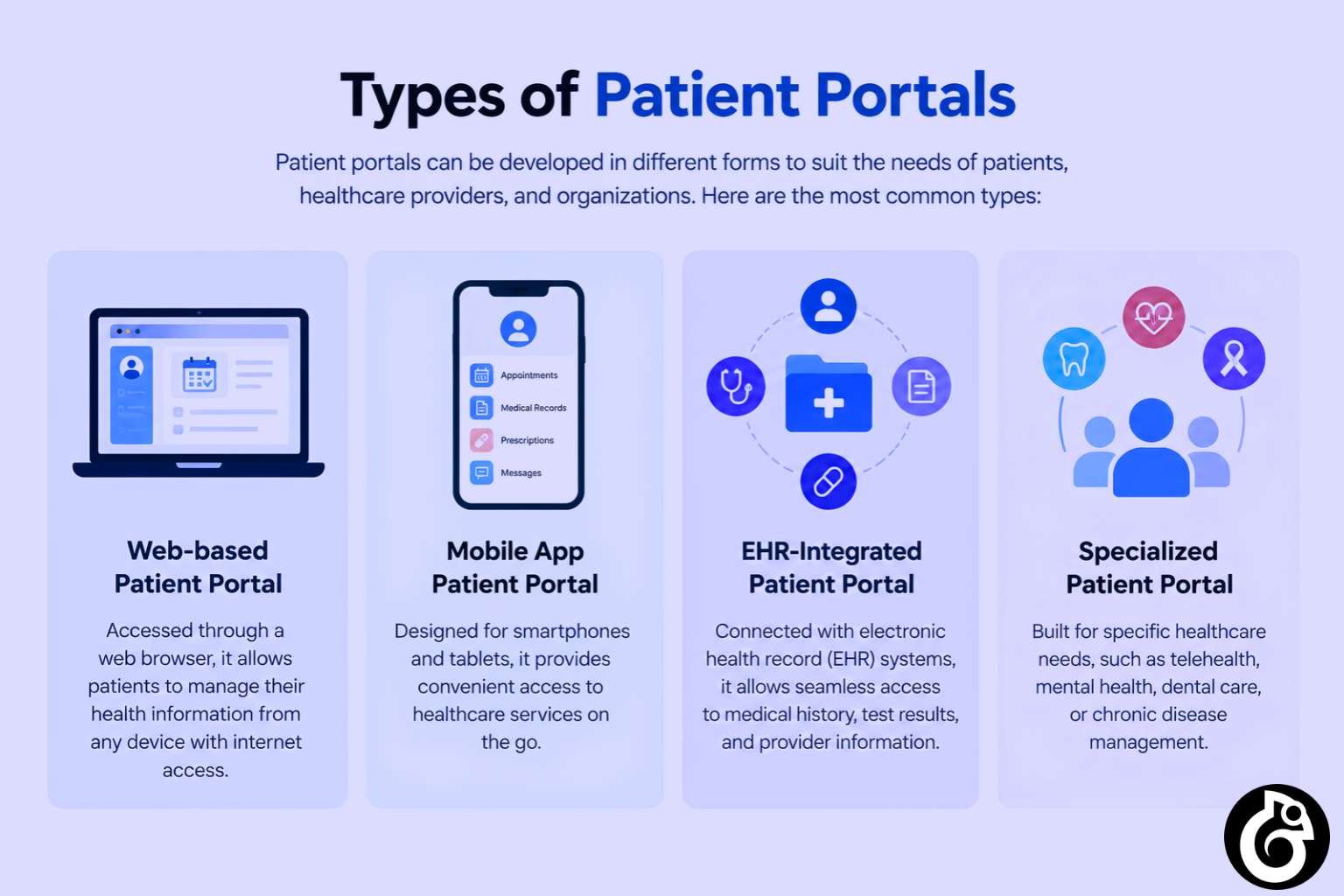
A patient portal is a secure digital platform through which patients can interact with healthcare providers and access healthcare-related information online. It can be developed as a web application, mobile application, or both.
Through a patient portal, several healthcare activities can be digitized, including:
- Appointment scheduling and cancellation
- Patient registration
- Medical record access
- Prescription management
- Lab and diagnostic result viewing
- Secure messaging
- Online payments
- Doctor communication
- Telemedicine access
- Insurance information management
- Health reminders
- Document sharing
- Notifications and alerts
Depending on the healthcare organization’s requirements, additional capabilities can also be integrated.
Patient Portal Market: Key Statistics
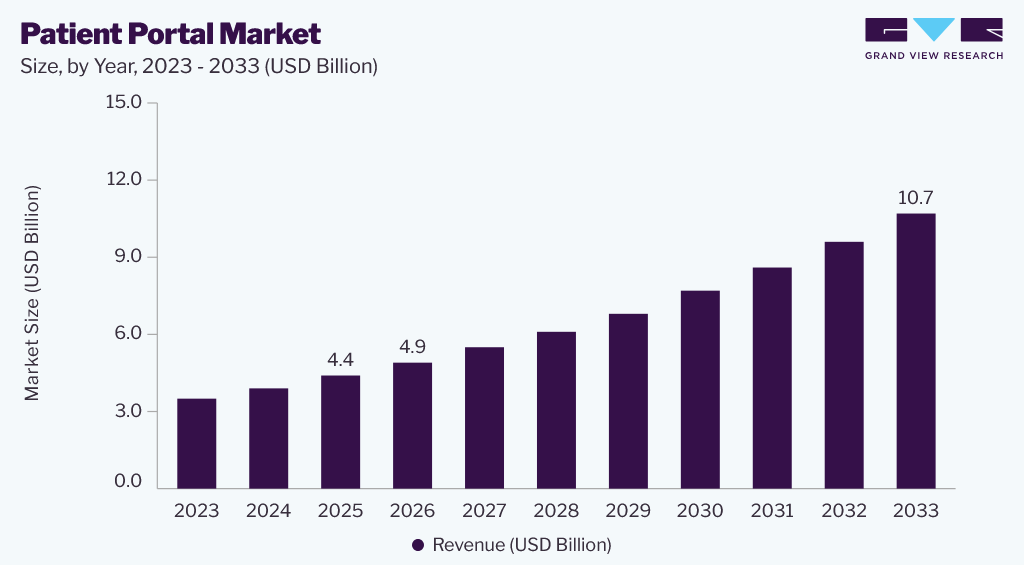
The growing adoption of digital healthcare solutions is creating strong demand for patient portals. According to Grand View Research, the global patient portal market was valued at approximately $87.1 billion in 2023 and is projected to reach $278.1 billion by 2030, representing a projected CAGR of around 17%.
Patient expectations are also contributing to this growth. Convenient access to medical records, online appointments, secure communication, prescriptions, and healthcare information is increasingly being expected through digital channels. These trends indicate that patient portal development is being positioned not simply as a technology investment, but as an important component of modern patient engagement and healthcare delivery strategies.
How Much Does Patient Portal Development Cost in 2026?
The cost of patient portal development in 2026 can be divided into several broad categories based on the complexity of the platform.
Patient Portal Type |
Estimated Development Cost |
Approximate Timeline |
|---|---|---|
| Basic Patient Portal | $30,000 – $60,000 | 3–5 months |
| Medium-Complexity Portal | $60,000 – $120,000 | 5–8 months |
| Advanced Patient Portal | $120,000 – $200,000 | 8–12 months |
| Enterprise Healthcare Portal | $200,000 – $250,000+ | 12–18+ months |
These figures are estimates rather than fixed development prices. The final cost is determined by the features, number of integrations, security requirements, geographic location of the development team, technology choices, testing requirements, and post-launch maintenance. For startups and healthcare businesses that want to validate an idea before making a larger investment, MVP development services can be used to create a smaller version of the patient portal with only the most important features.
Key Factors Affecting Patient Portal Development Cost
Several factors should be evaluated before a development budget is established.
1. Complexity of the Patient Portal
The overall complexity of the platform is one of the largest factors affecting development costs.
A basic portal containing patient registration, appointment scheduling, profile management, and secure messaging can be developed relatively quickly.
On the other hand, a more sophisticated portal may include:
- Electronic health record integration
- Telehealth
- AI-powered recommendations
- Prescription management
- Insurance verification
- Payment processing
- Remote patient monitoring
- Wearable device integration
- Advanced analytics
- Multi-provider management
As more functionality is added, additional development, testing, security, and infrastructure work is required.
2. UI/UX Design Requirements
The patient experience should be given significant attention because healthcare applications are used by people with different levels of technical knowledge. A confusing interface can result in poor adoption even when advanced functionality has been implemented.
Professional UI/UX design services can be used to create intuitive dashboards, simple navigation, accessible forms, appointment workflows, and easy-to-understand health information displays.
The cost of design can be influenced by:
- Number of screens
- User roles
- Design complexity
- Accessibility requirements
- Prototyping
- Usability testing
- Design system development
- Responsive design requirements
For this reason, UI/UX should not be treated as an afterthought. User flows should be designed before major development work is initiated.
3. Features and Functionalities
The number and complexity of features directly influence development costs.
A basic patient portal may include:
- Patient registration
- Login and authentication
- Profile management
- Appointment booking
- Medical record access
- Secure messaging
Advanced platforms may additionally include:
- Video consultations
- E-prescriptions
- AI-powered health assistants
- Insurance processing
- Online payments
- Medical document management
- Health tracking
- Lab integrations
- Pharmacy integrations
- Automated notifications
Every additional functionality generally requires additional design, development, testing, and maintenance.
4. Healthcare System Integrations
Integration with existing healthcare systems can significantly affect development costs.
A patient portal may need to communicate with:
- Electronic Health Record systems
- Electronic Medical Record systems
- Hospital Management Systems
- Laboratory systems
- Pharmacy systems
- Insurance platforms
- Payment gateways
- Telemedicine platforms
- Medical devices
- Wearable devices
APIs and healthcare interoperability standards may be required to exchange information securely. FHIR and HL7-based integrations, for example, may require specialized expertise and additional testing. The number and complexity of these integrations should therefore be considered when the development budget is estimated.
5. Security and Compliance
Healthcare applications are required to handle highly sensitive information. As a result, security should be incorporated into the platform from the beginning. Depending on the target market and jurisdiction, requirements related to HIPAA, GDPR, SOC 2, or other healthcare and data-protection frameworks may need to be addressed.
Security-related development may include:
- Data encryption
- Secure authentication
- Role-based access control
- Multi-factor authentication
- Audit logging
- Secure API communication
- Data backup
- Vulnerability testing
- Access monitoring
- Secure cloud infrastructure
Additional compliance requirements can increase both development and operational costs, but they are essential for protecting patient information and maintaining trust.
Essential Features of a Patient Portal
The final feature set should be determined according to the target users and business objectives. However, several features are commonly included in modern patient portals.
Patient Registration and Authentication
Patients should be provided with a secure registration and login process. Multi-factor authentication can be added to provide an additional layer of protection.
Appointment Management
Appointments can be scheduled, rescheduled, cancelled, and confirmed through the portal. Calendar integration and automated reminders can also be implemented.
Medical Records
Patients can be allowed to securely access relevant medical records, diagnoses, reports, prescriptions, and healthcare documents.
Secure Messaging
Communication between patients and healthcare professionals can be enabled through encrypted messaging functionality.
Prescription Management
Current and previous prescriptions can be displayed, while medication reminders and refill requests can also be supported.
Online Payments
Payment functionality can be integrated for consultations, diagnostic services, subscriptions, or other healthcare-related transactions.
Telemedicine
Video and audio consultations can be incorporated when remote healthcare delivery is required.
Notifications
Email, SMS, push, or in-app notifications can be used for appointments, prescriptions, test results, reminders, and other important updates.
Admin Dashboard
An administrative dashboard can be developed to allow healthcare organizations to manage users, appointments, records, communication, billing, and other operational activities.
Patient Portal Development Cost by Feature
A rough feature-level estimate can also be considered during early planning.
Feature |
Estimated Cost Range |
|---|---|
| User Registration & Login | $3,000 – $8,000 |
| Patient Profile | $2,000 – $5,000 |
| Appointment Scheduling | $5,000 – $12,000 |
| Medical Records | $8,000 – $20,000 |
| Secure Messaging | $5,000 – $12,000 |
| Prescription Management | $5,000 – $15,000 |
| Payment Integration | $3,000 – $8,000 |
| Telemedicine | $10,000 – $30,000+ |
| Admin Dashboard | $8,000 – $20,000 |
| Third-Party Integrations | $5,000 – $30,000+ |
These figures should be viewed only as planning ranges because integration complexity and compliance requirements can cause significant variations.
Development Team and Location
The location and composition of the development team can also influence the overall budget.
A patient portal may require a combination of:
- Business analysts
- UI/UX designers
- Frontend developers
- Backend developers
- Mobile developers
- QA engineers
- DevOps engineers
- Security specialists
- Project managers
Development rates can vary substantially between regions. A healthcare-focused web development company with experience in secure application development can be beneficial when complex integrations, compliance requirements, and scalable architecture are involved.
Instead of selecting a vendor only according to hourly rates, healthcare experience, security capabilities, technical expertise, previous projects, and long-term support should also be evaluated.
Role of Web Development Services in Patient Portal Development
Modern patient portals are often developed as responsive web applications so that patients can access healthcare services from desktops, tablets, and smartphones.
Professional web development services can be used to build:
- Responsive patient dashboards
- Secure authentication systems
- Healthcare APIs
- Provider dashboards
- Appointment systems
- Payment modules
- Communication systems
- Administrative panels
When specialized healthcare functionality is required, custom web development services can be used instead of relying on generic portal templates. Custom development allows functionality to be adapted according to the workflows of hospitals, clinics, healthcare networks, or specialized medical organizations.
Custom vs. Off-the-Shelf Patient Portal
Two primary approaches can be considered when a patient portal is being planned: an existing solution can be adopted, or a custom solution can be developed.
Off-the-Shelf Solution
An existing solution can usually be deployed faster and may require lower initial investment.
However, limitations may be encountered in areas such as:
- Customization
- Integration
- Branding
- Scalability
- Workflow configuration
- Feature flexibility
Custom Patient Portal
With a custom portal, the application can be designed around specific organizational requirements.
Benefits can include:
- Complete control over features
- Custom workflows
- Better integration flexibility
- Customized branding
- Scalable architecture
- Greater control over security
- Easier expansion
Although a custom solution can require a larger initial investment, greater long-term flexibility can be provided.
How MVP Development Services Can Reduce Initial Costs
A full-scale patient portal does not always need to be developed at the beginning.
An MVP can be created with a limited set of essential features, such as:
- Patient registration
- Login
- Profile management
- Appointment booking
- Basic medical records
- Secure messaging
- Notifications
Once the MVP has been released, feedback can be collected from patients, healthcare professionals, and administrators. Additional functionality can then be introduced based on actual usage patterns.
This approach can reduce initial development costs and allow product-market fit to be evaluated before significant resources are committed to a complete platform.
Patient Portal Development Process
A structured development process can help control costs and reduce technical risks.
Step 1: Requirement Analysis
Business objectives, user roles, workflows, technical requirements, integrations, and compliance needs should first be documented.
Step 2: UI/UX Design
User journeys, wireframes, prototypes, and interface designs should be created and evaluated.
Step 3: Technology Selection
A suitable frontend, backend, database, cloud infrastructure, API architecture, and security framework should be selected.
Step 4: Development
Frontend and backend functionality can then be implemented according to the approved designs and architecture.
Step 5: Integration
Healthcare systems, payment gateways, communication platforms, laboratory systems, and other required services can be integrated.
Step 6: Testing
Functional, performance, security, compatibility, usability, and integration testing should be conducted.
Step 7: Deployment
After testing and compliance checks have been completed, the portal can be deployed to a secure production environment.
Step 8: Maintenance
Continuous monitoring, security updates, bug fixes, performance improvements, and feature enhancements should be provided after launch.
Hidden Costs That Should Be Considered
The initial development quote should not be treated as the complete cost of owning a patient portal.
Additional expenses may include:
- Cloud hosting
- Security monitoring
- Third-party API fees
- SMS and email services
- Payment gateway charges
- Compliance audits
- SSL certificates
- Maintenance
- Technical support
- Data storage
- Backup infrastructure
- Software licenses
- Performance monitoring
These operational expenses should be included in the long-term financial plan.
How Can Patient Portal Development Costs Be Reduced?
Development costs can be controlled without compromising critical functionality through several approaches. First, requirements should be prioritized before development begins. Non-essential features can be moved to later development phases.
Second, an MVP can be developed using MVP development services to validate the concept. Third, reusable components and established frameworks can be used where appropriate. Fourth, integrations should be planned carefully because poorly designed integrations can create significant additional development and maintenance costs. Finally, security and scalability should be considered from the beginning so that expensive architectural changes do not become necessary later.
Best Practices for Patient Portal Development
Several practices should be followed to create a reliable healthcare portal.
Security Should Be Built From the Beginning
Security should be incorporated into architecture, APIs, databases, authentication, and deployment rather than being added after development.
Accessibility Should Be Prioritized
Interfaces should be designed so that they can be used by patients with different abilities and levels of digital literacy.
Scalable Architecture Should Be Used
The architecture should be capable of supporting additional users, providers, features, and integrations as adoption increases.
Data Privacy Should Be Protected
Patient information should be encrypted, access should be controlled, and audit trails should be maintained.
User Testing Should Be Conducted
The portal should be tested with representative users before a large-scale launch.
Performance Should Be Monitored
Slow loading times can negatively affect user experience. Performance monitoring should therefore be implemented from the beginning.
Why UI/UX and Design & Development Services Matter
A patient portal is not successful merely because technical functionality has been implemented. The overall experience should also be intuitive and accessible. Professional design & development services can bring UX research, interface design, frontend development, backend engineering, integration, testing, and deployment together within a coordinated development process.
When healthcare applications are designed around real user workflows, navigation can be simplified, unnecessary steps can be removed, and adoption can be improved.
Why Beadaptify Is the Right Partner for Patient Portal Development?
Patient portal development requires more than standard web development. Security, usability, healthcare workflows, third-party integrations, scalability, and data protection need to be considered throughout the development process. At Beadaptify, patient portal solutions can be designed and developed around specific business and patient requirements, allowing essential healthcare workflows to be brought together within a secure and user-friendly digital platform.
From UI/UX design services and custom web development to API integrations, testing, deployment, and ongoing support, the complete development lifecycle can be managed through a structured approach. Patient dashboards, appointment scheduling, medical record access, secure messaging, prescription management, payment functionality, notifications, and other required features can be incorporated according to the project’s scope. With a combination of design & development services, web development services, and healthcare-focused technical capabilities, Beadaptify can support the development of scalable patient portal solutions that are designed around usability, security, and long-term business growth.
Future of Patient Portal Development in 2026 and Beyond
Patient portals are expected to become increasingly connected with broader digital healthcare ecosystems. AI-powered healthcare assistants, personalized patient experiences, remote monitoring, wearable integration, predictive analytics, voice interfaces, and automated healthcare workflows are likely to receive greater attention.
More healthcare organizations are also expected to move toward unified digital platforms in which appointments, medical records, communication, payments, prescriptions, and virtual consultations can be accessed from a single environment. As these capabilities are introduced, patient portal development will become more sophisticated. Greater emphasis will therefore be placed on security, interoperability, scalability, accessibility, and user experience.
Conclusion
The cost of patient portal development in 2026 can range from approximately $30,000 for a basic solution to $250,000 or more for an advanced enterprise-grade platform. The final investment will depend on the number of features, design complexity, integrations, security requirements, technology stack, development team, and long-term support requirements. For organizations with limited initial budgets, an MVP can be developed first and expanded as user feedback and business requirements are validated. For hospitals and healthcare enterprises with complex workflows, a fully customized solution may be more appropriate.
Whether a basic portal or a sophisticated healthcare ecosystem is being planned, the right combination of UI/UX design services, custom web development solutions, security engineering, integrations, testing, and ongoing maintenance should be considered.

FAQs About Patient Portal Development Cost
What features should be included in a patient portal?
Common features include patient registration, secure login, appointment scheduling, medical record access, prescription management, secure messaging, notifications, online payments, telemedicine, and administrative dashboards.
Why is UI/UX important for a patient portal?
A simple and accessible interface can make it easier for patients to schedule appointments, access records, communicate with providers, and manage healthcare information. Professional UI/UX design services can therefore contribute significantly to adoption and usability.
Can a patient portal be integrated with an existing EHR or EMR system?
Yes. Patient portals can be integrated with existing healthcare systems through APIs and interoperability standards such as HL7 and FHIR, depending on the systems and requirements involved.
Should an MVP be developed before a complete patient portal?
An MVP can be a suitable approach when a healthcare organization wants to validate its concept before making a larger investment. MVP development services can be used to launch essential functionality first and expand the platform based on real-world feedback.