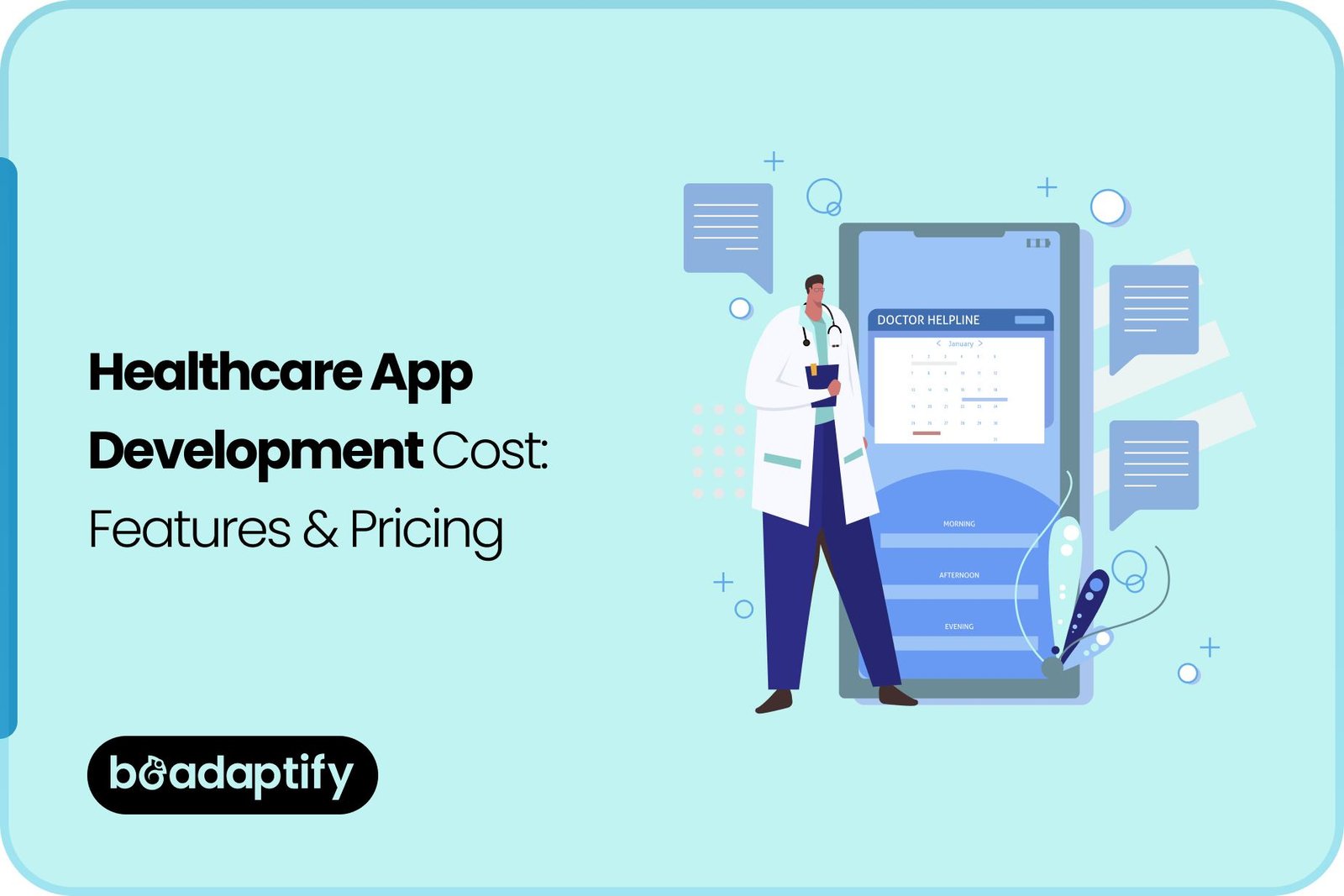
Healthcare has increasingly been transformed by mobile technology. Patients are being given more convenient ways to book appointments, communicate with providers, access health information, manage medications, monitor health conditions, and receive virtual care. Healthcare organizations, meanwhile, are using applications to improve operational efficiency, streamline administrative workflows, and provide more connected digital experiences.
As demand for digital healthcare continues to grow, healthcare app development is being considered by hospitals, clinics, healthcare startups, medical organizations, pharmacies, laboratories, insurance companies, and wellness businesses.
However, healthcare app development is usually more complex than standard consumer app development. Sensitive health information needs to be protected, integrations with healthcare systems may be required, accessibility and usability need to be considered, and regulatory requirements may apply depending on the application’s functionality, users, data, and market.
In 2026, the healthcare app development cost can range from approximately $30,000 to $250,000+, with highly complex platforms potentially requiring an even larger investment. The final cost is influenced by the number of features, platform requirements, UI/UX complexity, integrations, security architecture, compliance requirements, AI functionality, development team structure, testing requirements, and ongoing maintenance.
A simple appointment-booking application may be developed at a considerably lower cost than an enterprise telemedicine platform connected to electronic health records, wearable devices, payment systems, insurance workflows, and clinical decision-support functionality.
This guide explains the major healthcare app development costs in 2026, important features, compliance considerations, development stages, technology requirements, cost factors, and ways healthcare businesses can manage development investment more effectively.
What Is Healthcare App Development?
Healthcare app development refers to the process of designing, developing, testing, deploying, and maintaining applications intended to support healthcare-related activities.
Depending on the business model and target users, an application may be designed for:
- Patients
- Doctors
- Nurses
- Therapists
- Clinics
- Hospitals
- Pharmacies
- Laboratories
- Caregivers
- Insurance providers
- Healthcare administrators
- Wellness users
Different healthcare applications can serve very different purposes.
For example, a patient application may be developed for appointment scheduling and secure messaging, while a clinical application may be designed for patient monitoring and medical information management.
Some healthcare apps may also interact with regulated medical devices or perform functions that could bring them within FDA oversight. The FDA’s current digital-health guidance emphasizes that regulatory treatment is based on the software function and associated risk, rather than simply whether the product runs on a mobile device.
Because of these differences, a single healthcare app development price cannot be applied to every project.
Healthcare App Development Cost in 2026
The following ranges can be used as a general planning estimate:
Healthcare App Type |
Estimated Cost |
|---|---|
| Basic Healthcare App | $30,000–$50,000 |
| Appointment & Patient Portal App | $40,000–$70,000 |
| Telemedicine App | $60,000–$120,000 |
| Remote Patient Monitoring App | $70,000–$140,000 |
| Healthcare Marketplace App | $60,000–$130,000 |
| EHR/EMR-Integrated App | $80,000–$160,000+ |
| AI-Powered Healthcare App | $100,000–$200,000+ |
| Enterprise Healthcare Platform | $150,000–$250,000+ |
These figures should be treated as planning ranges rather than fixed quotations. The actual investment will be determined by project scope, technology, integrations, compliance requirements, development location, team composition, and product complexity.
A healthcare product with a limited feature set can be developed for less, while a highly regulated platform involving multiple healthcare systems and complex clinical workflows can require significantly more investment.
Why Does Healthcare App Development Cost More?
Healthcare applications are often developed under stricter technical and operational requirements than ordinary consumer applications.
Several factors contribute to the additional complexity.
Sensitive Data Protection
Healthcare applications may process highly sensitive information. If protected health information is involved and the application is operated by a covered entity or business associate, applicable HIPAA obligations need to be considered.
The HIPAA Security Rule establishes administrative, physical, and technical safeguards for electronic protected health information handled by covered entities and business associates.
This means that security cannot simply be added after development. It needs to be considered during architecture, design, development, testing, deployment, and maintenance.
Healthcare Integrations
Applications may need to communicate with:
- EHR systems
- EMR platforms
- Laboratory systems
- Pharmacy systems
- Payment gateways
- Insurance systems
- Medical devices
- Wearable devices
- Scheduling systems
- Video communication platforms
Each integration can add development and testing requirements.
Compliance
Depending on the application and market, HIPAA, FDA requirements, state privacy requirements, data protection laws, accessibility requirements, and other regulations may need to be evaluated.
HHS specifically provides guidance for developers of mobile health applications because the legal obligations can depend on the app’s functionality, data, relationships with covered entities, and other factors.
Testing
Healthcare applications need to be tested carefully because failures can affect privacy, availability, workflow accuracy, and potentially patient safety.
Testing may include:
- Functional testing
- Security testing
- Performance testing
- API testing
- Device testing
- Accessibility testing
- Usability testing
- Integration testing
- Compliance-focused testing
Major Features of a Healthcare App
The features included in the application will have a major effect on development cost.
1. User Registration and Authentication
Secure account creation should be provided for patients, providers, administrators, or other users.
Depending on requirements, authentication may include:
- Email and password
- Phone verification
- Multi-factor authentication
- Biometric authentication
- Single sign-on
- Role-based access
Additional authentication layers can increase development effort but may be necessary for protecting sensitive information.
2. Patient Profiles
A patient profile can be created to store relevant information.
Depending on the application’s purpose, the profile may include:
- Basic demographics
- Medical history
- Allergies
- Medications
- Appointments
- Test results
- Health goals
- Documents
- Provider information
Access should be controlled according to user roles and permissions.
3. Appointment Scheduling
Appointment management is one of the most commonly requested healthcare app features.
Patients can be allowed to:
- Search providers
- View available slots
- Book appointments
- Reschedule appointments
- Cancel appointments
- Receive reminders
Provider-side scheduling can also be included.
4. Telemedicine
Video consultation functionality can be integrated for remote healthcare delivery.
Features may include:
- Video calls
- Audio calls
- Secure messaging
- Virtual waiting rooms
- Appointment reminders
- Provider availability
- Consultation records
Third-party communication services can sometimes be integrated, while other products may require more customized infrastructure.
5. Secure Messaging
Patients and healthcare professionals can be provided with secure communication channels.
Messaging may be used for:
- Follow-up questions
- Appointment communication
- Care coordination
- Document sharing
- Prescription-related communication
The implementation should be designed around applicable privacy and security requirements.
6. Prescription Management
Prescription-related functionality may be added to appropriate applications.
Possible features include:
- Medication lists
- Dosage information
- Refill reminders
- Medication schedules
- Prescription history
If external pharmacy or prescription systems are integrated, additional development work may be required.
7. Medication Reminders
Medication reminders can be provided through push notifications.
Users may be reminded about:
- Medication schedules
- Refills
- Appointments
- Follow-up visits
- Health activities
8. Health Tracking
Health data can be collected and displayed through dashboards.
Depending on the application, tracked information may include:
- Blood pressure
- Weight
- Blood glucose
- Heart rate
- Activity
- Sleep
- Symptoms
- Medication adherence
If wearable or medical-device data is involved, integration complexity can increase considerably.
9. Wearable Device Integration
Applications can be connected to wearable ecosystems and compatible devices. This may allow health information to be collected automatically rather than entered manually.
Wearable integration can increase both development and testing requirements because device compatibility, synchronization, permissions, data quality, and platform differences need to be managed.
10. Notifications
Push notifications can be used for:
- Appointment reminders
- Medication reminders
- New messages
- Test results
- Follow-ups
- Health goals
Notification logic should be carefully designed so that sensitive information is not unnecessarily exposed through lock-screen messages or unsecured channels.
Advanced Healthcare App Features
For more sophisticated healthcare platforms, advanced capabilities may be included.
AI-Powered Features
Artificial intelligence can be used for:
- Patient support
- Document summarization
- Symptom information
- Administrative automation
- Medical information retrieval
- Clinical workflow assistance
- Personalized engagement
However, AI functionality should be evaluated carefully when clinical decisions or patient safety could be affected.
The FDA issued final Clinical Decision Support Software guidance in January 2026, clarifying how certain software functions may fall within or outside the device definition and how existing digital-health policies can apply to software functions that meet the definition of a device.
Remote Patient Monitoring
Remote monitoring platforms can collect information from connected devices and make it available to healthcare professionals.
The system may include:
- Device connectivity
- Data synchronization
- Provider dashboards
- Alerts
- Patient monitoring
- Trend visualization
- Reporting
Healthcare Analytics
Analytics dashboards can be created for providers and administrators.
Metrics may include:
- Appointment volume
- Patient engagement
- Treatment adherence
- Provider utilization
- Patient activity
- Operational performance
Multi-Role Dashboards
Separate dashboards can be created for:
- Patients
- Doctors
- Nurses
- Administrators
- Care managers
Each role can be provided with only the functionality and information required for its responsibilities.
Healthcare App Development Cost by Feature
A rough feature-level estimate can be useful during early planning.
Feature |
Approximate Cost Range |
|---|---|
| User Authentication | $2,000–$5,000 |
| Patient Profile | $3,000–$7,000 |
| Appointment Booking | $5,000–$12,000 |
| Secure Messaging | $5,000–$12,000 |
| Video Consultation | $8,000–$20,000 |
| Payment Integration | $3,000–$8,000 |
| EHR Integration | $10,000–$30,000+ |
| Wearable Integration | $8,000–$25,000+ |
| Health Dashboard | $7,000–$18,000 |
| AI Features | $15,000–$50,000+ |
| Admin Dashboard | $7,000–$20,000 |
| Advanced Analytics | $8,000–$25,000 |
These figures are indicative and can overlap depending on the architecture.
Healthcare App Compliance in 2026
Compliance is one of the most important components of healthcare app development. The exact requirements should not be assumed based only on the fact that an app is called a “healthcare app.”
The applicable obligations depend on what the application does, what data it handles, who operates it, which organizations it interacts with, and which markets it serves.
HIPAA Compliance
For applicable U.S. healthcare organizations and business associates, HIPAA can be a central consideration. The HIPAA Security Rule requires appropriate safeguards for electronic protected health information.
Security considerations can include:
- Access controls
- Authentication
- Encryption
- Audit controls
- Data integrity
- Transmission security
- Risk analysis
- Incident response
- Backup and recovery
HHS also explains that cloud and mobile technologies can be used with ePHI when appropriate safeguards and applicable business associate arrangements are in place.
Business Associate Agreements
When third-party service providers handle protected health information on behalf of a covered entity or business associate, appropriate contractual arrangements may be required.
This should be evaluated before selecting:
- Cloud providers
- Analytics services
- Communication providers
- Storage systems
- Healthcare integrations
- Other third-party platforms
FDA Considerations
Not every healthcare app is regulated as a medical device. The FDA applies a function- and risk-based approach. Certain software functions may be outside device regulation, while other functions can fall within FDA oversight when they meet the definition of a device and present relevant patient-safety risks.
For example, an application that simply helps users track wellness information may be treated differently from software that performs certain diagnostic functions or controls a medical device.
Therefore, regulatory assessment should be performed during product planning rather than after development has been completed.
State Privacy Requirements
Healthcare applications may also be affected by state privacy laws.
Requirements can vary based on:
- Location of users
- Type of data
- Business model
- Healthcare relationships
- Data-processing activities
A legal and compliance review should therefore be performed for the intended market.
Security Features That Should Be Considered
Security should be treated as part of the application architecture.
Encryption
Data should be protected during transmission and, where appropriate, at rest.
Role-Based Access Control
Users should only be given access to information and functions required for their role.
Multi-Factor Authentication
Additional authentication can be used for higher-risk accounts and administrative access.
Audit Logs
Important user and system activity can be recorded for monitoring and investigation.
Session Management
Sessions should be managed securely, with appropriate timeout and token-handling mechanisms.
Secure APIs
API endpoints should be authenticated, authorized, validated, monitored, and protected against common attacks.
Backup and Recovery
Reliable backup and disaster-recovery processes should be implemented for critical healthcare systems.
Vulnerability Testing
Security vulnerabilities should be identified and addressed before production deployment and throughout the application’s lifecycle.
Healthcare App Development Process
A structured development process can reduce technical and financial risk.
Step 1: Discovery and Requirement Analysis
Business objectives, users, workflows, regulatory considerations, integrations, and technical requirements are identified.
Step 2: Compliance and Risk Assessment
Potential privacy, security, regulatory, and clinical risks are evaluated.
Step 3: UI/UX Design
User journeys, wireframes, prototypes, and visual interfaces are created.
Healthcare interfaces should be designed for clarity because users may interact with the application under stressful or time-sensitive circumstances.
Step 4: Architecture Planning
The backend, database, APIs, cloud infrastructure, security architecture, and integrations are planned.
Step 5: Development
Frontend and backend components are developed according to the approved architecture.
Step 6: Integration
External healthcare systems, payment platforms, communication services, devices, and other required technologies are connected.
Step 7: Testing
The application is tested across functionality, performance, security, compatibility, and usability.
Step 8: Compliance Validation
Required controls and documentation are reviewed before launch.
Step 9: Deployment
The application is deployed to the intended environment.
Step 10: Monitoring and Maintenance
Performance, security, errors, integrations, infrastructure, and user feedback are continuously monitored.
Healthcare App Development Timeline
Development time can vary based on complexity.
| App Complexity | Estimated Timeline |
|---|---|
| Basic Healthcare App | 3–5 months |
| Medium-Complexity App | 5–8 months |
| Telemedicine Platform | 6–10 months |
| EHR-Integrated Platform | 8–12+ months |
| Advanced Healthcare Platform | 10–18+ months |
Compliance and integration work can extend timelines.
A healthcare application should not be rushed simply to meet a launch date because testing and security issues can create significantly greater costs after deployment.
Factors That Affect Healthcare App Development Cost
Platform Selection
Development for iOS, Android, or both can affect cost.
Cross-platform development may reduce duplicated development work in some scenarios, while native development may be selected when platform-specific capabilities are important.
UI/UX Complexity
A simple interface will generally require less design and development work than a complex multi-role healthcare ecosystem.
Backend Complexity
A sophisticated backend involving patient records, provider workflows, notifications, billing, analytics, and integrations can substantially increase development requirements.
Number of User Roles
Each additional role may require different permissions, workflows, dashboards, and testing scenarios.
Third-Party Integrations
External integrations can be among the largest sources of complexity.
AI Implementation
AI-powered features can require additional model integration, data pipelines, validation, monitoring, and security controls.
Compliance Requirements
Security and compliance requirements can add architecture, documentation, testing, and operational work.
Location of Development Team
Development rates vary significantly based on geography, team structure, expertise, and engagement model.
Maintenance
Healthcare applications require ongoing updates and monitoring.
Healthcare App Maintenance Cost
Development does not end after launch.
Annual maintenance can commonly be budgeted at approximately 15%–25% of the initial development cost, although the actual requirement will depend on application complexity and service expectations.
Maintenance may include:
- Security updates
- OS compatibility
- Bug fixes
- Server maintenance
- API updates
- Third-party integration changes
- Performance optimization
- Compliance updates
- Feature improvements
- Database management
- Monitoring
For healthcare applications, proactive maintenance is particularly important because security and integration failures can affect sensitive workflows.
How to Reduce Healthcare App Development Costs
Cost reduction should not be achieved by removing critical security or compliance controls.
Instead, development efficiency can be improved through better planning.
Build an MVP
A focused MVP can be launched with the most important features.
Additional functionality can then be introduced after user feedback has been collected.
Prioritize Features
Features can be divided into:
- Must-have
- Important
- Future
- Optional
This prevents unnecessary functionality from being developed during the first release.
Use Reusable Components
Reusable UI components, backend modules, and APIs can reduce duplicated development effort.
Select Integrations Carefully
Third-party systems should be selected based on functionality, security, reliability, compliance requirements, and long-term cost.
Plan Compliance Early
Late-stage compliance changes can be expensive.
Security and compliance requirements should therefore be considered during architecture and UX planning.
Choose the Right Development Model
Depending on the project, development may be performed through:
- In-house teams
- Dedicated development teams
- Outsourcing
- Hybrid teams
The best model should be selected according to product complexity, timeline, internal expertise, and long-term support requirements.
Native vs Cross-Platform Healthcare App Development
A key decision will be whether the application should be developed natively or through a cross-platform framework.
Native Development
Native applications can provide strong platform-specific performance and access to device capabilities.
They may be preferred when:
- Advanced device integration is required
- Platform-specific functionality is important
- High performance is necessary
- Complex hardware integration is planned
Cross-Platform Development
Cross-platform development can allow a shared codebase to be used across multiple platforms.
It can be attractive when:
- Development speed is important
- Budget needs to be controlled
- Similar experiences are required across platforms
- The application does not rely heavily on platform-specific features
The choice should be based on application requirements rather than cost alone.
Role of Software Product Development Services
Healthcare applications should be treated as complete digital products rather than isolated mobile interfaces.
Professional software product development services can cover:
- Product strategy
- Technical architecture
- UI/UX design
- Mobile development
- Backend development
- API development
- Healthcare integrations
- Security
- Testing
- Deployment
- Maintenance
This broader approach can reduce fragmentation between product, design, engineering, and operational teams.
Why Mobile App Development Services Matter
Healthcare users expect applications to be convenient, reliable, accessible, and easy to navigate.
Professional mobile app development services can be used to create patient-facing and provider-facing applications with responsive interfaces, secure authentication, push notifications, device integrations, and scalable backend systems.
For healthcare businesses targeting multiple platforms, the right mobile application development solutions can help create consistent experiences while maintaining the technical requirements needed for the specific product.
Why Design & Development Services Are Important
Healthcare applications should not only be technically functional. They should also be easy to understand.
Patients may have different levels of technical literacy. Healthcare professionals may need to complete tasks quickly. Administrators may require information-dense dashboards. Therefore, design & development services should be coordinated from the beginning.
UX research, accessibility, information hierarchy, navigation, typography, forms, alerts, and error states should all be designed around real user needs. A well-designed healthcare application can reduce confusion and make important workflows easier to complete.
Why Choose Beadaptify for Healthcare App Development?
Healthcare applications require a combination of product strategy, secure engineering, thoughtful UX, reliable integrations, and scalable architecture. Beadaptify can support these requirements through end-to-end product development tailored to the application’s users, workflows, and business objectives.
From patient-facing mobile applications and provider dashboards to telemedicine platforms, healthcare portals, integrations, AI-enabled workflows, and custom healthcare solutions, development can be structured around the specific requirements of the product.
Through software product development services, mobile application development services and design & development services, Beadaptify can support the journey from product discovery and UI/UX design through development, testing, deployment, and ongoing improvement. The focus can be placed on creating healthcare products that are scalable, user-friendly, secure, and prepared for long-term growth.
Future of Healthcare App Development
Healthcare applications are expected to become increasingly connected and intelligent. Several trends are likely to influence healthcare application development in the coming years.
AI-Powered Healthcare Experiences
AI can be used for administrative assistance, patient engagement, documentation, information retrieval, and selected clinical workflows.
Remote Patient Monitoring
Connected devices and wearables can continue to expand the ability to monitor patients outside traditional healthcare facilities.
Interoperable Healthcare Systems
Greater interoperability can make it easier for healthcare information to move between authorized systems.
Personalized Healthcare
Applications can increasingly be designed around individual patient preferences, health goals, and care journeys.
Digital Therapeutics and Clinical Software
More sophisticated software-based healthcare interventions may continue to emerge, although regulatory requirements will depend on the specific functionality and risk profile.
Voice-Based Healthcare Interfaces
Voice interaction can potentially make healthcare applications easier to use for certain users and situations.
Final Thoughts
The healthcare app development cost in 2026 can vary significantly depending on the application’s purpose, features, technology, integrations, security requirements, compliance considerations, and complexity. The most important consideration should not be the lowest development price. The application needs to be designed around security, usability, scalability, interoperability, and the actual needs of patients and healthcare professionals.
Compliance should also be considered early. HIPAA requirements may apply depending on the organization’s role and the information being handled, while FDA requirements may need to be evaluated when certain medical-device or clinical software functions are included. HHS and FDA guidance both emphasize that the applicable requirements depend on the specific circumstances and functionality of the product.
With the right software product development solutions, mobile app development services, and design & development services, healthcare organizations can create digital products that are built for both immediate usability and long-term growth. The strongest healthcare applications are not simply feature-rich. They are designed to solve real healthcare problems while protecting sensitive information and providing reliable experiences to the people who depend on them.

FAQs on Healthcare App Development Cost
How long does healthcare app development take?
A basic healthcare app may take around three to five months, while complex telemedicine, EHR-integrated, or enterprise healthcare platforms can require eight to eighteen months or longer.
Is HIPAA compliance required for every healthcare app?
No. HIPAA applicability depends on the organization, its role, the information involved, and how the application is used. Healthcare app developers should evaluate the specific business and data-processing circumstances rather than assuming that every health-related app is automatically subject to HIPAA.
Can healthcare apps integrate with EHR systems?
Yes. Healthcare applications can be integrated with EHR systems when appropriate APIs, standards, authentication mechanisms, contracts, and security requirements are available.
Can AI be added to a healthcare application?
Yes. AI can be used for selected administrative, informational, engagement, summarization, and workflow use cases. However, clinical or diagnostic functionality may require additional regulatory and safety evaluation.
How can Beadaptify help with healthcare app development?
Beadaptify can support healthcare product development from strategy and UI/UX design through mobile development, backend engineering, integrations, testing, deployment, and ongoing maintenance. Its software product development services, mobile app development services can be structured around the specific requirements of healthcare products.