Artificial intelligence has moved beyond simple automation and conversational interfaces. Across modern enterprises, AI systems are increasingly being designed to understand objectives, make decisions, use enterprise tools, and complete multi-step tasks with limited human intervention. This evolution has resulted in the emergence of agentic AI systems, where AI agents are provided with the ability to reason, plan, act, observe outcomes, and adjust their actions based on changing conditions.
For enterprises, agentic AI can be applied to customer service, finance, supply chain management, employee operations, software engineering, cybersecurity, sales, compliance, and numerous other business functions. However, the development of an enterprise-grade agentic AI system requires more than simply connecting a large language model to a chatbot interface. A carefully designed architecture, secure data infrastructure, reliable integrations, governance framework, and continuous evaluation process are required.
Through appropriate software product development services, agentic AI capabilities can be integrated into existing enterprise applications or developed as entirely new intelligent products. This article explains how an agentic AI system can be built for enterprise applications, what components are required, and which practices should be followed for scalability, security, and reliability.
What Is an Agentic AI System?
An agentic AI system is an AI-powered software system that is designed to pursue a defined objective by performing a sequence of actions rather than simply generating a single response.
Traditional AI applications are generally designed around a request-response model. A question is submitted, information is processed, and an answer is generated. In contrast, an agentic system can be given an objective and can determine which actions should be performed to achieve it.
For example, an enterprise procurement agent could be instructed to identify suppliers for a particular requirement. Supplier databases could be searched, pricing information could be compared, procurement policies could be checked, approval requirements could be identified, and a recommendation could be prepared. Human approval could then be requested before a purchase is finalized.
The following capabilities are generally associated with agentic AI:
- Goal interpretation
- Reasoning and decision-making
- Task decomposition
- Planning
- Tool utilization
- Enterprise data retrieval
- Workflow execution
- Memory management
- Context awareness
- Self-monitoring
- Human-in-the-loop intervention
By combining these capabilities, business processes can be transformed from manually coordinated workflows into intelligent, partially autonomous systems.
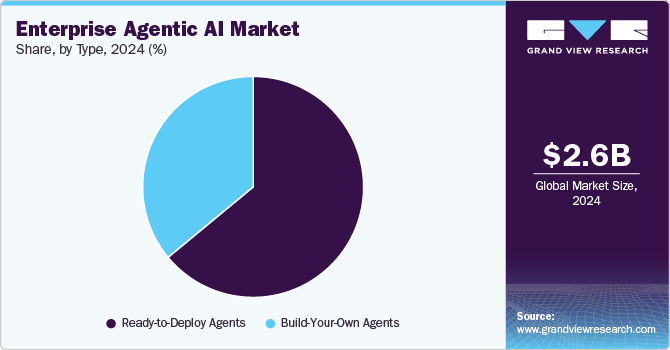
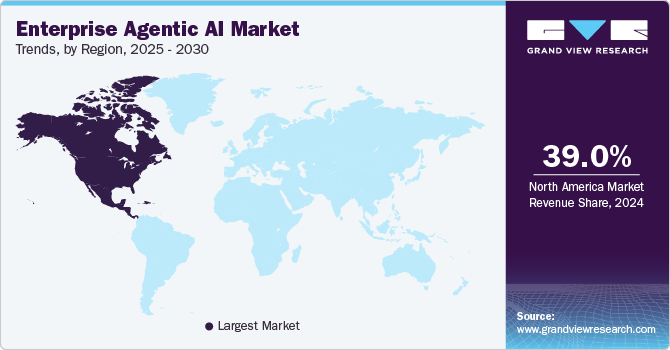
The global enterprise agentic AI market was valued at USD 2.6 billion in 2024 and is projected to reach USD 24.5 billion by 2030, growing at a CAGR of 46.2% from 2025 to 2030. The rapid growth is being driven by increasing enterprise automation, complex business environments, and the need for faster decision-making. North America held the largest share of the enterprise agentic AI market in 2024, accounting for more than 39% of global revenue. Meanwhile, Asia Pacific is expected to register the fastest growth, supported by increasing AI investments and adoption across countries such as China, India, and Japan.
Why Is Agentic AI Important for Enterprise Applications?
Enterprise applications have traditionally depended on predefined rules and workflows. Although these systems remain valuable, they can become difficult to manage when processes involve unstructured information, exceptions, multiple applications, and frequent decision-making.
Agentic AI can be introduced to address these limitations. Business processes can be interpreted dynamically, and appropriate actions can be selected based on available context. Repetitive operational activities can be delegated to AI agents while critical decisions can continue to be reviewed by employees.
For example, customer support tickets can be classified automatically, relevant customer information can be retrieved, previous interactions can be analyzed, recommended solutions can be generated, and responses can be prepared. Escalation can be triggered when a high-risk or unusual situation is detected.
Similar approaches can be applied to:
- IT service management
- Financial analysis
- Human resources
- Customer relationship management
- Enterprise resource planning
- Supply chain operations
- Legal document processing
- Compliance monitoring
- Sales operations
- Business intelligence
- Software development
These use cases can be implemented through customized software product development solutions, allowing organizations to build AI capabilities around their specific processes rather than depending exclusively on generic AI applications.
Step 1: Define the Business Objective
The first stage of agentic AI development should be focused on the business objective rather than the AI model.
A clear business problem should be identified before technical architecture is selected. The expected outcome, users, process boundaries, risks, and measurable success criteria should also be established.
For example, instead of defining a project as “build an AI agent for customer support,” a more precise objective could be established:
“Reduce the amount of time required to resolve standard customer support requests while ensuring that sensitive or complex cases are reviewed by human agents.”
This approach allows the agent’s responsibilities and limitations to be clearly defined.
KPIs can subsequently be established around:
- Resolution time
- Automation rate
- Escalation rate
- Customer satisfaction
- Operational cost
- Accuracy
- Compliance
- Human intervention frequency
A clearly defined objective will also make the later evaluation of the agent substantially easier.
Step 2: Identify the Tasks That Should Be Agentic
Not every enterprise workflow should be fully automated. Tasks should be evaluated according to their complexity, frequency, business value, risk, and requirement for human judgment. Processes involving repetitive decision-making and structured enterprise data are often suitable starting points.
A task can be divided into smaller activities such as:
- Information retrieval
- Data analysis
- Decision-making
- Tool invocation
- Action execution
- Validation
- Reporting
The appropriate level of autonomy should then be assigned to each activity. Low-risk tasks can be automated more extensively, while high-impact decisions can be placed behind approval checkpoints. This approach is often referred to as human-in-the-loop AI.
Step 3: Design the Agentic AI Architecture
A robust architecture should be designed before implementation is started. A typical enterprise agentic AI architecture can contain the following layers:
User Interface Layer
A web application, mobile application, enterprise portal, or conversational interface can be used to communicate with the agent.
Orchestration Layer
The orchestration layer is responsible for managing the agent’s workflow. Tasks can be broken down, actions can be selected, and tool calls can be coordinated from this layer.
AI Model Layer
Large language models or specialized AI models can be used for reasoning, classification, extraction, summarization, planning, and decision support.
Memory Layer
Relevant information can be retained through short-term and long-term memory mechanisms. Conversation history, user preferences, previous actions, and business context can be stored according to enterprise requirements.
Knowledge Layer
Enterprise information can be made accessible through databases, document repositories, APIs, knowledge bases, and vector databases.
Tool and Integration Layer
Business tools and enterprise systems can be connected so that agents can perform authorized actions.
Security and Governance Layer
Authentication, authorization, auditing, encryption, policy enforcement, and monitoring should be incorporated throughout the architecture. This layered approach allows individual components to be upgraded without requiring the entire application to be redesigned.
Step 4: Select the Right AI Models
An agentic system does not necessarily need to rely on one AI model. Different models can be assigned to different tasks depending on complexity, latency, accuracy, and cost requirements.
A powerful reasoning model can be used for complex planning, while smaller models can be used for classification, extraction, or routine processing. Embedding models can be used for semantic search, while specialized models can be used for document processing or domain-specific tasks.
Model selection should therefore be based on:
- Reasoning capability
- Context-window requirements
- Response latency
- Cost per request
- Data privacy requirements
- Hosting requirements
- Multimodal capabilities
- Domain performance
- Reliability
A model abstraction layer can also be introduced so that models can be changed without significantly affecting the rest of the application.
Step 5: Connect Enterprise Data
Agentic AI becomes considerably more valuable when relevant enterprise data can be accessed securely.
Data sources may include:
- CRM systems
- ERP platforms
- Databases
- Internal documentation
- Cloud storage
- APIs
- Business intelligence platforms
- Customer records
- Product catalogs
- Knowledge bases
Retrieval-augmented generation, commonly known as RAG, can be used to provide agents with relevant information without requiring all enterprise data to be embedded directly into a model. Documents can be indexed, converted into embeddings, stored in a vector database, and retrieved when relevant information is required.
Access permissions should also be inherited or enforced at the retrieval layer. An agent should not be allowed to retrieve information simply because that information exists within an enterprise repository.
Step 6: Build a Secure Tool-Calling Framework
The ability to use tools is one of the defining characteristics of agentic AI. An agent may be allowed to call enterprise APIs, query databases, create support tickets, generate reports, update records, send notifications, or initiate workflows.
However, unrestricted tool access can create significant risks. Every tool should therefore be assigned clearly defined permissions. Input validation should be performed, sensitive actions should require appropriate authorization, and important operations should be logged.
For example, an agent may be allowed to retrieve customer information but may not be allowed to modify billing information without human approval.
A permission model can be established around:
- Read access
- Write access
- Administrative access
- Financial actions
- External communication
- Data export
- Workflow execution
This controlled approach can help prevent unintended actions.
Step 7: Implement Planning and Reasoning
Planning capabilities should be introduced when enterprise tasks require multiple steps.
Instead of generating a direct answer, an agent can be designed to:
- Understand the objective.
- Identify the required information.
- Select appropriate tools.
- Execute actions.
- Observe the results.
- Evaluate whether the objective has been achieved.
- Continue, revise, or escalate the workflow.
This process is often implemented through an agent loop.
The loop can be supported by planning frameworks, workflow engines, state machines, or custom orchestration logic. Deterministic workflows should generally be preferred where business processes are predictable, while more flexible agentic behavior can be introduced where uncertainty and dynamic decision-making are involved.
Step 8: Add Memory and Context Management
Memory is important because enterprise tasks are rarely isolated. An AI agent may need to remember previous interactions, ongoing tasks, user preferences, business rules, or decisions that have already been made.
However, unlimited memory should not simply be provided. Relevant information should be selected, stored, retrieved, and expired according to defined policies.
Memory can generally be divided into:
- Short-term conversational memory
- Long-term user memory
- Task memory
- Enterprise knowledge
- Operational state
Sensitive information should be subject to strict retention and access policies.
Step 9: Introduce Human Oversight
Enterprise AI should not be designed around complete autonomy in every situation. Human intervention should be incorporated for actions that are financially significant, legally sensitive, security-related, customer-impacting, or otherwise high-risk.
Approval workflows can be introduced before actions such as:
- Financial transactions
- Contract modifications
- Employee record changes
- Customer account changes
- External communications
- Data deletion
- Privileged system operations
The agent can prepare the recommended action while the final decision is retained by an authorized employee. This approach can provide a practical balance between automation and organizational control.
Step 10: Implement Security and Governance
Security should be treated as a foundational requirement rather than a final development stage. Enterprise agentic AI systems may process confidential business information, personal data, financial records, intellectual property, and operational information.
Consequently, the system should be protected through:
- Identity and access management
- Role-based permissions
- Encryption
- Secure API gateways
- Data-loss prevention
- Prompt-injection defenses
- Audit logs
- Data retention policies
- Model access controls
- Continuous monitoring
AI governance policies should also be established to define which tasks can be automated, which actions require approval, and how agent decisions should be audited.
Step 11: Build Evaluation and Monitoring Systems
An agentic AI system cannot be considered production-ready simply because it performs successfully during demonstrations. Continuous evaluation should be implemented.
The agent should be tested against realistic business scenarios, including normal workflows, ambiguous requests, incomplete information, malicious inputs, unexpected tool responses, and system failures.
Important metrics can include:
- Task completion rate
- Tool-call accuracy
- Hallucination rate
- Escalation rate
- Response latency
- Cost per task
- Error frequency
- Policy violations
- Human override rate
Traceability should also be maintained so that the actions performed by an agent can be reviewed after a workflow has been completed.
Step 12: Design for Scalability
Enterprise workloads can vary significantly. Therefore, scalability should be considered during the initial design & development services phase. Horizontal scaling can be applied to orchestration services, API gateways, databases, and supporting infrastructure. Asynchronous processing can be used for long-running tasks, while queues can be introduced to manage workload spikes.
Caching can also be applied to frequently requested information where appropriate. The architecture should be designed so that additional agents, tools, users, and enterprise applications can be incorporated without major restructuring.
Step 13: Develop a Pilot Before Enterprise-Wide Deployment
A controlled pilot should generally be conducted before an agent is deployed across an entire organization. A single business process can be selected, and the agent can initially be given limited permissions. Performance can then be measured against predefined KPIs.
Feedback can be collected from employees, administrators, and business stakeholders. Problems can be identified, workflows can be refined, and safeguards can be strengthened before broader deployment is undertaken.
A phased rollout can subsequently be performed:
Phase 1: Proof of concept
Phase 2: Controlled pilot
Phase 3: Department-level deployment
Phase 4: Enterprise integration
Phase 5: Continuous optimization
This approach can reduce implementation risk while allowing business value to be demonstrated progressively.
Common Challenges in Building Enterprise Agentic AI
Several challenges should be expected during implementation.
Hallucinations
AI-generated information may occasionally be inaccurate. Grounding mechanisms, retrieval systems, structured outputs, validation, and human review can be used to reduce this risk.
Unpredictable Agent Behavior
Because agents can make dynamic decisions, unexpected workflows may sometimes be produced. Guardrails, constrained tool access, deterministic workflows, and approval mechanisms can be introduced to maintain control.
Data Privacy
Enterprise information should not be exposed unnecessarily. Data-access policies and secure infrastructure should therefore be implemented from the beginning.
Integration Complexity
Existing enterprise systems may use different APIs, data structures, authentication mechanisms, and business rules. A dedicated integration layer can be used to simplify these connections.
Cost Management
Agentic workflows can involve multiple model calls and tool interactions. Cost controls, model routing, caching, and workflow optimization can be introduced to maintain predictable operating expenses.
How Beadaptify Helps Businesses Build Scalable Agentic AI Systems?
The adoption of agentic AI can be accelerated with the right combination of AI expertise, software engineering capabilities, and enterprise application knowledge. At Beadaptify, agentic AI solutions can be designed and developed around specific business objectives, operational workflows, and technology environments rather than being treated as standalone AI experiments.
From strategy and architecture to development, integration, testing, and deployment, end-to-end support can be provided for organizations seeking to introduce intelligent agents into their enterprise applications. Existing systems can be connected with AI-powered workflows, while appropriate controls can be established to ensure that automation remains secure, scalable, and aligned with business requirements.
Through comprehensive software product development services, AI agents can be developed for use cases such as customer support, business process automation, data analysis, internal operations, knowledge management, and intelligent decision assistance. Enterprise data sources, APIs, databases, and business applications can be integrated so that agents can retrieve relevant information and execute authorized actions.
Customized software product development solutions can also be developed for organizations with complex workflows or industry-specific requirements. Agent orchestration, retrieval-augmented generation, tool calling, memory management, human-in-the-loop workflows, and monitoring capabilities can be incorporated according to the requirements of each application.
Best Practices for Enterprise Agentic AI Development
Several practices should be followed to improve the reliability and maintainability of an agentic AI platform:
- Business objectives should be defined before AI technologies are selected.
- Agent permissions should be restricted according to business requirements.
- Human approval should be maintained for high-risk actions.
- Enterprise data should be accessed through secure retrieval mechanisms.
- AI outputs should be validated wherever accuracy is critical.
- Agent workflows should be observable and auditable.
- Multiple AI models should be evaluated before a final selection is made.
- Security should be incorporated into the architecture from the beginning.
- Performance and cost should be monitored continuously.
- Production deployment should be conducted incrementally.
- Feedback should be incorporated into continuous improvement cycles.
Conclusion
Agentic AI is expected to become an important component of next-generation enterprise software because intelligent systems can be used not only to generate information but also to perform meaningful business tasks. However, enterprise agentic AI should not be treated as a simple chatbot development project. A combination of AI models, orchestration, enterprise data, memory, tools, security, governance, monitoring, and human oversight is required for a reliable implementation.
The most successful systems will be those in which autonomy is introduced carefully and business value is prioritized over technological complexity. Repetitive processes can be automated, employees can be supported with intelligent decision assistance, and enterprise workflows can be made more adaptive. Ultimately, enterprise agentic AI should be built as a governed software product rather than an isolated AI experiment. When architecture, security, data, user experience, and business objectives are aligned, AI agents can be positioned to deliver measurable operational improvements while maintaining the control and reliability expected from enterprise applications.
FAQs on Agentic AI Applications
How can agentic AI be used in enterprise applications?
Agentic AI can be used for customer support, IT service management, employee operations, sales, finance, supply chain management, document processing, data analysis, compliance, and workflow automation. The level of autonomy can be configured according to business requirements and risk levels.
Is agentic AI secure for enterprise applications?
Agentic AI can be made suitable for enterprise environments when appropriate security and governance mechanisms are implemented. Role-based access, authentication, authorization, encryption, controlled tool access, audit logs, data protection, and human approval workflows can be incorporated to reduce risks.
Can agentic AI be integrated with existing enterprise software?
Yes. Agentic AI can be integrated with existing CRM, ERP, HR, customer support, databases, cloud platforms, internal applications, and third-party services through APIs and integration layers. Existing workflows can therefore be enhanced without necessarily replacing the underlying systems.
How can Beadaptify help with agentic AI development?
Beadaptify can support agentic AI initiatives through software product development services, AI integration, application architecture, enterprise system integration, workflow automation, and scalable application development. Customized software product development solutions and design & development services can also be provided according to specific business requirements.