Shopping behavior has been transformed by smartphones, faster internet connectivity, digital payments, personalized recommendations, and increasingly convenient delivery experiences. As more purchasing journeys are being completed through mobile devices, an eCommerce app can be used to create a direct and personalized channel between a business and its customers.
However, successful eCommerce app development involves much more than placing products inside a mobile interface. A complete ecosystem needs to be created around product discovery, search, payments, inventory, order management, customer accounts, logistics, notifications, security, analytics, and customer support.
In 2026, an eCommerce app is also increasingly expected to provide personalized experiences, intelligent search, flexible payment options, real-time order visibility, and seamless interactions across multiple devices and channels. For businesses planning to enter online commerce or modernize an existing shopping platform, a carefully structured development process can help reduce unnecessary costs while creating a scalable foundation for future growth.
This guide explains how to develop an eCommerce app in 2026, including essential features, advanced functionality, technology choices, development stages, estimated costs, monetization models, security considerations, challenges, and best practices.
What Is an eCommerce App?
An eCommerce app is a mobile application through which products or services can be discovered, evaluated, purchased, and managed digitally.
A typical eCommerce app can allow customers to:
- Create and manage accounts
- Browse products
- Search and filter items
- View product details
- Add products to a cart
- Save products to wishlists
- Apply discounts
- Make payments
- Track orders
- Request returns
- Contact customer support
- Receive personalized recommendations
- Manage addresses and payment methods
Behind the customer-facing interface, an administration system is generally required for product management, inventory, orders, customers, payments, promotions, analytics, and fulfillment. For businesses operating at scale, the application may also be connected with ERP, CRM, warehouse management, accounting, logistics, marketing automation, and payment systems.
Why Should Businesses Develop an eCommerce App in 2026?
A mobile application can provide several advantages over a conventional mobile website when the customer journey requires frequent interaction.
1. Personalized Shopping Experiences
Customer behavior can be analyzed to provide personalized recommendations, recently viewed products, relevant offers, and customized content. This can make product discovery more relevant and reduce the effort required to find suitable products.
2. Direct Customer Engagement
A mobile application can provide a direct communication channel through push notifications. Customers can be notified about:
- New products
- Discounts
- Abandoned carts
- Order updates
- Delivery status
- Personalized offers
- Back-in-stock products
3. Faster Shopping Experiences
Frequently used information can be stored securely so that checkout and account management can be completed with fewer steps. Mobile-specific experiences can also be optimized for touch interactions and smaller screens.
4. Improved Customer Retention
Loyalty programs, personalized recommendations, rewards, subscriptions, and exclusive offers can be incorporated into an application. As a result, repeat purchasing behavior can be encouraged through a more consistent digital experience.
5. Better Use of Mobile Features
Device capabilities such as cameras, biometrics, GPS, notifications, and mobile wallets can be incorporated when they provide genuine value. For example, a camera can be used for visual product search or barcode scanning.
The Rise of M-Commerce
Mobile commerce (m-commerce) has become a major part of online shopping as more customers use smartphones to browse products, compare prices, and complete purchases. Global mobile commerce sales are forecast to reach approximately $2.74 trillion in 2026, accounting for around 60% of global eCommerce sales.
Mobile devices also generated 77% of eCommerce website visits in 2025, highlighting how often shopping journeys begin on a phone. This shift is encouraging businesses to invest in mobile-friendly shopping experiences, including fast-loading interfaces, secure digital payments, simplified checkout, and personalized recommendations. Features such as saved payment details, one-tap checkout, loyalty programs, and push notifications can make repeat purchases more convenient. As mobile shopping continues to grow, eCommerce apps are increasingly being designed not just for browsing, but for a seamless end-to-end buying experience.
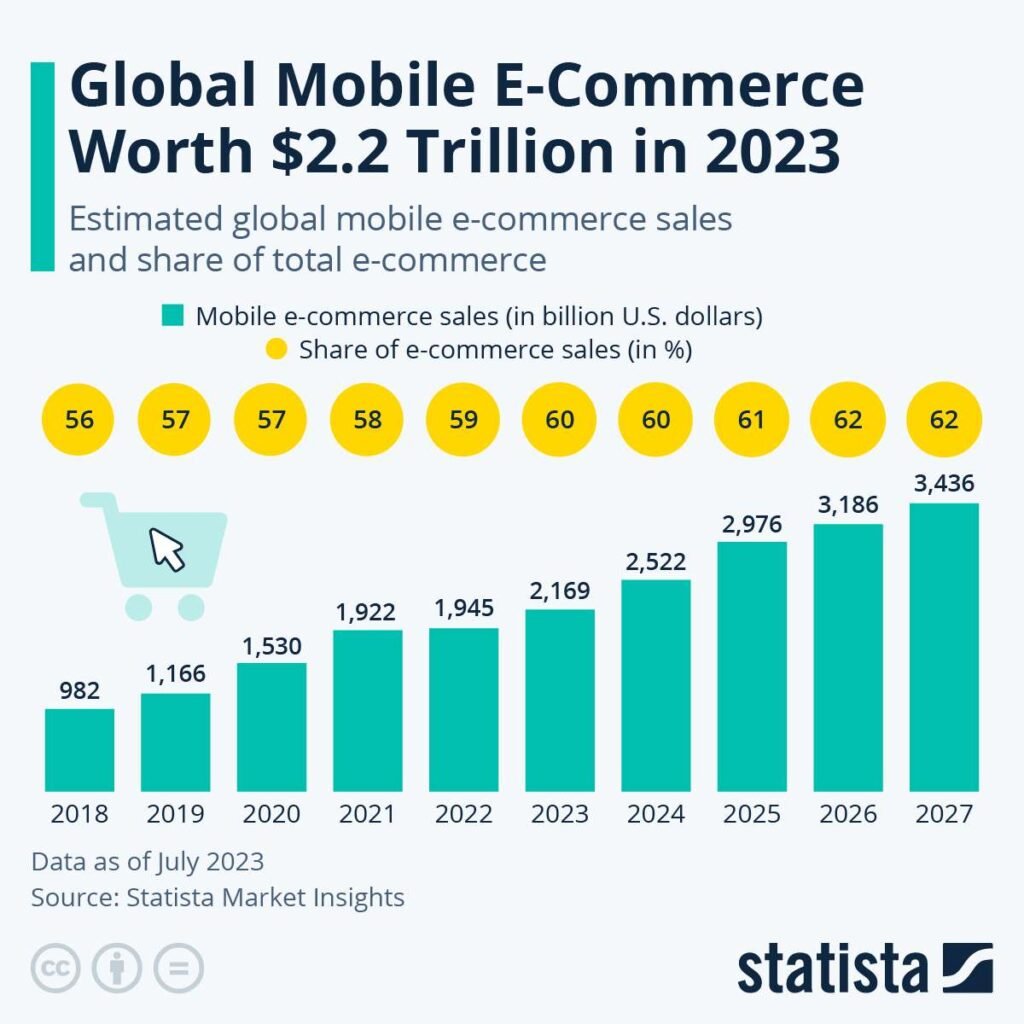
Global M-Commerce Worth in 2026 & Beyond [Source: Statista]
Types of eCommerce Apps
Before development is started, the business model should be clearly defined.
B2C eCommerce App
Products are sold directly to individual consumers. Examples include fashion, electronics, grocery, beauty, furniture, and lifestyle applications.
B2B eCommerce App
Products or services are sold between businesses. Additional functionality may be required for bulk ordering, negotiated pricing, purchase approvals, invoices, and multiple business users.
C2C Marketplace App
Customers are allowed to sell products to other customers. Seller profiles, listings, payments, reviews, dispute management, and platform commissions may be required.
Multi-Vendor Marketplace
Multiple vendors can sell products through a single platform. Separate seller dashboards, commission management, vendor verification, inventory management, and payout systems may be required.
Subscription eCommerce App
Products or services are provided through recurring subscriptions. Subscription plans, recurring billing, renewal notifications, upgrades, cancellations, and customer retention features can be included.
Essential Features of an eCommerce App
A successful eCommerce application should be designed around the complete shopping journey.
1. User Registration and Login
Customers should be able to create accounts easily and securely.
Authentication can be provided through:
- Email and password
- Phone number and OTP
- Social login
- Biometric authentication
- Passwordless authentication
Account verification and password recovery should also be included.
2. Customer Profile
A personalized account area should be provided.
Customers can be allowed to manage:
- Personal details
- Addresses
- Order history
- Payment methods
- Wishlist
- Saved products
- Preferences
- Notifications
- Loyalty points
Account information should be protected through appropriate access controls.
3. Product Catalog
Products should be organized into categories and subcategories. Each product can include:
- Product name
- Images
- Videos
- Description
- Price
- Discounts
- Variants
- Specifications
- Availability
- Ratings
- Reviews
The catalog should be structured so that products can be managed efficiently from the administration system.
4. Search and Filters
Search functionality is one of the most important components of an eCommerce application.
Customers should be able to search using product names, categories, brands, attributes, and other relevant terms.
Filters can include:
- Price
- Brand
- Size
- Color
- Rating
- Availability
- Category
- Material
- Features
Sorting can also be provided based on price, popularity, ratings, newest arrivals, and relevance.
5. Product Details
A product details page should provide enough information for a purchase decision to be made. High-quality images, product descriptions, specifications, reviews, shipping information, return policies, and availability can be displayed. Product recommendations can also be presented to support cross-selling and upselling.
6. Shopping Cart
Customers should be able to add, remove, and modify products before checkout. The cart can display:
- Product quantities
- Product prices
- Discounts
- Taxes
- Shipping costs
- Estimated delivery
- Final order value
Cart information can be synchronized across devices when customers are logged into their accounts.
7. Wishlist
Products can be saved for future purchases through a Wishlist. Price-drop notifications, stock alerts, and personalized recommendations can be connected with Wishlist activity.
8. Secure Checkout
Checkout should be kept as simple as possible. A typical checkout process can include:
Cart → Address → Delivery Method → Payment → Order Confirmation
Unnecessary fields and steps should be avoided. Guest checkout can also be provided when appropriate.
9. Payment Gateway Integration
Multiple payment options can be offered based on the target market. These may include:
- Credit cards
- Debit cards
- Digital wallets
- Bank transfers
- Buy now, pay later
- Cash on delivery
- Local payment methods
Payment processing should be implemented using secure and compliant payment infrastructure.
10. Order Management
Customers should be able to view order information after checkout. Order management can include:
- Order confirmation
- Processing status
- Shipment status
- Delivery tracking
- Cancellation
- Return requests
- Refund status
- Order history
11. Push Notifications
Push notifications can be used to keep customers informed. Notifications can be triggered for:
- Order confirmation
- Shipping updates
- Delivery
- Promotions
- Cart reminders
- Wishlist price changes
- Back-in-stock alerts
- Personalized offers
Notification frequency should be controlled carefully to avoid creating unnecessary interruptions.
12. Ratings and Reviews
Customers can be allowed to rate and review products. Reviews can increase transparency and help other customers evaluate products. Verified-purchase indicators can also be introduced where appropriate.
13. Customer Support
Support can be provided through:
- Live chat
- Support tickets
- FAQs
- AI assistants
- Phone support integration
A help center can also be developed so that common questions can be answered without direct support intervention.

Image Source: [Ecommerce Shopping App]
Advanced eCommerce App Features for 2026
Basic shopping functionality can be expanded through advanced features when business requirements justify the additional investment.
AI-Powered Product Recommendations
AI can be used to analyze browsing behavior, purchasing history, preferences, and other signals. Relevant products can then be recommended to individual customers.
AI Shopping Assistants
Conversational assistants can be used to help customers find products, compare options, answer questions, and navigate the shopping journey. For example, a customer could describe what they need in natural language and be shown relevant products.
Visual Search
Customers can be allowed to upload or capture an image and search for visually similar products. This can be particularly useful for fashion, furniture, accessories, and home décor.
Augmented Reality
AR functionality can be used to allow products to be visualized in real-world environments. For example, furniture can be previewed in a room before purchase.
Voice Search
Voice-based product discovery can be integrated for customers who prefer spoken interactions.
Personalized Pricing and Offers
Relevant discounts and promotions can be presented based on customer segments, loyalty status, purchase history, or campaign rules.
Loyalty and Rewards
Points, membership tiers, cashback, referral rewards, and exclusive offers can be integrated into the application.
Subscription Management
Recurring purchases can be supported for products such as groceries, cosmetics, supplements, household products, and other frequently purchased items.
Real-Time Inventory
Inventory data can be synchronized so customers can see whether products are available. This can reduce situations where products are purchased despite being unavailable.
How to Develop an eCommerce App: Step-by-Step Process
A structured development process should be followed to reduce risks and ensure that business requirements remain aligned with technical implementation.
Step 1: Define the Business Model
The business model should be established before development is started. It should be determined whether the application will be:
- B2C
- B2B
- C2C
- Multi-vendor
- Subscription-based
- Direct-to-consumer
Target customers, revenue sources, geographic markets, product categories, and competitive positioning should also be defined.
Step 2: Conduct Market and User Research
The target audience should be researched to understand customer expectations and shopping behavior.
Competitor applications can be reviewed to identify:
- Common features
- Navigation patterns
- Pricing approaches
- Checkout experiences
- Customer complaints
- Market gaps
User personas and customer journeys can then be created.
Step 3: Define the MVP
A minimum viable product should be created around the most important shopping functions.
An MVP may include:
- Registration
- Product catalog
- Search
- Product details
- Cart
- Checkout
- Payments
- Orders
- Notifications
- Customer support
Advanced AI, AR, voice search, and other features can be introduced later if they are not essential to the initial launch.
Step 4: Create the UX Architecture
The application structure should be planned before visual design is started.
Important screens can include:
- Splash screen
- Onboarding
- Login
- Home
- Categories
- Search
- Product details
- Cart
- Checkout
- Payment
- Order tracking
- Profile
- Wishlist
- Support
User flows should be mapped to ensure that customers can move between these screens naturally.
Step 5: Design the UI
Once the UX structure has been approved, high-fidelity designs can be created.
The design system should define:
- Colors
- Typography
- Buttons
- Cards
- Forms
- Navigation
- Product components
- Icons
- Notifications
- Modals
Responsive and accessible design principles should be considered where applicable.
Step 6: Select the Technology Stack
The technology stack should be selected based on application requirements, expected traffic, performance requirements, development budget, integrations, and long-term scalability.
Mobile Development
Native applications can be developed using:
- Swift for iOS
- Kotlin for Android
Cross-platform applications can be developed using:
- Flutter
- React Native
Backend
Common backend technologies include:
- Node.js
- Python
- PHP
- Laravel
- .NET
- Java
Database
Depending on requirements, databases such as:
- PostgreSQL
- MySQL
- MongoDB
- Microsoft SQL Server
can be considered.
Cloud Infrastructure
Cloud platforms can be used for hosting, storage, monitoring, databases, backups, and scaling.
Step 7: Develop the Backend
Backend development forms the foundation of the application.
Business logic can be implemented for:
- Users
- Products
- Categories
- Inventory
- Orders
- Payments
- Discounts
- Reviews
- Notifications
- Shipping
- Returns
APIs can be developed so the mobile application can securely communicate with backend systems.
Step 8: Develop the Mobile Application
The approved designs can be converted into functional mobile interfaces. The frontend can be connected with APIs to support real-time data exchange.
Features such as product search, cart management, checkout, payments, and order tracking can then be implemented. Experienced mobile app development services can be used when complex shopping workflows, multiple platforms, and high scalability are required.
Step 9: Integrate Third-Party Services
External services may be required for:
- Payments
- Maps
- Shipping
- SMS
- Analytics
- Customer support
- Marketing automation
- Product search
- Authentication
Integration architecture should be planned carefully so that external service changes can be managed without disrupting the entire application.
Step 10: Testing and Quality Assurance
Testing should be performed across the entire application.
Testing may include:
- Functional testing
- UI testing
- API testing
- Payment testing
- Security testing
- Performance testing
- Device testing
- Compatibility testing
- Usability testing
- User acceptance testing
Special attention should be given to checkout and payment workflows because failures at these stages can directly affect revenue.
Step 11: Launch
Before launch, the production environment should be configured. App store requirements, analytics, crash monitoring, payment configurations, security settings, and customer support processes should be verified. A staged rollout can be considered so that potential issues can be identified before a wider release.
Step 12: Post-Launch Maintenance
eCommerce applications require continuous improvement. After launch, performance, customer feedback, conversion metrics, crash reports, and feature usage should be monitored. Updates can then be released based on actual customer behavior.
eCommerce App Development Cost in 2026
The cost of developing an eCommerce app can vary significantly depending on complexity, platform requirements, features, integrations, design, and development team structure.
A general planning estimate can be structured as follows:
eCommerce App Type |
Estimated Cost |
|---|---|
| Basic eCommerce App | $20,000–$40,000 |
| Standard eCommerce App | $40,000–$80,000 |
| Advanced eCommerce App | $80,000–$150,000 |
| Multi-Vendor Marketplace | $60,000–$150,000+ |
| AI-Powered eCommerce App | $100,000–$200,000+ |
| Enterprise eCommerce Platform | $150,000–$300,000+ |
These figures should be treated as planning ranges rather than fixed quotations. The final cost should be determined after the features, platforms, integrations, design requirements, backend architecture, and business workflows have been defined.
Major Factors Affecting eCommerce App Development Cost
Number of Platforms
Developing separate native iOS and Android applications can require more effort than using a cross-platform approach.
UI/UX Complexity
Custom experiences, animations, personalization, interactive product views, and advanced navigation can increase design and development costs.
Number of Features
Every additional feature adds development and testing requirements.
Integrations
Payment, shipping, ERP, CRM, inventory, analytics, and marketing integrations can increase the project scope.
Backend Complexity
A sophisticated backend with real-time inventory, pricing rules, personalization, promotions, and multi-vendor functionality requires additional development.
Security
Authentication, authorization, encryption, payment security, fraud prevention, and monitoring can add to development requirements.
AI and Advanced Technologies
AI recommendations, visual search, conversational shopping assistants, and AR experiences require specialized development.
eCommerce App Development Cost by Feature
Feature |
Estimated Cost |
|---|---|
| User Registration | $2,000–$5,000 |
| Product Catalog | $4,000–$10,000 |
| Search & Filters | $3,000–$8,000 |
| Product Details | $2,000–$5,000 |
| Shopping Cart | $3,000–$7,000 |
| Checkout | $4,000–$10,000 |
| Payment Integration | $4,000–$12,000 |
| Order Management | $4,000–$10,000 |
| Push Notifications | $2,000–$5,000 |
| Reviews & Ratings | $2,000–$5,000 |
| Wishlist | $1,500–$4,000 |
| Admin Dashboard | $5,000–$15,000 |
| AI Recommendations | $10,000–$30,000+ |
| Visual Search | $10,000–$30,000+ |
| AR Features | $15,000–$40,000+ |
Actual pricing will depend on feature complexity and integration requirements.
eCommerce App Development Timeline
The development timeline will vary according to project scope.
Development Stage |
Approximate Duration |
|---|---|
| Research & Planning | 2–4 weeks |
| UX/UI Design | 3–6 weeks |
| Backend Development | 6–12 weeks |
| Mobile App Development | 8–16 weeks |
| Integrations | 3–8 weeks |
| Testing & QA | 3–6 weeks |
| Deployment | 1–2 weeks |
A basic eCommerce application can often be developed within approximately 3–5 months, while advanced and enterprise applications may require 6–12+ months.
eCommerce App Monetization Models
Different revenue models can be used depending on the business structure.
Product Sales
Revenue can be generated directly through product purchases.
Commission Model
A percentage can be charged on transactions when multiple sellers are operating on a marketplace.
Subscription Model
Customers can be charged recurring fees for premium benefits.
Freemium Model
Basic functionality can be provided without charge while premium services are monetized.
Advertising
Relevant brands and products can be promoted through sponsored placements.
Delivery Fees
Delivery charges can be applied based on location, order value, delivery speed, or service type.
How to Make an eCommerce App More Successful
Keep Checkout Simple
A complicated checkout process can create unnecessary friction. The number of steps should be reduced wherever possible.
Improve Search
Customers should be able to find products quickly through accurate search and useful filters.
Use High-Quality Product Content
Images, videos, specifications, reviews, and clear descriptions should be provided.
Personalize the Experience
Recommendations and offers should be made relevant to customer interests whenever sufficient data is available.
Optimize Performance
Pages and product data should load quickly. Caching, optimized images, efficient APIs, and scalable infrastructure can be used to improve performance.
Build Trust
Security information, transparent pricing, return policies, customer reviews, and reliable support can improve confidence during purchasing.
Security Considerations for eCommerce Apps
Customer information and payment-related data can make eCommerce applications attractive targets for attacks. Security should therefore be considered throughout development. Important measures can include:
- Secure authentication
- Multi-factor authentication
- Encryption
- Secure API communication
- Role-based access
- Secure payment processing
- Tokenization where appropriate
- Rate limiting
- Fraud monitoring
- Vulnerability testing
- Secure session management
- Data backups
- Security monitoring
Security requirements should also be evaluated according to the countries and markets in which the application will operate.
Common eCommerce App Development Mistakes
Building Too Many Features at Once
A large initial feature set can increase costs and delay launch. A focused MVP can be used to validate the business model before advanced functionality is introduced.
Ignoring User Experience
An application can contain excellent functionality while still being difficult to use. User flows should therefore be tested before development is finalized.
Choosing Technology Based Only on Trends
The newest technology is not automatically the best technology for every project. The technology stack should be selected according to project requirements and long-term maintenance needs.
Underestimating Backend Requirements
Product catalogs, inventory, pricing, promotions, payments, orders, and analytics require a strong backend foundation.
Neglecting Performance
Slow product pages or checkout processes can negatively affect the shopping experience. Performance should be considered from the architecture stage.
Ignoring Post-Launch Optimization
Customer behavior changes over time. Continuous analytics and improvement should therefore be planned from the beginning.
Why Professional eCommerce Development Services Matter
A professional ecommerce development company can provide the technical expertise required to manage the complete application lifecycle. Through specialized ecommerce development services, businesses can receive support across:
- Business analysis
- Product strategy
- UX/UI design
- Mobile development
- Backend development
- Payment integration
- API development
- Inventory integration
- Security
- Testing
- Deployment
- Maintenance
A structured development approach can reduce technical risks while providing a stronger foundation for future growth.
How eCommerce Development Solutions Support Business Growth
Custom ecommerce development solutions can be designed around specific business processes rather than forcing a business into a generic application structure.
For example, a custom solution can be created for:
- Fashion brands
- Grocery businesses
- Electronics retailers
- Furniture companies
- Beauty brands
- B2B suppliers
- Subscription businesses
- Multi-vendor marketplaces
Custom workflows can be developed for pricing, inventory, fulfillment, customer accounts, promotions, and integrations.
The Role of Mobile App Development Services
Mobile applications require specialized attention because customer interactions are often performed through smaller screens and touch interfaces. Professional mobile app development services can be used to create optimized experiences for iOS and Android.
Native or cross-platform development can be selected according to performance, budget, functionality, and long-term requirements. Push notifications, biometric authentication, mobile wallets, camera access, GPS, and other device capabilities can also be integrated where appropriate.
Mobile App Development Solutions for eCommerce
Custom mobile app development solutions can be created to support different shopping models. A retail brand may require a direct-to-consumer application, while a marketplace may require separate customer and vendor applications.
A B2B business may require bulk ordering, account-based pricing, approval workflows, and invoice management. Therefore, the architecture should be designed around the actual business model rather than copied from another eCommerce application.
Why Choose Beadaptify for eCommerce App Development?
An eCommerce application should be developed as a complete digital product rather than simply as a shopping interface. At Beadaptify, eCommerce products can be planned around business goals, customer journeys, operational requirements, and long-term scalability.
From research and product strategy to UI/UX design, mobile development, backend engineering, integrations, testing, deployment, and ongoing optimization, the development lifecycle can be supported under one structured approach. Custom ecommerce development services, mobile application development services, and design & development services can be combined to create a consistent customer experience across the complete shopping journey. The platform can also be structured so that new features, integrations, product categories, markets, and customer segments can be added as the business grows.
Future of eCommerce App Development in 2026
The eCommerce experience is expected to become increasingly personalized and intelligent. AI-powered shopping assistants, conversational commerce, visual search, predictive recommendations, augmented reality, automated customer support, and personalized experiences are likely to become more widely integrated.
At the same time, fundamentals such as fast performance, secure payments, reliable order fulfillment, clear product information, and intuitive checkout will remain essential. The strongest eCommerce applications will therefore not be defined only by the number of technologies that are included. Their value will be determined by how effectively those technologies solve real customer and business problems.
Final Thoughts
Developing an eCommerce app in 2026 requires a combination of strong product strategy, intuitive UX, reliable technology, secure payments, scalable infrastructure, and continuous optimization. The development process should begin with a clearly defined business model and customer journey. Essential features should then be prioritized into an MVP before advanced functionality is introduced.
The final investment will be influenced by the number of platforms, features, integrations, backend complexity, design requirements, security needs, and advanced technologies being implemented. By working with Beadaptify, an experienced ecommerce development company, businesses can create a shopping application that is not only visually engaging but also secure, scalable, fast, and prepared for long-term growth. With the right mobile app development services, an eCommerce idea can be transformed into a complete digital commerce product.

FAQs About eCommerce App Development
What features are essential in an eCommerce app?
Essential features generally include registration, product catalogs, search, filters, product details, cart, checkout, payment integration, order tracking, notifications, customer profiles, and support.
Should an eCommerce app be developed for iOS and Android?
If customers are distributed across both platforms, applications for both iOS and Android can be considered. Cross-platform development can also be evaluated when reduced development duplication is a priority.
Can AI be added to an eCommerce app?
Yes. AI can be used for product recommendations, conversational shopping assistants, search, customer support, personalization, demand forecasting, and other applications.
Can a mobile eCommerce app be connected to an existing website?
Yes. A mobile application can be connected to an existing eCommerce backend through APIs. This can allow products, inventory, orders, customers, and other information to be synchronized.