Artificial intelligence is increasingly being incorporated into enterprise software to improve productivity, automate repetitive operations, enhance decision-making, and deliver more personalized customer experiences. From intelligent customer support and predictive analytics to document processing and workflow automation, AI capabilities are being embedded into applications across industries.
However, successful enterprise AI development involves considerably more than integrating an AI model into an existing application. Business objectives, data infrastructure, security requirements, model selection, system architecture, user experience, integrations, scalability, and ongoing maintenance all need to be considered.
The overall investment can also vary significantly depending on the complexity of the AI solution, the number of integrations required, the type of models being used, the volume of data being processed, and the level of customization required.
For organizations planning an AI initiative, an understanding of enterprise AI development costs, challenges, and best practices can help with better planning and resource allocation. With the support of an experienced enterprise software development company, AI-powered applications can be designed around specific business requirements while being prepared for enterprise-scale deployment.
What Is Enterprise AI Development?
Enterprise AI development refers to the process of designing, developing, integrating, and maintaining artificial intelligence capabilities within business applications and organizational workflows.
Unlike consumer-oriented AI applications, enterprise AI solutions are generally required to operate within complex technology ecosystems. Data may be distributed across multiple systems, strict security policies may need to be followed, and AI-generated results may need to be monitored and validated.
Enterprise AI can be implemented through several technologies, including:
- Machine learning
- Generative AI
- Large language models
- Natural language processing
- Computer vision
- Predictive analytics
- Retrieval-augmented generation (RAG)
- AI agents
- Recommendation systems
- Intelligent automation
These technologies can be used independently or combined to create sophisticated enterprise applications.
For example, an enterprise customer service platform could use natural language processing to understand customer requests, RAG to retrieve information from internal documentation, generative AI to prepare responses, and predictive models to identify customers who may require additional assistance.
Why Is Enterprise AI Development Becoming Important?
Traditional enterprise applications are often based on predefined workflows and business rules. While these systems remain essential, increasingly complex business environments are creating demand for more adaptive software.
AI can be used to process large volumes of structured and unstructured information, identify patterns, generate insights, and automate activities that would otherwise require significant manual effort.
Enterprise AI can be applied to:
- Customer service automation
- Fraud detection
- Sales forecasting
- Financial analysis
- Predictive maintenance
- Employee support
- Document processing
- Contract analysis
- Supply chain optimization
- Business intelligence
- Cybersecurity
- Healthcare administration
- Marketing personalization
By embedding AI directly into enterprise applications, intelligent capabilities can be made available within existing business workflows instead of requiring employees to use separate tools.
Enterprise AI Market: Key Statistics
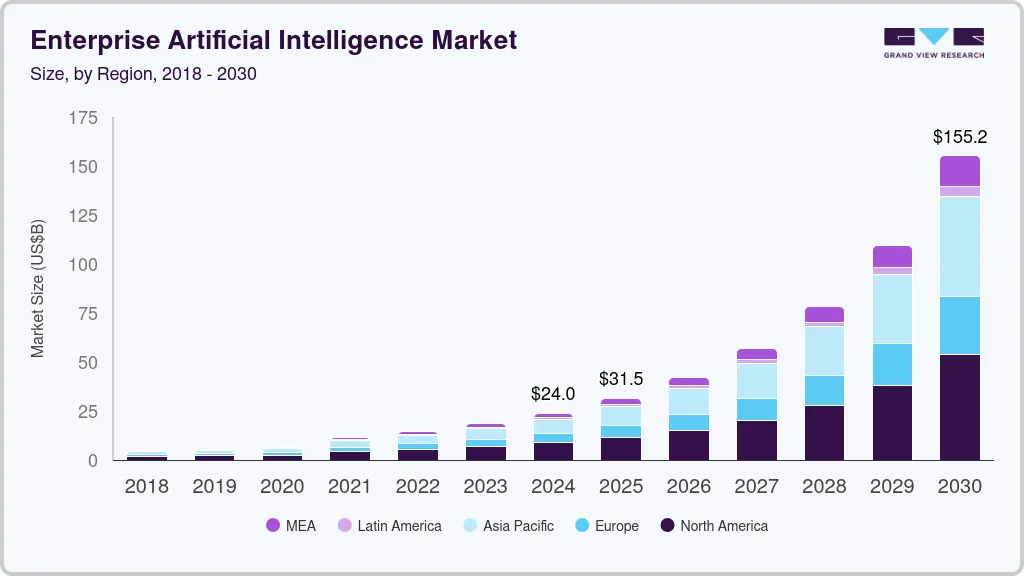
The global enterprise artificial intelligence market was valued at USD 23.9 billion in 2024 and is projected to reach USD 155.2 billion by 2030, representing a 37.6% CAGR from 2025 to 2030. This growth is being driven by increasing demand for automation, operational efficiency, and data-driven decision-making.
- $23.9 billion — Global enterprise AI market size in 2024.
- $155.2 billion — Projected global enterprise AI market size by 2030.
- 37.6% — Expected CAGR of the global enterprise AI market from 2025–2030.
- 44% — Share of McKinsey survey respondents reporting that AI is being scaled across their enterprise in 2026.
- $2.7 trillion — Forecast global AI spending in 2026.
- 44.9% — Expected CAGR of India’s enterprise AI market from 2025–2030.
Key Factors That Influence Enterprise AI Development Costs
There is no single fixed price for enterprise AI development. The total investment is influenced by numerous technical and business factors.
1. Complexity of the AI Solution
The complexity of the application is one of the biggest cost factors. A basic AI-powered document classification system will generally require fewer resources than a sophisticated enterprise AI platform containing multiple AI models, real-time processing, agentic workflows, and integrations with numerous business applications.
Projects can broadly be categorized as:
- Basic AI-powered applications
- AI-enhanced enterprise applications
- Custom generative AI applications
- Advanced AI platforms
- Enterprise-scale AI ecosystems
As functionality increases, additional development, testing, infrastructure, and maintenance resources will be required.
2. AI Model Selection
The choice of AI model can significantly influence development and operating costs. Pre-trained models can often be integrated more quickly, whereas customized or fine-tuned models may require additional data preparation, training infrastructure, experimentation, and evaluation.
Costs can also be influenced by whether models are:
- Consumed through APIs
- Hosted in the cloud
- Deployed on private infrastructure
- Fine-tuned for specific business requirements
- Combined through a multi-model architecture
For some enterprise applications, smaller specialized models may provide sufficient performance at a lower operational cost.
3. Data Preparation and Infrastructure
High-quality data is essential for enterprise AI. Before AI models can be used effectively, data may need to be collected, cleaned, structured, labeled, transformed, indexed, and secured.
Additional infrastructure may be required for:
- Data warehouses
- Data lakes
- Vector databases
- Feature stores
- Document repositories
- Model storage
- Data pipelines
- Real-time processing
If enterprise data is fragmented across multiple legacy systems, additional integration and data engineering work may also be required.
4. Enterprise Integrations
AI applications rarely operate independently. An enterprise AI system may need to be connected with CRM platforms, ERP systems, HR software, databases, cloud storage, payment systems, internal APIs, and third-party applications.
Every integration introduces additional development and testing requirements. The complexity of existing systems, API availability, authentication mechanisms, data formats, and legacy infrastructure can therefore have a direct impact on project costs.
5. UI/UX Requirements
The user experience should not be overlooked during enterprise AI development. AI functionality may be powerful, but its value can be reduced if employees find the application difficult to understand or operate.
Professional UI/UX design services can be used to create intuitive dashboards, conversational interfaces, AI-assisted workflows, approval screens, reporting interfaces, and explainability features.
Additional UX considerations may be required for AI applications, including:
- AI-generated content review
- Confidence indicators
- Human approval workflows
- Error correction
- Feedback mechanisms
- Conversation history
- Explainability
- Action confirmations
Consequently, the design phase should be included in the overall development budget.
6. Security and Compliance Requirements
Enterprise AI applications often process confidential business information.
Additional investment may therefore be required for:
- Identity management
- Access control
- Encryption
- Secure APIs
- Audit logging
- Data governance
- Compliance controls
- Threat monitoring
- Data-loss prevention
Industries with strict regulatory requirements may require additional security testing and documentation.
Estimated Enterprise AI Development Cost
Because enterprise AI projects differ significantly in scope, development costs should be estimated based on functionality rather than a single generic figure.
A broad project classification can be considered:
Enterprise AI Solution |
Typical Complexity |
Relative Cost |
|---|---|---|
| Basic AI feature | Low | Low |
| AI-enabled business application | Medium | Moderate |
| Custom GenAI application | Medium–High | High |
| Multi-system enterprise AI platform | High | Very High |
| Advanced agentic AI ecosystem | Very High | Significant |
The final cost can be influenced by development hours, team composition, AI model usage, cloud infrastructure, integrations, security requirements, testing, deployment, and post-launch maintenance. A detailed discovery and architecture phase should therefore be conducted before a final budget is established.
Major Challenges in Enterprise AI Development
Enterprise AI adoption can provide significant benefits, but several challenges need to be addressed.
1. Poor Data Quality
AI systems depend heavily on the quality of their data. Inaccurate, incomplete, duplicated, outdated, or inconsistent data can result in unreliable AI outputs. Data quality should therefore be assessed before model implementation. Data cleansing, validation, governance, and continuous monitoring should be incorporated into the AI development process.
2. Data Privacy and Security
Sensitive enterprise data can create significant security risks when it is processed by AI systems. Information such as customer records, financial information, employee data, intellectual property, and internal documentation should be protected through appropriate security controls. Data access should be restricted according to user roles and business requirements.
3. AI Hallucinations
Generative AI models can occasionally generate information that appears credible but is inaccurate. This can be particularly problematic in enterprise environments where incorrect information may influence business decisions.
Several approaches can be used to reduce this risk:
- Retrieval-augmented generation
- Grounded knowledge sources
- Structured outputs
- Output validation
- Human review
- Model evaluation
- Confidence-based escalation
Critical AI-generated information should not automatically be treated as factual without appropriate validation.
4. Legacy System Integration
Many organizations operate a combination of modern cloud applications and older enterprise systems. Legacy systems may have limited APIs, outdated architectures, or complex data structures. AI integration can therefore become technically challenging. An integration layer can be introduced to connect AI services with existing applications while minimizing disruption to core systems.
5. Scalability
An AI application that works effectively during a pilot may encounter performance problems when thousands of users begin accessing it. Infrastructure should therefore be designed for scalability from the beginning. Load balancing, caching, asynchronous processing, containerization, API management, and cloud-based infrastructure can be used where appropriate.
6. Employee Adoption
Enterprise AI adoption is not purely a technical challenge. Employees may be reluctant to use AI systems if the purpose of automation is unclear or if AI-generated outputs cannot be trusted. Training, transparent communication, intuitive interfaces, and human oversight can help increase adoption. This is another area in which custom UI/UX design services can provide substantial value.
Best Practices for Enterprise AI Development
1. Start With a Clearly Defined Business Problem
AI should not be implemented simply because the technology is available. A specific business problem should first be identified. The expected business outcome should then be defined. For example, instead of creating a generic AI assistant, an organization could focus on reducing customer support resolution times by automating repetitive support requests. Specific objectives make ROI easier to measure.
2. Establish Measurable KPIs
Performance should be evaluated using predefined metrics.
Depending on the application, KPIs may include:
- Cost reduction
- Processing time
- Automation rate
- Employee productivity
- Customer satisfaction
- Error reduction
- Revenue improvement
- Response time
- AI accuracy
These measurements can be compared before and after implementation to determine whether the AI initiative is delivering meaningful value.
3. Build a Strong Data Foundation
AI performance is closely connected to data quality. Data governance should therefore be established before large-scale deployment.
Data should be:
- Accurate
- Relevant
- Accessible
- Secure
- Consistently structured
- Properly governed
Appropriate data pipelines should also be established to ensure that models receive updated information.
4. Use a Modular Architecture
A modular architecture should be preferred so that AI models, databases, APIs, and application components can be replaced or upgraded independently. This can reduce long-term technology dependency and simplify maintenance. An abstraction layer can also be used to allow multiple AI models to be incorporated based on cost, performance, and use-case requirements.
5. Keep Humans in the Loop
Complete automation should not always be the objective. For high-risk decisions, human approval should be maintained.
AI can be used to generate recommendations, identify patterns, summarize information, or prepare actions while final decisions are retained by authorized employees. This approach can increase trust while reducing operational risks.
6. Prioritize Security From the Beginning
Security should be incorporated during the architecture and development phases rather than being added after the application has been completed.
Security requirements should cover:
- Authentication
- Authorization
- Encryption
- API security
- Data access
- Model access
- Audit trails
- Monitoring
- Incident response
Security testing should also be conducted before production deployment.
7. Design for Explainability
Users should be provided with enough context to understand how AI-generated recommendations were produced, especially when decisions have significant business consequences. Sources, supporting information, confidence indicators, and reasoning summaries can be presented where appropriate. Explainability can improve user trust and make errors easier to identify.
8. Conduct Continuous Testing
AI systems can behave differently as data, models, prompts, and business conditions change. Continuous evaluation should therefore be performed.
Testing should include:
- Functional testing
- AI output evaluation
- Security testing
- Performance testing
- Bias testing
- Integration testing
- User acceptance testing
Production performance should also be monitored continuously.
The Role of an Enterprise Software Development Company
The development of enterprise AI applications often requires expertise across multiple disciplines. Beadaptify, an experienced enterprise software development company can bring together AI engineers, software developers, data engineers, cloud specialists, cybersecurity professionals, and UI/UX designers. This multidisciplinary approach can help ensure that AI capabilities are integrated properly into the wider enterprise technology ecosystem.
An enterprise development partner can assist with:
- AI strategy
- Product architecture
- AI model integration
- Data engineering
- API development
- Enterprise integrations
- Cloud deployment
- Security implementation
- UI/UX design
- Testing
- Monitoring
- Maintenance
Through specialized enterprise software development services, AI capabilities can be incorporated into existing products or used as the foundation for entirely new enterprise applications.
How Design and Development Influence Enterprise AI Success
Technology alone does not determine whether an AI application will be successful. The way in which users interact with AI can have a significant influence on adoption. Through professional design & development services, enterprise AI applications can be designed to provide clear workflows, understandable AI outputs, intuitive dashboards, and efficient interaction models.
For example, an AI-powered financial analysis application should not simply generate a block of text. Information could instead be presented through dashboards, charts, recommendations, supporting data, alerts, and approval actions. Similarly, an AI customer service application can be designed to show suggested responses while allowing employees to review and modify them before they are sent. This combination of intelligent technology and thoughtful design can make AI substantially more useful within day-to-day business operations.
Enterprise AI Development Roadmap
A structured development roadmap can reduce risks and improve implementation efficiency.
Phase 1: Business Analysis
Business requirements, objectives, users, workflows, and challenges are identified.
Phase 2: AI Feasibility Assessment
Potential AI use cases are evaluated based on technical feasibility, business value, data availability, and expected ROI.
Phase 3: Architecture Design
AI models, application architecture, data infrastructure, integrations, security, and deployment strategies are defined.
Phase 4: Proof of Concept
A limited AI solution is developed to validate the proposed approach.
Phase 5: MVP Development
The most valuable features are implemented and tested with real users.
Phase 6: Enterprise Integration
The AI system is connected with relevant business applications and data sources.
Phase 7: Security and Testing
Security, performance, AI accuracy, usability, and compliance are evaluated.
Phase 8: Production Deployment
The application is deployed gradually, with monitoring and rollback mechanisms in place.
Phase 9: Continuous Optimization
Model performance, infrastructure costs, user feedback, and business KPIs are monitored to identify opportunities for improvement.
Future of Enterprise AI Development
Enterprise AI is expected to become increasingly integrated into everyday business software. AI assistants may evolve into intelligent workflow participants capable of retrieving information, preparing reports, coordinating tasks, analyzing data, and interacting with multiple enterprise systems.
Agentic AI is also expected to become more prominent. Instead of simply generating responses, AI agents can be assigned objectives and provided with controlled access to enterprise tools. However, the future of enterprise AI will likely be shaped not only by model intelligence but also by governance, security, data quality, interoperability, and user experience. Organizations that establish strong AI foundations today can be better positioned to adopt more advanced capabilities as the technology continues to mature.

Conclusion
Enterprise AI development represents a significant opportunity for organizations seeking to improve productivity, automate operations, and create more intelligent software experiences. However, successful implementation requires careful consideration of development costs, data quality, security, integrations, scalability, user experience, and long-term maintenance. The investment required for an enterprise AI solution will depend on the complexity of the application, AI models, data infrastructure, integrations, security requirements, and expected scale. A structured approach can help prevent unnecessary expenditure while ensuring that the technology is aligned with measurable business objectives.
The most effective enterprise AI solutions are developed around real business problems rather than technology trends. Strong data foundations, modular architecture, continuous testing, human oversight, robust security, and intuitive interfaces should all be incorporated into the development strategy. Ultimately, enterprise AI should be viewed as a long-term technology investment. When business strategy, AI capabilities, software architecture, data, security, and user experience are aligned, intelligent enterprise applications can become a sustainable source of operational efficiency and competitive advantage.
FAQs on Enterprise AI Development
What factors affect enterprise AI development costs?
Major cost factors include AI model selection, data preparation, application complexity, enterprise integrations, cloud infrastructure, security and compliance requirements, UI/UX design, testing, deployment, and post-launch support.
What are the biggest challenges in enterprise AI development?
Common challenges include poor data quality, data privacy, AI hallucinations, legacy system integration, scalability, security, regulatory compliance, model performance, and employee adoption.
How can enterprise AI security be improved?
Enterprise AI security can be strengthened through role-based access control, authentication, encryption, secure APIs, data governance, audit logging, model access controls, monitoring, and human approval for high-risk operations.
Can AI be integrated with existing enterprise applications?
Yes. AI can be integrated with CRM, ERP, HR, databases, cloud platforms, customer support systems, and other enterprise applications through APIs and dedicated integration layers. Existing workflows can therefore be enhanced without necessarily replacing the underlying systems.
Why is UI/UX important for enterprise AI applications?
Effective UI/UX can make AI-powered applications easier to understand and use. Through professional UI/UX design services, intuitive dashboards, AI recommendations, approval workflows, feedback mechanisms, and conversational interfaces can be created to improve employee adoption and productivity.
How can an enterprise software development company help with AI development?
Beadaptify can provide support across AI strategy, architecture, application development, data integration, API development, cloud deployment, security, testing, and maintenance. Specialized enterprise software development services can also be used to develop customized AI solutions around specific business requirements.