Businesses are increasingly relying on digital portals to simplify operations, connect customers with services, manage employees, and improve access to information. From customer self-service platforms to partner portals and enterprise dashboards, custom-built solutions are being used to address business requirements that standard websites and off-the-shelf software may not fully support.
However, determining the right budget requires more than estimating the cost of writing code. User experience, system architecture, third-party integrations, testing, deployment, and ongoing maintenance must also be considered.
In this guide, the cost of custom portal development in 2026 is explored in detail, including typical price ranges, major cost factors, development stages, portal types, and practical ways to manage your budget.
What Is Custom Portal Development?
Custom portal development is the process of designing and building a web-based platform that provides users with specific information, tools, services, or functionality through a centralized interface. Unlike a traditional website, which primarily presents information to visitors, a web portal often provides personalized experiences, user authentication, dashboards, data management, and interactive features.
For example, a customer portal may allow users to view orders, download invoices, submit support requests, and manage account details. An employee portal may provide access to internal documents, HR resources, project updates, and company announcements. Through custom web portal development, functionality can be designed around an organization’s existing workflows, user requirements, and long-term business objectives.
Common portal types include:
- Customer portals: Used to manage customer accounts, service requests, purchases, and support interactions.
- Employee portals: Used to centralize HR information, internal communications, documents, and workplace resources.
- Partner portals: Used to support distributors, vendors, suppliers, and business partners.
- Client portals: Used by service providers to share files, track projects, manage approvals, and communicate with clients.
- Vendor portals: Used to coordinate procurement, supplier onboarding, purchase orders, and invoice processing.
- Custom CRM web portals: Used to manage customer relationships, sales activities, communication histories, and business opportunities.
- Enterprise portals: Used to connect multiple departments, business systems, databases, and operational workflows.
The cost of development varies significantly according to the portal’s intended users, required features, and technical complexity.
How Much Does Custom Portal Development Cost in 2026?
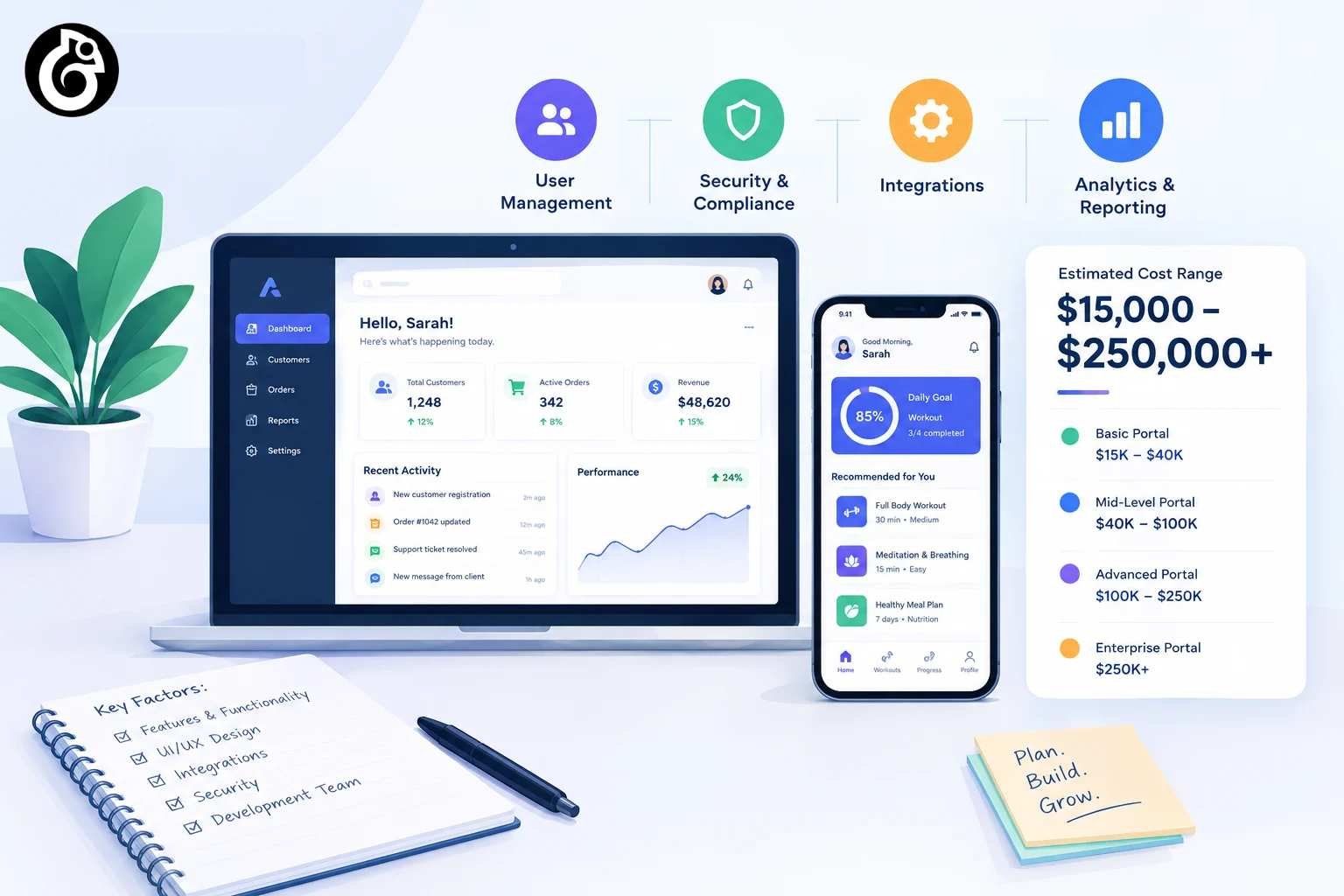
The cost of developing a custom portal is primarily determined by the scope of the project. A portal with basic authentication and document access requires fewer resources than an enterprise platform with advanced analytics, multiple user roles, real-time integrations, and complex automation.
The following estimates can be used as initial planning benchmarks. They are illustrative development budgets rather than fixed quotations, and actual costs will depend on the selected development partner, location, scope, and project requirements.
Portal complexity |
Estimated cost |
Typical timeline |
|---|---|---|
| Basic portal | $15,000–$40,000 | 6–10 weeks |
| Mid-level portal | $40,000–$100,000 | 10–18 weeks |
| Advanced portal | $100,000–$250,000 | 4–8 months |
| Enterprise portal | $250,000+ | 6–12+ months |
These timelines represent indicative planning ranges. Larger projects may require phased releases, additional discovery, security reviews, or complex integration work.
1. Basic Custom Web Portal: $15,000–$40,000
A basic portal is generally designed for businesses that need a centralized platform with a limited set of features.
Typical functionality may include:
- User registration and login
- Basic role-based access
- User dashboards
- Document uploads and downloads
- Profile management
- Contact or support forms
- Basic administrative controls
- Responsive interface design
For example, a small consulting business may require a client portal through which documents can be shared, project information can be accessed, and service requests can be submitted. Because the functionality is relatively limited, a smaller development team and a shorter delivery schedule may be sufficient.
2. Mid-Level Custom Portal: $40,000–$100,000
A mid-level portal is generally suitable for businesses that require more advanced workflows, additional user roles, and connections with existing business systems.
Potential features include:
- Advanced dashboards
- Multiple user roles and permissions
- Search, filtering, and reporting
- Workflow automation
- CRM or payment integrations
- Notifications and messaging
- Advanced document management
- User activity tracking
- Expanded administrative tools
For example, a B2B company may require a partner portal that allows distributors to manage orders, access product information, monitor order status, and communicate with internal teams. The additional workflows and integrations increase the effort required for development, testing, and deployment.
3. Advanced Custom Web Portal: $100,000–$250,000
An advanced portal is typically designed for businesses with more complex operational requirements. These platforms may involve extensive business logic, multiple external integrations, sophisticated reporting, and customized workflows.
Common capabilities include:
- Multi-step approval processes
- Advanced reporting and analytics
- Integration with ERP, CRM, and financial systems
- Automated notifications and business rules
- Multiple departments or business units
- Complex access permissions
- Enhanced security controls
- Large-scale data processing
- Performance optimization
For example, a logistics company may require a portal that connects customers, suppliers, warehouse teams, and delivery partners through a single platform. The complexity of connecting these users and systems can significantly affect both the development budget and delivery timeline.
4. Enterprise Portal Development: $250,000+
Enterprise portals are designed to support large organizations, multiple business units, extensive data requirements, and complex operational workflows.
Such platforms may include:
- Multi-tenant architecture
- Enterprise single sign-on
- Advanced identity and access management
- Integration with multiple legacy systems
- Custom analytics and reporting
- High-availability infrastructure
- Advanced auditing and monitoring
- Complex workflow orchestration
- Extensive security and compliance requirements
- Distributed deployment environments
The cost of enterprise development depends heavily on the number of systems involved, the scale of expected usage, and the reliability requirements. In these projects, development is often delivered in phases so that core capabilities can be introduced before additional modules are implemented.
Key Factors That Affect Custom Portal Development Cost
Several factors influence the final cost of custom web portal development services. Understanding these variables early can help businesses avoid unnecessary expenses and prioritize the features that provide the greatest value.
1. Portal Type and Business Requirements
The purpose of the portal has a direct impact on the development effort. A basic customer portal may require account management, document access, and support forms. A vendor portal may require procurement workflows, purchase order management, invoice processing, and supplier approvals.
Similarly, a custom CRM web portal may require customer profiles, sales pipelines, communication histories, lead management, and reporting dashboards. Each additional business workflow introduces design, development, testing, and maintenance requirements.
Before development begins, business processes should be documented and reviewed so that the required functionality can be distinguished from optional enhancements.
2. UI/UX Design and Custom Portal Design
The user interface affects how easily people can navigate the portal and complete important tasks. Custom portal design typically includes user research, information architecture, wireframes, visual design, interactive prototypes, and usability considerations.
A straightforward portal may require a relatively small number of screens and reusable components. A complex enterprise platform may need separate interfaces for administrators, customers, employees, partners, and other user groups.
The following elements can influence design costs:
- Number of screens and user journeys
- Dashboard complexity
- Design system requirements
- Interactive components
- Responsive layouts
- Accessibility considerations
- Prototype development
- Usability testing
A consistent design system can help control long-term costs by reducing duplicated work and supporting future improvements. However, design should not be treated as a purely visual activity. The underlying user experience must be aligned with actual workflows and user expectations.
3. Feature Complexity
The number and complexity of features are among the most important cost drivers. Basic functionality such as login forms, profile settings, and document downloads is generally easier to implement than advanced automation, real-time collaboration, or predictive analytics.
For example, a standard reporting dashboard may display information retrieved from a database. An advanced analytics dashboard may require data processing, custom calculations, interactive visualizations, and connections to multiple systems.
The same distinction applies to workflow automation. A simple notification can be implemented relatively quickly, while a multi-stage approval system involving different departments may require extensive business logic. For better budget control, features should be divided into essential, important, and optional categories before development begins.
4. Third-Party Integrations
Portals often need to exchange data with existing business applications.
Common integrations include:
- Customer relationship management systems
- Enterprise resource planning platforms
- Payment gateways
- Accounting software
- Email and SMS services
- Cloud storage
- Identity providers
- Analytics platforms
- Inventory and order management systems
Integration costs depend on API availability, documentation quality, authentication requirements, data mapping, and the complexity of the business workflows involved. A well-documented API may be relatively straightforward to connect. A legacy application with limited integration support may require custom middleware, additional testing, or changes to the existing infrastructure. External licensing fees and usage-based charges should also be included in the project budget where applicable.
5. Backend Architecture and Database Design
The backend is responsible for managing application logic, user permissions, data processing, and communication between system components. A basic portal may use a straightforward architecture with a limited number of data entities. A larger portal may require more complex database relationships, background processing, caching, search functionality, and integration services.
The architecture should be selected according to actual requirements rather than anticipated complexity alone. Overengineering can increase initial costs and maintenance effort. An architecture that is too limited, however, may create expensive performance and scalability problems later. A balanced technical approach helps support both current needs and realistic future growth.
6. Security and Data Protection
Security requirements can have a significant effect on development costs, particularly when sensitive customer, financial, employee, or business information is handled.
Depending on the use case, security measures may include:
- Secure authentication
- Role-based access control
- Encryption in transit and at rest
- Multi-factor authentication
- Audit logs
- Session management
- Secure file handling
- Vulnerability testing
- Backup and recovery procedures
- Monitoring and incident response planning
Organizations operating in regulated industries may also need additional safeguards, documentation, risk assessments, and compliance-related reviews. Security should be incorporated throughout development rather than added only after the application has been completed.
7. Scalability and Expected Traffic
A portal designed for a few hundred users may have different infrastructure requirements from one expected to serve tens of thousands of users. Expected traffic, concurrent sessions, file storage, database activity, and background processing all influence architecture and infrastructure decisions.
Scalability-related costs may include:
- Cloud infrastructure
- Load balancing
- Database optimization
- Caching
- Automated deployment pipelines
- Monitoring and alerting
- Performance testing
- High-availability configurations
The infrastructure should be planned around realistic usage forecasts, with room for growth where appropriate.
8. Development Team and Location
Development rates vary according to the provider’s location, expertise, delivery model, and level of project involvement. A project may require a business analyst, UI/UX designer, frontend developer, backend developer, QA engineer, project manager, and security specialist.
Not every project needs all these roles full-time. The team structure should be adapted to the complexity of the portal and the stage of development. When comparing proposals, businesses should evaluate the scope of work, team experience, communication processes, testing practices, and post-launch support rather than relying on hourly rates alone.
Custom Portal Development Cost Breakdown
The total budget can be divided into several development activities. The following percentages are illustrative planning allocations and will vary by project.
Development activity |
Indicative budget allocation |
|---|---|
| Discovery and requirements | 5%–10% |
| UI/UX design | 10%–15% |
| Frontend development | 15%–25% |
| Backend development | 25%–35% |
| Integrations | 10%–20% |
| Quality assurance and security testing | 10%–15% |
| Deployment and launch preparation | 5%–10% |
These ranges are not intended to add up to a fixed total because allocations overlap and vary according to project scope. For example, a portal with extensive integrations may require a larger backend and integration budget, while a product with many unique user journeys may require additional design and frontend work.
Discovery and Requirements Analysis
During discovery, business objectives, user roles, workflows, integrations, and technical requirements are identified. The resulting documentation may include a feature list, project roadmap, technical recommendations, and initial budget estimate. This stage helps prevent misunderstandings and reduces the risk of expensive changes later.
UI/UX Design
Design work translates business requirements into user flows, wireframes, interface concepts, and high-fidelity screens. The effort depends on the number of screens, user types, design complexity, and amount of prototype testing required.
Frontend Development
The frontend is the part of the portal users interact with directly. It includes navigation, forms, dashboards, responsive layouts, interactive elements, and connections to backend services.
Backend Development
Backend development covers application logic, databases, authentication, permissions, APIs, workflow rules, and data processing. For feature-rich portals, this stage can account for a substantial share of the total budget.
Testing and Deployment
Testing is performed to identify functional issues, usability problems, security weaknesses, and performance limitations. Deployment includes environment configuration, production preparation, data migration where required, and launch coordination.
How Much Does Different Portal Functionality Cost?
The following figures are illustrative incremental planning estimates for individual feature groups. They are not fixed market prices, and the amounts should not simply be added together because features may share underlying infrastructure.
Feature or module |
Indicative cost range |
|---|---|
| User authentication and profiles | $2,000–$8,000 |
| Role-based access management | $3,000–$12,000 |
| Custom dashboard and reporting | $5,000–$20,000 |
| Document management | $3,000–$15,000 |
| Notifications and messaging | $2,000–$10,000 |
| Third-party API integration | $3,000–$20,000+ |
| Advanced workflow automation | $8,000–$30,000+ |
| Advanced analytics | $10,000–$35,000+ |
The actual cost depends on the number of user roles, data sources, business rules, and edge cases involved. For example, a basic dashboard displaying a few database fields will cost less than one that combines data from multiple enterprise systems and supports custom reporting. A discovery phase is recommended before using these figures to establish a formal project budget.
Custom CRM Web Portal Development Cost
A custom CRM web portal is designed to centralize customer information, sales activities, communication histories, and business processes. The cost depends on whether the portal is being developed as a lightweight customer management solution or a comprehensive CRM platform.
A basic CRM portal may include:
- Customer and contact records
- Lead management
- Sales pipeline tracking
- Notes and communication histories
- Task reminders
- Basic reports
An advanced solution may also include:
- Automated lead assignment
- Sales forecasting
- Custom approval workflows
- Marketing automation integrations
- Advanced permissions
- Customer segmentation
- Multi-department dashboards
- Data synchronization with other systems
A CRM portal with limited functionality may fit within a basic or mid-level development budget. A complex CRM platform with extensive automation and integrations may require a substantially larger investment. The decision should be based on the processes that need to be supported, the limitations of existing tools, and the expected return from customization.
Custom Portal Development Cost by Business Use Case
Different industries require different functionality, which means development costs should be evaluated in relation to the intended use case.
Customer Self-Service Portal
A customer self-service portal may allow users to update account information, access invoices, track requests, and find relevant resources. Costs are influenced by authentication, account data integration, document access, support workflows, and notification requirements.
Employee Portal
An employee portal may provide access to HR resources, internal announcements, company documents, leave requests, and workplace services. Integration with HR systems, employee directories, identity providers, and internal approval processes can affect the total cost.
B2B Partner Portal
A partner portal may support product catalogs, orders, pricing, inventory visibility, sales resources, and partner communications. Complex pricing rules, ERP integration, account-specific permissions, and order processing can increase development effort.
Vendor and Supplier Portal
A vendor portal may be used for onboarding, procurement, purchase orders, invoices, and supplier performance reporting. Workflow complexity, financial system integration, document validation, and audit requirements should be considered during estimation.
Healthcare or Financial Services Portal
Portals used in healthcare or financial services may require more rigorous access controls, data protection, auditing, and compliance-related processes. The cost depends on the applicable regulatory requirements, the sensitivity of the data, and the level of assurance required. Compliance should be assessed against the specific organization and use case rather than assumed from the presence of security features alone.
Custom Portal Development vs. Off-the-Shelf Software
Before investing in a custom portal, businesses should evaluate whether an existing platform can meet their requirements.
Consideration |
Custom portal |
Off-the-shelf solution |
|---|---|---|
| Initial investment | Usually higher | Often lower |
| Custom functionality | Designed around business needs | Limited by platform capabilities |
| Time to launch | Depends on development scope | Often faster |
| Integrations | Can be tailored | Depends on available connectors |
| Ownership and control | Greater control over implementation | Governed by vendor and licensing terms |
| Maintenance | Requires an ongoing plan | May be partly managed by the vendor |
| Long-term flexibility | Can be extended as required | Constrained by product roadmap and configuration options |
Off-the-shelf software may be a suitable choice when standard functionality meets the business requirements. Custom portal development becomes more attractive when the business needs specialized workflows, differentiated customer experiences, extensive integrations, or greater control over future product development.
The total cost of ownership should be evaluated over several years rather than comparing initial implementation costs alone.
Hidden Costs to Consider in 2026
The initial development quotation may not include every expense associated with operating a portal. A realistic budget should account for the following areas.
Hosting and Infrastructure
Cloud hosting, databases, storage, bandwidth, monitoring, and backup services may introduce recurring costs. Infrastructure requirements will depend on usage, architecture, and availability needs.
Third-Party Licensing
External services may charge subscription fees, API usage fees, transaction fees, or per-user licensing costs.
Maintenance and Updates
Security patches, dependency updates, bug fixes, compatibility changes, and routine improvements are required throughout the portal’s lifecycle.
Data Migration
Moving existing customer records, documents, and operational data into a new system may require mapping, cleanup, validation, and migration testing.
Staff Training and Documentation
Employees and administrators may need onboarding, operating documentation, and training to use the portal effectively.
Ongoing Security and Compliance
Periodic security assessments, monitoring, access reviews, and compliance-related activities may be necessary depending on the application.
Future Enhancements
Additional modules, new integrations, changing business processes, and increased user demand may create future development expenses.
As a preliminary planning measure, some businesses reserve approximately 15%–25% of the initial development cost annually for maintenance and improvements. This is only a budgeting guideline, not a universal rule. Actual spending may be lower or higher depending on the service agreement, system complexity, infrastructure, and rate of change.
How to Reduce Custom Portal Development Costs
Cost optimization should focus on reducing unnecessary complexity without compromising essential security, usability, or reliability.
1. Start With an MVP
A minimum viable product (MVP) includes the smallest practical set of features needed to address the primary business requirement. Instead of launching with every planned feature, the first release may focus on authentication, core workflows, essential dashboards, and critical integrations. Additional functionality can be introduced after user feedback and operational requirements have been evaluated.
2. Define Requirements Clearly
Unclear requirements can lead to repeated revisions, scope changes, and delays. Business workflows, user permissions, acceptance criteria, and integration needs should be documented before full development begins. A clearly defined scope makes it easier to compare proposals and evaluate progress.
3. Prioritize Features by Business Value
Features should be evaluated according to their expected benefit, implementation effort, and operational importance. A complex analytics module may be postponed if a simpler report provides sufficient value for the first release. This approach helps direct resources toward the functionality that matters most.
4. Use Reusable Components
Reusable UI components, established development frameworks, and proven architecture patterns can reduce duplicated work.However, reuse should be balanced with the need for customization and maintainability.
5. Select Integrations Carefully
Every integration adds implementation and maintenance considerations. Existing systems should be reviewed to determine which integrations are essential for the initial launch and which can be introduced later.
6. Plan for Scalability Without Overengineering
The system should support realistic growth expectations without unnecessary architectural complexity. A modular approach can allow functionality to be expanded as requirements evolve.
7. Include Testing From the Beginning
Early testing can help identify issues before they become expensive to resolve. Requirements reviews, automated tests, usability evaluations, and integration testing should be included throughout the project.
8. Compare Development Proposals Beyond Price
A lower quotation may exclude important activities such as discovery, security testing, deployment, documentation, or post-launch support. Proposals should be evaluated according to deliverables, technical approach, team expertise, ownership terms, communication, and support arrangements.
How to Choose the Right Custom Portal Development Partner
The development partner can influence the quality, delivery timeline, and long-term cost of the portal. When evaluating custom web development services, consider the following factors.
Relevant experience: Look for demonstrated experience with similar portals, workflows, integrations, and user requirements.
Technical capabilities: Evaluate the team’s ability to design the frontend, backend, database, API architecture, and deployment environment.
Design expertise: Review whether the provider can deliver user-focused design and development services rather than treating UI design as a separate visual exercise.
Security practices: Ask how authentication, access control, testing, data protection, and ongoing maintenance will be addressed.
Project transparency: Confirm that deliverables, milestones, assumptions, dependencies, and change requests will be documented.
Post-launch support: Establish who will manage updates, bug fixes, infrastructure, and future enhancements after deployment.
Code and intellectual property ownership: Clarify access to source code, repositories, design files, documentation, and third-party dependencies.
Why Beadaptify for Custom Portal Development?
Choosing the right development partner is an important step toward building a portal that supports business operations and long-term growth. At Beadaptify, custom software solutions are approached with attention to business requirements, user experience, technical architecture, and future scalability.
Our design & development services can support businesses looking to create customer portals, partner platforms, employee portals, and custom CRM web portal solutions.
The development process can be structured around key project stages, including:
- Requirements analysis and project planning
- UI/UX design and custom portal design
- Frontend and backend development
- API and third-party integrations
- Testing and quality assurance
- Deployment and ongoing improvements
By aligning functionality with actual business needs, the goal is to avoid unnecessary complexity while creating a practical foundation for future enhancements. Whether you are planning a new digital portal or modernizing an existing application, the appropriate development approach should be selected according to your workflows, users, integrations, and budget.
Final Thoughts
The cost of custom portal development in 2026 depends on the functionality, complexity, security requirements, integrations, and long-term objectives of the project. A basic portal may require an investment of approximately $15,000–$40,000, while more advanced platforms can cost $100,000–$250,000 or more. Enterprise solutions may require larger budgets when extensive integrations, advanced security, and high-availability infrastructure are involved.
The most effective approach begins with clearly defined requirements, a realistic budget, and a prioritized feature roadmap. By starting with essential functionality, selecting appropriate technologies, and working with an experienced development partner, businesses can build a portal that addresses current needs while allowing for future growth.

FAQs About Custom Portal Development Cost
What factors affect custom web portal development costs the most?
The most significant factors include feature complexity, UI/UX design, backend architecture, third-party integrations, security requirements, scalability, and the size and expertise of the development team.
Is custom portal development better than using an existing platform?
Custom development may be more suitable when specialized workflows, unique integrations, or greater control are required. An existing platform may be more cost-effective when its standard features meet the business requirements.
What is included in custom web portal development services?
Depending on the provider and project scope, services may include requirements analysis, UI/UX design, frontend and backend development, database design, API integrations, testing, deployment, documentation, and ongoing maintenance.
What is the difference between a website and a web portal?
A website generally presents information to visitors, while a web portal provides authenticated users with personalized information, dashboards, tools, and interactive functionality. Some websites also include portal features, so the distinction depends on the intended user experience.
How can custom portal development costs be reduced?
Costs can be managed by starting with an MVP, prioritizing essential features, defining requirements clearly, using reusable components, selecting integrations carefully, and avoiding unnecessary architectural complexity.