Generative AI has been widely adopted for creating content, generating images, summarizing documents, answering questions, and assisting with creative tasks. Agentic AI, on the other hand, has been developed to handle more complex objectives through planning, reasoning, decision-making, and autonomous task execution. Instead of simply generating a response, an AI agent can be designed to perform a sequence of actions using connected tools, APIs, and business systems.
As organizations explore new opportunities for automation and digital transformation, an important question is being raised: Agentic AI vs. Generative AI: Which technology should businesses choose?
The answer depends on business objectives, operational requirements, application complexity, and the level of automation expected. Both technologies can provide significant value, and in many cases, they can be combined to develop intelligent business applications.
In this guide, the differences between Agentic AI and Generative AI, their benefits, practical business applications, implementation challenges, and future opportunities will be explored.
What Is Generative AI?
Generative AI refers to artificial intelligence systems that are designed to create new content based on patterns learned from training data. Text, images, audio, video, code, and other forms of digital content can be generated through these systems.
Large Language Models (LLMs), such as GPT-based models, are commonly used for generating human-like text, answering questions, summarizing information, and assisting with programming tasks. Image-generation models are used to produce visual content, while other generative models can be applied to audio and video creation.
Unlike conventional AI systems that are primarily used to classify information or make predictions, Generative AI is focused on producing new outputs based on the instructions and context provided.
For example, a business employee may request that an AI tool generate a customer email, summarize a lengthy report, prepare a product description, or explain a technical document. The requested content can then be generated within seconds.
How Does Generative AI Work?
Generative AI is generally powered by machine learning models that have been trained on large datasets. During training, patterns, relationships, language structures, and contextual information are learned. When a user submits a prompt, the model processes the available context and generates an output based on its learned patterns.
The process can generally be explained through the following stages:
- Data Training: Large datasets are used to train the AI model and identify patterns within the information.
- Prompt Processing: User instructions are received and interpreted to understand the requested task.
- Context Understanding: Relevant information is processed to determine the context of the request.
- Content Generation: An output is generated based on the model’s learned patterns and the provided instructions.
- Output Review: The generated response can be reviewed, refined, or corrected before being used.
For business applications, Generative AI can also be connected with company documents, databases, and knowledge repositories through techniques such as Retrieval-Augmented Generation (RAG).
However, the quality of the generated output can be influenced by the accuracy of the source information, prompt quality, model capabilities, and available context. Human review may therefore be required, particularly when sensitive business decisions or customer-facing information is involved.
What Is Agentic AI?
Agentic AI refers to AI systems that are designed to pursue specific goals by planning tasks, selecting actions, interacting with external tools, and evaluating results. Unlike a basic generative application that primarily responds to individual prompts, an AI agent can be assigned a broader objective. The required steps can then be identified and executed through connected systems, subject to the permissions and controls established for the application.
For example, when a customer support request is received, a traditional Generative AI chatbot may be used to draft a response. An Agentic AI system could be designed to identify the customer’s issue, retrieve relevant account information, check an order status, initiate an approved action, and prepare a response.
This capability makes Agentic AI particularly useful for business process automation, multi-step workflows, enterprise operations, and applications that require interactions across multiple systems.
How Does Agentic AI Work?
Agentic AI systems are typically developed using AI models, orchestration frameworks, memory systems, APIs, and external tools. A generative model may be used to interpret instructions and support reasoning, while additional components are used to execute tasks.
The workflow can generally be divided into the following stages:
- Goal Identification: A business objective or user request is received and interpreted.
- Planning: The required steps are identified and organized into a practical sequence.
- Reasoning: Available information is evaluated, and suitable actions are selected.
- Tool Selection: Relevant APIs, databases, applications, or external services are identified.
- Task Execution: Approved actions are performed through connected tools and systems.
- Result Evaluation: The outcome is checked to determine whether the objective has been achieved.
- Continuous Adjustment: When an unexpected result is received, the next action may be modified or additional information may be requested.
Depending on the application, multiple agents can also be coordinated to complete larger workflows. This approach is commonly referred to as a multi-agent AI system.
However, greater autonomy does not mean unrestricted access. Appropriate permissions, approval mechanisms, monitoring, and security controls should be established before actions are allowed to affect business systems.
Core Adoption & Market Stats
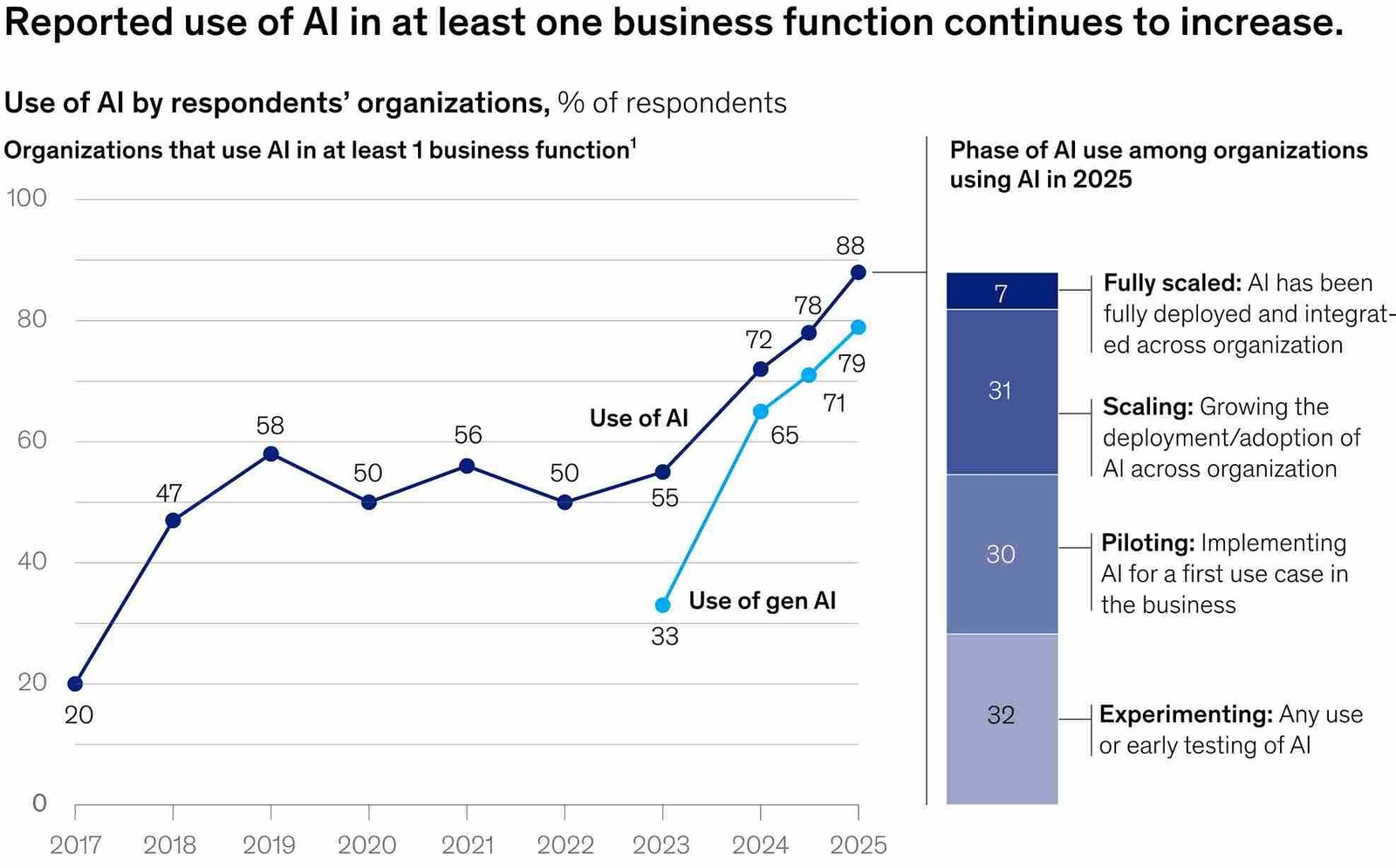
The adoption of artificial intelligence is accelerating across industries, with businesses increasingly exploring both Generative AI and Agentic AI capabilities. According to McKinsey’s 2026 State of AI report, 40% of respondents from large organizations reported scaling AI agents, compared with 27% in the previous year.
Additionally, 80% of respondents reported improvements in individual productivity through AI, while 50% said it helped them make better decisions. These findings highlight how AI is moving beyond content generation and becoming an important part of business automation, workflow management, and enterprise decision-making.
Agentic AI vs. Generative AI: Key Differences
Although Agentic AI and Generative AI can use similar underlying models, their primary objectives and operational capabilities are different. Generative AI is mainly focused on producing content and responses, whereas Agentic AI is focused on achieving goals through a sequence of actions.
The following comparison highlights the major differences.
Comparison Factor |
Generative AI |
Agentic AI |
|---|---|---|
| Primary Purpose | Content and information generation | Goal-oriented task execution |
| Main Function | Generates text, images, code, and other content | Plans, reasons, and performs actions |
| User Interaction | Usually prompt-driven | Can operate through multi-step workflows |
| Decision-Making | Produces responses based on context and learned patterns | Selects actions based on objectives and available information |
| Autonomy | Generally limited to individual interactions unless extended | Can execute approved tasks with greater autonomy |
| Tool Usage | Can use connected tools when enabled | Frequently depends on APIs and external tools |
| Memory | Often relies on conversation context or connected memory | Can use task-specific or persistent memory |
| Business Applications | Content creation, summarization, chatbots, and coding assistance | Workflow automation, research, coordination, and process execution |
| Complexity | Varies according to the model and application | Often higher because of orchestration and execution requirements |
| Human Oversight | Outputs may require review | Actions and decisions may require approval and monitoring |
1. Content Generation vs. Task Execution
The most noticeable difference can be found in the way both technologies are used. Generative AI is primarily used to create content based on instructions. Reports, emails, product descriptions, marketing materials, summaries, and code can be generated without requiring users to complete every step manually.
Agentic AI is designed to move beyond content generation. Tasks can be planned, assigned, executed, and evaluated through connected applications. For example, a marketing team may use Generative AI to prepare a campaign draft. An Agentic AI workflow could be designed to organize campaign assets, check approval status, schedule approved content, and generate performance summaries.
2. Reactive Responses vs. Goal-Oriented Workflows
Generative AI is commonly used in response to user prompts. A question is submitted, and an answer is generated. Agentic AI can be assigned a broader objective, after which a sequence of actions can be determined. The workflow may be adjusted when new information is received or an unexpected condition is encountered. This makes Agentic AI more suitable for processes that require multiple steps and interactions across business applications.
3. Limited Interaction vs. Connected Systems
Generative AI can be integrated into websites, mobile applications, chatbots, and productivity tools. Agentic AI generally requires a broader integration architecture because actions must be performed through APIs, databases, enterprise software applications, and other connected services. For example, an AI agent used in a CRM platform may be connected with customer records, communication tools, scheduling systems, and sales workflows.
4. Output Generation vs. Operational Automation
Generative AI can reduce the time required to produce information and creative assets. Agentic AI can be used to automate selected operational processes.
Both can improve productivity, but their business contributions are measured differently. Content quality, response accuracy, and time saved may be measured for Generative AI, while task completion rates, workflow efficiency, error reduction, and operational savings may be evaluated for Agentic AI.
Business Applications of Generative AI
Generative AI can be used across different departments because content creation and information processing are required in many business activities.
Some of the most common applications include:
1. Content Creation and Marketing
Marketing teams can use Generative AI to prepare blog outlines, social media posts, product descriptions, email campaigns, advertisements, and other promotional materials. Content variations can also be generated for different audiences and platforms. This can reduce the time spent on repetitive content production while allowing creative teams to focus on strategy and quality.
2. Customer Support Chatbots
AI-powered chatbots can be integrated into websites and applications to answer frequently asked questions, explain products, and provide basic customer assistance. Responses can be generated using relevant business information, allowing customer queries to be handled more efficiently. For complex or sensitive requests, human support can still be provided.
3. Software Development Assistance
Generative AI can support developers by generating code suggestions, explaining technical concepts, creating documentation, identifying potential issues, and assisting with test-case preparation. When properly reviewed, these capabilities can improve developer productivity and reduce time spent on routine programming activities.
4. Document Processing and Summarization
Long reports, contracts, internal documents, and research materials can be summarized through Generative AI applications. Important information can be extracted and presented in a more accessible format, allowing employees to review large volumes of information more efficiently.
5. Personalized Recommendations
Generative AI can be used to create personalized product suggestions, learning content, marketing messages, and customer communication. When combined with relevant customer data and recommendation systems, more contextual experiences can be delivered.
Business Applications of Agentic AI
Agentic AI can be particularly valuable when business processes involve multiple steps, applications, and decisions. The following use cases demonstrate how AI agents can be introduced into business operations.
1. Automated Customer Support Workflows
AI agents can be integrated with customer support platforms to handle selected service workflows. For example, an agent may be assigned to identify a customer’s issue, retrieve relevant account information, check order details, and prepare a suitable response. Approved actions may also be initiated through connected systems. More complex cases can be transferred to human support representatives.
2. Sales and CRM Automation
Sales teams often spend considerable time updating CRM records, preparing follow-ups, tracking leads, and organizing customer information. Agentic AI can be used to automate selected activities by connecting CRM systems with email platforms, calendars, and internal databases. For example, a sales agent could identify a new lead, retrieve available information, prepare a personalized follow-up draft, and update the relevant CRM record after approval.
3. Enterprise Workflow Automation
Large organizations frequently depend on processes that involve several departments and software platforms. AI agents can be designed to coordinate selected activities across these systems. Invoice processing, employee onboarding, document verification, approval workflows, and internal request management can be partially automated. The level of automation should be determined by the business risk and the permissions granted to each agent.
4. Data Research and Analysis
Agentic AI can be used to collect information from approved sources, organize findings, compare available data, and prepare research summaries. For example, a business research agent could be assigned to collect market information, identify relevant trends, and prepare a structured report for review. This can reduce manual research effort while allowing employees to focus on interpretation and strategic decisions.
5. IT Operations and Monitoring
AI agents can be integrated with IT monitoring platforms to identify alerts, collect diagnostic information, categorize incidents, and recommend corrective actions. For approved low-risk activities, selected responses may also be automated. Critical system changes should remain subject to appropriate approval and operational controls.
Benefits of Generative AI for Businesses
Generative AI can create business value by making information easier to produce, understand, and distribute.
Some important benefits include:
- Improved Productivity: Routine writing, summarization, and content preparation can be completed more quickly.
- Faster Content Development: Marketing and communication materials can be generated with less manual effort.
- Better Information Accessibility: Large volumes of information can be summarized and presented in understandable formats.
- Developer Assistance: Code suggestions, documentation, and testing support can be provided to development teams.
- Personalized Experiences: Customer communication and recommendations can be adapted to individual preferences.
- Creative Support: New ideas, concepts, and content variations can be explored more efficiently.
However, generated information should not automatically be treated as accurate. Review procedures should be maintained to identify incorrect, incomplete, or misleading outputs.
Benefits of Agentic AI for Businesses
Agentic AI can support a different category of business improvements because tasks can be completed through coordinated actions rather than being limited to content generation.
1. Reduced Manual Work
Repetitive activities can be automated through agents connected to business systems. Employees can therefore spend more time on strategic, creative, and customer-focused responsibilities.
2. Improved Workflow Efficiency
Multi-step business processes can be coordinated through AI agents. Information can be retrieved, tasks can be assigned, and workflow updates can be completed through connected applications.
3. Faster Operational Responses
When suitable permissions and integrations are available, selected tasks can be completed without waiting for every step to be performed manually.
4. Better System Connectivity
Multiple business applications can be connected through an agentic architecture. This can reduce the need for employees to switch between different platforms to complete routine activities.
5. Scalable Automation
Additional agents and workflows can be introduced as business requirements expand. This can allow automation capabilities to be extended across departments without requiring every process to be redesigned from the beginning.
6. Improved Decision Support
Relevant information can be collected and organized before recommendations are presented to employees. Decisions can therefore be supported with more accessible and contextual information.
Limitations and Challenges of Agentic AI and Generative AI
Although both technologies offer valuable opportunities, their implementation can introduce technical, operational, and security challenges.
1. Accuracy and Reliability
Generative AI can produce incorrect information or hallucinated responses. Agentic AI can also make unsuitable decisions if inaccurate information is processed or an incorrect action is selected. Output validation, testing, and human review should therefore be included in the implementation process.
2. Data Privacy and Security
Both technologies may process sensitive business information. Customer records, financial information, internal documents, and proprietary data should be protected through appropriate access controls and encryption. For Agentic AI, additional safeguards are required because connected tools may allow actions to be performed within business systems.
3. Integration Complexity
Generative AI can often be introduced through relatively simple application integrations. Agentic AI generally requires additional components, including orchestration, APIs, permissions, memory, monitoring, and error-handling mechanisms. Legacy systems can create further integration challenges when suitable APIs or documentation are unavailable.
4. Development and Maintenance Costs
The cost of implementation can vary according to model selection, data infrastructure, integration requirements, application complexity, and ongoing maintenance. Agentic AI solutions may require a larger engineering effort when multiple agents, tools, and workflows are involved.
5. Governance and Human Oversight
Unrestricted autonomy should not be assumed to be appropriate for every business process. Approval mechanisms should be established for financial transactions, sensitive data changes, customer commitments, and other high-impact activities. Clear responsibility should also be assigned for monitoring system performance.
6. Employee Adoption
Employees may need training before new AI-powered workflows can be adopted successfully. Interfaces should be designed to make AI capabilities understandable, accessible, and easy to use.
Agentic AI vs. Generative AI: Which Should Businesses Choose?
The right technology should be selected according to the business problem being addressed. Generative AI may be the more suitable option when content creation, information processing, communication, and knowledge assistance are the main priorities. Agentic AI may be more appropriate when tasks need to be planned, coordinated, and executed across connected business applications.
The following scenarios can be used as a starting point:
Business Requirement |
Recommended Approach |
|---|---|
| Generating marketing content | Generative AI |
| Summarizing business reports | Generative AI |
| Creating code suggestions | Generative AI |
| Answering common customer questions | Generative AI |
| Automating multi-step customer support workflows | Agentic AI |
| Coordinating CRM activities | Agentic AI |
| Managing approved business workflows | Agentic AI |
| Collecting and organizing information from multiple systems | Agentic AI |
| Producing content and automatically managing selected workflows | Combined approach |
For businesses entering AI adoption for the first time, a focused Generative AI application may provide a simpler starting point. When measurable opportunities for workflow automation have been identified, Agentic AI can be introduced in a controlled manner. The technologies should not be viewed as competitors. Their capabilities can be combined according to the product requirements.
Can Agentic AI and Generative AI Work Together?
Yes. In fact, Generative AI can serve as an important component within an Agentic AI system. An LLM can be used to interpret instructions, understand context, generate plans, and support reasoning. The agentic framework can then be used to select tools, execute actions, retrieve information, and evaluate results. For example, an enterprise application may include an AI agent designed to process customer requests.
The Generative AI model can be used to understand the customer’s message and prepare an appropriate response. The agent can then retrieve customer information, check the status of an order, interact with the CRM, and initiate an approved workflow. This combination can be used to create more comprehensive AI-powered business applications. A similar approach can be followed in healthcare, finance, retail, logistics, SaaS, and other industries where information processing and multi-step operations are required.
However, the architecture should be carefully designed so that the AI model, agent orchestration layer, external tools, and business systems operate within clearly defined permissions.
How Businesses Can Implement Agentic AI and Generative AI
A successful implementation should be guided by business requirements rather than by technology adoption alone. The following steps can be followed when an AI-powered solution is being planned.
1. Identify Business Objectives
The specific problem to be addressed should be defined first. Content generation, customer assistance, document processing, workflow automation, and decision support may require different AI approaches.
2. Evaluate Existing Software Infrastructure
Existing applications, databases, APIs, and business processes should be analyzed before an AI solution is selected. This evaluation can help identify integration opportunities and technical limitations.
3. Select the Appropriate AI Technology
The choice between Generative AI, Agentic AI, or a combined approach should be made according to the required functionality.
4. Design the Technical Architecture
The required models, APIs, data sources, security controls, orchestration components, and monitoring systems should be identified.
5. Develop a Prototype or MVP
A limited version of the solution can be developed to validate the business concept. This approach can help identify technical issues and gather user feedback before larger investments are made.
6. Integrate Business Systems
AI capabilities can be connected with existing applications through APIs, databases, and other approved integration methods.
7. Implement Security and Governance
Authentication, role-based permissions, encryption, audit trails, human approval, and data access restrictions should be incorporated.
8. Test and Monitor Performance
The solution should be evaluated using realistic business scenarios. Accuracy, response quality, task completion, security, reliability, and operational impact should be measured continuously.
9. Expand Gradually
Once the initial implementation has been validated, additional features, agents, integrations, and workflows can be introduced in phases.
How Beadaptify Can Help Businesses Build AI-Powered Solutions
The successful adoption of Generative AI and Agentic AI requires more than selecting an AI model. Business requirements, technical architecture, software integrations, security, user experience, and scalability must be considered throughout the development process. Beadaptify can support businesses in planning and developing AI-powered applications that are aligned with their operational requirements and long-term product objectives.
Through design & development services, the complete application experience can be planned around user needs, business workflows, and technical requirements. Interfaces can be designed to make AI interactions intuitive, while backend systems and integrations can be developed to support reliable functionality.
Depending on the project scope, development support can include:
- AI-powered application planning and architecture
- Generative AI and LLM integration
- AI agent development and workflow automation
- API and third-party system integrations
- Business data and knowledge integration
- Custom web and mobile application development
- Security and access-control implementation
- AI application testing and performance monitoring
- Scalable backend architecture and deployment
For businesses that want to validate an AI product before committing to a larger development investment, MVP development services can be used to build a focused initial version. A specific business use case can be selected, essential AI capabilities can be introduced, and the solution can be tested with real users. Once the concept has been validated, additional features and automation workflows can be introduced. Whether Generative AI, Agentic AI, or a combination of both is selected, the development approach should remain focused on measurable business outcomes.
Future of Agentic AI and Generative AI in Business
The future of artificial intelligence is expected to be shaped by increasingly connected and intelligent systems. Generative AI capabilities are likely to become more deeply integrated into business software, allowing information to be created, summarized, and interpreted within existing workflows.
At the same time, Agentic AI is expected to support more complex operational processes through coordinated agents, connected tools, and improved reasoning capabilities. Several developments are likely to influence enterprise adoption:
More Intelligent Enterprise Applications
AI capabilities may increasingly be embedded into CRM, ERP, HR, finance, healthcare, and project management applications.
Growth of Multi-Agent Systems
Multiple specialized agents may be coordinated to complete complex business processes. Individual agents could be assigned specific responsibilities, while a central orchestration layer manages the overall workflow.
Greater Personalization
AI-powered applications may provide more contextual recommendations and assistance based on user preferences, business data, and previous interactions.
Stronger AI Governance
As AI systems are given access to more business processes, governance, security, monitoring, and human oversight are expected to become increasingly important.
Expansion of AI-Powered Automation
More organizations may explore the use of AI agents for repetitive and multi-step tasks, particularly where existing systems can be connected through secure APIs. The long-term opportunity will not be limited to generating better content. Greater value may be created when AI capabilities are integrated into the systems and workflows through which businesses operate.
Conclusion
The comparison of Agentic AI vs. Generative AI highlights two different but closely connected approaches to artificial intelligence. Generative AI is primarily used to create content, answer questions, summarize information, and assist with knowledge-based activities. Agentic AI extends these capabilities by enabling systems to plan tasks, interact with external tools, and execute approved actions toward defined objectives. For businesses, the right choice will depend on the intended application. Generative AI can be a practical option for content generation and information assistance, while Agentic AI can be considered for workflow automation and multi-step operational processes.
In many situations, the greatest value can be achieved by combining both technologies. Generative AI can provide the intelligence needed to interpret and process information, while Agentic AI can coordinate actions across business systems. With a well-planned implementation strategy, appropriate security controls, and scalable software architecture, both technologies can be used to build smarter business applications and improve operational efficiency.

FAQs on Agentic AI vs Generative AI
What is the main difference between Agentic AI and Generative AI?
The main difference lies in how these technologies operate and what they are designed to accomplish. Generative AI is used to create new content, such as text, images, videos, and code, based on user prompts. Agentic AI, on the other hand, is designed to understand goals, make decisions, plan actions, and execute multi-step tasks with a degree of autonomy. While Generative AI focuses primarily on content generation, Agentic AI focuses on completing tasks and achieving specific objectives.
Is Agentic AI better than Generative AI for businesses?
Neither technology is universally better, as the right choice depends on business requirements. Generative AI is suitable for content creation, customer support, research assistance, and data summarization. Agentic AI is more appropriate for automating complex workflows, coordinating multiple tasks, managing processes, and supporting autonomous decision-making. Businesses should select the technology based on their operational goals, available resources, and required level of automation.
Can Agentic AI and Generative AI be used together?
Yes, Agentic AI and Generative AI can be combined to build more intelligent and capable business solutions. Generative AI can be used to understand prompts, generate responses, analyze information, and support reasoning, while AI agents can use these capabilities to plan and execute tasks. For example, an AI-powered customer support system can generate personalized responses while an agent manages customer queries, retrieves relevant information, updates records, and coordinates follow-up actions.
What are the business applications of Agentic AI and Generative AI?
Generative AI can be applied to content creation, marketing campaigns, software code generation, customer communication, document summarization, and knowledge management. Agentic AI can be used for workflow automation, lead management, customer service operations, inventory monitoring, financial process automation, and enterprise task coordination. When combined, both technologies can support intelligent business applications that improve productivity, reduce repetitive work, and streamline operations.
How can businesses decide which AI technology to implement?
Businesses should begin by identifying the specific problem they want to solve and the outcomes they expect to achieve. If the primary requirement is content generation, information processing, or conversational assistance, Generative AI may be the right starting point. If multiple steps need to be planned, coordinated, and executed with limited human intervention, Agentic AI may be more suitable. Factors such as implementation costs, data readiness, security, system integrations, scalability, and human oversight should also be evaluated. A small pilot or MVP can be developed first to assess performance before the solution is expanded across the organization.