Developing a mobile application can require a significant investment of time, money, and technical resources. However, even an innovative app concept may fail to attract users if it does not solve a genuine problem or address an existing market demand. This is why app idea validation should be considered an essential step before development is started.
Many businesses and startup founders become excited about an application concept and immediately begin planning its features, design, and development budget. However, without proper research, the actual requirements of potential users may remain unknown. As a result, resources may be spent on features that are not needed, business opportunities may be overlooked, and the final product may struggle to gain traction.
Through a structured validation process, an app concept can be evaluated before a major investment is made. Market research, customer interviews, competitor analysis, landing page experiments, wireframes, and Minimum Viable Product (MVP) development can be used to determine whether an idea has genuine potential.
Whether a food delivery application, healthcare platform, fitness app, marketplace, or business productivity tool is being planned, its feasibility should be evaluated before development begins.
In this guide, the process of validating an app idea will be explained step by step, along with practical testing methods, important considerations, estimated costs, and common mistakes that should be avoided.
What Is App Idea Validation?
App idea validation is the process of evaluating whether a proposed mobile application can solve a genuine user problem, attract a suitable target audience, and create sustainable business value.
Before an application is developed, its concept is examined through market research, user feedback, competitor analysis, feasibility assessments, and early product experiments. The purpose is to determine whether sufficient demand exists to justify the investment required for development.
For example, suppose a startup founder wants to develop a food delivery application focused on healthy meals. Instead of immediately investing in mobile app development, the concept could first be evaluated by studying existing food delivery platforms, interviewing health-conscious consumers, researching local demand, and testing a landing page.
If sufficient interest is demonstrated, the concept can be developed further through wireframes or an MVP.
App idea validation is not simply about determining whether people like an idea. Evidence should be collected to understand whether users actually experience the problem, whether they would use the proposed solution, and whether a viable business model can be established.
Why Should You Validate an App Idea Before Development?
An application may look promising during the planning stage, but its commercial success cannot be guaranteed. Validation helps reduce uncertainty before a significant development budget is committed. Several important benefits can be achieved through early product validation.
1. Development Costs Can Be Reduced
A considerable amount of money can be spent on designing, developing, testing, and maintaining an application. If the concept is not validated, unnecessary features may be developed and expensive changes may be required later.
Through early research and prototype testing, unsuitable features can be identified before development begins. The initial scope can also be reduced, allowing the available budget to be directed toward essential functionality.
2. Actual Market Demand Can Be Evaluated
An idea may appear useful to its creator but may not be considered important by potential customers. Market research and user interviews can be conducted to determine whether the problem is experienced frequently enough to justify a dedicated application. By understanding customer needs, the possibility of developing a product without sufficient demand can be reduced.
3. The Right Target Audience Can Be Identified
A product cannot be effectively positioned until its intended audience has been understood. During validation, user demographics, preferences, challenges, spending behavior, and technology usage can be examined. This information can be used to develop more relevant features and create a better user experience.
4. Competitive Advantages Can Be Discovered
Existing applications may already serve the same market. However, customer reviews and competitor research can reveal unmet requirements, poor experiences, missing features, and opportunities for improvement. A stronger unique value proposition can then be developed.
5. Business Feasibility Can Be Assessed
An application should not only attract users but should also support a sustainable business model. Revenue opportunities, customer acquisition expenses, operating costs, and possible monetization strategies should be evaluated before development.
6. Technical Risks Can Be Identified Early
Some app concepts may require complex integrations, real-time communication, artificial intelligence, location tracking, payment processing, or large-scale data management. Technical feasibility should be evaluated before development resources are committed. This can help prevent unexpected engineering expenses and project delays.
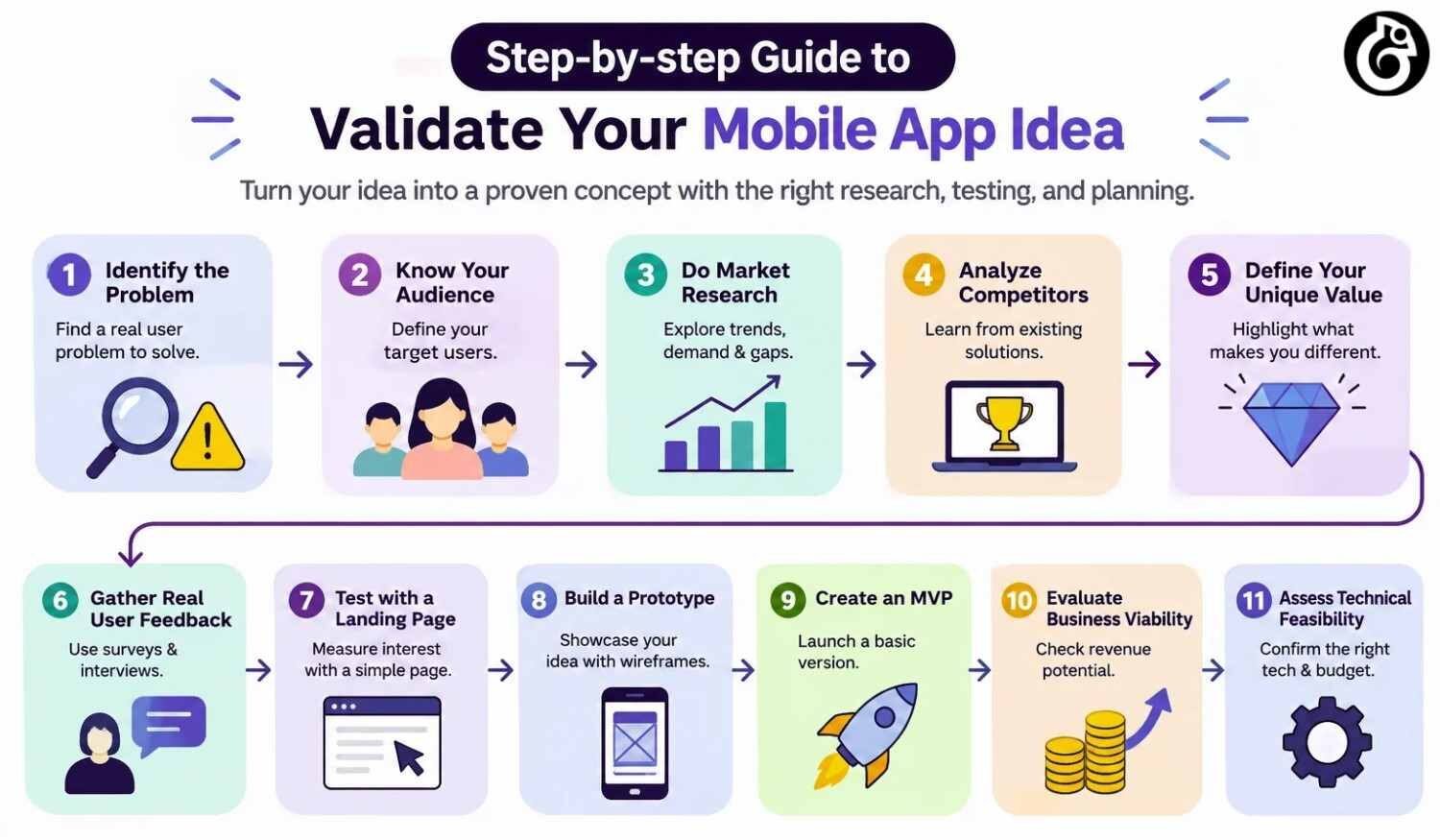
11 Steps to Validate an App Idea Before Spending on Development
A structured validation process should be followed so that business assumptions can be replaced with practical evidence.
Step 1: Identify the Problem Your App Will Solve
Every successful application should be built around a meaningful user problem. Before its features are planned, the specific problem that will be addressed should be clearly identified.
The following questions should be considered:
- What problem will be solved by the application?
- Who experiences this problem?
- How frequently does the problem occur?
- How is it currently being addressed?
- Why are existing solutions insufficient?
- Would users be willing to adopt a new solution?
For example, a fitness application may be proposed for individuals who struggle to maintain consistent workout routines. However, the underlying problem should be investigated further.
It may be discovered that users do not need another exercise library. Instead, personalized workout schedules, progress tracking, reminders, and affordable coaching may be more valuable. By identifying the actual customer pain points, the app concept can be refined around a problem that users genuinely want to solve. A clear problem statement should be prepared before the next validation stage.
Example:
“Busy professionals struggle to maintain consistent fitness routines because personalized workout planning and progress tracking are not easily accessible.”
This statement can be used to guide market research and feature prioritization.
Step 2: Define Your Target Audience
Once the problem has been identified, the intended audience should be defined. A mobile application should not be developed for everyone because different user groups may have different expectations, budgets, and usage patterns.
Target audience research can be conducted by examining:
- Age groups and demographics
- Location and geographic preferences
- Income levels and spending behavior
- Professional backgrounds
- Technology adoption patterns
- Lifestyle and interests
- Common frustrations and requirements
User personas can also be created to represent the most important audience segments. For example, if a grocery delivery application is being planned, three potential user groups could be identified:
Working professionals: Individuals who need convenient grocery ordering because of limited free time.
Families: Households that require regular grocery deliveries, product comparisons, and scheduled orders.
Senior citizens: Individuals who may prefer simplified navigation, accessible interfaces, and reliable delivery services.
After these groups have been evaluated, the most promising audience can be selected for initial testing.
The intended user experience should also be considered at this stage. This information will later support UI/UX design services, interface planning, and product development decisions.
Step 3: Conduct Market Research
Market research should be performed to determine whether a sufficient opportunity exists for the proposed application. A market research process should include an examination of industry trends, existing solutions, customer demand, and possible market gaps.
Several sources can be used:
- Google Trends for evaluating search interest over time
- Google Keyword Planner for examining relevant search demand
- Industry reports for understanding market growth
- App Store and Google Play listings for identifying competing products
- Reddit and relevant online communities for understanding user frustrations
- Social media discussions for identifying emerging requirements
- Customer surveys for collecting direct feedback
For example, if a mental wellness application is being considered, the demand for meditation tools, mood tracking, guided sessions, and habit-building features can be examined.
Search trends may indicate growing interest in a particular topic. However, search interest alone should not be treated as proof that users will download or pay for an application. Market demand should be evaluated alongside actual user feedback and competitive conditions.
Important market research questions:
- Is the target market growing or declining?
- Are users actively searching for solutions?
- How are existing products meeting customer requirements?
- Are any important customer needs being overlooked?
- Is the market large enough to support a sustainable business?
The findings should be documented so that the app business idea can be evaluated using evidence rather than assumptions.
Step 4: Analyze Competitor Apps
Competitor analysis is an important part of mobile app idea validation. Existing applications can provide useful information about customer expectations, market positioning, pricing, features, and usability.
Both direct and indirect competitors should be examined.
Direct competitors offer similar applications or solve the same problem.
Indirect competitors provide alternative ways of addressing the same customer need.
For example, a new online doctor consultation application may compete directly with existing telemedicine platforms. However, traditional hospital booking systems and offline consultation services may also be considered indirect alternatives.
During competitor research, the following aspects should be examined:
- Core application features
- User interface and navigation
- Pricing and subscription plans
- Customer ratings and reviews
- Download and engagement indicators, where available
- Onboarding experience
- Payment options
- Customer support
- Missing or poorly implemented features
Particular attention should be paid to negative reviews. For example, users of a delivery application may repeatedly complain about delayed orders, inaccurate delivery tracking, or limited payment options. These complaints may indicate opportunities for a new product.
A competitor comparison table can be prepared to organize the findings.
Evaluation criteria |
Competitor A |
Competitor B |
Proposed app |
|---|---|---|---|
| Core functionality | Available | Available | Planned |
| Real-time tracking | Limited | Available | Improved |
| Subscription options | Available | Not available | Planned |
| Personalized recommendations | Limited | Limited | Planned |
| User onboarding | Complex | Simple | Simplified |
The proposed application should not simply copy competing features. A stronger market position should be established by addressing customer problems more effectively.
Step 5: Define Your Unique Value Proposition (UVP)
A unique value proposition explains why customers should choose the proposed application instead of existing alternatives.
Without a clear value proposition, an application may struggle to differentiate itself, even when its features are technically well developed.
The UVP should explain:
- Who the application is designed for
- Which problem will be addressed
- How the solution will be delivered
- What makes the product different
- Why users should prefer it over existing options
For example, a regular travel booking application may provide hotel and flight reservations. However, a new travel application could differentiate itself through personalized itineraries, budget-based recommendations, local experiences, and simplified trip management.
The value proposition should be written in simple language and tested with potential users. If the intended benefit cannot be explained clearly, the product positioning should be refined before development is started.
Step 6: Validate Demand Through Surveys and User Interviews
Market reports and competitor research can provide useful information, but direct customer feedback is equally important. Surveys and user interviews should be conducted to understand how potential customers experience the problem and whether the proposed solution would be considered useful.
Surveys can be distributed through:
- Google Forms
- Social media communities
- Email lists
- Startup communities
- Relevant online forums
- Existing customer groups
The questions should be designed to identify actual behavior rather than simply collect positive opinions.
Examples of useful survey questions:
- How do you currently solve this problem?
- What is the most frustrating part of the existing process?
- How frequently do you experience this problem?
- Have you previously used an application for this purpose?
- What features would be most useful?
- Would you consider paying for a better solution?
- What would prevent you from using a new application?
User interviews should also be conducted with a smaller group of relevant participants. During these conversations, real experiences and frustrations can be explored in greater detail.
A useful distinction should be made between stated interest and actual commitment. Someone saying that an application sounds interesting does not necessarily indicate that the person will download, use, or pay for it. Stronger validation signals can be collected through email registrations, demo requests, waitlist sign-ups, pre-orders where appropriate, and prototype testing.
Step 7: Test Your App Idea with a Landing Page
A landing page can be created to measure interest before an application is developed. This is one of the simpler and more affordable methods of testing an app concept. A landing page should communicate the proposed solution, its primary benefits, intended audience, and important features.
The following elements can be included:
- A clear headline explaining the application
- A short description of the problem being solved
- Key benefits and proposed features
- Screenshots or conceptual design previews
- Customer testimonials, only when genuine
- A call-to-action button
- An email registration or waitlist form
For example, if a personal finance application is being planned, a landing page could introduce features such as expense tracking, monthly budgets, spending insights, and savings goals. Visitors could be encouraged to join an early-access waitlist.
The results should be evaluated through measurable indicators:
- Landing page visitors
- Sign-up conversion rate
- Call-to-action clicks
- Demo requests
- Waitlist registrations
- Cost per acquired lead
Traffic should be directed toward the page through relevant online communities, organic content, or carefully controlled advertising experiments. A high number of visitors without meaningful sign-ups may indicate that the value proposition needs improvement or that the audience is not sufficiently interested. Landing page validation does not guarantee future application success, but it can provide an early indication of demand.
Step 8: Create Wireframes and Interactive Prototypes
After initial demand has been evaluated, the proposed application can be represented through wireframes and interactive prototypes. At this stage, the complete application does not need to be developed. Instead, its structure, navigation, and primary user journeys can be demonstrated through clickable screens.
Wireframes are generally used to represent the layout and functionality of individual screens. Interactive prototypes provide a more realistic experience by allowing users to navigate between screens.
For example, a food delivery application prototype may include:
- User registration and login
- Restaurant discovery
- Food category selection
- Menu browsing
- Cart management
- Checkout
- Order tracking
Potential users can be invited to test these screens and provide feedback.
The following aspects should be evaluated:
- Is the navigation understandable?
- Can important features be found easily?
- Is the checkout process straightforward?
- Are the labels and instructions clear?
- Are unnecessary steps being included?
- Can the application be used comfortably?
UI/UX design services can be used to develop these wireframes and prototypes before full-scale engineering work is started. This approach can help usability problems and confusing user journeys be identified early, when changes are generally less expensive to implement.
Step 9: Build a Minimum Viable Product (MVP)
An MVP is a simplified version of an application that contains only the essential functionality required to test its core value proposition with real users. Instead of developing every planned feature, the initial product is restricted to the capabilities that are most important for solving the identified problem.
For example, a new fitness application may initially include:
- User registration
- Basic profile creation
- Workout schedules
- Progress tracking
- Reminder notifications
Advanced capabilities such as AI-based coaching, wearable device integrations, personalized nutrition planning, and community challenges may be introduced later.
MVP development services can be used to build this initial version with a controlled scope and budget. The MVP should then be released to a selected group of early users. Their interactions, feedback, and engagement should be evaluated.
Useful indicators may include:
- User activation rate
- Daily and monthly active users
- Feature adoption
- Retention rate
- Session frequency
- Customer feedback
- Conversion to paid plans, where applicable
An MVP should not be treated as an unfinished product with randomly selected features. It should be developed around a clear hypothesis that can be tested.
For example:
“Users who struggle with workout consistency will use a fitness application more frequently when personalized weekly schedules and progress reminders are provided.”
The results can be used to determine whether the hypothesis is supported or whether the product strategy needs to be changed.
Step 10: Evaluate Monetization and Business Feasibility
An application may attract interest without generating enough revenue to support its ongoing operation. Therefore, the business model should be evaluated before a large development investment is made.
Several app monetization strategies can be considered.
Freemium model: Basic functionality is provided without charge, while advanced features are offered through paid subscriptions.
Subscription model: Users are charged a recurring monthly or annual fee.
In-app purchases: Additional content, services, or digital features are purchased within the application.
Commission-based model: Revenue is earned from transactions completed through the platform.
Advertising model: Revenue is generated through advertisements displayed within the application.
For example, a language-learning application may provide introductory lessons for free while premium courses and personalized learning plans are offered through subscriptions. The most suitable revenue model should be selected according to the target audience, product category, and customer willingness to pay.
Important financial indicators should also be estimated:
- Customer acquisition cost (CAC)
- Customer lifetime value (LTV)
- Average revenue per user (ARPU)
- Subscription conversion rate
- Customer retention
- Operating expenses
- Expected break-even period
Revenue projections should be based on realistic assumptions rather than optimistic estimates.
Step 11: Assess Technical Feasibility and Development Costs
Once market and business feasibility have been evaluated, the technical requirements should be examined. Not every application can be developed with the same technology stack or level of complexity. Features, integrations, performance requirements, security, and expected user volume can significantly influence development expenses.
Technical feasibility should be assessed through questions such as:
- Which platforms should be supported?
- Will Android, iOS, or both be required?
- Is a web-based application also necessary?
- Which third-party integrations will be needed?
- Will real-time data processing be required?
- How will user information be secured?
- What level of scalability will be necessary?
The development approach should be selected according to the project’s requirements.
For applications that need to operate on multiple platforms, cross-platform app development services may be considered. Frameworks such as React Native and Flutter can support the development of Android and iOS applications through shared codebases, although platform-specific implementation may still be required.
Depending on the project’s architecture and technical requirements, react native app development services or Flutter app development services may be evaluated. Native Android development may also be considered when advanced platform-specific capabilities or deeper Android integrations are required. In such cases, Android app development services can be included in the development plan.
The final technology decision should be based on performance, functionality, development time, maintenance requirements, and available budget rather than framework popularity alone. A technical feasibility assessment can help the estimated development budget become more realistic before a project is approved.
How Much Does It Cost to Validate an App Idea?
The cost of app idea validation depends on the methods selected, research requirements, design complexity, and whether an interactive prototype or working MVP is required. A basic validation exercise can be performed with limited resources, while a more comprehensive process may require professional research, product strategy, UI/UX design, and software development.
The following figures are indicative planning estimates in USD, not fixed market prices.
Validation activity |
Estimated cost |
|---|---|
| Initial research and competitor analysis | $100–$500 |
| Customer surveys and interviews | $100–$800 |
| Landing page development | $200–$1,000 |
| Wireframe creation | $300–$1,500 |
| Interactive prototype development | $800–$3,000 |
| MVP development | $5,000–$20,000+ |
The actual investment may vary depending on the number of screens, integrations, testing participants, and product requirements.
1. Basic App Idea Validation
Estimated budget: $100–$500
A basic validation process can include competitor research, online surveys, customer interviews, and initial market analysis. This approach may be suitable for founders who want to test an early concept before investing in design or development.
2. Landing Page and Prototype Validation
Estimated budget: $500–$3,000
A landing page and interactive prototype can be created to communicate the product concept and evaluate user interest. This approach is useful when the application involves several user journeys that need to be demonstrated before development.
3. MVP-Based Validation
Estimated budget: $5,000–$20,000+
A functional MVP can be developed when stronger evidence is required through actual user interactions. The budget may increase when advanced integrations, payment processing, real-time capabilities, or complex business logic are required.
These estimates should be treated as early planning ranges. A detailed project scope and technical assessment should be completed before a final budget is established.
Common Mistakes to Avoid When Validating an App Idea
Even when research is conducted, incorrect assumptions can lead to poor development decisions. The following mistakes should be avoided.
1. Building an App Based Only on Personal Assumptions
An idea should not be considered commercially viable simply because its creator finds it useful. Customer problems and demand should be verified through actual research and feedback.
2. Ignoring Competitor Applications
Existing applications should not be overlooked. Their strengths, weaknesses, pricing, and customer reviews can reveal important market information.
3. Targeting an Audience That Is Too Broad
When an application is designed for everyone, its value proposition may become unclear. A specific initial audience should be selected so that the product can be positioned effectively.
4. Adding Too Many Features Before Validation
A large feature list can increase development costs and delay product launch. Essential functionality should be prioritized, while additional features should be considered after user feedback has been collected.
5. Treating Positive Feedback as Guaranteed Demand
People may express interest in an idea without actually using or purchasing the product. More meaningful signals, such as sign-ups, prototype engagement, and payment commitments, should also be evaluated.
6. Ignoring User Experience
Even a useful application may struggle if its navigation is confusing or its main tasks are difficult to complete. Usability testing should be performed before the product is launched.
7. Underestimating Maintenance and Operating Costs
Development expenses are not the only costs associated with an application. Hosting, third-party services, security updates, maintenance, and future improvements should also be included in financial planning.

When Is Your App Idea Ready for Development?
An application concept should move into development only after sufficient evidence has been collected to support the main business assumptions.
Although no validation method can guarantee success, several practical indicators can be used to assess readiness.
Problem clarity: The customer problem has been clearly identified and supported by research.
Audience confirmation: A specific target audience has been defined, and the problem has been verified through conversations or surveys.
Market opportunity: Existing demand and competitive conditions have been examined.
Value proposition: A clear reason for choosing the proposed solution over alternatives has been established.
User interest: Meaningful interest has been demonstrated through waitlist registrations, prototype engagement, or other measurable actions.
MVP scope: The essential features required to test the product have been prioritized.
Business feasibility: A potential revenue model and basic financial assumptions have been evaluated.
Technical feasibility: The required integrations, architecture, platforms, and security considerations have been assessed.
A validation scorecard can also be used to organize the findings.
Validation area |
What should be confirmed? |
|---|---|
| Problem validation | A genuine customer problem exists |
| Audience validation | A relevant target audience has been identified |
| Market validation | Demand and market opportunity are supported by evidence |
| Competitor validation | A meaningful differentiation opportunity exists |
| Product validation | Core features have been tested |
| Business validation | A viable monetization approach has been identified |
| Technical validation | The application can be developed within realistic constraints |
If major assumptions remain untested, additional research should be conducted before the full development budget is committed.
How Beadaptify Can Help Validate and Develop Your App Idea
Turning an application concept into a successful digital product requires more than development expertise. A clear product strategy, market understanding, user-focused design, and appropriate technology decisions should also be established.
At Beadaptify, businesses and startup founders can be supported throughout the early product planning and development journey. From refining an initial concept to creating prototypes and building a functional MVP, the right development approach can be selected according to the product’s objectives and budget.
Product Research and Planning
The application concept can be evaluated through requirement analysis, feature prioritization, audience research, and technical planning. This helps ensure that the proposed solution is aligned with actual user requirements.
UI/UX Design and Prototyping
Through professional UI/UX design services, user journeys, wireframes, and interactive prototypes can be prepared. The proposed interface can be evaluated before full-scale engineering work is started.
MVP Development
With MVP development services, essential product functionality can be prioritized and developed within a manageable scope. Early users can then be engaged, and their feedback can be used to guide future improvements.
Mobile App Design and Development
Once the concept has been validated, mobile app development services can be used to turn the approved requirements into a functional application.
Depending on the intended platforms and product requirements, native or cross-platform development approaches can be evaluated. React native app development services, Flutter app development services, and Android application development services may be considered as part of the technical strategy.
Scalable Software Product Development
After initial validation, the application can be expanded through structured software product development. Additional functionality, integrations, and performance improvements can be introduced as business requirements evolve.
By combining design & development services with a validation-first approach, a more practical foundation can be established for long-term product growth. Planning to turn your app idea into a digital product? Connect with Beadaptify to discuss your concept, validation requirements, and development goals.
Conclusion
Validating an app idea before spending on development is an important step toward building a product that addresses genuine customer needs. Without sufficient research, even a technically advanced application may struggle to attract users or establish a sustainable business model. Through problem identification, target audience research, market analysis, competitor evaluation, customer interviews, landing page experiments, prototypes, and MVP testing, an app concept can be assessed before a major investment is made.
The process should also include business and technical feasibility assessments so that development costs, monetization opportunities, integrations, and scalability requirements can be understood early. Rather than immediately investing in a complete application, a validation-first approach should be followed. Essential assumptions should be tested, user feedback should be collected, and the product scope should be refined before development is started. With the right research, product strategy, and development partner, a promising app idea can be transformed into a practical digital solution with a stronger foundation for market adoption and long-term growth.
FAQs on
How do I know if my app idea is worth developing?
An app idea may be worth developing when a genuine customer problem has been identified, sufficient market demand has been demonstrated, and a clear value proposition has been established. User interest, competitive opportunities, technical feasibility, and potential revenue should also be evaluated.
Can I validate an app idea without spending money?
Yes. Initial validation can be performed through free market research tools, online communities, customer interviews, competitor reviews, and basic surveys. However, expenses may be required later for landing pages, professional prototypes, usability testing, or MVP development.
Why is competitor analysis important before developing an app?
Competitor analysis helps identify existing solutions, customer expectations, pricing strategies, feature gaps, and market opportunities. Through this research, a stronger value proposition can be established and unnecessary feature duplication can be avoided.
How long does it take to validate an app idea?
The timeline depends on the research scope and validation methods. Basic market research may be completed within one or two weeks, while customer interviews, prototype testing, and MVP validation may require several additional weeks.
What is the difference between an app prototype and an MVP?
A prototype is generally an interactive representation of an application’s design and user journey. An MVP is a functional product containing essential features that can be used by real customers. A prototype is primarily used for usability and concept testing, while an MVP is used to evaluate actual product behavior and demand.
How can I test demand for a mobile app?
Demand can be tested through customer surveys, interviews, landing page registrations, waitlist sign-ups, prototype engagement, and controlled advertising experiments. Stronger evidence can be collected when users take meaningful actions rather than simply expressing interest.