Artificial intelligence is rapidly evolving from systems that simply generate responses into intelligent solutions capable of planning tasks, making decisions, interacting with applications, and executing complex workflows. This transformation has increased interest in Agentic AI among businesses looking to improve operational efficiency, automate repetitive processes, and develop smarter digital products.
Unlike traditional AI applications, Agentic AI systems are designed to pursue specific objectives through multiple steps. Tasks can be planned, information can be retrieved, external tools can be accessed, and actions can be executed with limited human intervention. As a result, custom Agentic AI solutions are increasingly being explored across healthcare, finance, eCommerce, education, manufacturing, and enterprise software.
However, the development of autonomous AI systems involves more than connecting a language model to an application. AI architecture, model selection, agent orchestration, data infrastructure, API integrations, security, testing, and ongoing maintenance must all be considered.
This raises an important question for businesses planning to adopt this technology: How much does Agentic AI development cost in 2026?
The Agentic AI development cost can range from approximately $8,000 for a basic single-task AI agent to $500,000 or more for an advanced enterprise platform. The final investment is determined by project complexity, the number of agents, integration requirements, autonomy levels, technology selection, and scalability needs.
In this guide, Agentic AI development pricing will be explored in detail, including cost estimates, major pricing factors, technology requirements, development stages, industry applications, and strategies for reducing implementation expenses.
What Is Agentic AI Development?
Agentic AI development refers to the process of designing and building intelligent systems that can independently pursue defined objectives by planning actions, making decisions, interacting with tools, and adapting their approach according to results.
Traditional AI applications are generally designed to respond to individual prompts or perform predefined operations. Agentic AI systems, on the other hand, can be configured to manage multi-step workflows. A business objective can be divided into smaller tasks, relevant information can be retrieved, suitable actions can be selected, and outcomes can be evaluated.
For example, a traditional chatbot may provide instructions for scheduling a meeting. An autonomous AI agent can be connected to an authorized calendar, availability can be checked, suitable time slots can be identified, and a meeting invitation can be prepared for approval.
Several technologies are commonly used during Agentic AI development:
- Large Language Models (LLMs): Language understanding, reasoning, and response generation can be supported.
- AI Agent Frameworks: Planning, memory, tool usage, and workflow execution can be managed.
- Retrieval-Augmented Generation (RAG): Relevant information can be retrieved from business documents and knowledge repositories.
- APIs and Integrations: Communication with external applications and enterprise systems can be enabled.
- Memory Systems: Relevant context can be retained across multi-step interactions.
- Multi-Agent Orchestration: Multiple specialized agents can be coordinated to complete shared objectives.
- Monitoring and Evaluation Tools: Agent performance, response quality, and execution reliability can be assessed.
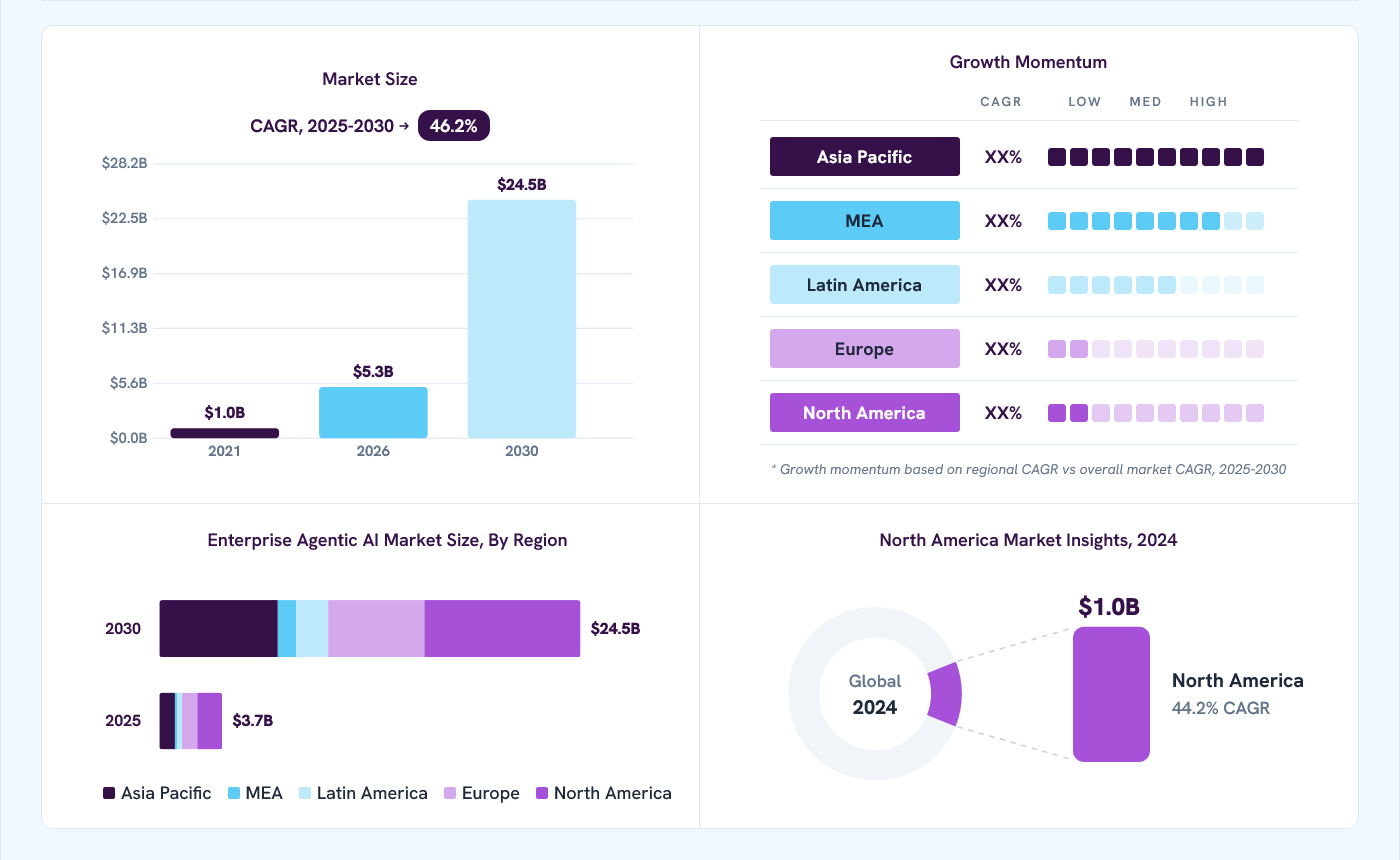
The complexity of these components directly affects AI agent development cost. A single-purpose agent generally requires fewer resources than an enterprise Agentic AI platform involving multiple autonomous agents and business applications. The global enterprise Agentic AI market is projected to grow from $2.6 billion in 2024 to $24.5 billion by 2030, at a CAGR of 46.2%.
How Much Does Agentic AI Development Cost in 2026?
The cost of Agentic AI development in 2026 is primarily determined by the capabilities, architecture, integrations, and production requirements of the proposed solution.
The following estimates can be used for preliminary project budgeting.
Agentic AI solution |
Estimated development cost |
|---|---|
| Basic single-task AI agent | $8,000–$25,000 |
| RAG-powered AI agent | $25,000–$80,000 |
| Advanced tool-using AI agent | $60,000–$150,000 |
| Multi-agent AI system | $120,000–$400,000+ |
| Enterprise Agentic AI platform | $250,000–$500,000+ |
These figures represent indicative development estimates, not fixed market prices or guaranteed quotations. Actual AI agent implementation cost will depend on the selected technology stack, development location, team composition, integrations, and operational requirements.
Basic Single-Task AI Agent: $8,000–$25,000
A basic AI agent is generally designed to perform one clearly defined business task. Limited workflows and integrations are usually required, making this a suitable option for startups and businesses exploring autonomous AI technology.
Common applications include:
- Customer inquiry classification.
- Automated email categorization.
- Document information extraction.
- Appointment request management.
- Basic internal knowledge assistance.
A language model, focused workflow, limited API integration, and basic monitoring capabilities are generally sufficient for this type of implementation.
RAG-Powered AI Agent: $25,000–$80,000
A RAG-powered AI agent is designed to retrieve relevant information from business documents, databases, and knowledge repositories before generating responses.
Common applications include enterprise knowledge assistants, customer support systems, internal research tools, and documentation assistants.
Additional investment is generally required for document processing, embedding generation, vector databases, retrieval pipelines, and access management.
Advanced Tool-Using AI Agent: $60,000–$150,000
Advanced AI agents can interact with external applications and perform authorized actions across multiple steps. For example, an operations agent may retrieve customer information, check inventory, update CRM records, and create follow-up tasks.
Additional engineering is required for API integrations, tool execution, workflow planning, authentication, error handling, and human approval mechanisms.
Multi-Agent AI System: $120,000–$400,000+
Multi-agent system development involves multiple specialized agents working together to complete complex business objectives. For example, an AI-powered sales platform may include separate research, lead qualification, communication, and reporting agents.
Higher development costs are generally associated with agent coordination, shared memory, task allocation, communication protocols, and system-wide testing.
Enterprise Agentic AI Platform: $250,000–$500,000+
Enterprise Agentic AI development involves the creation of scalable systems capable of supporting complex operations, multiple departments, large datasets, and extensive software integrations.
Features such as advanced governance, audit trails, access management, high availability, security controls, and human approval workflows may be required. Consequently, a larger development team and longer implementation timeline may be necessary.
Agentic AI Development Cost by Project Complexity
The cost of building Agentic AI is not determined only by the number of agents. The complexity of decision-making, autonomy, workflow execution, and integrations must also be evaluated.
Development level |
Main capabilities |
Estimated timeline |
|---|---|---|
| Basic agent | Single-task automation | 3–6 weeks |
| RAG-powered agent | Knowledge retrieval and contextual responses | 6–12 weeks |
| Advanced autonomous agent | Multi-step workflows and API actions | 10–16 weeks |
| Multi-agent system | Agent collaboration and orchestration | 12–24 weeks |
| Enterprise platform | Complex integrations and governance | 6–12+ months |
A focused MVP is often recommended when an Agentic AI solution is being introduced for the first time. Instead of developing an entire autonomous platform immediately, one valuable business workflow can be selected, tested, and improved before additional capabilities are introduced.
AI Agent Development Costs Through Real-World Examples
The cost of developing an AI agent is largely determined by the level of intelligence, autonomy, integrations, and functionality required. A basic conversational assistant can be developed with a relatively simple architecture, whereas an advanced AI agent capable of using external tools, processing complex information, remembering context, and completing multi-step tasks requires a more sophisticated development approach.
Several popular AI products demonstrate how different levels of AI capabilities can be implemented in real-world applications. Although their exact development budgets are not publicly disclosed, their features can be used to understand the technical complexity and potential investment involved in building comparable solutions.
Let’s explore some well-known examples.
1. ChatGPT – Conversational AI and Tool-Using Agents
ChatGPT demonstrates how conversational AI can be extended beyond basic question answering. Responses can be generated from user instructions, while additional capabilities can be used to analyze files, search for information, work with data, and interact with supported tools.
For a business, a comparable AI application could be developed to handle customer queries, summarize documents, retrieve information from internal databases, generate reports, and automate selected workflows.
Estimated development cost for a comparable custom solution:
$25,000–$100,000+ depending on the number of integrations, knowledge sources, and tool-using capabilities.
2. GitHub Copilot – AI-Powered Coding Assistance
GitHub Copilot demonstrates how AI can be integrated into an existing software development environment to assist with coding tasks. Suggestions can be generated from code context, while more advanced agentic capabilities can be used to help plan changes, modify files, and work through development tasks.
A comparable solution could be developed for businesses that want to automate repetitive programming activities, assist developers, review code, generate documentation, or support software maintenance.
Estimated development cost for a comparable custom solution:
$40,000–$150,000+ depending on the supported programming languages, repository integrations, codebase complexity, and level of autonomous execution.
3. Google Assistant – Voice-Based AI Assistance
Google Assistant provides an example of how voice interfaces can be combined with AI-powered assistance and connected services. Voice-based assistants can interpret spoken instructions, respond to user requests, and interact with supported applications or devices.
Google is also transitioning its assistant experience toward Gemini, reflecting the evolution from traditional voice-command systems toward more capable conversational AI.
Businesses can develop comparable voice-enabled AI agents for customer service, appointment scheduling, smart devices, internal assistance, and hands-free operations.
Estimated development cost for a comparable custom solution:
$20,000–$80,000+ depending on voice-processing requirements, supported languages, integrations, and response complexity.
4. Character.AI – Personalized Conversational AI Agents
Character.AI demonstrates how personalized conversational experiences can be created through AI-powered characters. Users can interact with different characters, each designed with distinct personalities, conversational styles, and behavioral characteristics.
A comparable business solution could be developed for virtual companions, interactive learning assistants, entertainment platforms, role-playing applications, and personalized customer engagement.
Estimated development cost for a comparable custom solution:
$30,000–$120,000+ depending on personalization, memory capabilities, model requirements, moderation systems, and expected user traffic.
5. Claude – Advanced AI Reasoning and Task Assistance
Claude demonstrates how advanced language models can support complex reasoning, document analysis, coding, and tool-assisted workflows. Through supported integrations and tool-use capabilities, AI applications can be designed to process information and assist with multi-step business activities.
For businesses, comparable solutions could be developed for legal document analysis, financial research, enterprise knowledge management, software development, and operational decision-making.
Estimated development cost for a comparable custom solution:
$30,000–$120,000+ depending on reasoning requirements, document volume, integration complexity, and security requirements.
6. Perplexity AI – AI-Powered Search and Research Assistance
Perplexity AI demonstrates how conversational AI can be combined with search and information retrieval to provide research-oriented responses. Instead of relying only on previously learned model information, search-based systems can retrieve relevant sources and generate responses grounded in available information.
A comparable business solution could be developed for market research, competitive analysis, internal knowledge discovery, customer support, and industry-specific information retrieval.
Estimated development cost for a comparable custom solution:
$35,000–$130,000+ depending on search infrastructure, data sources, retrieval accuracy, indexing requirements, and expected query volume.
What Do These Examples Tell Us About AI Agent Development Costs?
These examples demonstrate that AI agent development is not a one-size-fits-all process. The investment required is influenced by the intended use case, underlying AI models, data infrastructure, integrations, autonomy, and scalability requirements.
For instance, a basic conversational assistant can be developed with a comparatively limited set of features. However, an application that can independently research information, interact with external systems, remember previous interactions, and complete multi-step workflows requires a more advanced architecture.
The following table provides an indicative comparison of development complexity and potential investment for custom solutions with comparable capabilities.
| AI product example | Comparable development complexity | Indicative custom development cost |
|---|---|---|
| ChatGPT | Conversational AI with tool integrations | $25,000–$100,000+ |
| GitHub Copilot | AI coding and developer assistance | $40,000–$150,000+ |
| Google Assistant | Voice-enabled AI assistant | $20,000–$80,000+ |
| Character.AI | Personalized conversational agents | $30,000–$120,000+ |
| Claude | Advanced reasoning and task assistance | $30,000–$120,000+ |
| Perplexity AI | AI-powered search and research assistant | $35,000–$130,000+ |
Note: These are illustrative planning estimates for custom applications with comparable feature sets, not the actual development costs of the named products. The original products operate at a much larger scale and may involve proprietary models, substantial research investments, extensive infrastructure, and ongoing operational expenses. Actual project costs will depend on business requirements, technology choices, integrations, and deployment scale.
Before development is started, the required capabilities should be clearly identified. By prioritizing essential features, selecting suitable AI models, and launching an MVP before expanding functionality, businesses can manage their initial investment while creating a foundation for future growth.
Key Factors That Affect Agentic AI Development Costs
Several technical and business-related considerations influence Agentic AI development pricing.
1. Complexity of AI Agents
The complexity of the agents is one of the most significant cost factors. A basic agent may be configured to interpret a request and perform a predefined task. An advanced autonomous agent may be required to plan multiple actions, evaluate results, recover from errors, and interact with different applications.
As autonomy increases, additional engineering is required for reasoning workflows, decision validation, exception handling, and testing.
2. AI Model Selection
The selection of Large Language Models can influence both initial development and ongoing operating expenses. Different models offer different levels of reasoning capability, response speed, context length, and pricing. Smaller models may be sufficient for classification and extraction, whereas more capable models may be required for complex reasoning workflows.
The following factors should be evaluated:
- Reasoning and task completion quality.
- API pricing and usage limits.
- Response latency.
- Context window requirements.
- Data privacy and deployment options.
- Reliability and availability.
A suitable model strategy can help balance performance and cost.
3. Number of Agents and Orchestration
A single-agent system generally requires a simpler architecture than a multi-agent AI system. When multiple agents are introduced, additional components may be required for task distribution, communication, shared memory, conflict resolution, and workflow coordination.
The responsibilities of each agent and the complexity of their interactions should therefore be evaluated before an architecture is finalized.
4. Third-Party API Integrations
Agentic AI systems are frequently connected to existing business applications. Common integrations include CRM platforms, ERP systems, payment gateways, customer support software, communication tools, project management applications, and enterprise databases.
Each integration may require API development, authentication, data mapping, testing, and error handling. Businesses operating multiple legacy applications may therefore face higher implementation expenses.
5. Data Preparation and Knowledge Management
Reliable information is required for AI agents to complete tasks accurately. Data preparation may include collecting documents, cleaning datasets, organizing business information, configuring permissions, and building retrieval pipelines.
For RAG-powered applications, embedding generation, vector database implementation, retrieval optimization, and knowledge source maintenance must also be included in the project scope.
6. Security and Compliance Requirements
Security becomes particularly important when AI agents are provided with access to sensitive business information or authorized to execute actions.
The following measures may be required:
- Secure authentication.
- Role-based access control.
- Data encryption.
- API permission management.
- Audit logging.
- Human approval workflows.
- Data retention policies.
- Regular security testing.
Additional compliance and governance requirements may be introduced for healthcare, finance, and insurance applications.
7. UI/UX Design and User Experience
The user interface remains an important part of an Agentic AI application, even when most operations are performed through autonomous workflows. Users should be able to understand agent activities, review outputs, approve sensitive actions, and intervene when necessary.
Custom UI/UX design services can be used to create intuitive dashboards, conversational interfaces, workflow monitoring screens, and approval mechanisms.
8. Testing and Evaluation
Agentic AI systems may behave differently depending on user inputs, available information, and external application responses. Testing should cover task completion accuracy, tool execution reliability, retrieval quality, error recovery, security, performance, and unexpected input handling.
A comprehensive evaluation process may increase initial development expenses, but it can help reduce operational risks after deployment.
Cost Breakdown of Building an Agentic AI System
A detailed budget allocation can be used to understand where development resources are generally required.
Development component |
Approximate budget share |
|---|---|
| Requirement analysis and architecture | 8–12% |
| AI model and agent development | 20–25% |
| Backend and API integrations | 15–20% |
| Data preparation and knowledge systems | 10–15% |
| Frontend and UI/UX development | 8–12% |
| Testing and AI evaluation | 10–15% |
| Deployment and monitoring setup | 5–8% |
These percentages are illustrative planning assumptions rather than universal industry benchmarks. A data-intensive application may require a larger data engineering budget, whereas a multi-agent platform may require more investment in orchestration and evaluation.
Why Is Agentic AI Development More Expensive Than Basic AI Integration?
Traditional AI integration may involve connecting a model to an application to generate responses or classify information. Agentic AI development requires additional capabilities, including multi-step planning, tool execution, dynamic decision-making, memory management, workflow orchestration, error recovery, permission controls, and continuous evaluation.
The additional engineering required to make autonomous actions reliable is one of the main reasons custom Agentic AI solutions can cost more than conventional AI applications.
Agentic AI Development Cost by Industry and Use Case
The cost of developing an Agentic AI solution also varies according to the industry and business processes being automated.
Industry |
Example applications |
Indicative budget |
|---|---|---|
| Healthcare | Appointment coordination and administrative automation | $40,000–$200,000+ |
| Finance and banking | Document verification and compliance assistance | $60,000–$300,000+ |
| eCommerce and retail | Order management and customer support | $20,000–$120,000+ |
| Education | Student assistance and enrollment workflows | $20,000–$100,000+ |
| Manufacturing and logistics | Inventory and supply chain coordination | $50,000–$250,000+ |
| SaaS and enterprise software | Onboarding, reporting, and workflow automation | $30,000–$180,000+ |
These are broad planning estimates, not independently measured industry averages.
Healthcare
Agentic AI can be used for appointment coordination, patient communication, document processing, and administrative workflows. Additional privacy, security, auditability, and human oversight requirements may increase development costs.
Finance and Banking
AI agents can be introduced for document verification, transaction monitoring support, internal research, and customer service workflows. Advanced security and approval mechanisms may be required.
eCommerce and Retail
Customer support, product recommendations, order tracking, and inventory inquiries can be automated through AI-powered workflows. Integrations with inventory, payment, logistics, and CRM systems can influence the overall budget.
Education
Student inquiries, course recommendations, enrollment assistance, and learning resource discovery can be supported through intelligent agents.
Manufacturing and Logistics
Supply chain coordination, inventory monitoring, production planning assistance, and operational reporting can be supported through Agentic AI applications.
SaaS and Enterprise Software
AI agents can be integrated into existing products to automate onboarding, technical support, account management, reporting, and internal workflows.
Technology Stack Required for Agentic AI Development
The selected technology stack influences performance, scalability, integration capabilities, and development expenses.
Technology category |
Examples |
Purpose |
|---|---|---|
| Large Language Models | GPT, Claude, Gemini | Reasoning and language generation |
| Agent frameworks | LangGraph, AutoGen, CrewAI | Agent orchestration |
| Backend development | Python, Node.js | Application logic and APIs |
| Vector databases | Pinecone, Weaviate, Qdrant | Semantic search and retrieval |
| Traditional databases | PostgreSQL, MongoDB | Application and business data |
| Cloud infrastructure | AWS, Azure, Google Cloud | Hosting and scalability |
| Monitoring tools | Langfuse, LangSmith, OpenTelemetry | Tracing and evaluation |
| Integration tools | REST APIs, webhooks | External application connectivity |
Role of Large Language Models
LLMs provide the reasoning and language capabilities used by many Agentic AI systems. Instructions can be interpreted, plans can be generated, and suitable actions can be selected.
Role of AI Agent Frameworks
Agent frameworks are used to manage workflows, tool calls, memory, and interactions between agents. Custom business logic and security controls must still be implemented for production-ready applications.
Role of APIs and Cloud Infrastructure
APIs allow agents to communicate with external applications and databases. Cloud infrastructure is used for application deployment, model access, data storage, and workload scaling. The technology stack should be selected according to actual business requirements rather than framework popularity alone.
Agentic AI vs. Traditional AI Chatbots: Development Cost Comparison
Agentic AI systems and traditional AI chatbots are designed for different purposes, which is reflected in their development requirements.
Comparison factor |
Traditional AI chatbot |
Agentic AI system |
|---|---|---|
| Primary purpose | Answer questions | Complete objectives |
| Workflow | Conversation-based | Multi-step and action-oriented |
| Decision-making | Limited or predefined | Dynamic and context-aware |
| Tool usage | Basic integrations | Multiple authorized tools |
| Memory | Often limited | Can support task and context memory |
| Complexity | Generally lower | Generally higher |
| Development cost | Often lower | Often higher |
For example, a traditional chatbot may explain how a refund can be requested. An AI agent may retrieve the order, verify refund eligibility, prepare a request, and submit it through an approved workflow.
The additional integration, decision-making, and validation requirements can increase Agentic AI development costs.
Hidden and Ongoing Costs of Agentic AI Development
The initial development investment is only one part of the total cost of ownership. After deployment, recurring expenses must also be considered.
LLM API and Token Usage
AI agents may make multiple model calls during reasoning, planning, response generation, and tool selection. Consequently, token consumption can increase with task complexity and usage volume.
Cloud Hosting and Infrastructure
Cloud servers, databases, storage, networking, and other infrastructure services may be required. Expenses will depend on the number of users, execution frequency, data volume, and performance requirements.
Monitoring and Observability
Production systems should be monitored for failed tool calls, errors, latency, unusual behavior, and unexpected spending.
Maintenance and Updates
Models, APIs, frameworks, and external applications may change over time. Regular maintenance may be required to update integrations, improve prompts, fix errors, and maintain compatibility.
Security and Governance
Security assessments, access reviews, audit logs, and policy updates may be required as agent permissions and capabilities evolve.
Human Supervision and Evaluation
Some workflows will continue to require employee reviews, approval of sensitive actions, and exception handling. These operational requirements should be included in the budget.
Indicative Monthly Operating Costs
System type |
Estimated monthly operating cost |
|---|---|
| Basic AI agent | $200–$1,000 |
| RAG-powered agent | $500–$2,500 |
| Advanced tool-using agent | $1,500–$6,000 |
| Multi-agent system | $4,000–$20,000+ |
| Enterprise AI platform | $8,000–$30,000+ |
These estimates are illustrative and depend on model usage, infrastructure, monitoring, maintenance, and operational support. High-volume deployments may cost considerably more.
How to Reduce Agentic AI Development Costs
A large initial investment is not always necessary when an autonomous AI solution is being introduced. With suitable planning, development expenses can be controlled while scalability can be maintained.
Start With a Clearly Defined Use Case
One high-value workflow should be selected instead of attempting to automate every business process immediately.
Develop an MVP First
A minimum viable product can be used to validate the business value of an Agentic AI solution through a limited set of essential features. MVP development services can be used to prioritize requirements, test workflows, gather feedback, and reduce unnecessary initial investment.
Use Existing AI Models and Frameworks
Training a foundation model from scratch is generally unnecessary for many business applications. Existing models, APIs, and agent frameworks can be used to reduce engineering effort.
Prioritize Essential Integrations
Only the applications required for the primary workflow should be integrated during the first release. Additional connections can be introduced as the solution expands.
Choose Models According to Task Complexity
Smaller and more economical models may be used for classification, extraction, and simple decisions. More capable models can be reserved for complex reasoning tasks.
Monitor Token and Infrastructure Usage
Caching, efficient prompts, context management, and model routing can help reduce unnecessary model calls and infrastructure expenses.
Build a Scalable Architecture
A modular architecture can allow individual components to be improved without rebuilding the entire application. This approach can reduce long-term development and maintenance effort.
Step-by-Step Agentic AI Development Process
A structured development process is essential for managing project scope, controlling budgets, and ensuring that the final system meets business requirements.
Step 1: Requirement Analysis
The business problem should first be identified, and workflows suitable for AI automation should be evaluated. User requirements, expected tasks, available data, existing applications, and desired outcomes should be documented.
Step 2: Use Case and Architecture Planning
A single-agent or multi-agent architecture should be selected according to workflow complexity. Model integrations, databases, APIs, memory, orchestration, permissions, and monitoring should be planned.
Step 3: Technology Selection
Suitable LLMs, agent frameworks, backend technologies, databases, and cloud services should be selected according to project requirements.
Step 4: Agent Development
Agents should be developed with clearly defined responsibilities, instructions, tools, and permissions. Each agent’s boundaries should be established to prevent unauthorized actions.
Step 5: Integration Development
APIs and connectors should be implemented to allow agents to interact with existing applications. Integration testing should be performed to verify information retrieval and action execution.
Step 6: UI/UX and Dashboard Development
Intuitive interfaces should be developed so users can interact with agents, monitor workflows, review outputs, and approve sensitive actions. Professional UI/UX design services can help make complex AI functionality easier to manage.
Step 7: Testing and Evaluation
The system should be tested against realistic business scenarios. Task accuracy, tool execution, security, exception handling, and performance should be evaluated.
Step 8: Deployment and Optimization
The system can be deployed after successful testing. Performance should be monitored, and improvements should be introduced according to actual usage and business feedback.
Is Agentic AI Worth the Investment in 2026?
Agentic AI can provide meaningful business value when it is applied to workflows involving repetitive tasks, multiple systems, information retrieval, and structured decision-making. However, the investment should be evaluated against development expenses, operating costs, supervision requirements, and potential risks.
The following questions should be considered before implementation:
- How much employee time can be saved?
- How frequently is the selected workflow performed?
- What is the current cost of completing the task manually?
- How many applications must be integrated?
- What level of human supervision will be required?
- How will success be measured?
- What are the ongoing model and infrastructure expenses?
For example, an AI agent used to automate a high-volume administrative process may deliver substantial long-term value. However, an advanced multi-agent platform developed for an occasional low-value task may not provide a suitable return on investment. A focused MVP should therefore be developed, tested, and evaluated before additional investment is committed.
How Beadaptify Can Help With Agentic AI Development?
Building an Agentic AI solution requires a combination of AI engineering, software architecture, application integration, and user-focused design. A suitable development strategy can help transform business requirements into reliable and scalable AI-powered products.
At Beadaptify, custom digital product development solutions can be planned around specific business goals, workflows, and technical requirements. Through software product development services and professional design & development services, businesses can be supported throughout the development lifecycle.
The following capabilities can be included:
- Custom Agentic AI Development: AI agents can be developed to perform specific business tasks and workflows.
- Multi-Agent System Development: Specialized agents can be coordinated to complete complex objectives.
- LLM and RAG Integration: Language models can be connected with business knowledge sources and applications.
- AI Workflow Automation: Repetitive business operations can be automated through intelligent workflows.
- Enterprise Application Integration: AI agents can be connected with existing databases, APIs, and business software.
- UI/UX Design: Intuitive interfaces and dashboards can be created for monitoring and managing AI-powered workflows.
- MVP Development: Initial AI product concepts can be validated through focused releases before larger investments are made.
Whether a specific business workflow needs to be automated or an advanced enterprise AI platform is being planned, a structured development roadmap can help control costs and support future scalability. Ready to explore Agentic AI for your business? Contact Beadaptify to discuss your requirements and plan a custom AI solution aligned with your business objectives.

Conclusion
Agentic AI development cost in 2026 can vary significantly according to system complexity, autonomy, technology selection, integrations, security requirements, and ongoing operational needs. A basic single-task agent may require a relatively modest investment, whereas RAG-powered applications, advanced tool-using agents, multi-agent systems, and enterprise platforms require progressively larger budgets.
However, the initial development price should not be treated as the only investment consideration. Model usage, infrastructure, monitoring, maintenance, security, and human supervision should also be included when total ownership costs are calculated.
For businesses planning to adopt Agentic AI, a clearly defined use case and a focused MVP can provide an effective starting point. With suitable architecture, technology choices, and development expertise, Agentic AI can become a valuable investment in business automation, operational efficiency, and long-term digital growth.
FAQs on Agentic AI development
What factors affect Agentic AI development costs?
The main factors include agent complexity, AI model selection, the number of agents, API integrations, data preparation, system architecture, security requirements, UI/UX design, testing, and deployment infrastructure. Ongoing model usage and maintenance must also be considered.
How much does it cost to build a custom AI agent?
A custom single-task AI agent may cost approximately $8,000–$25,000, while an agent that performs multiple actions through external applications may cost $60,000–$150,000 or more. Advanced solutions generally require additional architecture, integrations, and testing.
How long does it take to develop an Agentic AI solution?
A basic AI agent may take approximately 3–6 weeks to develop. RAG-powered agents may require 6–12 weeks, while multi-agent systems can take 12–24 weeks or longer. Enterprise implementations may require 6–12 months or more.
What technologies are required for Agentic AI development?
Common technologies include Large Language Models, AI agent frameworks, Python or Node.js, vector databases, APIs, cloud infrastructure, and monitoring tools. The selected technology stack should be determined by system functionality, integrations, and scalability requirements.
Is Agentic AI worth the investment for small businesses?
Agentic AI can be valuable for small businesses when repetitive, time-consuming workflows can be automated and measurable operational benefits can be achieved. A narrowly scoped agent or MVP can be used to validate its usefulness without requiring the investment associated with a large enterprise platform.