Businesses are increasingly looking for ways to deliver seamless digital experiences across smartphones, tablets, and desktops without investing in separate applications for every platform. As a result, Progressive Web Apps (PWAs) are being considered as a flexible and cost-effective approach to modern application development.
Through PWA technology, website experiences can be enhanced with app-like capabilities such as offline access, push notifications, home-screen installation, and faster loading. A single web application can be made accessible across supported devices, reducing the need for multiple platform-specific development efforts.
However, the overall investment required for a Progressive Web App can vary significantly. A basic PWA with responsive pages and installation support may require a relatively modest budget, whereas an advanced enterprise application with offline workflows, payment integrations, real-time functionality, and complex backend systems may require a much larger investment.
So, how much does Progressive Web App development cost in 2027?
In this guide, the estimated development costs, feature-wise pricing, development stages, timelines, maintenance expenses, and major cost factors will be explored. The differences between PWA and native mobile app development will also be discussed to help businesses make informed investment decisions.
What Is a Progressive Web App (PWA)?
A Progressive Web App is a web application that uses modern browser technologies to deliver an experience similar to a traditional mobile application. It can be accessed through a web browser and, on supported devices, installed directly on the home screen. Unlike conventional websites, PWAs can be enhanced with capabilities such as offline access, background synchronization, push notifications, and app-like navigation.
A PWA is generally developed using standard web technologies such as HTML, CSS, and JavaScript, along with browser APIs and supporting technologies.
Three important components are commonly used:
- Service Workers: Background scripts are used to manage caching, selected offline functionality, and certain network-related tasks.
- Web App Manifest: Application information, including its name, icons, display mode, and launch settings, is defined through a manifest file.
- HTTPS: Secure connections are required for service workers and other important PWA capabilities.
For businesses, a PWA can be used to provide a consistent digital experience without requiring separate web and mobile applications for every supported platform.
Key Features of a Progressive Web App
The features included in a PWA can have a direct influence on the overall development budget. While basic functionality can be implemented with a relatively limited scope, advanced capabilities may require additional development, integrations, and testing.
Installability
A PWA can be installed on supported devices and accessed through a home-screen icon. The application can be launched in an app-like display mode, depending on browser and operating system support.
Offline Functionality
Selected application content and features can be made available without an active internet connection through service workers and caching strategies.
For example, previously viewed content, saved information, and selected workflows may remain accessible when connectivity is unavailable.
Push Notifications
Notifications can be delivered through supported browsers and operating systems to communicate updates, offers, reminders, and other important information. However, notification support and permission requirements vary across platforms and browsers.
Responsive Design
A PWA can be designed to adjust automatically to different screen sizes. Consistent experiences can therefore be provided across smartphones, tablets, laptops, and desktop computers.
Fast Loading
Caching, optimized assets, and efficient resource delivery can be used to reduce loading times and improve application responsiveness.
Secure Access
HTTPS and appropriate authentication mechanisms can be implemented to protect application communication and user information. The final feature set should be determined according to business requirements, user expectations, and the devices on which the application is expected to be used.
How Much Does Progressive Web App Development Cost in 2027?
The cost of developing a Progressive Web App in 2027 can range from approximately $5,000 to more than $250,000, depending on the project’s scope and technical complexity.
A simple PWA may be developed with responsive pages, basic installation support, and limited offline functionality. More advanced applications may require custom dashboards, user authentication, payment processing, real-time data synchronization, and enterprise integrations.
The following estimates can be used for initial project budgeting.
PWA Development Level |
Estimated Cost |
Approximate Timeline |
|---|---|---|
| Basic PWA | $5,000–$15,000 | 4–8 weeks |
| Mid-Level PWA | $15,000–$45,000 | 8–16 weeks |
| Advanced PWA | $45,000–$120,000 | 4–6 months |
| Enterprise PWA | $100,000–$250,000+ | 6–12+ months |
These are indicative planning estimates for 2027, not verified universal market averages or fixed vendor quotations. Actual pricing will depend on team location, project scope, technology choices, integrations, and security requirements.
Basic PWA Development: $5,000–$15,000
A basic Progressive Web App can be developed for businesses that need a mobile-friendly web experience with selected app-like capabilities.
The following features may be included:
- Responsive website interface
- Basic PWA installation support
- Web app manifest configuration
- Basic service worker implementation
- Static content caching
- Contact forms and simple user interactions
- Basic analytics integration
- Essential browser compatibility testing
This level may be suitable for small businesses, service providers, startups, and organizations that want to improve their existing website experience.
Mid-Level PWA Development: $15,000–$45,000
A mid-level PWA can be developed when more interactive functionality and user-specific experiences are required.
The following features may be included:
- User registration and authentication
- User dashboards
- Push notification functionality
- Advanced offline access
- API integrations
- Database connectivity
- Content management functionality
- Search and filtering
- Third-party service integrations
- Enhanced performance optimization
This development level may be appropriate for educational platforms, booking systems, service applications, and growing eCommerce businesses.
Advanced PWA Development: $45,000–$120,000
Advanced PWAs are generally developed when complex workflows, personalized functionality, and multiple integrations are required.
The following features may be included:
- Advanced user management
- Payment gateway integration
- Real-time notifications
- Offline data synchronization
- Complex search and filtering
- Customer dashboards
- CRM or ERP integrations
- Advanced analytics
- Custom backend development
- Enhanced security and performance optimization
This level may be suitable for marketplaces, travel platforms, logistics applications, and larger digital products.
Enterprise PWA Development: $100,000–$250,000+
Enterprise-level applications are developed when large-scale operations, complex business workflows, and extensive integrations need to be supported.
The following capabilities may be included:
- Multi-role access management
- Enterprise authentication
- Complex API architecture
- ERP and CRM integrations
- Advanced offline workflows
- Real-time data processing
- Large-scale database architecture
- Advanced security controls
- Performance monitoring
- Extensive testing and deployment
- Long-term maintenance planning
This development level may be required for enterprise commerce platforms, financial services, healthcare systems, and large operational applications.
Also Read: PWA vs Native Apps: Which Is Better for Modern Businesses?
Progressive Web App Development Cost Breakdown by Stage
The total development budget is generally distributed across several stages. Each stage contributes to the quality, functionality, performance, and reliability of the final application.
The following table provides indicative budget allocations for a project with a total development budget of $30,000.
Development Stage |
Estimated Allocation |
Approximate Cost |
|---|---|---|
| Research and planning | 10% | $3,000 |
| UI/UX design | 15% | $4,500 |
| Frontend development | 25% | $7,500 |
| Backend development | 20% | $6,000 |
| PWA implementation | 10% | $3,000 |
| Testing and quality assurance | 10% | $3,000 |
| Deployment and launch | 5% | $1,500 |
| Maintenance preparation | 5% | $1,500 |
| Total | 100% | $30,000 |
The percentages are illustrative budgeting allocations. Actual costs may be distributed differently according to the project’s architecture and requirements.
Research and Planning
During this stage, project objectives, target audiences, functional requirements, and technical specifications are identified. A suitable architecture is also selected, and the major development milestones are established.
UI/UX Design
The application interface is planned through wireframes, prototypes, and responsive design layouts. Through professional design & development services, user journeys can be structured to ensure that the application remains intuitive across different devices.
Frontend Development
The user interface is implemented using suitable web technologies. Responsive layouts, navigation, forms, and interactive components are developed during this stage.
Backend Development
Databases, APIs, authentication, business logic, and server-side functionality are implemented according to application requirements.
PWA Implementation
Service workers, caching strategies, manifest configuration, installation support, and selected offline capabilities are integrated.
Testing and Deployment
Browser compatibility, performance, security, responsiveness, and application functionality are evaluated before the PWA is deployed.
Cost of Essential Progressive Web App Features
The feature set can have a considerable impact on PWA development pricing. Each additional capability may require separate implementation, testing, and integration work.
The following estimates can be used as illustrative feature-level budgeting ranges.
PWA Feature |
Estimated Development Cost |
|---|---|
| PWA setup and installation support | $500–$2,000 |
| Responsive interface development | $1,000–$5,000 |
| Service worker implementation | $1,000–$3,500 |
| Basic offline functionality | $1,500–$5,000 |
| Advanced offline synchronization | $3,000–$10,000 |
| Push notification integration | $800–$3,000 |
| User authentication | $1,000–$4,000 |
| Payment gateway integration | $1,500–$5,000 |
| Custom dashboard | $2,000–$8,000 |
| Third-party API integration | $1,000–$6,000 |
These costs represent potential feature-level effort and should not be added together as a fixed package. Some features overlap with the core application architecture, and additional complexity may increase the actual budget.
For example, a basic notification feature may require limited implementation, whereas personalized notifications with scheduling, segmentation, and analytics may require considerably more development effort. Similarly, offline functionality can be implemented at different levels. Simple content caching is generally less complex than offline form submissions, conflict resolution, and background data synchronization.
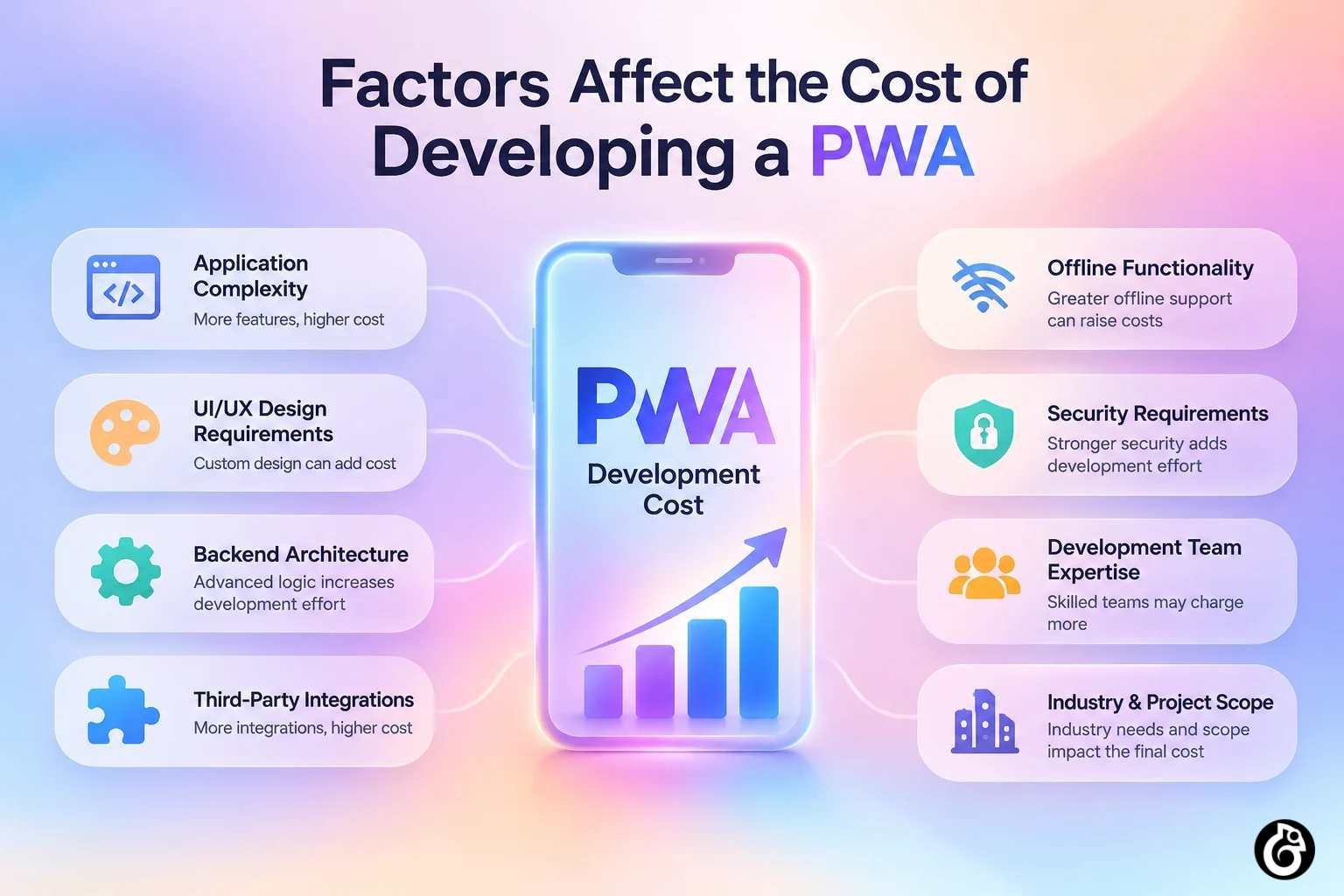
Factors That Affect Progressive Web App Development Costs
Several technical and business-related factors should be evaluated before a PWA development budget is finalized.
1. Application Complexity
The number of pages, workflows, user roles, and interactive features can influence the total development effort. A simple business application may require limited functionality, whereas a marketplace or enterprise platform may involve multiple interconnected modules.
2. UI/UX Design Requirements
Custom interface designs, animations, interactive elements, accessibility requirements, and personalized user journeys can increase design and implementation effort. The cost of design may also be influenced by the number of device layouts and user scenarios that need to be supported.
3. Backend Architecture
Backend complexity can significantly affect the development budget. Authentication, database management, API architecture, real-time processing, and complex business logic may require additional development resources.
4. Third-Party Integrations
Payment gateways, CRM platforms, analytics tools, marketing automation systems, and external APIs may need to be integrated. The implementation effort will depend on API documentation, security requirements, data structures, and integration complexity.
5. Offline Functionality
Offline support is not limited to caching website pages. More advanced applications may require local data storage, synchronization, conflict management, and background processing. These requirements should be evaluated carefully because advanced offline functionality can increase development complexity.
6. Security Requirements
Applications that handle sensitive user information, financial transactions, or business data may require additional security controls. Authentication, authorization, secure API communication, data protection, and compliance-related requirements should be included in the development plan.
7. Development Team Expertise
The experience and technical capabilities of the selected development team can influence both the budget and project timeline. When a progressive web app development company is selected, its experience with service workers, offline architecture, responsive design, and cross-browser compatibility should be evaluated.
PWA Development Cost by Industry
The cost of a Progressive Web App can also vary according to the industry in which it is being developed. Different industries require different features, integrations, security controls, and user workflows.
Industry |
Potential PWA Features |
Indicative Cost Range |
|---|---|---|
| eCommerce | Product catalogs, carts, payments, notifications | $15,000–$60,000 |
| Healthcare | Patient access, appointments, secure communication | $25,000–$100,000 |
| Education | Courses, learning dashboards, offline content | $15,000–$50,000 |
| Travel | Booking, search, itinerary management, notifications | $20,000–$75,000 |
| Logistics | Tracking, driver dashboards, offline workflows | $30,000–$100,000 |
| Business applications | Dashboards, authentication, API integrations | $20,000–$80,000 |
These are broad planning estimates for illustrative project scopes, not fixed industry-specific prices.
For example, an eCommerce PWA may require product management, payment processing, and shopping cart functionality. A logistics PWA may require location-related services, tracking integrations, and offline data handling. The required functionality should therefore be identified before an accurate estimate is prepared.
How Long Does It Take to Develop a Progressive Web App?
The development timeline is influenced by application complexity, design requirements, backend architecture, integrations, and testing scope.
A basic PWA may be delivered within a few weeks, whereas a complex enterprise application may require several months.
Project Type |
Estimated Timeline |
|---|---|
| Basic PWA | 4–8 weeks |
| Mid-Level PWA | 8–16 weeks |
| Advanced PWA | 4–6 months |
| Enterprise PWA | 6–12+ months |
The timeline may be extended when complex integrations, extensive data migration, advanced offline capabilities, or additional security testing are required. A structured development process can help reduce unnecessary delays. Requirements should be finalized early, priorities should be established, and testing should be conducted throughout development rather than being postponed until launch.
PWA vs. Native App Development Cost
Progressive Web Apps and native mobile applications can both be used to deliver digital experiences, but their development approaches are different.
A PWA can be built using a shared web codebase for supported browsers and devices. Native applications are generally developed separately for platforms such as iOS and Android, using their respective development technologies.
Comparison Factor |
Progressive Web App |
Native Mobile App |
|---|---|---|
| Development approach | Shared web application codebase | Platform-specific development |
| Installation | Browser-supported installation | App store distribution |
| Offline access | Supported through caching and service workers | Supported through native application architecture |
| Push notifications | Support varies by browser and platform | Supported through platform notification services |
| Device integration | Browser and operating system limitations apply | Broader access to native device capabilities |
| Updates | Web deployment can make updates available without traditional app store releases | Store distribution and review may be required for many updates |
| Development cost | Often lower for shared cross-platform requirements | Can be higher when separate platform implementations are needed |
| Maintenance | Shared web application maintenance | Platform-specific maintenance may be required |
Which Is More Cost-Effective?
A PWA may be more cost-effective when a business needs broad web accessibility, responsive functionality, and selected app-like capabilities through a shared codebase.
Native development may be more appropriate when extensive device integration, advanced background processing, platform-specific user experiences, or specialized native capabilities are required. The decision should be based on functionality and user expectations rather than development cost alone.
Hidden and Ongoing PWA Maintenance Costs
The development budget should not be treated as the only expense associated with a Progressive Web App. After launch, maintenance and operational costs will also need to be considered.
The following expenses may be included in the ongoing budget:
Expense |
Indicative Cost |
|---|---|
| Hosting and infrastructure | $20–$500+ per month |
| Domain registration | $10–$50 per year |
| SSL certificate | $0–$300+ per year |
| Maintenance and technical support | $500–$3,000+ per month |
| Performance monitoring | $20–$300+ per month |
| Third-party services and APIs | $50–$1,000+ per month |
These are indicative planning ranges. Actual expenses will depend on traffic, infrastructure requirements, service providers, and support agreements. SSL certificates may also be included with hosting plans.
Why Is PWA Maintenance Important?
Regular maintenance is required to ensure that the application continues to function correctly as browsers, operating systems, dependencies, and third-party services change.
The following activities may be included:
- Security updates and dependency upgrades
- Service worker maintenance
- Performance monitoring
- Browser compatibility testing
- Database and API maintenance
- Bug fixing and feature improvements
- Backup and recovery planning
For businesses that depend on their PWA for daily operations, a suitable maintenance plan should be included from the beginning.
How to Reduce Progressive Web App Development Costs
Development costs can be managed more effectively when requirements are prioritized and unnecessary complexity is avoided.
The following approaches can be considered.
Start with an MVP
An MVP can be developed with only the essential features required to validate the product idea. Advanced functionality can be introduced after user feedback and business requirements have been evaluated.
Through MVP development services, the initial investment can be focused on core product capabilities rather than a large feature set that may not be needed immediately.
Prioritize Essential Features
Features should be divided into essential, important, and optional categories. For example, user authentication and responsive design may be required from the beginning, whereas advanced analytics or complex automation may be introduced later.
Use Reusable Components
Reusable interface components and established development libraries can help reduce repetitive implementation work. However, the selected components should be evaluated for compatibility, security, and long-term maintainability.
Choose the Right Technology Stack
The technology stack should be selected according to application requirements, team expertise, and future scalability. Unnecessary architectural complexity should be avoided, especially during the initial development phase.
Plan Integrations Carefully
Third-party integrations should be prioritized according to their actual business value. A clear integration plan can reduce duplicated work and help prevent unexpected development expenses.
Work with an Experienced Development Team
The right development partner can help identify technical risks, establish realistic budgets, and recommend an appropriate architecture. A reliable web development company should be selected based on relevant project experience, technical expertise, communication practices, and maintenance capabilities.
Is Progressive Web App Development Worth the Investment in 2027?
A Progressive Web App can be a valuable investment when a business needs to provide an app-like experience through web technologies while maintaining broad accessibility.
Several benefits can be achieved:
- Wider Accessibility: Applications can be accessed through supported browsers without requiring users to visit an app store.
- Reduced Development Duplication: A shared web codebase can be maintained for multiple supported platforms.
- Improved User Experience: Responsive layouts, fast loading, and selected offline capabilities can be implemented.
- Simplified Distribution: Web-based updates can be deployed without the traditional app store release process.
- Flexible Development: Features can be introduced gradually according to business needs.
However, PWAs are not suitable for every application. Extensive native device integration, certain background capabilities, platform-specific features, and app store distribution requirements may make native development more appropriate.
Before an investment is made, the target audience, feature requirements, browser support, and long-term product strategy should be evaluated.
How Beadaptify Can Help with Progressive Web App Development
A successful Progressive Web App requires more than responsive pages and installation support. A suitable architecture, user-focused interface, reliable backend, and carefully implemented PWA functionality must also be established. At Beadaptify, web application projects can be planned around business objectives, user requirements, technical complexity, and future scalability. Through professional PWA development services, businesses can have tailored solutions developed with features such as responsive interfaces, offline functionality, push notifications, API integrations, and secure user experiences.
From initial planning and UI/UX design to frontend development, backend integration, testing, and deployment, each development stage can be aligned with the intended product requirements. Whether a startup MVP, an eCommerce PWA, or an enterprise-level application is required, the development scope can be structured around the business’s priorities and available budget.
With the right progressive web app development services, a scalable digital product can be created without introducing unnecessary technical complexity. Planning to build a Progressive Web App? The right development strategy can help ensure that the application is delivered with the required functionality, performance, and long-term flexibility.

Conclusion
The cost of Progressive Web App development in 2027 can range from approximately $5,000 for a basic application to more than $250,000 for a complex enterprise-level solution. The final investment will depend on application complexity, design requirements, offline functionality, backend architecture, third-party integrations, security, and ongoing maintenance. For startups and small businesses, a basic or mid-level PWA may be sufficient to establish a digital presence and validate a product idea. For larger businesses, advanced functionality and enterprise integrations may need to be included.
A PWA can provide a cost-effective development approach when broad accessibility, responsive experiences, and selected app-like capabilities are required. However, the decision should always be based on actual business and technical requirements. By defining the project scope, prioritizing essential features, and selecting an experienced development partner, businesses can build a Progressive Web App that supports both immediate objectives and long-term growth.
FAQs on Progressive Web App Cost
Is PWA development cheaper than native app development?
PWA development can be more cost-effective when a shared web codebase is sufficient for the required platforms. Native applications may require additional platform-specific development, but they can provide broader access to device capabilities. The final cost will depend on the application requirements.
How long does it take to build a Progressive Web App?
A basic PWA may take approximately 4–8 weeks, while a mid-level application may require 8–16 weeks. Advanced applications may take 4–6 months, and enterprise-level solutions may require 6–12 months or longer.
What features affect PWA development costs the most?
Advanced offline functionality, real-time synchronization, payment integrations, user authentication, complex dashboards, third-party APIs, and enterprise security requirements can significantly influence development costs.
Can a Progressive Web App work without an internet connection?
Yes. Selected PWA content and functionality can be made available offline through service workers and caching. However, features that require live server communication will generally remain dependent on an internet connection unless offline data handling has been implemented.
Is a Progressive Web App suitable for eCommerce businesses?
Yes. A PWA can be used for product browsing, shopping carts, customer accounts, and payment workflows. However, payment security, offline behavior, browser compatibility, and integration requirements should be evaluated before development.
Can an existing website be converted into a PWA?
Yes. An existing website can be enhanced with PWA capabilities by implementing a web app manifest, service worker, suitable caching strategies, HTTPS, and responsive functionality. The required effort will depend on the website’s current architecture.