Choosing the right eCommerce development approach is an important decision for businesses planning to launch an online store or expand an existing digital commerce operation. The platform selected can influence website performance, customization, scalability, maintenance, integrations, and long-term development costs.
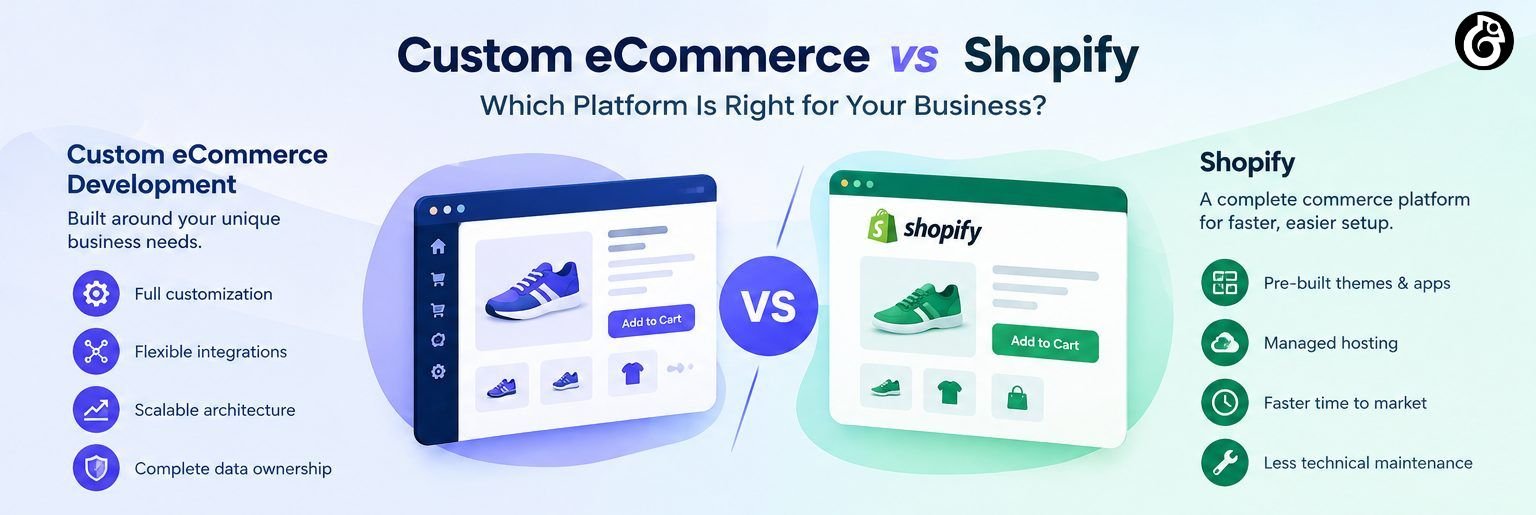
Two common options are custom eCommerce development and Shopify. With Shopify, an online store can be launched using a hosted commerce platform, prebuilt themes, apps, and established commerce features. With custom eCommerce development, the store is built around specific business requirements, allowing greater control over functionality, workflows, integrations, and technical architecture.
However, neither approach is the right choice for every business. A startup that needs to validate a product quickly may benefit from Shopify, while an enterprise with complex pricing rules, specialized workflows, or extensive system integrations may require a custom-built solution.
Before a decision is made, the differences between these approaches should be evaluated in terms of budget, flexibility, development time, scalability, ownership, and future business goals. With guidance from an experienced ecommerce development company, the right approach can be selected according to current needs and long-term growth plans.
What Is Custom eCommerce Development?
Custom eCommerce development refers to the creation of an online store or digital commerce platform that is tailored to a business’s specific requirements. Instead of relying entirely on predefined platform features, the website architecture, user experience, business logic, and integrations are developed around the intended customer journey and operational model.
A custom solution may be developed from the ground up or built using an existing framework, commerce engine, or headless architecture. The exact approach depends on the required level of flexibility, technical complexity, and control.
Custom eCommerce development may be suitable for businesses that require:
- Unique product configuration or customization.
- Complex pricing, discounts, or quotation workflows.
- B2B purchasing and account-specific pricing.
- Multi-vendor marketplace functionality.
- Advanced inventory and order management.
- Integration with ERP, CRM, PIM, or warehouse systems.
- Specialized subscription or recurring billing workflows.
- Custom checkout and customer account experiences.
- Multi-region operations with specific business rules.
For example, a manufacturer selling products through distributors may need customer-specific catalogs, negotiated pricing, approval workflows, and integration with an existing ERP system. If these requirements cannot be supported efficiently by a standard platform, custom development may provide greater control.
An experienced ecommerce development company can help determine which components should be custom-built, which existing technologies can be reused, and how the platform should be structured for future expansion.
What Is Shopify Development?
Shopify is a hosted eCommerce platform through which businesses can create and manage online stores without having to build every core commerce component independently. Hosting, store administration, product management, order processing, and many essential commerce capabilities are provided through the platform.
Additional functionality can be introduced through themes, apps, integrations, and custom development. Shopify also supports more advanced implementation approaches, including headless commerce and custom storefront experiences.
Shopify development services may include:
- Store setup and configuration.
- Theme customization and responsive design.
- Product catalog and collection setup.
- Payment and shipping configuration.
- App installation and integration.
- Custom storefront development.
- Checkout customization within supported capabilities.
- Store migration and data transfer.
- Performance and conversion optimization.
- Ongoing maintenance and improvements.
Shopify can be especially useful when a business needs to establish an online presence quickly and wants core commerce infrastructure to be managed through a hosted platform.
A Shopify development company can help the store be configured according to the brand, product catalog, target audience, and business workflows. More advanced requirements can also be evaluated to determine whether custom apps, APIs, or a different architecture will be needed.
Custom eCommerce Development vs. Shopify: Key Differences
Although both approaches can support online sales, they differ in how the store is built, maintained, extended, and scaled.
Comparison Factor |
Custom eCommerce Development |
Shopify |
|---|---|---|
| Initial development | Often requires more planning and engineering | Generally faster with themes and built-in features |
| Customization | Extensive control over business logic and architecture | Customization is available within platform capabilities and APIs |
| Launch timeline | Depends on complexity and integrations | Often shorter for standard stores |
| Technical expertise | Greater engineering involvement may be required | Basic setup can be completed with less technical effort |
| Hosting and infrastructure | Must be selected and managed according to the architecture | Core hosting is managed by Shopify |
| Maintenance | Infrastructure, dependencies, and custom code require ongoing attention | Core platform maintenance is largely managed, while store customizations still require support |
| Integrations | Can be tailored to specialized systems | Apps and APIs cover many common requirements |
| Scalability | Can be designed around specific workload and business needs | Infrastructure is managed, but platform limits and plan-specific capabilities must be considered |
| Cost structure | Development and infrastructure costs vary by scope | Subscription, apps, themes, transaction-related costs, and development fees may apply |
| Platform dependency | Depends on the selected technologies and services | Greater dependency on Shopify’s platform and ecosystem |
| Best suited for | Complex or highly differentiated commerce requirements | Many startups, small businesses, and growing online retailers |
The best option should be selected according to the business model and requirements rather than based on a general assumption that custom development is always more powerful or Shopify is always less expensive.
Development Cost: Which Option Is More Affordable?
Budget is often one of the first considerations when an eCommerce project is planned. However, the initial development quote should not be treated as the total cost of ownership.
Custom eCommerce Development Cost
Custom eCommerce development can require a larger initial investment because the architecture, user interface, business rules, integrations, and testing processes may need to be developed specifically for the project.
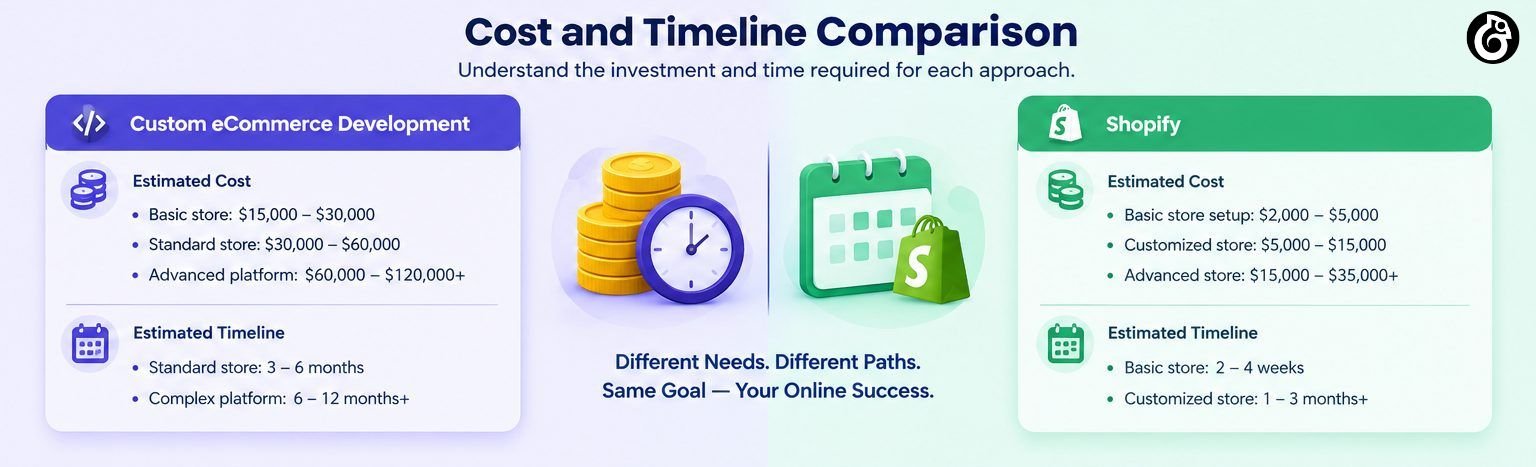
Illustrative planning ranges are shown below. Actual costs will depend on the development team’s location, scope, technology stack, and complexity.
Project Type |
Estimated Development Cost |
|---|---|
|
Basic custom online store |
$15,000–$30,000 |
|
Standard custom eCommerce website |
$30,000–$60,000 |
|
Advanced eCommerce platform |
$60,000–$120,000 |
| B2B eCommerce platform |
$50,000–$150,000+ |
| Multi-vendor marketplace |
$60,000–$180,000+ |
| Enterprise commerce solution |
$100,000–$300,000+ |
These figures are indicative planning estimates, not fixed market prices. Hosting, third-party services, licenses, payment processing, and ongoing maintenance may be charged separately.
Shopify Development Cost
Shopify generally allows a store to be launched with a lower initial development investment when standard features and existing themes are sufficient.
Typical project-level planning estimates may include:
Project Type |
Estimated Development Cost |
|---|---|
| Basic Shopify store setup | $2,000–$5,000 |
| Customized Shopify store | $5,000–$15,000 |
| Advanced Shopify storefront | $15,000–$35,000 |
| Shopify store with complex integrations | $20,000–$60,000+ |
| Large-scale Shopify implementation | $40,000–$100,000+ |
These estimates cover development work and may exclude Shopify subscription fees, paid apps, premium themes, transaction costs, and other recurring expenses.
Which Is More Cost-Effective?
Shopify is often more cost-effective when standard commerce features can meet the business requirements. Lower infrastructure management demands and the availability of established apps can reduce the amount of custom engineering required.
Custom development may provide better long-term value when specialized workflows are central to the business and would otherwise require extensive workarounds, multiple apps, or ongoing subscription expenses.
The total cost should therefore be evaluated over several years, including development, subscriptions, maintenance, infrastructure, integrations, and future enhancements.
 Customization and Design Flexibility
The level of customization required should be considered before the platform is selected.
Custom eCommerce Development
A custom platform can be designed around the exact needs of the business. Product configuration, navigation, checkout workflows, pricing logic, account permissions, and operational dashboards can be developed to match specific requirements.
This flexibility can be valuable when a unique customer experience is part of the competitive strategy. For example, a business selling made-to-order industrial equipment may require complex product specifications, technical approvals, and quote-based ordering.
With custom development, the underlying architecture can be selected to support these requirements. However, every additional custom feature introduces design, testing, maintenance, and security responsibilities.
Shopify
Shopify offers a large ecosystem of themes, apps, storefront customization options, and APIs. Brand identity, product pages, collections, navigation, and many checkout-related experiences can be customized within supported boundaries.
For many retailers, these capabilities are sufficient to deliver a distinctive shopping experience without developing an entire commerce system from scratch.
More advanced customization may require custom app development, specialized APIs, or a headless storefront. Such approaches can provide greater flexibility, but development complexity and costs may also increase.
Verdict: Custom eCommerce development is generally better when business logic and workflows must be highly specialized. Shopify is often sufficient when the required experience can be delivered through its existing capabilities and supported extensions.
Development Time and Speed to Market
The time required to launch an online store depends on scope, design complexity, integrations, product data, testing, and the availability of decision-makers.
Custom eCommerce Development Timeline
A custom platform may require several months because the architecture, user experience, backend services, integrations, and administrative workflows must be planned and implemented.
An illustrative timeline is provided below:
Development Stage |
Estimated Duration |
|---|---|
| Discovery and requirements | 2–4 weeks |
| UI/UX design | 3–6 weeks |
| Architecture and backend development | 6–12 weeks |
| Frontend development | 4–10 weeks |
| Integrations | 2–8 weeks |
| Testing and quality assurance | 3–6 weeks |
| Deployment | 1–2 weeks |
Some stages can be completed in parallel. A standard custom store may take approximately 3–6 months, while a complex platform may require 6–12 months or longer.
Shopify Development Timeline
A basic Shopify store may be launched in a few weeks when product data, content, branding, and business decisions are ready. A more customized store with multiple integrations may require several months.
Theme selection, standard checkout capabilities, product management, and established payment options can reduce implementation time.
However, launch speed should not be evaluated only by the time required to publish the website. Product migration, analytics, shipping rules, tax configuration, accessibility, performance testing, and operational readiness must also be included.
Verdict: Shopify is usually the faster option for standard stores. Custom development is more suitable when the required functionality justifies the additional planning and engineering time.
Scalability and Business Growth
Scalability should be evaluated across technical performance, operational complexity, product expansion, and business processes.
Custom eCommerce Development
A custom solution can be architected around expected traffic, order volumes, integrations, regional requirements, and data processing needs. Caching, databases, background jobs, search infrastructure, and service boundaries can be selected according to the workload.
This level of control can be useful for businesses with complex operations or differentiated commerce models.
However, scalability is not guaranteed simply because a platform is custom-built. Poor architecture, inefficient database queries, inadequate testing, and weak operational practices can create significant limitations.
Shopify
Shopify provides managed commerce infrastructure and can support many growing businesses without requiring the merchant to manage underlying hosting servers.
As traffic and order volume increase, the platform’s managed capabilities can reduce the operational burden. Nevertheless, API limits, app performance, data access patterns, plan-specific functionality, and platform constraints should be reviewed as the business grows.
A headless implementation may be appropriate for some advanced storefront needs, but it should be adopted only when the additional flexibility justifies the extra complexity.
Verdict: Both approaches can support growth. Custom development offers greater architectural control, while Shopify reduces infrastructure management for businesses whose needs fit within the platform.
SEO, Performance, and Customer Experience
Search visibility and user experience can have a direct influence on product discovery, engagement, and sales. The selected approach should support technical SEO, fast page loading, mobile usability, accessible navigation, and an effective checkout journey.
Custom eCommerce Development
With a custom platform, control can be provided over URL structures, metadata, structured data, internal linking, rendering strategies, image delivery, caching, and page templates.
However, these capabilities must be implemented correctly. SEO problems can be introduced when redirects, canonical tags, indexation rules, or structured data are overlooked.
Performance must also be engineered and monitored rather than assumed.
Shopify
Shopify provides established commerce functionality and supports many common SEO requirements, including editable page metadata, product URLs, redirects, and sitemap generation. Themes and apps can be used to extend store functionality.
Performance can still be affected by large images, excessive apps, third-party scripts, poorly implemented themes, and unnecessary code.
Regardless of the platform, product descriptions, category structure, navigation, page speed, mobile usability, and checkout clarity should be optimized.
Verdict: Neither approach automatically guarantees stronger SEO or conversions. Results depend on implementation quality, content strategy, technical optimization, and ongoing testing.
Integrations and Business Automation
An eCommerce store often needs to exchange data with payment gateways, shipping providers, inventory systems, accounting software, marketing platforms, and customer relationship management systems.
Custom eCommerce Development
Custom integrations can be designed around the requirements of existing business systems. Data synchronization, approval processes, order routing, inventory updates, and specialized workflows can be implemented according to operational needs.
This approach is useful when an organization depends on legacy systems or proprietary applications that cannot be integrated easily through standard connectors.
Shopify
Shopify supports many common integrations through apps and APIs. Standard connections can be implemented for marketing, payments, fulfillment, analytics, and inventory management.
For less common workflows, custom apps or middleware may be required. Compatibility, app maintenance, API limits, data synchronization, and ongoing subscription costs should be assessed before implementation.
Verdict: Shopify works well for many standard integrations. Custom development may be preferable when integrations are central to the business and require specialized control.
Security, Maintenance, and Platform Ownership
Security and maintenance responsibilities differ between the two approaches.
Custom eCommerce Development
Greater technical control is provided through custom development, but responsibility is also increased. Security patches, dependency updates, infrastructure configuration, backups, access controls, monitoring, and incident response must be managed.
A qualified team should be assigned to maintain the application after launch. Security testing and regular reviews should be included in the ongoing development plan.
Shopify
Core hosting and much of the underlying platform infrastructure are managed by Shopify. This can reduce the burden of maintaining servers and core commerce infrastructure.
However, the store owner remains responsible for appropriate account security, staff permissions, app selection, customer data practices, and compliance with applicable requirements. Themes, custom code, integrations, and third-party apps must also be maintained.
Shopify stores are also more dependent on the platform’s supported features, pricing, policies, and ecosystem.
Verdict: Shopify generally requires less infrastructure maintenance. Custom development provides more technical control but requires a stronger ongoing engineering and security commitment.
Which Option Is Better for Different Business Types?
The best approach depends on the business model, operational requirements, and available resources.
Business Type |
Potentially Better Fit |
Reason |
|---|---|---|
| Startup launching its first store | Shopify | Faster launch and lower initial engineering requirements |
| Small or mid-sized retailer | Shopify | Standard commerce capabilities may be sufficient |
| Direct-to-consumer brand | Shopify or custom | Depends on catalog, customer experience, and integrations |
| B2B distributor | Custom or advanced Shopify | Account-specific pricing and workflows may be required |
| Multi-vendor marketplace | Custom or specialized marketplace solution | Vendor management, commissions, and complex permissions may be needed |
| Enterprise with legacy systems | Custom or hybrid | Deeper integration and architectural control may be required |
| Subscription business | Shopify or custom | Depends on billing, account, and subscription complexity |
| Global retailer | Either | Regional needs, currencies, tax, fulfillment, and platform capabilities must be evaluated |
These recommendations are starting points rather than fixed rules. Shopify may support more advanced use cases than a basic store, while custom development may be unnecessary when the business requirements can be met effectively through established commerce tools.
When Should You Choose Custom eCommerce Development?
Custom development should be considered when the business requirements extend beyond standard commerce functionality or when the online store is expected to serve as a core operational platform.
It may be the better choice when:
- Highly specialized business logic is required.
- Complex B2B pricing or ordering workflows must be supported.
- Multiple enterprise systems need deep integration.
- Product configuration requires custom logic.
- A unique customer experience is central to differentiation.
- Greater control over architecture and data processing is needed.
- Long-term product development is expected to extend beyond standard store functionality.
Before the project is approved, the required features should be prioritized. A minimum viable product can be launched first, with advanced capabilities added after the most important workflows have been validated.
When Should You Choose Shopify?
Shopify should be considered when a business needs a reliable commerce foundation without investing in the development and maintenance of every underlying component.
It may be the better choice when:
- A store needs to be launched quickly.
- Standard product, order, and payment workflows are sufficient.
- Budget and internal engineering resources are limited.
- Common apps can meet integration requirements.
- Store management should remain accessible to nontechnical teams.
- The business needs a managed hosting environment.
- A conventional retail model is being used.
The platform’s limitations should still be evaluated before a long-term commitment is made. Important requirements should be tested in a prototype or proof of concept where uncertainty exists.
Can Custom Development and Shopify Be Combined?
Yes. A hybrid or headless commerce approach can be used when the business wants to retain Shopify’s commerce capabilities while introducing a more customized storefront or specialized services.
For example, Shopify may be used for product and order management, while a separate frontend is developed to provide a distinctive shopping experience. Additional services may be introduced for search, personalization, or integration with enterprise systems.
This approach can provide a balance between managed commerce functionality and custom experiences. However, more components must be coordinated, and additional responsibility may be introduced for hosting, API integrations, testing, monitoring, and maintenance. A hybrid solution should therefore be selected only when the benefits justify its complexity and cost.
How to Choose the Right eCommerce Development Partner
The quality of implementation can be just as important as the platform selected. A development partner should be evaluated according to technical expertise, project experience, communication, delivery process, and ongoing support.
Before a partner is selected, the following areas should be reviewed:
- Relevant experience: Previous work with comparable commerce models and integrations.
- Technical capability: Knowledge of the selected platform, APIs, performance, security, and data architecture.
- UX and design quality: Ability to create intuitive shopping journeys and responsive interfaces.
- Project transparency: Clear scope, milestones, assumptions, and change-management procedures.
- Testing practices: Functional, integration, performance, and security testing.
- Post-launch support: Maintenance, monitoring, bug fixes, and future improvements.
- Business alignment: A clear understanding of the organization’s objectives and constraints.
If a custom store is being planned, the ability to hire ecommerce developers with the right frontend, backend, integration, and architecture skills should be considered. For a Shopify project, a team experienced in theme development, Shopify APIs, app integrations, and platform-specific constraints may be more suitable.
How Beadaptify Can Support Your eCommerce Project
Selecting the right commerce platform requires a balance between business goals, technical requirements, budget, and future growth. At Beadaptify, the development approach can be aligned with the specific needs of each project, whether a Shopify store, a custom eCommerce platform, or a hybrid solution is being considered.
Through tailored ecommerce development services, the required features, integrations, user journeys, and technical architecture can be planned before implementation begins. Where custom functionality is required, experienced developers can be engaged to build and integrate the components needed to support business operations.
For Shopify-based projects, Shopify development services can be used to support store configuration, theme customization, integrations, and storefront improvements. A Shopify development approach can also help ensure that platform-specific requirements are considered during planning, development, and testing.
The focus should be placed on creating a store that is easy to use, reliable, secure, and capable of supporting the intended business model. Whether the goal is to launch quickly or build a highly differentiated commerce experience, the right development strategy should be guided by measurable requirements and long-term value.
Final Thoughts: Custom eCommerce Development vs. Shopify
The decision between custom eCommerce development and Shopify should be based on the complexity of the business model, desired flexibility, development budget, launch timeline, integration needs, and long-term operating costs.
Shopify is often the practical choice when a store can be built around established commerce capabilities and a faster launch is a priority. Custom eCommerce development may be more appropriate when specialized workflows, complex integrations, or deeper architectural control are required. Neither option should be selected solely because it is cheaper, more flexible, or more popular. The right choice is the one that meets current requirements without creating unnecessary complexity or restricting future growth.

FAQs About Custom eCommerce Development vs. Shopify
Is custom eCommerce development better than Shopify?
Custom eCommerce development may be better for businesses with complex workflows, specialized integrations, or unique technical requirements. Shopify may be better for businesses that need a faster launch and can use established commerce features. The right choice depends on the requirements, budget, and long-term goals.
Is Shopify cheaper than custom eCommerce development?
Shopify often has a lower initial development cost because hosting and core commerce features are provided through the platform. However, subscriptions, apps, transaction-related expenses, and customizations must be considered. Custom development may cost more initially but can be justified when specialized functionality is required.
How long does custom eCommerce development take?
A standard custom eCommerce website may take approximately three to six months, while a complex enterprise platform may require six to twelve months or longer. The timeline depends on feature complexity, integrations, design, testing, and project readiness.
How long does it take to build a Shopify store?
A basic Shopify store may be launched within a few weeks when the content, products, and branding are ready. A highly customized store with advanced integrations may require several months.
Can Shopify support enterprise eCommerce?
Shopify can support many growing and enterprise commerce operations, depending on the required capabilities and selected plan. However, complex workflows, specialized integrations, and platform constraints should be evaluated before a decision is made.
Can a business migrate from Shopify to a custom eCommerce platform?
Yes. A migration can be planned to transfer products, customers, orders, and other required data to a custom platform. The process should include data mapping, URL redirects, integration planning, testing, SEO checks, and a controlled launch to minimize disruption.