Building a software product requires more than selecting a technology stack and defining features. The right development model also needs to be selected because team structure can influence project control, communication, cost, scalability, development speed, and long-term maintenance.
Two commonly used approaches are dedicated development teams and outsourced development. In a dedicated team model, developers are assigned to a specific project and work as an extension of the client’s internal team. With outsourcing, a software development company or external development partner is engaged to manage some or all parts of the development process.
Both models can be used for web applications, mobile applications, SaaS platforms, enterprise software, and other digital products. However, the right choice will depend on project scope, internal resources, technical requirements, budget, timeline, and expected involvement.
This guide explains the major differences between dedicated development teams and outsourcing, including cost, control, flexibility, scalability, hiring, communication, security, and project suitability.
What Is a Dedicated Development Team?
A dedicated development team is a group of professionals assigned to work exclusively or primarily on a client’s project for an agreed period.
The team can include:
- Project managers
- Business analysts
- UI/UX designers
- Front-end developers
- Back-end developers
- Mobile app developers
- QA engineers
- DevOps engineers
- Solution architects
The team is usually managed according to the client’s product requirements and development priorities. Developers can work as an extension of the internal organization while remaining employed or contracted through an external technology provider.
For example, a company developing a SaaS platform may require a long-term team consisting of a project manager, UI/UX designer, React developer, Node.js developer, QA engineer, and DevOps specialist. Instead of recruiting each position internally, a dedicated team can be assembled through a technology partner.
What Is Software Development Outsourcing?
Software development outsourcing involves assigning development responsibilities to an external software development company or technology provider.
Depending on the agreement, the external provider may manage:
- Product discovery
- Business analysis
- UI/UX design
- Software architecture
- Development
- Testing
- Deployment
- Maintenance
- Technical support
The level of client involvement can vary significantly.
A project-based outsourcing arrangement may be used when a clearly defined product needs to be developed within a specific scope and timeline. Managed outsourcing may also be used when ongoing development and maintenance are required.
Dedicated Development Team vs. Outsourcing: Key Differences
Factor |
Dedicated Development Team |
Outsourcing |
|---|---|---|
| Team structure | Dedicated professionals are assigned to the project | External team manages defined project responsibilities |
| Client control | High | Moderate to high, depending on contract |
| Flexibility | High for long-term changes | High for defined scopes |
| Scalability | Team size can be adjusted | Resources can usually be added based on project needs |
| Management | Greater client involvement | More management may be handled externally |
| Cost model | Usually ongoing monthly cost | Usually project-based, milestone-based, or hourly |
| Long-term development | Highly suitable | Suitable when ongoing support is included |
| Communication | Direct and continuous | Depends on provider and engagement model |
| Recruitment effort | Reduced | Significantly reduced |
| Product ownership | Usually retained by client | Usually retained by client |
| Best fit | Long-term and evolving products | Defined projects and outsourced functions |
How Does a Dedicated Development Team Work?
The dedicated model is generally structured around long-term collaboration.
1. Requirements Are Defined
The business requirements, technical requirements, product goals, and expected team composition are identified.
2. The Team Is Assembled
Developers and other specialists are selected according to the required technologies and experience.
3. Responsibilities Are Assigned
Roles, communication channels, development processes, reporting structures, and project responsibilities are established.
4. Development Begins
The team works according to the agreed development methodology, which may include Agile, Scrum, Kanban, or another approach.
5. The Team Evolves With the Product
As requirements change, team composition can be adjusted. Additional developers can be added, while unnecessary roles can be reduced.
This structure can be particularly useful for products that are expected to evolve continuously.
How Does Software Development Outsourcing Work?
A typical outsourcing process can be structured as follows:
1. Project Scope Is Defined
The required features, platforms, integrations, technical requirements, and expected outcomes are documented.
2. Development Partner Is Selected
A software development company is evaluated based on technical expertise, relevant experience, development capabilities, communication processes, and commercial terms.
3. Proposal and Agreement Are Prepared
The scope, timeline, responsibilities, pricing structure, deliverables, intellectual property terms, and support requirements are established.
4. Development Is Started
The external team begins design, development, testing, and other agreed activities.
5. Progress Is Reviewed
Milestones, demonstrations, testing results, and deliverables are reviewed throughout the project.
6. Product Is Delivered and Supported
After deployment, maintenance and ongoing development can be continued when such services have been included in the engagement.
Cost Comparison: Dedicated Team vs. Outsourcing
Cost is one of the most important considerations when a development model is being selected.
However, a direct price comparison cannot always be made because different pricing structures are used.
Dedicated Development Team Costs
Costs are generally influenced by:
- Number of developers
- Developer experience
- Technology stack
- Team location
- Project duration
- Required specialists
- Project management requirements
- QA and DevOps requirements
A monthly payment structure is commonly used.
For example, a long-term SaaS project may require a team of five to eight specialists. A monthly team cost can then be calculated according to the roles and experience levels required.
Outsourcing Costs
Outsourcing costs can be calculated using:
- Fixed-price contracts
- Hourly billing
- Milestone-based pricing
- Monthly retainers
- Dedicated team arrangements
Fixed-price outsourcing can be useful when requirements are clearly defined. Hourly or milestone-based models can provide greater flexibility when requirements are expected to change.
Which Model Provides More Control?
A dedicated development team generally provides greater day-to-day involvement.
Product priorities can be communicated directly, sprint planning can be influenced, and technical decisions can be discussed with the team.
Outsourcing can also provide substantial control, but the degree of involvement depends on the engagement model.
For businesses that want to participate heavily in product development, a dedicated team may provide a more integrated working structure. For businesses that prefer to delegate more responsibilities, outsourcing can provide a more managed experience.
Which Model Offers Greater Flexibility?
Flexibility is particularly important for products where requirements are expected to evolve. A dedicated team can be adjusted as new requirements are introduced. Additional developers, designers, testers, or specialists can be added when necessary.
Outsourcing can also be flexible, particularly when an experienced software development company is involved. However, flexibility may depend on the original scope and contractual structure. For rapidly evolving products, the engagement model should therefore be selected with future changes in mind rather than only the initial development scope.
Dedicated Development Team for SaaS Products
SaaS products are often developed continuously rather than being treated as one-time projects.
New features, integrations, performance improvements, security updates, analytics capabilities, and customer requests may need to be addressed after the initial launch.
For this reason, companies planning long-term SaaS products may choose to Hire SaaS Developers through a dedicated development model.
A dedicated SaaS team can be structured around:
- Product management
- UI/UX design
- Front-end development
- Back-end development
- API development
- Cloud infrastructure
- QA
- Security
- DevOps
This approach allows the team to build product knowledge over time.
When Should You Hire Mobile App Developers?
Businesses planning a mobile product may choose to hire mobile app developers when specialized mobile expertise is required.
Mobile development may involve:
- Android development
- iOS development
- React Native
- Flutter
- Swift
- Kotlin
- API integration
- Push notifications
- Mobile payments
- Device features
- App-store deployment
When a mobile product is expected to receive continuous updates, mobile app developers for hire can be incorporated into a dedicated development team.
This approach can reduce the need to repeatedly recruit specialists whenever a new feature is planned.
When Should You Hire Web Developers?
Web applications can involve complex front-end, back-end, database, API, cloud, and security requirements.
Businesses may choose to hire web developers when internal development capacity is limited or specialized expertise is required.
Depending on the project, web developers for hire may be engaged for:
- Corporate websites
- SaaS platforms
- Customer portals
- E-commerce applications
- Enterprise applications
- Marketplaces
- Business dashboards
- Custom web applications
For long-term products, web developers can be incorporated into a dedicated team. For clearly defined projects, development can instead be outsourced to a software development company.
Dedicated Team vs. Outsourcing for Startups
Startups often operate with limited budgets and small internal teams.
A dedicated team can provide access to multiple specialists without requiring full-time internal recruitment. This can be useful when a product is expected to evolve significantly after the MVP stage.
Outsourcing can also be useful when the startup has a clearly defined MVP and wants the product to be developed within a specific scope.
The decision should be based on the expected product lifecycle.
If continuous product development is expected, a dedicated model may provide greater continuity. If an MVP is being developed around a clearly defined scope, project-based outsourcing may be considered.
Dedicated Team vs. Outsourcing for Enterprises
Enterprise software projects often involve complex integrations, security requirements, multiple user roles, legacy systems, and long development cycles.
A dedicated team can be created around specific enterprise requirements, allowing technical knowledge to remain within the team over an extended period.
Outsourcing can also be used to supplement internal teams, modernize legacy systems, develop specific applications, or support specialized technology requirements.
A hybrid approach can also be adopted, where internal product teams work alongside external developers.
Communication and Collaboration
Communication can strongly affect development quality.
A dedicated team usually works closely with the client’s product and management teams. Regular sprint meetings, technical discussions, reviews, and planning sessions can be established.
In outsourced projects, communication processes are normally established through:
- Weekly meetings
- Sprint reviews
- Project management platforms
- Documentation
- Progress reports
- Video conferences
- Technical demonstrations
Regardless of the model, communication responsibilities should be defined before development begins.
Security and Intellectual Property
Security should be addressed in both development models.
Contracts should clearly define:
- Intellectual property ownership
- Source-code ownership
- Confidentiality
- Data protection
- Access controls
- Security responsibilities
- Documentation ownership
- Third-party dependencies
Security should not be treated as an additional activity after development. It should be incorporated throughout the development lifecycle.
Quality Assurance and Testing
Quality assurance is required regardless of the selected model.
Testing may include:
- Functional testing
- Regression testing
- API testing
- Performance testing
- Security testing
- Compatibility testing
- Usability testing
- Mobile device testing
- Browser testing
- User acceptance testing
With a dedicated team, QA specialists can remain involved throughout the product lifecycle.
With outsourcing, QA responsibilities can be included within the development agreement and managed by the external provider.
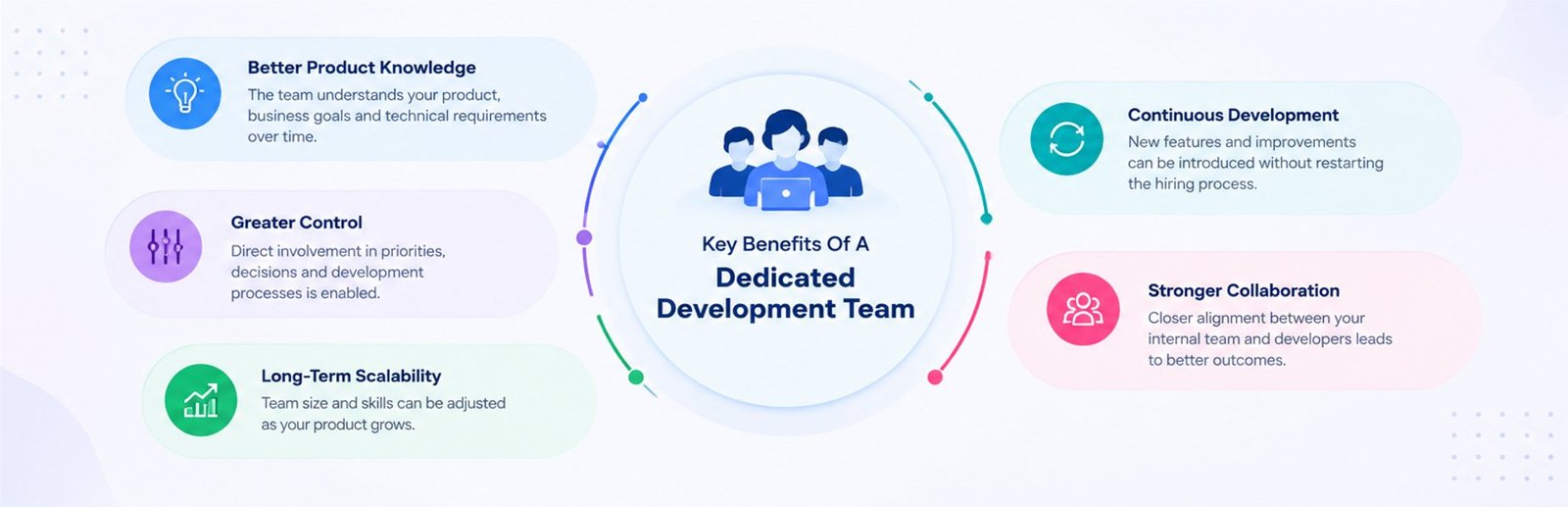
Advantages of a Dedicated Development Team
Several benefits can be provided by the dedicated model.
Better Product Knowledge
Long-term involvement allows developers to become familiar with the product architecture and business requirements.
Greater Control
Product priorities and development decisions can be influenced more directly.
Long-Term Scalability
The team can be expanded as product requirements increase.
Continuous Development
New features and improvements can be introduced without starting the recruitment process again.
Stronger Collaboration
Closer collaboration can be established between the internal business team and developers.
Advantages of Outsourcing
Outsourcing can provide several benefits as well.
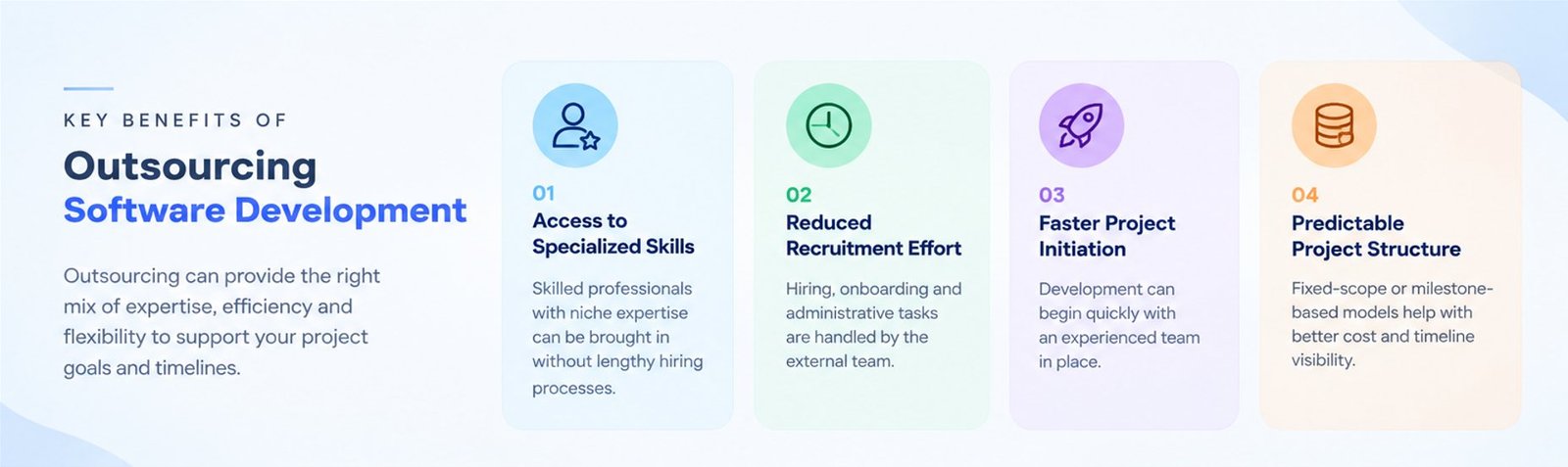
Access to Specialized Skills
Specialists can be accessed without being recruited internally.
Reduced Recruitment Effort
Hiring, onboarding, and administrative responsibilities can be reduced.
Faster Project Initiation
Development can often be started with an existing team.
Predictable Project Structure
Fixed-scope projects can be managed around defined milestones and deliverables.
Access to Broader Expertise
A software development company may provide access to designers, developers, QA engineers, DevOps specialists, and architects within one organization.
Limitations of a Dedicated Development Team
Although dedicated teams provide significant flexibility, some limitations should be considered.
A longer-term financial commitment may be required. More internal management may also be needed because product priorities and team coordination are often handled closely by the client.
If the product scope changes significantly, the team structure may need to be adjusted.
Limitations of Outsourcing
Outsourcing can introduce challenges when communication processes are unclear.
Potential concerns may include:
- Less direct control
- Communication gaps
- Differences in working hours
- Misunderstood requirements
- Scope changes
- Dependency on the external provider
These risks can be reduced through clear documentation, regular communication, transparent project management, and well-defined contracts.
Dedicated Development Team vs. Outsourcing: Which Model Should Be Used?
There is no universal model that should be used for every software project.
A dedicated development team can be considered when:
- Long-term development is expected
- Requirements will evolve
- Continuous product improvement is required
- Strong developer involvement is preferred
- A SaaS product is being built
- Internal product management is available
- The team may need to be scaled over time
Outsourcing can be considered when:
- A specific project needs to be completed
- Requirements are relatively clear
- Internal technical resources are limited
- Faster access to specialists is required
- Development management should be delegated
- A defined budget and timeline are available
Can Both Models Be Combined?
Yes. A hybrid model can also be used.
For example, a company may maintain an internal product management team while an external development team handles engineering.
Another structure may involve:
Internal Team + Dedicated Developers + Specialized Outsourcing
Under this model, internal employees can manage business strategy while dedicated developers handle continuous development and specialized external teams support specific requirements such as cybersecurity, cloud migration, or UI/UX design.
This structure can provide flexibility when different stages of a product require different types of expertise.
How to Choose the Right Development Partner
The development partner should be evaluated beyond pricing.
Important factors include:
Technical Expertise
The required technologies should be supported by experienced developers.
Relevant Experience
Experience with similar products, industries, platforms, or integrations can reduce the learning curve.
Communication
Clear communication processes should be established from the beginning.
Development Methodology
Agile, Scrum, or another suitable development methodology should be supported.
Security Practices
Security procedures, access controls, testing, and data protection should be clearly defined.
Post-Launch Support
Maintenance and ongoing development should be available when required.
Scalability
The team should be capable of being expanded or adjusted as project requirements change.
Why Work With Beadaptify?
Working with Beadaptify, an experienced software development company can provide access to multiple technical capabilities under one engagement. Instead of separately searching for designers, developers, QA engineers, DevOps specialists, and project managers, the required team can be assembled through one technology partner.
This can be particularly useful when a business needs to hire developers, hire mobile app developers, hire web developers, or Hire SaaS Developers without establishing a large internal engineering department. A structured development partner can also provide product discovery, UI/UX design, architecture, development, testing, deployment, and ongoing support under one coordinated process.
Cost Optimization Tips
Regardless of the selected model, development costs can be controlled through careful planning.
Start With an MVP
Only the most important features should be developed during the initial release.
Define Requirements Clearly
Detailed requirements can reduce rework and unnecessary development hours.
Prioritize Features
Features should be ranked according to business value and user requirements.
Select the Right Technology
The technology stack should be selected according to scalability, performance, maintenance, and project requirements.
Use Reusable Components
Reusable UI components, APIs, libraries, and development practices can reduce unnecessary development effort.
Plan for Scalability
The architecture should be designed to support future growth without requiring a complete rebuild.
Final Thoughts
The choice between a dedicated development team and outsourcing should be based on the project’s goals, duration, complexity, budget, and expected level of involvement. A dedicated team can provide long-term collaboration, greater control, continuous product knowledge, and flexible scaling. Outsourcing can provide access to specialized expertise, faster team availability, reduced recruitment effort, and structured project delivery.
Neither model is automatically suitable for every business. The development approach should instead be aligned with the product lifecycle and technical requirements. Whether developers are needed for a SaaS platform, mobile application, web application, or enterprise product, the right engagement structure can make development more organized and scalable.

FAQs About Dedicated Development Team vs. Outsourcing
Is a dedicated development team more expensive than outsourcing?
The cost depends on team size, developer experience, technology requirements, project duration, and pricing structure. A dedicated team is generally structured around ongoing costs, while outsourcing may be priced by project, milestone, hour, or month.
When should a dedicated development team be used?
A dedicated team can be useful for long-term products, SaaS platforms, continuously evolving applications, and projects where close collaboration is required.
When should software development be outsourced?
Outsourcing can be considered when a clearly defined project needs to be completed, internal technical resources are limited, or specialized development expertise is required.
Can I hire mobile app developers through a dedicated team?
Yes. Mobile app developers can be included in a dedicated team based on the required platform and technology, including Android, iOS, React Native, or Flutter.
Can web developers be hired for long-term projects?
Yes. Web developers can be engaged as part of a dedicated development team for SaaS platforms, portals, e-commerce applications, enterprise systems, and custom web applications.
Can SaaS developers be hired through an external company?
Yes. SaaS developers can be provided through a software development company or dedicated development partner based on the product’s technical requirements.
Can dedicated development and outsourcing be combined?
Yes. A hybrid model can be created where internal teams, dedicated developers, and specialized outsourcing partners work together.