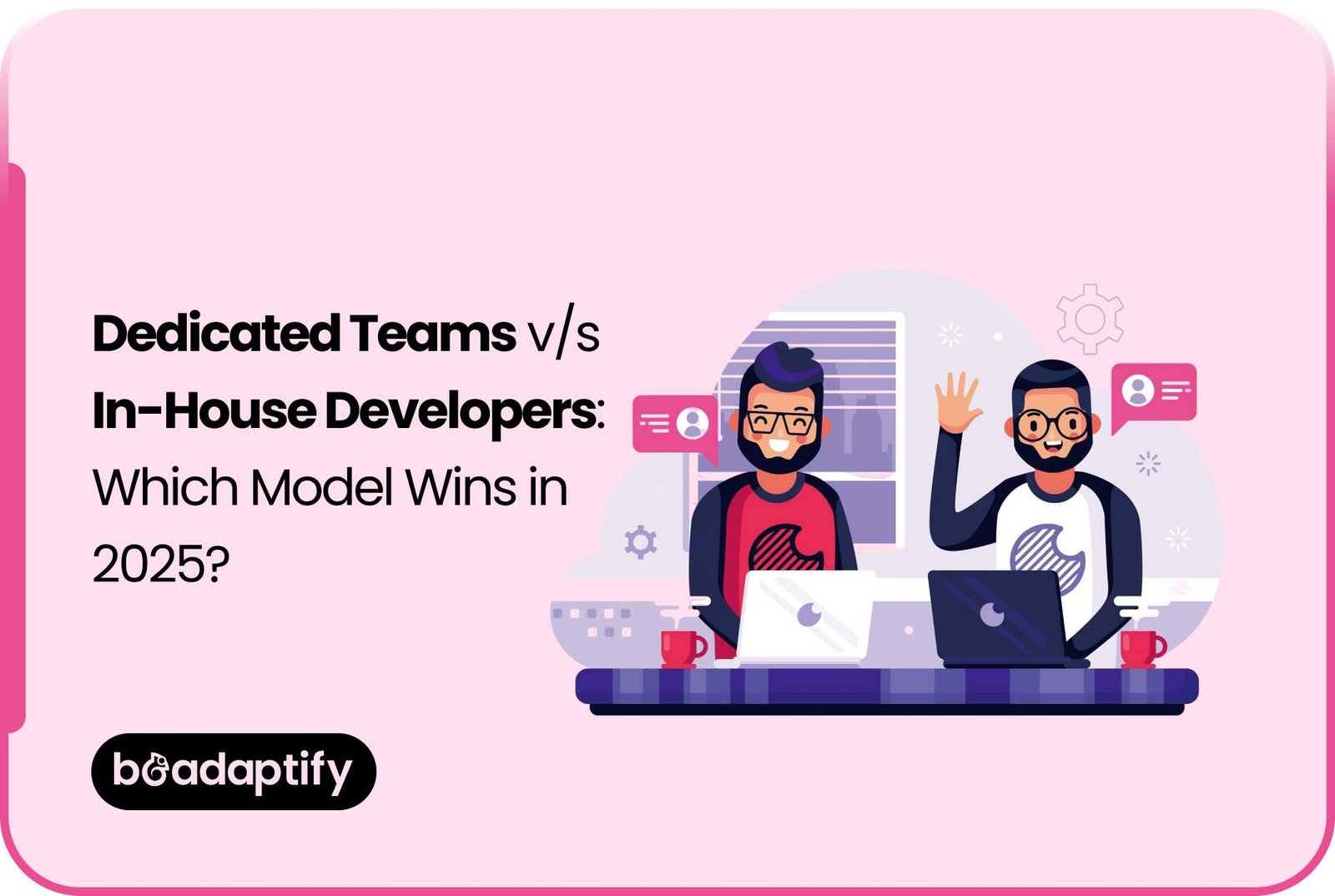
In 2025, the digital ecosystem is being reshaped by AI-driven workflows, remote collaboration tools, and on-demand tech talent. As competition intensifies, businesses are required to decide between two major development models: In-House vs. Dedicated Development Team.
This choice defines not only the speed and quality of product delivery, but also the long-term scalability of a company’s digital ecosystem. Both models have evolved rapidly, yet their advantages and trade-offs continue to spark debate among startups, enterprises, and digital transformation leaders.
The question is no longer just about cost, it’s about strategic alignment, innovation velocity, and resource sustainability.
Understanding the Models
What Is an In-House Development Team?
An In-House Development Team consists of employees directly hired by a company. They are trained, managed, and nurtured under the organization’s internal culture and processes.
In-house developers typically work full-time within the company’s infrastructure, following its methodologies, technologies, and product roadmaps. Their commitment is exclusive, and they are deeply integrated into business goals and brand values.
What Is a Dedicated Development Team?
A Dedicated Development Team is formed by an external Software Development Company that provides experts exclusively focused on your project. These professionals engineers, designers, QA specialists, and project managers work remotely but act as an extension of your core team.
This model is often chosen through Software Development Outsourcing, where businesses can hire mobile app developers or hire dedicated web developers based on project needs. Dedicated teams bring scalability, flexibility, and global expertise without the overhead of full-time hiring.

The Evolution of Software Development Models
Over the last decade, the global software industry has seen a shift from purely internal development to hybrid collaboration ecosystems. Remote work adoption, cost optimization, and global talent availability have redefined how companies build and scale products.
- In the early 2010s, in-house teams dominated.
- By the 2020s, outsourcing and dedicated teams became a strategic necessity.
- In 2025, the conversation is about balance, not replacement.
As digital products require specialized roles UX designers, AI engineers, DevOps specialists companies can no longer rely on a single in-house structure to handle every aspect of innovation. Dedicated Teams vs In-House Teams is now a decision rooted in adaptability, not ideology.
Key Differences Between In-House vs. Dedicated Development Team
| Aspect | In-House Team | Dedicated Development Team |
|---|---|---|
| Employment Type | Full-time employees | External professionals from a vendor |
| Control Level | Direct and high | Shared with vendor’s management |
| Cost Structure | Fixed salaries, benefits, and overheads | Flexible contract-based model |
| Scalability | Slower due to hiring constraints | Rapid scalability possible |
| Expertise Diversity | Limited to internal talent | Access to global specialists |
| Setup Time | Longer | Quick setup with ready resources |
| Maintenance | Fully on company | Shared responsibility |
Each model offers strengths. While in-house teams provide cultural cohesion and brand alignment, dedicated teams enable speed, cost-efficiency, and diverse skillsets.
Cost Comparison: The Economics Behind Each Model
When cost efficiency is analyzed, Dedicated Developer vs. In-House Team showcases a clear financial difference.
In-House Team Costs Include:
- Salaries and benefits
- Office infrastructure and equipment
- Recruitment and onboarding costs
- Training and career development
- Turnover and replacement expenses
Dedicated Team Costs Include:
- Vendor management fees
- Hourly or monthly resource costs
- Communication and coordination tools
- Minimal setup or training overhead
In 2025, many CFOs are prioritizing total cost of ownership (TCO) over upfront cost. Dedicated teams reduce the burden of recruitment and retention while maintaining delivery consistency.
For example, hiring a Dedicated Developer from a reputable Software Development Company can cut operational costs by 30–50%, without sacrificing quality.
Productivity, Flexibility, and Scalability
Productivity
In-house teams thrive when long-term goals and brand familiarity are needed. However, when workload fluctuates, productivity can decline due to task misalignment or burnout.
Dedicated teams operate under milestone-based accountability, ensuring measurable productivity metrics. The flexibility of adjusting team size and composition allows continuous optimization.
Flexibility & Scalability
Dedicated teams offer unmatched scalability. New specialists QA, DevOps, UI/UX can be onboarded instantly from the partner’s talent pool.
In contrast, scaling an in-house team requires hiring cycles, HR processes, and training time. This delay impacts time-to-market, especially for fast-moving startups or enterprise MVP launches.
For projects involving mobile app developers for hire or web developers for hire, dedicated teams deliver agile adaptability that traditional hiring cannot match.
Talent Access and Technical Expertise
A primary advantage of Dedicated Teams vs In-House Teams lies in talent diversity.
In-house teams are limited to the local hiring ecosystem, often restricted by geography, cost, and niche skill availability. In 2025, the demand for specialists in AI, blockchain, cloud infrastructure, and cybersecurity continues to rise, and internal teams struggle to keep pace.
By contrast, a software development outsourcing partner provides instant access to a global network of developers with proven expertise. Through these teams, companies can tap into specialized skills that would otherwise take months to recruit in-house.
Communication and Project Management
While communication used to be a barrier for outsourced models, technology has bridged that gap.
Modern Dedicated Development Teams use collaborative tools like Jira, Slack, ClickUp, and Figma to maintain transparency. Regular sprints, daily standups, and progress dashboards ensure real-time visibility.
In-house teams naturally benefit from proximity and informal discussions. However, dedicated teams rely on structured communication frameworks often resulting in more consistent documentation and accountability.
The project management layer provided by software development company partners adds strategic oversight. This ensures alignment with business goals while maintaining performance standards.
Security, Culture, and Accountability
Security
In-house development ensures direct control over intellectual property and infrastructure. However, in 2025, NDAs, secure servers, and compliance frameworks have made dedicated models equally secure.
Leading Software Development Companies implement ISO-certified protocols, GDPR compliance, and data encryption, matching enterprise-grade standards.
Culture and Accountability
In-house teams align deeply with organizational culture and mission. Dedicated teams, though external, integrate culturally through onboarding processes and shared values.
Accountability in dedicated setups is reinforced through service-level agreements (SLAs) and performance metrics. These frameworks provide tangible assurance of deliverables and deadlines.
When to Choose a Dedicated Team
A Dedicated Development Team should be chosen when:
- Specialized skills are required quickly.
- Project scope or workload fluctuates.
- Speed to market is a priority.
- There’s a need for continuous development or long-term product evolution.
- Internal recruitment bandwidth is limited.
It’s especially suitable for startups scaling MVPs, enterprises managing multiple products, or businesses expanding digital ecosystems.
When companies hire mobile app development team or hire web developers through a dedicated partner like Beadaptify, they gain access to structured expertise without long-term liabilities.
When to Choose an In-House Team
An In-House Development Team is more beneficial when:
- Product development is ongoing and strategically core.
- Intellectual property must remain strictly internal.
- Real-time collaboration and physical presence are essential.
- A long-term culture of innovation is being built.
For established enterprises with consistent project pipelines, maintaining an in-house team ensures alignment with long-term vision.
However, in fast-paced digital landscapes, even enterprises now blend in-house management with Dedicated Developers for specialized modules.
The Hybrid Future: Merging Strengths in 2025
The winner in 2025 is not an absolute one it’s the hybrid model.
Organizations increasingly combine both approaches:
- An in-house core team ensures brand and strategic alignment.
- A dedicated external team extends technical bandwidth and speed.
This synergy results in a distributed innovation framework, where control, speed, and expertise coexist seamlessly.
At Beadaptify, such hybrid ecosystems are implemented regularly through integrated design & development services, allowing businesses to scale flexibly without sacrificing quality or cultural coherence.
How Beadaptify Helps You Choose the Right Model
At Beadaptify, businesses are guided through a strategic discovery process to identify the ideal collaboration model.
Our Approach Includes:
- Business Goal Alignment: Understanding your long-term vision and operational context.
- Technical Assessment: Evaluating existing infrastructure, skills, and resource gaps.
- Scalability Planning: Designing modular team structures adaptable to project growth.
- Cultural Integration: Ensuring communication and workflow harmony between in-house and external teams.
Whether your organization seeks mobile application developers for hire, web development team for hire, or complete software development outsourcing, Beadaptify provides end-to-end support strategy, design, development, and optimization under one roof.
By leveraging our design & development services, businesses can transition smoothly between models without disruption.

Final Thoughts
In the evolving digital environment of 2025, adaptability outperforms rigidity. Whether through an In-House vs. Dedicated Development Team comparison or a hybrid model, businesses thrive when flexibility, transparency, and expertise intersect.
In the Dedicated Teams vs In-House Teams debate, context defines victory.
- For speed, scalability, and specialized expertise, dedicated teams lead.
- For cultural integration and strategic continuity, in-house teams hold value.
- For innovation at scale, hybrid collaboration is the clear path forward.
At Beadaptify, solutions are crafted to empower your business with exactly that balance through tailored software development outsourcing, strategic partnerships, and world-class design & development solutions that scale as your vision grows.
FAQ’s About In-House vs Dedicated Teams
What is the main difference between In-House and Dedicated Teams?
An in-house team consists of full-time employees within your company, while a dedicated team is an external group hired from a software development company to work exclusively on your project.
Which is more cost-effective in 2025?
Dedicated teams are generally more cost-effective because they eliminate expenses related to recruitment, infrastructure, and benefits while offering scalable flexibility.
Can dedicated teams handle complex, long-term projects?
Yes. Modern Dedicated Developers often collaborate on enterprise-grade systems for years, functioning as integrated long-term partners.
How does communication work with a dedicated team?
Through structured tools like Jira, Slack, and Figma, daily progress and deliverables are transparently tracked ensuring consistent visibility.
Is data security safe with outsourced teams?
Reputable partners like Beadaptify implement strict NDAs, access controls, and ISO-standard security protocols to safeguard intellectual property.
Can Beadaptify help with both models?
Yes. Beadaptify specializes in both in-house team augmentation and Dedicated Development Team models through its design & development services helping clients choose what best fits their goals.