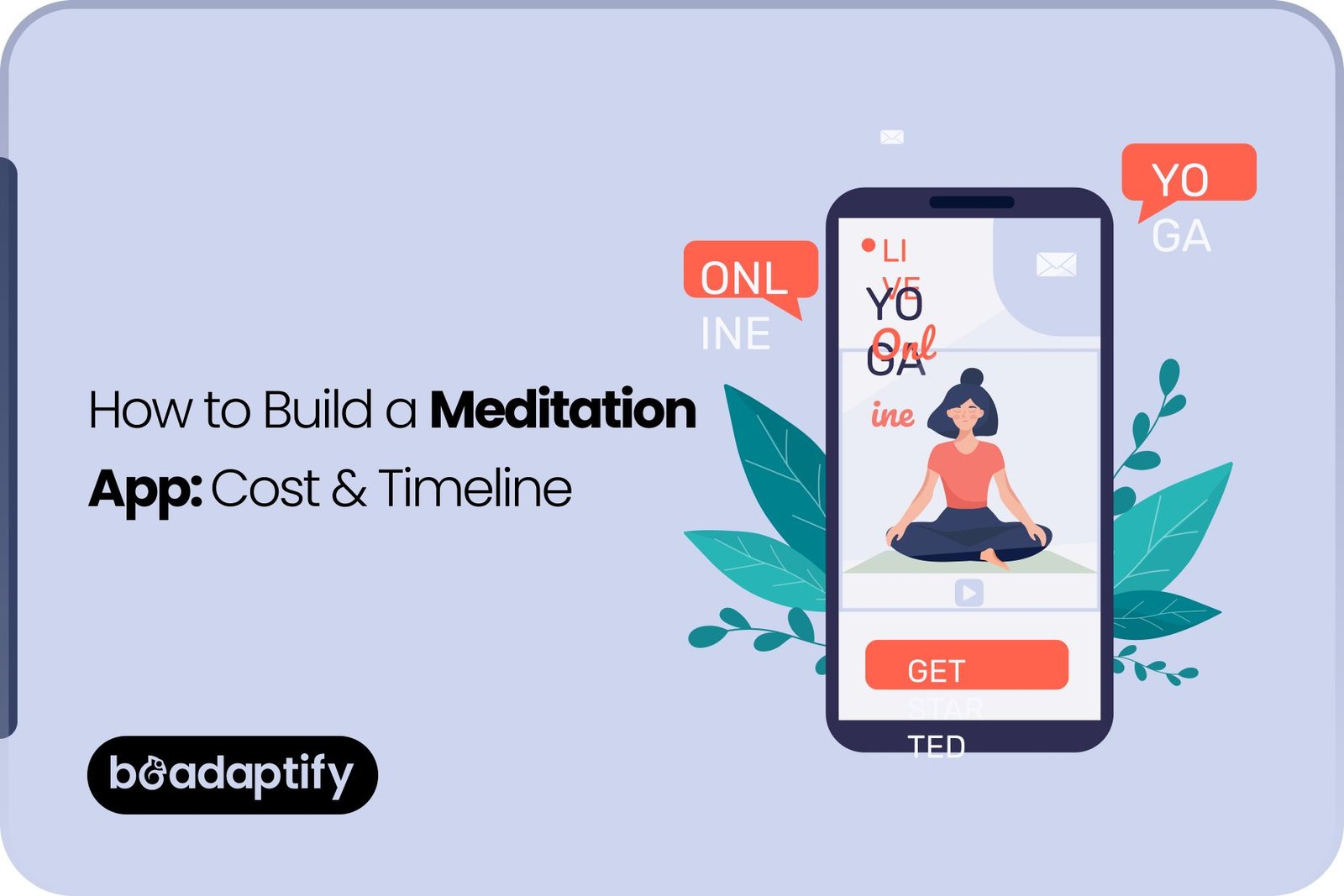
Meditation and mindfulness have increasingly been integrated into everyday digital experiences. As smartphones have become central to daily routines, meditation practices have also been moved from traditional settings into convenient mobile applications. Guided sessions, breathing exercises, sleep stories, mindfulness programs, progress tracking, and personalized recommendations can now be accessed from almost anywhere.
For businesses entering the wellness technology market, a meditation app can be developed as a scalable digital product that combines content, personalization, behavioral engagement, and subscription-based monetization. However, successful development requires more than simply adding meditation audio to a mobile interface. A carefully planned user experience, reliable content infrastructure, secure architecture, personalized recommendations, and an effective retention strategy must be incorporated.
In 2026, users are increasingly expecting wellness applications to be personalized, accessible, visually engaging, and easy to use. AI-powered recommendations, wearable integrations, offline listening, adaptive programs, and smart reminders are also being introduced to create more meaningful experiences.
For organizations planning such a product, the most important questions are often:
- How should a meditation app be built?
- Which features should be included?
- How much does meditation app development cost?
- How long does development take?
- Which technology stack should be selected?
- How can users be retained after installation?
- Which monetization model should be used?
In this guide, the complete meditation app development process is explained, including essential features, development stages, technology considerations, estimated costs, timelines, monetization strategies, challenges, and emerging trends.
Why Build a Meditation App in 2026?
The wellness application market is being shaped by changing consumer behavior. Meditation is no longer being viewed only as a scheduled activity. It is increasingly being incorporated into morning routines, work breaks, exercise schedules, bedtime routines, and stress-management practices.
A mobile meditation platform can provide users with convenient access to structured content without requiring physical attendance at a wellness center.
Several opportunities can be created through a well-designed meditation application.
Convenient Access to Wellness Content
Meditation sessions can be accessed from smartphones and tablets at any time. Users can be provided with short sessions for busy schedules as well as longer programs for users who prefer extended practice.
Personalized Experiences
Users can be guided toward content based on their preferences, session history, goals, and selected duration.
For example, a user interested in improving sleep can be presented with:
- Sleep meditations
- Relaxation exercises
- Breathing sessions
- Bedtime stories
- Sleep soundscapes
Personalization can make content discovery more relevant.
Subscription Opportunities
Meditation applications can be monetized through:
- Monthly subscriptions
- Annual subscriptions
- Premium content
- One-time purchases
- Corporate wellness plans
- In-app purchases
A freemium model can also be introduced, where basic content is provided free of charge and premium programs are placed behind a subscription.
Integration With Wearable Devices
Wearables can provide information such as heart rate, activity levels, and sleep patterns. When used appropriately and with user consent, these data points can be incorporated into personalized wellness experiences.
What Is a Meditation App?
A meditation app is a mobile or web-based platform through which guided meditation, mindfulness, breathing, relaxation, sleep, and wellness content is delivered digitally.
Depending on the product strategy, the platform may be designed for beginners, experienced practitioners, corporate users, wellness communities, or a broader consumer audience.
A meditation app may contain:
- Guided meditation sessions
- Breathing exercises
- Mindfulness programs
- Sleep content
- Relaxation music
- Nature sounds
- Progress tracking
- Personalized recommendations
- Daily reminders
- Goal setting
- Expert-led programs
- Community features
Some applications are focused primarily on audio content, while others are designed as comprehensive wellness platforms.
How to Build a Meditation App: Step-by-Step Process
A structured development process should be followed to reduce technical risks and ensure that the final product aligns with user expectations.
1. Define the Target Audience
The target audience should be identified before UI/UX design or development begins.
Potential audiences include:
- Meditation beginners
- Professionals
- Students
- Parents
- Athletes
- Sleep-focused users
- Corporate employees
- Experienced meditation practitioners
Each audience may have different requirements.
For example, beginners may benefit from introductory programs and simple navigation, while experienced users may prefer advanced sessions and customizable meditation timers.
2. Define the App’s Core Value Proposition
The primary problem being solved should be clearly defined.
A meditation app could be positioned around:
- Better sleep routines
- Stress management
- Daily mindfulness
- Guided meditation
- Breathing exercises
- Focus and productivity
- Workplace wellness
- Personalized wellness plans
A focused value proposition can help differentiate the application from competing products.
3. Conduct Market and Competitor Research
Competitor research should be performed to identify:
- Popular features
- Pricing models
- User complaints
- Content formats
- User onboarding approaches
- Subscription structures
- Engagement strategies
The goal should not be to duplicate another product. Instead, gaps in the existing market should be identified and used to create differentiation.
4. Plan the MVP
A Minimum Viable Product should be developed before every possible feature is introduced.
A meditation app MVP may include:
- User registration
- Profile management
- Meditation library
- Audio player
- Categories
- Search
- Favorites
- Basic progress tracking
- Notifications
- Subscription management
Advanced AI recommendations, wearable integrations, social communities, and complex analytics can be introduced during later development phases.
MVP development reduces initial investment and allows user feedback to be collected before the product is expanded.
5. Design the UI/UX
The interface should be designed around simplicity and calmness.
Meditation applications should generally avoid overly complicated navigation.
Important UX considerations include:
- Simple onboarding
- Clear content categories
- Minimal navigation
- Easy audio controls
- Accessible typography
- Consistent visual hierarchy
- Fast content discovery
- Dark-mode support
- Responsive layouts
Professional design & development services can be used to create an experience that balances aesthetics, accessibility, and functionality.
6. Select the Technology Stack
Technology should be selected according to scalability, performance, security, and platform requirements.
A possible technology stack may include:
Mobile Development
- Swift for iOS
- Kotlin for Android
- Flutter for cross-platform applications
- React Native for cross-platform development
Backend
- Node.js
- Python
- Java
- .NET
Databases
- PostgreSQL
- MySQL
- MongoDB
Cloud Infrastructure
- AWS
- Microsoft Azure
- Google Cloud
APIs
Third-party APIs can be integrated for:
- Payments
- Notifications
- Analytics
- Authentication
- Wearables
- AI services
7. Develop the Application
Development can be divided into frontend and backend implementation.
The frontend is responsible for:
- Screens
- Navigation
- Audio controls
- User interactions
- Animations
- Content presentation
The backend is responsible for:
- Authentication
- User profiles
- Content management
- Subscription management
- Recommendation logic
- Analytics
- Notifications
- Data storage
API-based architecture should be used to allow future integrations.
8. Test the Application
Testing should be performed across multiple devices and operating systems.
Testing should cover:
- Functional behavior
- Audio playback
- Streaming
- Offline downloads
- Payment processing
- Notifications
- Authentication
- Performance
- Security
- Accessibility
- Device compatibility
Special attention should be given to audio playback because interruptions, buffering, or crashes can negatively affect the meditation experience.
9. Launch and Monitor
After testing has been completed, the application can be submitted to the relevant app stores.
Post-launch activities should include:
- Crash monitoring
- User feedback analysis
- Performance tracking
- Conversion analysis
- Subscription monitoring
- Feature improvements
- Security updates
Development should be treated as an ongoing process rather than a one-time activity.
Essential Features of a Meditation App
The feature set should be selected according to the target audience and business model.
1. User Registration and Login
Users should be able to create accounts using:
- Phone number
- Apple
- Other supported authentication providers
Secure authentication should be implemented to protect user information.
2. Personalized User Profile
A profile can contain:
- Meditation goals
- Session history
- Favorite content
- Daily targets
- Subscription details
- Preferences
Personalization can be increased as more user interaction data becomes available.
3. Meditation Content Library
The content library should be organized into intuitive categories.
Examples include:
- Stress relief
- Sleep
- Focus
- Anxiety management
- Morning meditation
- Evening relaxation
- Breathing
- Mindfulness
- Beginner sessions
Content should be searchable and filterable.
4. Guided Meditation Audio
Audio content forms the core of many meditation applications.
Users can be offered sessions with different:
- Durations
- Voices
- Topics
- Difficulty levels
- Background sounds
Audio quality should be maintained consistently.
5. Meditation Timer
A customizable meditation timer can be provided for users who prefer unguided sessions.
Settings may include:
- Duration
- Start sound
- End sound
- Interval bells
- Background audio
6. Sleep Stories and Soundscapes
Sleep content can expand the application’s usefulness beyond meditation.
Users can be offered:
- Sleep stories
- White noise
- Rain sounds
- Ocean sounds
- Forest sounds
- Ambient music
Content can be downloaded for offline use.
7. Progress Tracking
Progress dashboards can show:
- Total sessions
- Meditation minutes
- Current streak
- Weekly activity
- Monthly progress
- Completed programs
Visual progress indicators can encourage continued engagement.
8. Daily Reminders
Push notifications can be used to encourage consistent practice.
Users should be allowed to customize:
- Reminder time
- Reminder frequency
- Notification type
Notifications should remain helpful rather than excessive.
9. Personalized Recommendations
Content recommendations can be generated according to:
- Previous sessions
- Selected goals
- Session duration
- Favorite categories
- Completion behavior
AI-based recommendation systems can be introduced as the application scales.
10. Offline Access
Meditation content should ideally be available offline.
This is particularly useful for users traveling or using the application in locations with unreliable internet connectivity.
Advanced Features for a Meditation App
Once an MVP has been validated, advanced functionality can be introduced.
AI-Powered Meditation Recommendations
AI can be used to analyze user preferences and recommend appropriate sessions.
For example, if shorter sessions are consistently completed, shorter content can be prioritized.
AI Meditation Assistant
An AI assistant can help users discover content and answer basic questions about the application’s programs.
However, AI-generated health or medical guidance should be carefully controlled, reviewed, and clearly distinguished from professional medical advice.
Wearable Integration
Integration with supported wearable devices can allow wellness information to be incorporated into user experiences.
Possible data points include:
- Heart rate
- Sleep duration
- Activity levels
Explicit user consent and appropriate privacy controls should be implemented.
Community Features
Community functionality can be introduced through:
- Group meditation
- Challenges
- Discussion areas
- Shared milestones
- Leaderboards
Community features should be designed carefully so that they support wellness rather than create unnecessary competition.
Monetization Models for Meditation Apps
Several revenue models can be used.
Freemium
Basic content is offered for free while premium programs require payment.
This model allows users to experience the product before subscribing.
Subscription
Monthly and annual subscriptions can provide access to premium content.
Annual plans can be offered at a discounted effective monthly rate.
One-Time Purchases
Individual courses or meditation programs can be sold separately.
Corporate Wellness
Meditation content can be offered to organizations as part of employee wellness programs.
Business accounts can be provided with administrative dashboards and group access.
Meditation App Development Cost in 2026
The cost of developing a meditation app depends heavily on its scope.
A basic application with essential audio functionality requires considerably less investment than an AI-powered platform with wearable integration and personalized recommendations.
A general estimate can be structured as follows:
App Type |
Estimated Cost |
|---|---|
| Basic Meditation MVP | $25,000–$50,000 |
| Medium-Complexity App | $50,000–$100,000 |
| Advanced Meditation Platform | $100,000–$200,000+ |
| AI & Wearable-Enabled Platform | $150,000–$300,000+ |
These figures are indicative rather than fixed prices.
Costs can be influenced by:
- Number of platforms
- UI/UX complexity
- Audio infrastructure
- Backend architecture
- AI integration
- Wearable integration
- Payment gateway
- Admin dashboard
- Content management
- Security requirements
- Third-party APIs
- Development team location
Factors That Affect Meditation App Development Cost
Platform Selection
Developing separate native applications for iOS and Android generally requires more development resources than building a cross-platform application.
UI/UX Complexity
Custom animations, interactive experiences, advanced dashboards, and personalization increase design and development requirements.
Content Management
If thousands of audio sessions, stories, and soundscapes are expected to be managed, a robust content management system will be required.
AI Integration
AI recommendations and conversational assistants require additional backend infrastructure, model integration, testing, and monitoring.
Third-Party Integrations
Payment systems, analytics, wearable APIs, authentication providers, and cloud services can increase development costs.
Meditation App Development Timeline
A meditation application can generally be developed according to the following timeline:
Development Stage |
Estimated Duration |
|---|---|
| Discovery & Planning | 2–3 Weeks |
| UI/UX Design | 3–5 Weeks |
| Backend Development | 6–10 Weeks |
| Mobile Development | 8–14 Weeks |
| API & Third-Party Integration | 3–6 Weeks |
| Testing & QA | 3–5 Weeks |
| Launch Preparation | 1–2 Weeks |
A basic MVP may be launched within approximately 3–5 months, while an advanced platform can require 6–12 months or longer.
The final timeline will depend on the number of features, platforms, integrations, and customization requirements.
How to Improve Meditation App User Retention
Downloads alone do not determine success.
Long-term engagement should be encouraged through thoughtful product design.
Personalized Goals
Users can be encouraged to establish realistic meditation goals.
Streaks
Daily streaks can encourage consistency.
Progress Insights
Simple visual summaries can demonstrate progress over time.
Fresh Content
New sessions and programs can be introduced regularly.
Smart Notifications
Reminders can be personalized according to user preferences.
Personalized Programs
Multi-day programs can guide users through structured experiences.
The objective should be to create sustainable engagement rather than excessive notification-driven usage.
Challenges in Meditation App Development
Several challenges should be anticipated.
Content Quality
High-quality meditation content requires experienced instructors, voice talent, audio production, and editorial oversight.
User Retention
The wellness application market is competitive. Strong onboarding and meaningful personalization are needed to encourage long-term use.
Data Privacy
Personal wellness information should be protected through secure storage, controlled access, and transparent privacy policies.
Audio Performance
Streaming and downloading should work reliably across different network conditions.
Platform Compliance
Applications must comply with Apple App Store and Google Play requirements, particularly regarding subscriptions, payments, privacy, and user data.
Best Practices for Building a Meditation App
The following practices should be incorporated into the development strategy:
- Start with a focused MVP.
- Prioritize intuitive UI/UX.
- Invest in high-quality content.
- Use scalable cloud infrastructure.
- Implement strong data security.
- Make content available offline.
- Track meaningful engagement metrics.
- Introduce personalization gradually.
- Test across multiple devices.
- Continuously improve the application using user feedback.
Professional mobile app development services can be used to manage the entire product lifecycle from strategy through post-launch optimization.
Why Choose Beadaptify for Meditation App Development?
A successful meditation application requires the right combination of product strategy, intuitive design, reliable engineering, and scalable technology.
At Beadaptify, end-to-end mobile product development can be supported from initial concept through launch and ongoing enhancement. As an experienced mobile app development company, customized solutions can be created according to the target audience, business model, feature requirements, and long-term growth strategy.
Our mobile app development solutions can include:
- Product discovery
- Market research
- UI/UX design
- iOS development
- Android development
- Cross-platform development
- Backend development
- API integration
- Cloud infrastructure
- AI integration
- Payment integration
- Quality assurance
- App store deployment
- Post-launch maintenance
Through comprehensive design & development services, the user experience can be designed around simplicity, accessibility, engagement, and brand consistency. Whether a meditation MVP or a full-scale wellness ecosystem is being planned, the application can be built with scalability in mind so that additional features can be introduced as the product grows.
Final Thoughts
The meditation app market is being shaped by increasing demand for convenient, personalized, and accessible wellness experiences. However, long-term success cannot be achieved through a basic content library alone. A successful meditation platform should be supported by intuitive design, high-quality content, reliable audio delivery, personalization, secure infrastructure, and a carefully planned monetization strategy.
Development should begin with a clearly defined target audience and focused MVP. Core features should be validated before advanced capabilities such as AI recommendations, wearable integration, and community functionality are introduced. For businesses, development costs can range from approximately $25,000 for a basic MVP to $300,000 or more for an advanced AI and wearable-enabled platform. Development timelines can range from three to five months for a focused MVP to twelve months or more for a highly customized application.
FAQs On Meditation App
How much does it cost to develop a meditation app?
A meditation app can cost approximately $25,000–$50,000 for an MVP, while advanced applications with AI, wearable integration, personalized recommendations, and extensive content management can exceed $150,000–$300,000.
What are the essential features of a meditation app?
Essential features can include user registration, meditation libraries, guided audio, search, categories, favorites, meditation timers, progress tracking, reminders, subscriptions, and offline content.
Can AI be added to a meditation app?
Yes. AI can be used for personalized content recommendations, conversational assistance, adaptive programs, and engagement optimization. Appropriate privacy controls and responsible AI practices should be implemented.
Should a meditation app be developed for iOS and Android?
If a broad audience is being targeted, both platforms should be considered. Cross-platform development can also be used to reduce initial development time and costs.
How can a meditation app generate revenue?
Revenue can be generated through subscriptions, premium content, one-time purchases, in-app purchases, and corporate wellness programs.
Why is UI/UX important for meditation apps?
A calm, simple, and intuitive interface can reduce friction and help users begin meditation sessions quickly. Complex navigation can negatively affect the overall experience.
Can wearable devices be integrated with a meditation app?
Yes. Supported wearable devices can be integrated to provide relevant wellness information such as heart rate, sleep, or activity data, subject to platform capabilities and user permissions.